



The Women’s World Cup is here. And as we like to do here, we have our team maps to work out who does what and when.
These numbers come from our special sauce algorithms, which tell you what you need to know about each team. Will Australia win? Who is the most likely team to beat them? And how will New Zealand go back-to-back without any batting?
Welcome to the Women’s World Cup team maps.
***
Even though Australia lost the semi-final of the last T20 (and ODI) World Cup, they have a 10-2 record in T20Is in this time period. Both the losses came against India, who are the only team to defeat them in a series since then. They swept the rest of the sides - England, New Zealand and the West Indies.
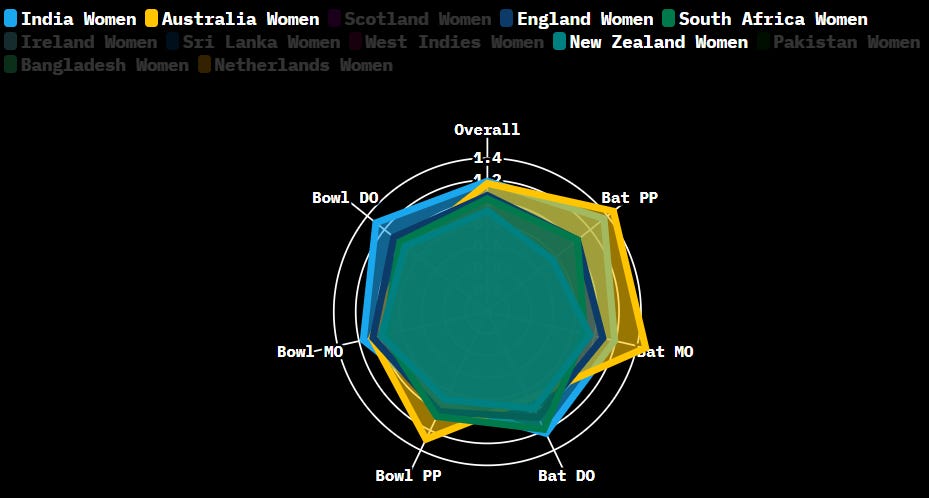
Of the top five ranked teams, they are clearly the best on three out of six metrics - powerplay batting, middle overs batting and powerplay bowling. Georgia Voll is the attacking opener, while Beth Mooney is the anchor in this partnership.
These two have also been Australia’s most successful batters in the middle phase. They are both incredible at avoiding dots and running between the wickets. However, Phoebe Litchfield and Ellyse Perry have both been underwhelming for Australia in this period. But their franchise T20 stats are solid. Plus Ash Gardner hasn’t played many T20Is, and we know she’s good at cricket.
Strangely, they seem to taper off at the end of the innings. But they have plenty of all-rounders, and they bat very deep. If they can work out Annabel Sutherland’s optimal batting position, that can further strengthen them. Probably a floater role in a collapse situation makes the most sense looking at her conventional gameplay.
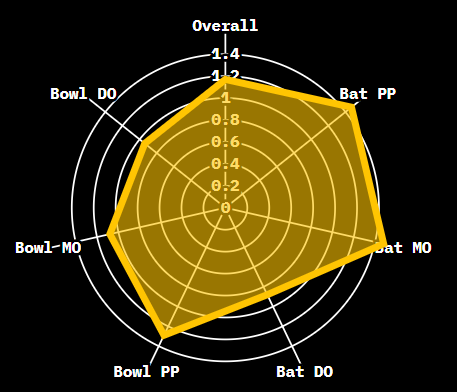
Sutherland has also, by far and away, been Australia’s best seamer. She has the most new ball wickets for them. Megan Schutt and Alana King have also done well early on, while Kim Garth’s performances have been a bit below par in the first six overs. The two leggies starred through the middle overs, and nobody can seem to score off Sutherland either. Molineux hasn’t played too much cricket due to injuries. Once again, they are below par at the death. The issue isn’t wickets, it’s that teams have managed to find boundaries off them.
If we compare India to them, they are significantly better at the death on either side of the ball. Richa Ghosh and Harmanpreet Kaur do the bulk of the work for India in the final four overs, and they’re successful at it in the WPL too. A set Jemimah Rodrigues can also utilize this phase very well, plus they have the high-intent Bharti Fulmali in their team too.
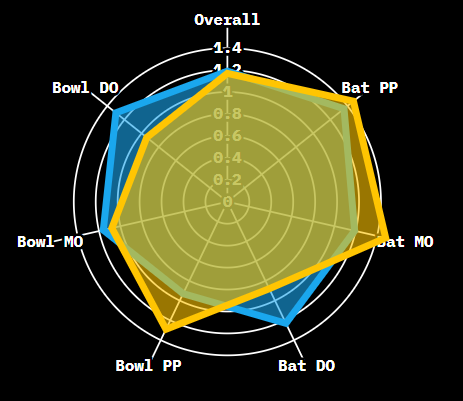
They’re also a strong powerplay batting team, thanks to Shafali Verma and Smriti Mandhana. However, Jemimah - who usually bats at No.3 - likes to take her time and settle in when the field is up. Like Australia, both the openers are also effective after the field restrictions are over, and Jemimah is also elite. Harmanpreet Kaur is more of an anchor from overs 7 to 16. In the England series, we also saw Yastika Bhatia start quick in the powerplay and then slow down after the field was spread out.
However, India have really struggled with the new ball. They go for a few runs, and don’t take loads of wickets. None of their main quicks have provided that impetus. WPL star Nandani Sharma is also in the squad, but she wasn’t hugely successful in the powerplay in the tournament either. Deepti Sharma has been very economical, but she didn’t get to bowl in this phase in the recent series in England.
But they catch up in the middle period, actually edging out Australia ever so slightly on our team maps. They have heaps of quality spin bowling options, and their seamers have also taken wickets.
Their death overs success is primarily down to them protecting runs at the end. Sree Charani is their main bowler here. And while Deepti and Arundhati Reddy have been a bit expensive, they’re among India’s most used bowling options at the end. Radha Yadav also has excellent stats for India, though from a very small sample. Plus, this is exactly where Nandani and Shreyanka Patil were at their best in the WPL.
India were on a series winning run in T20Is after they exited the last T20 World Cup in the group stage. Even after the ODI World Cup victory, they beat Australia in Australia in the shortest format. But they’re coming into the tournament after losing 1-4 in South Africa and 1-2 in England. And in truth, outside of middle overs bowling, they weren’t up to the mark on these two tours.
Let’s compare India to the team they most recently lost, England. Both these teams are very similar in terms of win-loss ratios since the last mega event. But the hosts are not as good as India with the bat in any period of the game, though they are above average at everything.
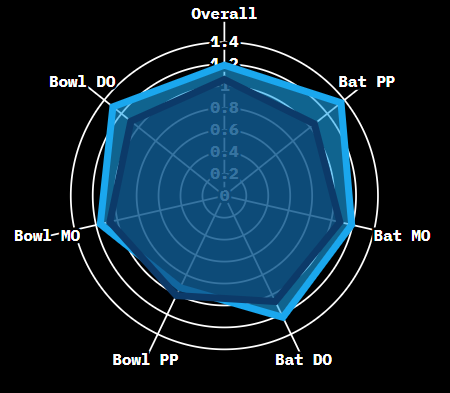
Nat Sciver-Brunt has been their best batter in the powerplay, and she mainly bats at 3 and 4. Their openers have been susceptible to getting out early, and they don’t really score at uber-attacking rates either. They did promote Alice Capsey up top this summer, so they’ll hope she can set the tone of their innings if she’s opening.
They do get better in the middle overs. When their openers get past the early phase, they are able to cash in. Sciver-Brunt and Heather Knight provide stability in the middle, though it’ll be interesting to see how fast they score after a good platform. Capsey and Amy Jones also performed well versus India recently.
Knight and Sophie Ecclestone have been their key batters at the death, but off late the left-handed Freya Kemp has also smashed the ball in the last few overs. And if Sciver-Brunt is set, she can also damage opposition attacks.
England are a better new ball bowling unit on our maps than India. On raw stats, there’s actually not much between them and Australia. But it’s been harder to score runs in England in the first six overs, and if that trend continues this World Cup, they should be fine. Lauren Bell is their main wicket-taker in this phase, and they also have spin options in Linsey Smith and Charlie Dean that can take the new ball. Lauren Filer has been an economical seamer early in the innings, but she hasn’t taken plenty of wickets.
They are 7% better in the middle overs. Usually, you’d expect Ecclestone to be the main player here. She is still good, of course, but Charlie Dean has been even more exceptional. Also, Ecclestone’s wickets have dried up a bit this summer. And at the end, it’s Ecclestone, Bell, Dean, Linsey and Issy Wong that have bowled the majority of the overs and done a solid job.
Remember, they also have the 18-year-old Tilly Corteen-Coleman who was superb in the Hundred last year. She bowled well in both the powerplay and middle, so it will be interesting to see how they deploy her overs if she starts.
***
This is a weird sentence, but now we have looked at the favourites, let’s look at the finalists of the last T20 World Cup - New Zealand and South Africa.
