


Buy your copy of ‘The Art of Batting’ here:
Ellyse Perry can’t bowl.
Not for lack of talent, but her first two attempts are stopped, as she can’t run on her leg. She needs to put 4-7 times her body weight through the crease, and her leg won’t allow it. Australia is only a few overs into defending their total in the World Cup final, and their star player is limping.
Their captain, Jodie Fields, shoots a look up to the dressing room as if to say we might have got this wrong.
But Perry wants to play on. The ghost of Rick McCosker’s jaw is never far away in Australian cricket.
In 1977, the opener is hit in the face by a Bob Willis bouncer, breaking his jaw, which has to be wired back together.
In the second innings, when Australia need to put on a defendable total, McCosker comes out at number ten with his swollen face wrapped in bandages to make 25. McCosker makes four Test hundreds and is remembered for making less than 30 in a declaration total. That story gets passed down in Australian cricket families as lore.
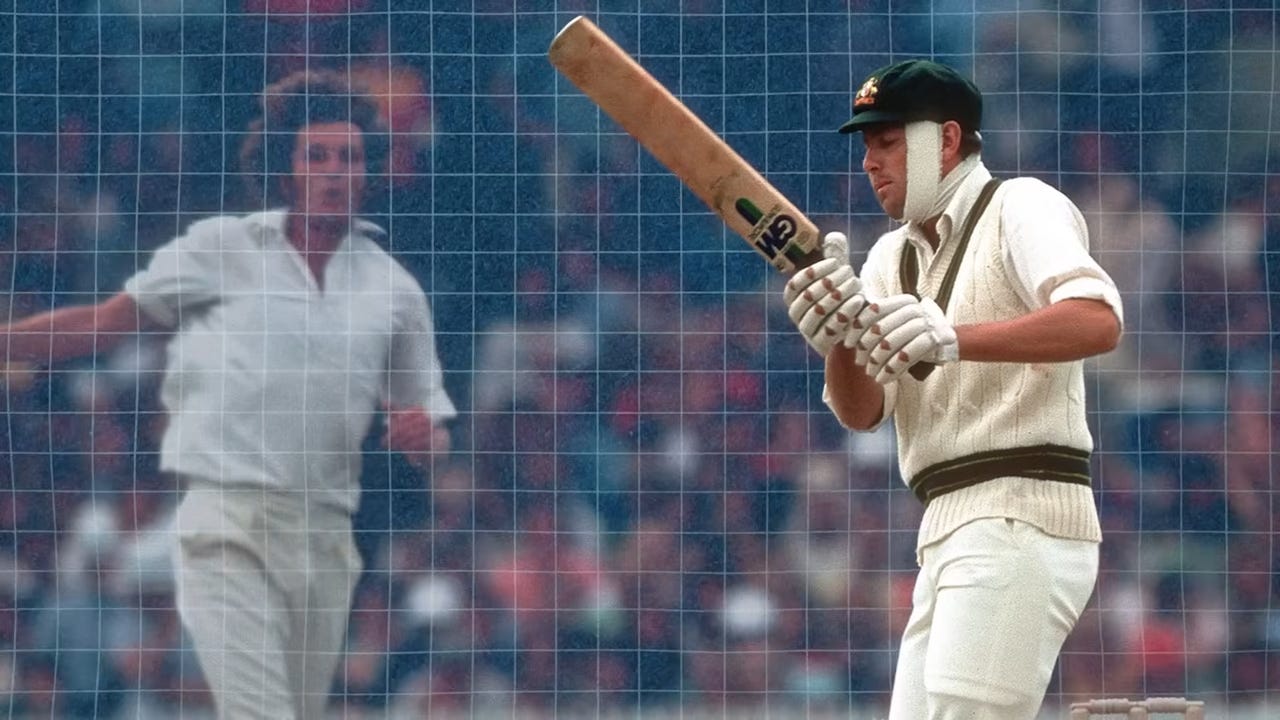
Perry knows about Rick’s jaw, even if she doesn’t think her ankle is that bad.
She’s already starred in this game by breathing air into Australia’s first innings. Being the only player going at more than a run a ball.
Now the West Indies have built a platform without losing a wicket, and still have Stafanie Taylor and Deandra Dottin to come. Australia needs Perry.
But the leg won’t let her do it. It doesn’t look like she’ll get through a ball, let alone an over. Her captain is now trying to do her sums, while still worrying about her star. Perry could limp off; no one would blame her.
But she refuses to give up. Her third attempt is painful to watch; it is someone hurting, someone who doesn’t trust her body. But somehow she delivers a ball. Nothing great, but one more than looked likely. Her teammates scream their support.
With her sixth, Perry takes Kycia Knight with a dodgy lbw. Perry’s seventh takes the edge of West Indies’ gun Taylor, but the cameras say the catch is inconclusive. On Perry’s tenth ball, she takes Taylor, caught and bowled - running to her damaged right side. Her 15th delivery pins Natasha McLean, plumb.
After three overs, Perry has two maidens, two runs and three wickets, on a busted leg. The contest is basically over.
Later, she throws herself insanely to try to catch Deandra Dottin, bowls a bouncer, and finishes her ten overs. She averages 69.6 mph on average in that game; her fastest touches 74.7. All on a bum leg.
Perry’s injury wasn’t fully known at the time. They let her play through because they don’t see it as a major concern. Just a fast bowler with a sore ankle. They were wrong.
When she came home, they find she has a stress fracture in her distal left tibia and that she’ll be back playing in ten weeks without any surgery. It turns out even that wasn’t right, and she needed almost six months off, after an operation.
This was not a minor injury. Ellyse Perry won the World Cup on a broken leg.
***
Ellyse Perry was the face of the game, literally. She was young, looks good in front of the camera, and has a perpetual smile. It is as if she is built for not just sports, but also promoting them. Women’s cricket as a public spectacle was built around her.
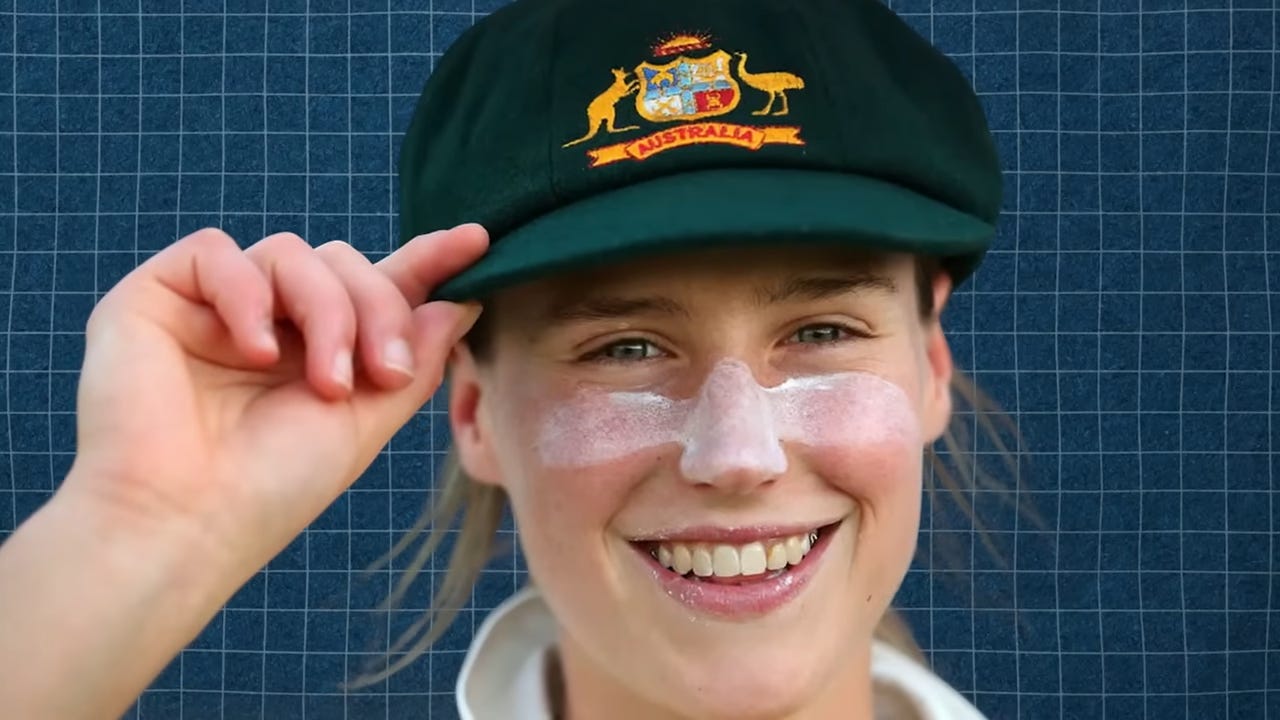
That is a lot of pressure in what was still an amateur game. There were sponsorships and opportunities, but she wasn’t earning a substantial amount of money. And yet she was famous like someone who should be.
But from the start, she has prepared herself to think as a professional. Not at a normal level - more than some of the men already in the game. Great athletes often become all-rounders, but her attention to detail made it almost inevitable.
Her career also meant she was the first woman in the limelight of cricket. Women’s games weren’t always on TV in the first part of her career. But if Australia was playing, Perry was bound to have a good game, batting or bowling. So even as her sport was battling for recognition, she was turning into a massive name.
Barely out of her teens she was a great player and a global ambassador for women’s cricket. All as an amateur. The money comes next, almost as if women’s cricket becomes professional in her honour.
There are different kinds of toughness, and Perry has a lot of them. Sometimes people who look like she does, with that incredible level of skill, are thought of as having an easy ride.
But this was a player who lived a career that no one ever had before, while being the youngest player ever for her country and still more than lived up to it.
***
Perry looks tired, old and gaunt. Fielding in the first innings against India of their 2025 World Cup match, it is clear that something has wrong. With the bat, she still comes in at number three, her normal spot.
And despite looking like a distant, older haunted aunt, she still knocks the ball around with a decent strike rate. But it is clear, she is struggling: cramp, illness, maybe even something else is causing her some trouble, and she leaves the field.
Due to her history one thing is certain, whatever it is, must have been really tough, just to get her to stop batting.
***
In the 2014 World Cup final, Perry bowls first change. England are already struggling when she comes on, but her wicket of Lydia Greenway puts them a long way back. Later, she takes Amy Jones too.
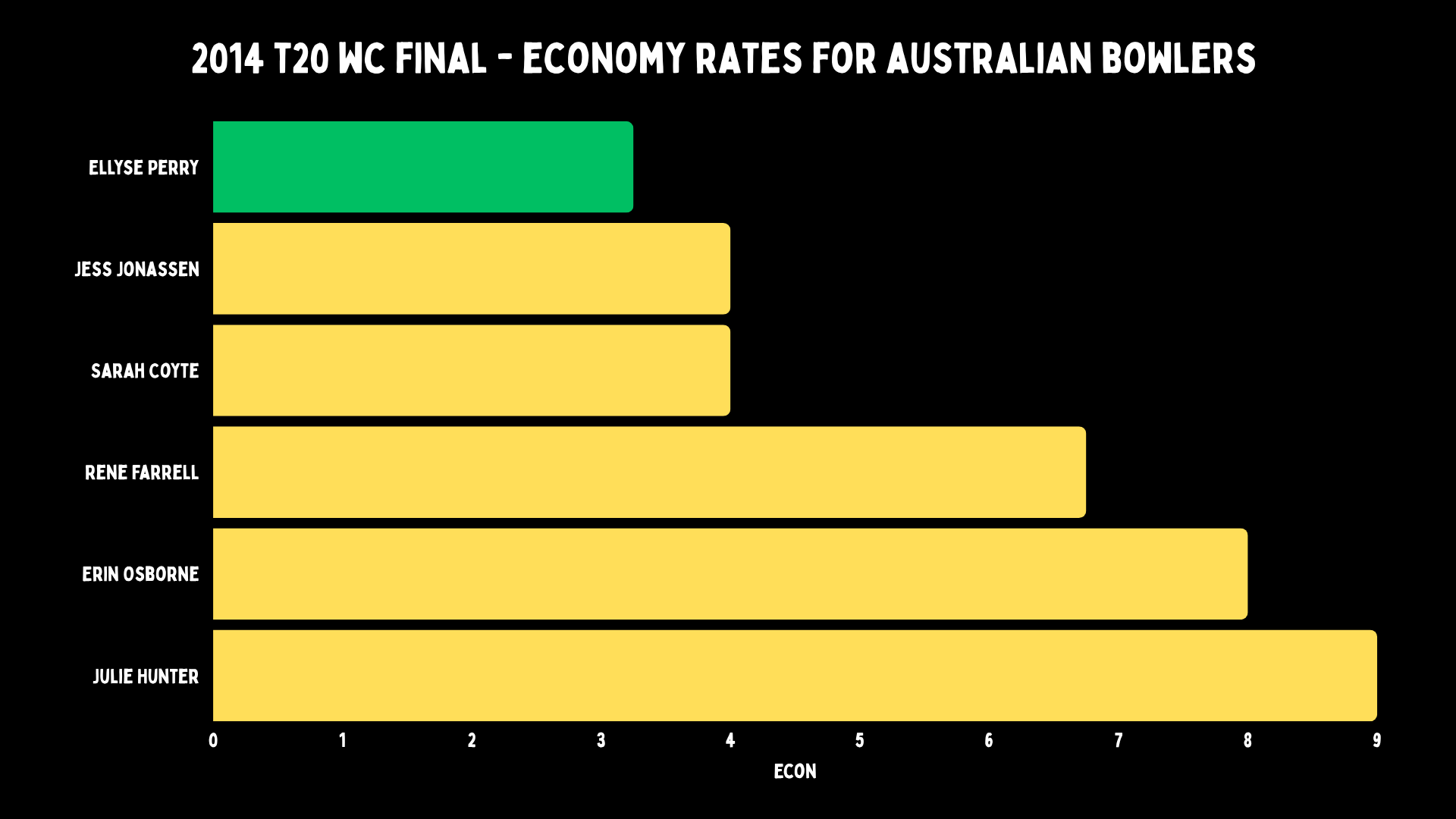
While the wickets are cool; the econ is something else. England struggle with everyone, but she goes for 13 runs in four overs. She shuts them down.
Then in the chase she makes 31 not out, including the winning runs. It is just another day at the office for her; she isn’t even Player of the Match.
It also means that a year after winning a World Cup on a broken leg, she is back again to do it fully fit. In both finals, she can be felt on the bat and ball side.
***
Perry’s batting career is built on a simple, stubborn principle: she does not get out. In Tests she’s not out in nearly a third of her innings; in ODIs it is very similar and she’s still elite at it in T20s. In ODIs, only Mithali Raj was better at surviving.
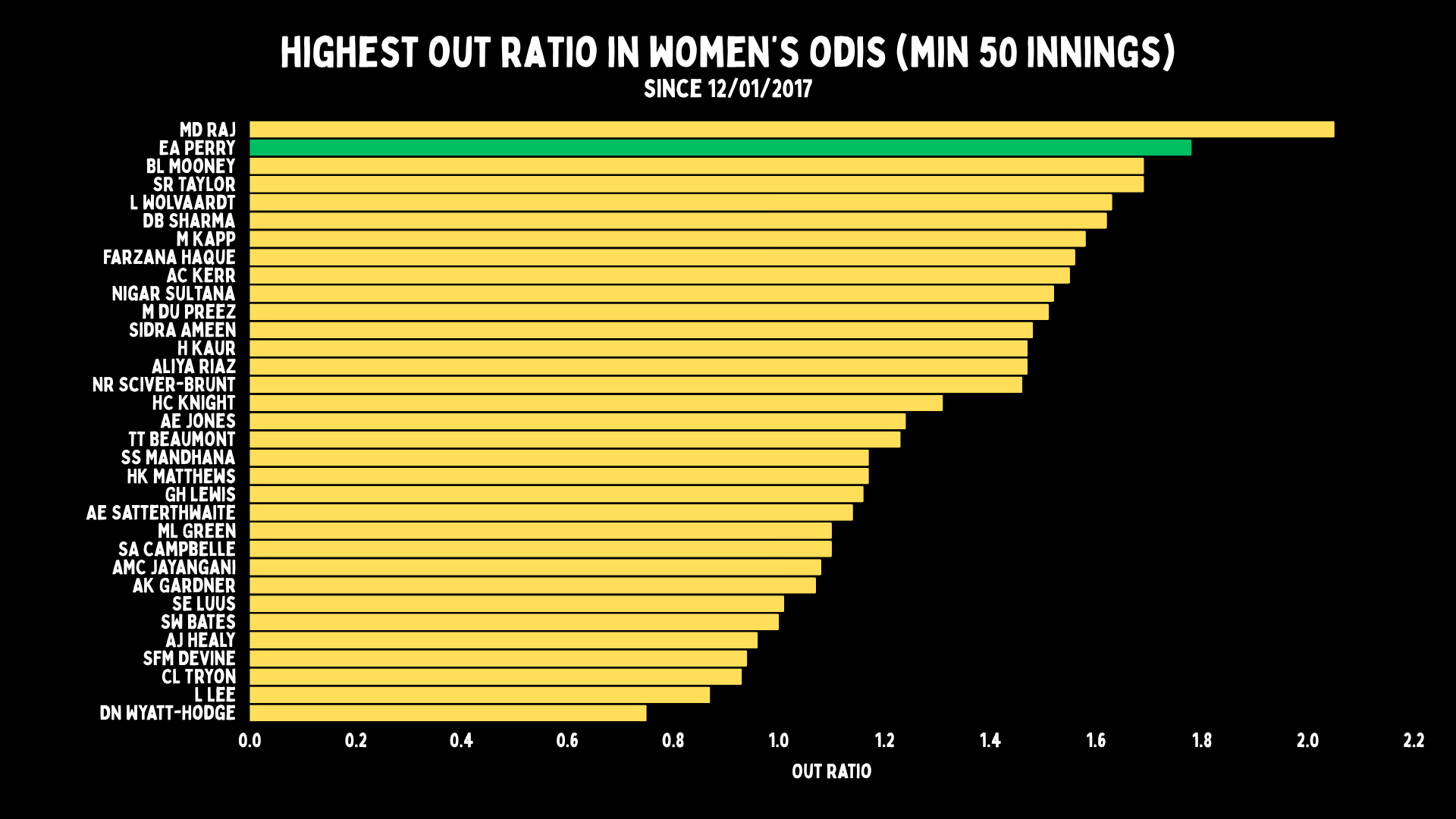
If you want to dismiss Perry, bring a big posse. She isn’t a dasher, she’s a metronome - building a legacy on endurance rather than flair.
Number four suits her well - often starting against spin, not having to hit from ball one, long, slow innings that catch up because no one can dismiss her. In terms of Australia, Lanning hits harder, Mooney may be purer, but none match Perry’s consistency or refusal to exit.
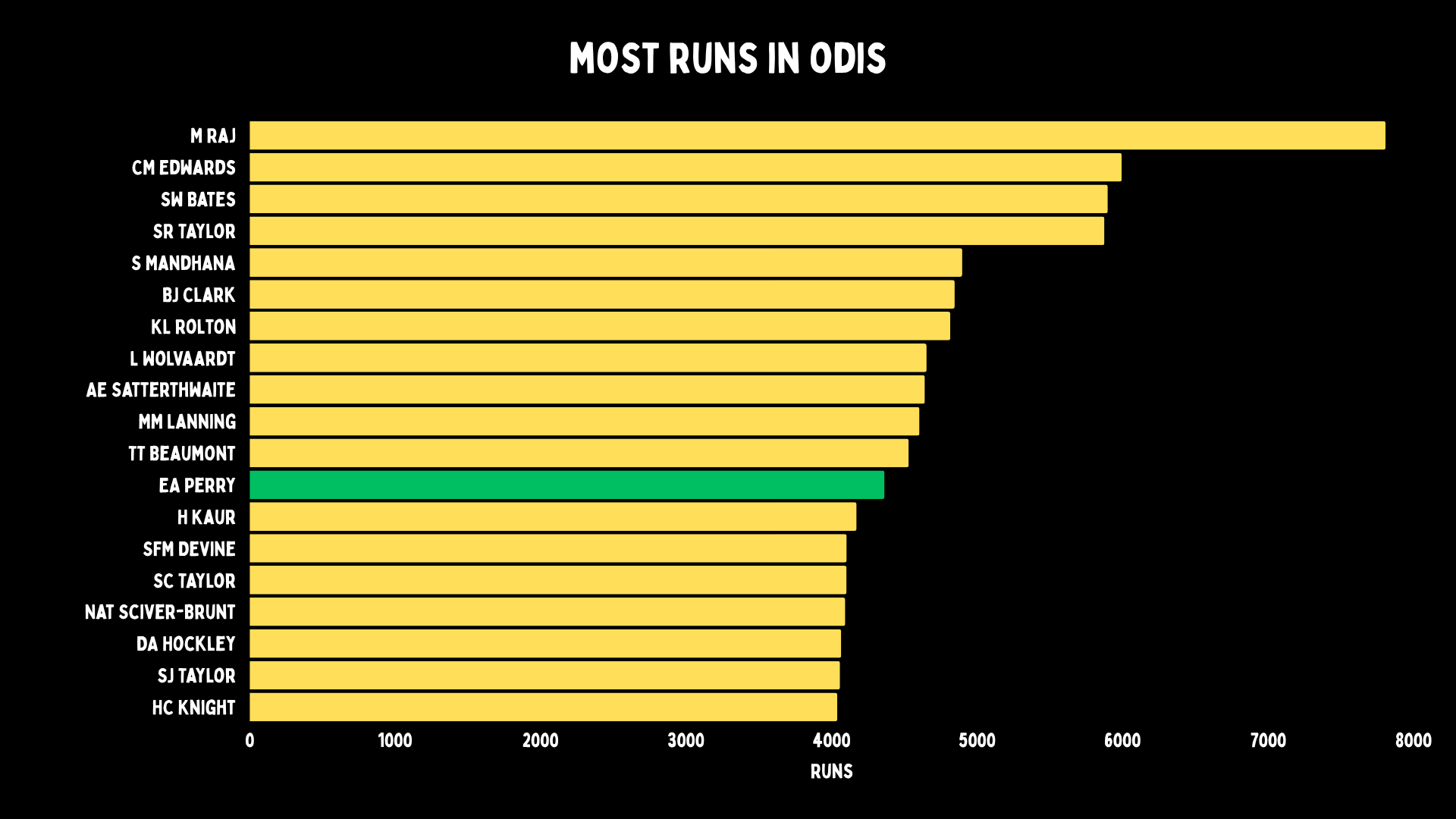
Her greatest talent is the ability to grind through the tedium and play nearly identical innings on repeat.
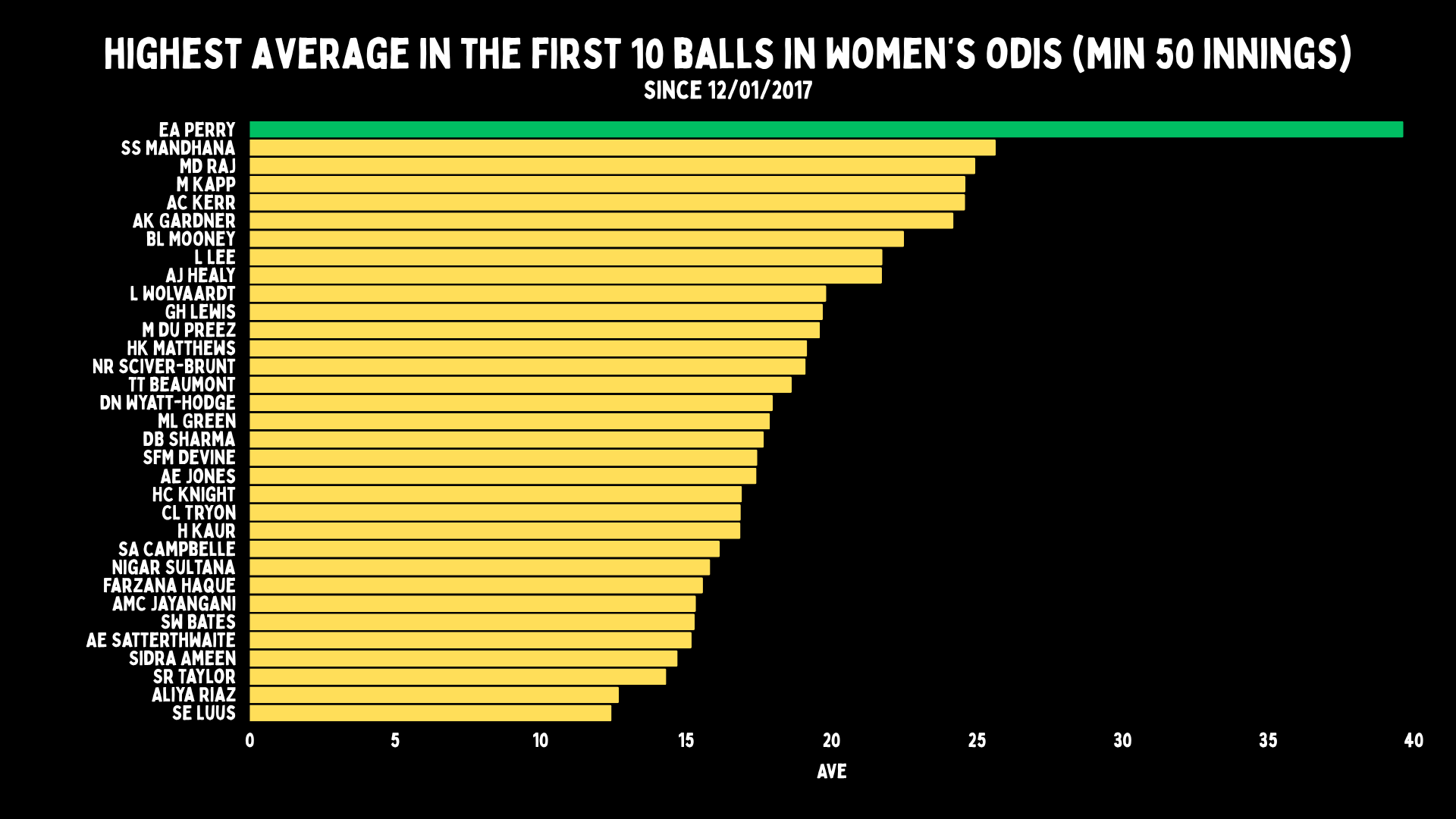
It means she goes through her process every time, and part of that is being almost impossible to dismiss at the start of her knock. She averages nearly 40 in her first ten balls - an absurd number when beginnings are meant to be hard.
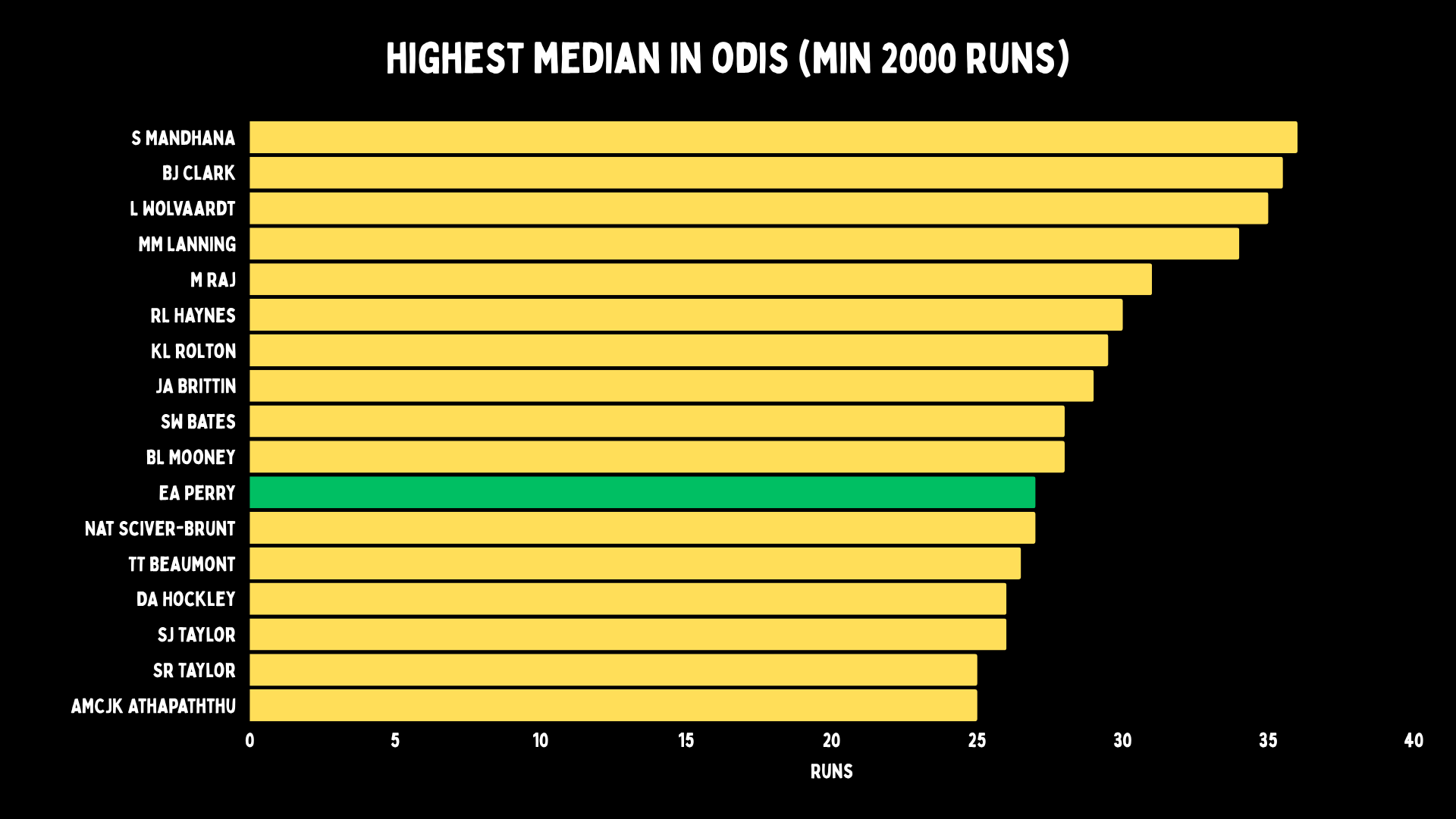
Her median score ranks 11th all-time. She has only three hundreds in 160 matches, but 36 fifties. She has 18 scores between 60 and 75.
Analyst Himanish Ganjoo’s model shows she’s almost impossible to dislodge until 60; a machine of survival, just game after game, churning through.
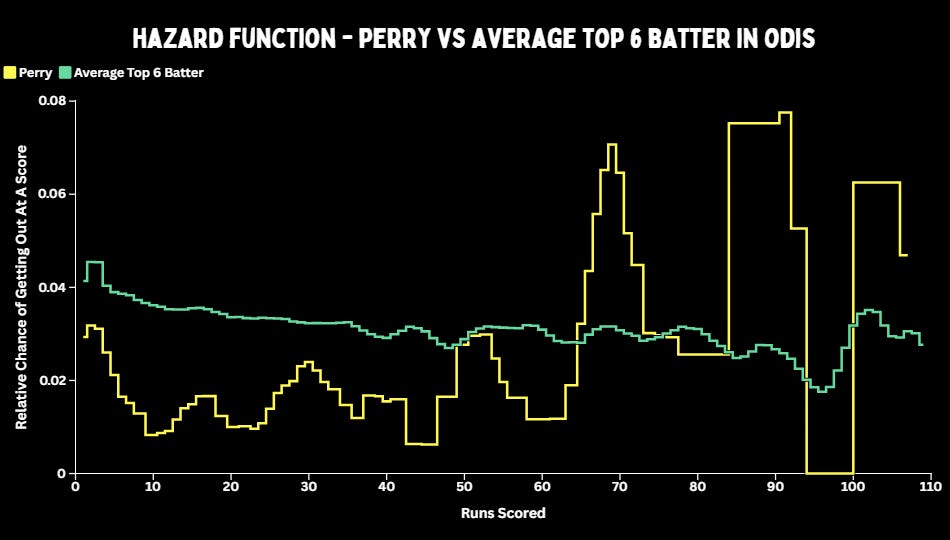
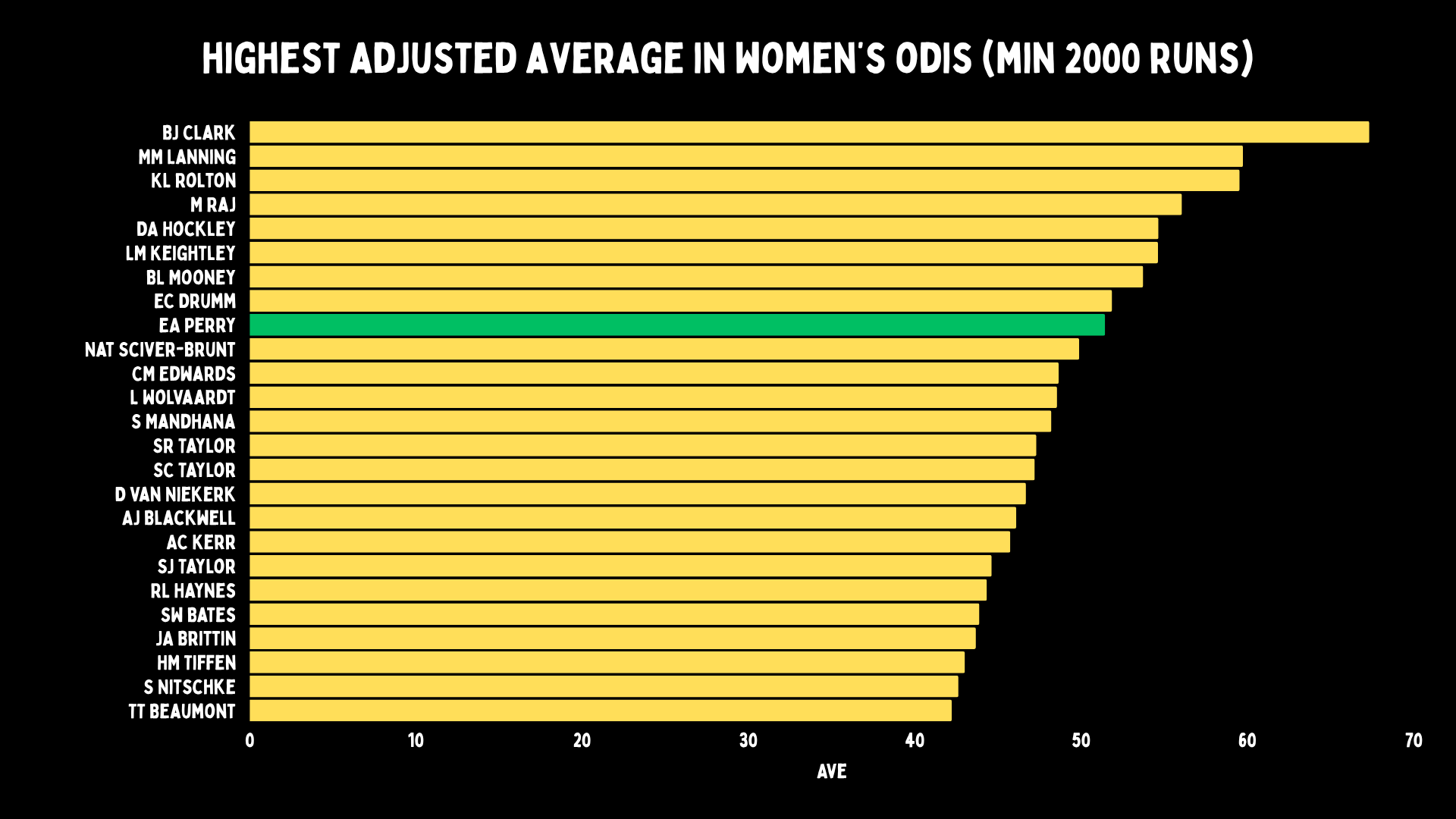
Her lack of hundreds limits her ceiling, especially when her teammates often go on. But adjusted for era, she still sits comfortably in the top ten. Not to mention good in raw numbers.
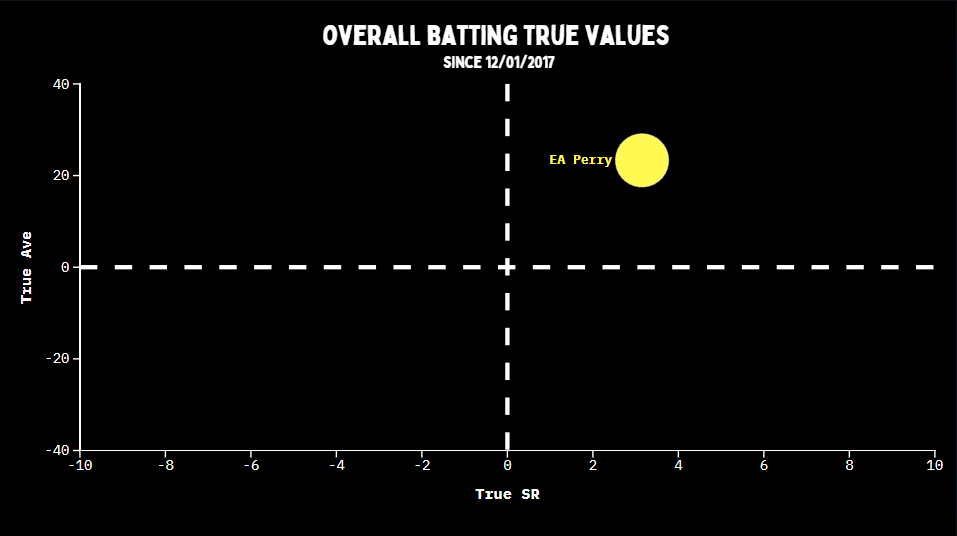
She’s a mild plus on both average and strike rate; even if her genius is simply not getting out.
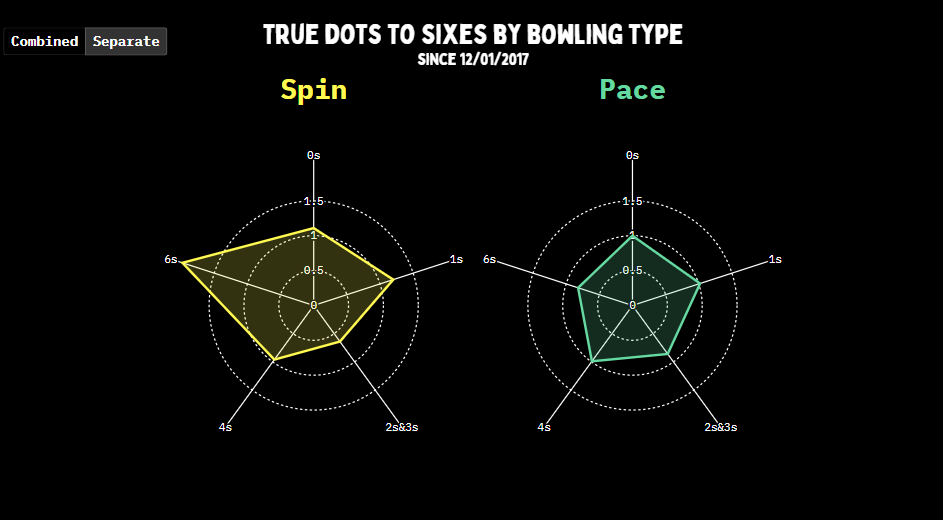
Surprisingly for an Australian, she’s stronger against spin, and twice as effective at hitting sixes as neutral - her lone vice in a career built on control.
In many ways, you look at this weird record, and think she could be better. Instead, you have to be ok with her only averaging 48.5 in ODIs.
***
Therese Sjögran, Lisa Dahlkvist and Lotta Schelin are not greats of women’s football. But they all score a goal in the 2011 Women’s World Cup quarter-final.
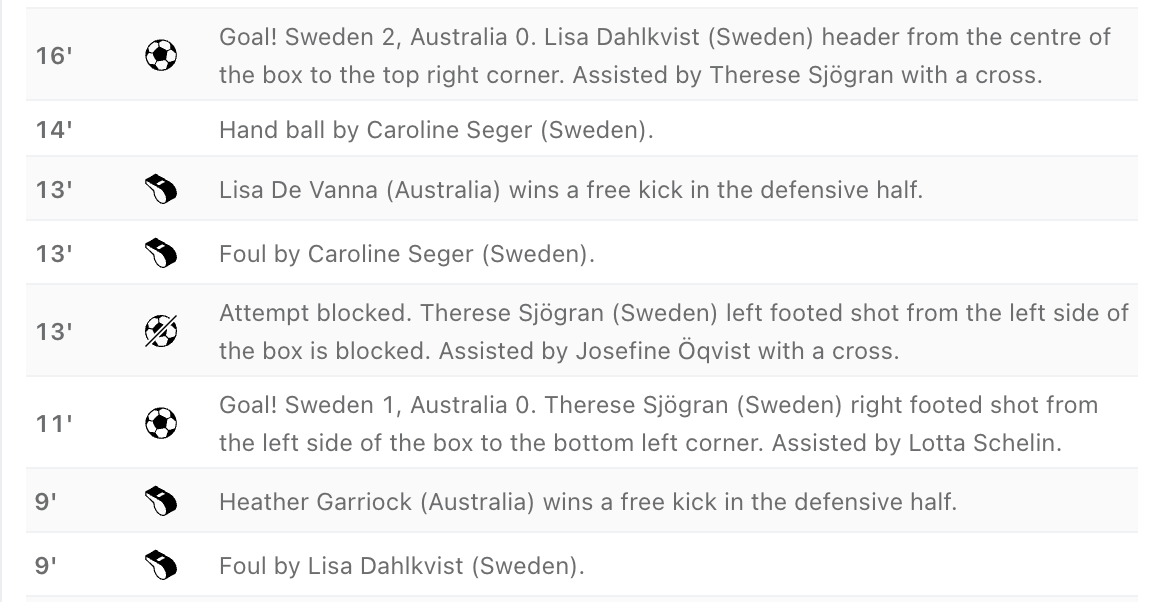
Sjögran scores for Sweden after 11 minutes, Dahlkvist’s header is 16 minutes in. And Australia are 0–2. You are going to struggle to come back from that.
Before half-time, the Australians have a corner, which they play short to their right-back, who is hanging out on the wing unmarked. She receives the ball on the wrong side, and moves it to a better position as a Swedish player rushes her. She kicks the ball with her left foot from just outside the box. The ball veers off outside the line of the goal, and then it bends back. And now Australia are 1–2, and still alive.
The right-back is also not a great of football, but she is certainly a great. Ellyse Perry comes off the bench to play in the back for Australia, and in the quarter-final of a World Cup curls one into the net from outside the box.
With her left foot.
***
Ellyse Perry was a frontline bowler from her debut until 2019. For 12 years, she is a virtual lock to deliver her ten overs. Australia usually get teams out before then, but there is no doubt that’s her role. Since then, she has been either part-time or on break in case of emergency.
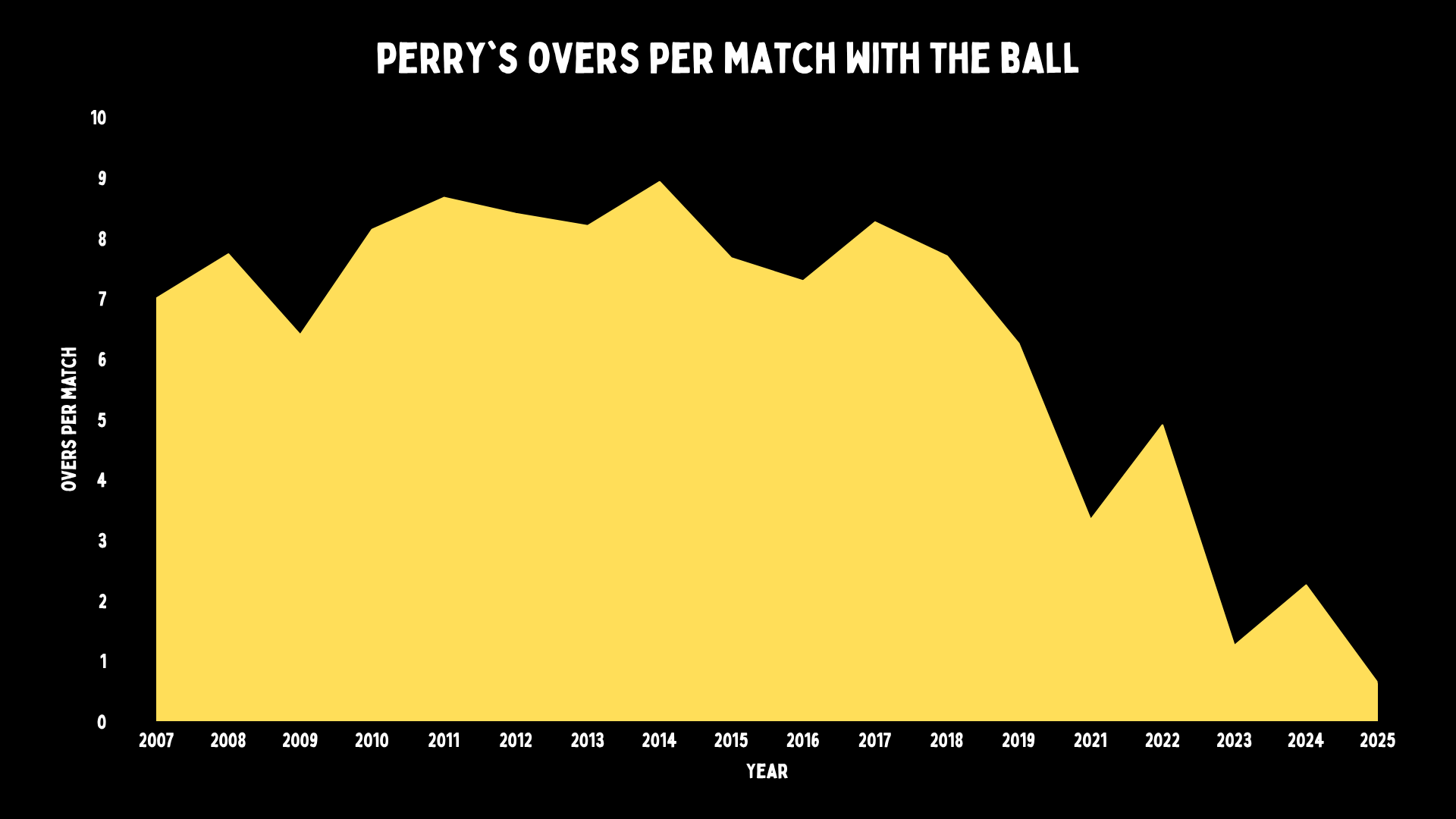
Right now, she is not a bowler.
But she was, for a very long time.
Her raw numbers - averaging 25.5 at an economy of 4.4 - sound good, but women bowlers usually have low averages and don’t go for many runs.
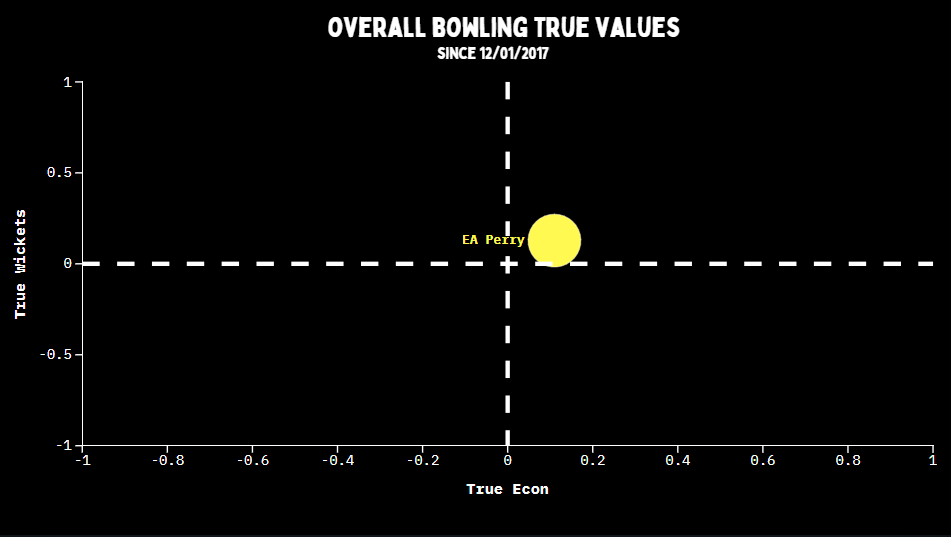
On true values - which we only have since 2017 - she rates as a plus on both metrics, but barely. You wouldn’t want this from your first-choice bowler, but from your third, fourth, or even sixth-best option, it’s massive.
She has one great skill: bowling up front. She strikes early. Some of her greatest performances come at the start of matches, when she takes a load of wickets. She doesn’t take many in the first half of the middle overs and becomes a defensive option, and she’s not great from overs 26 to 40.
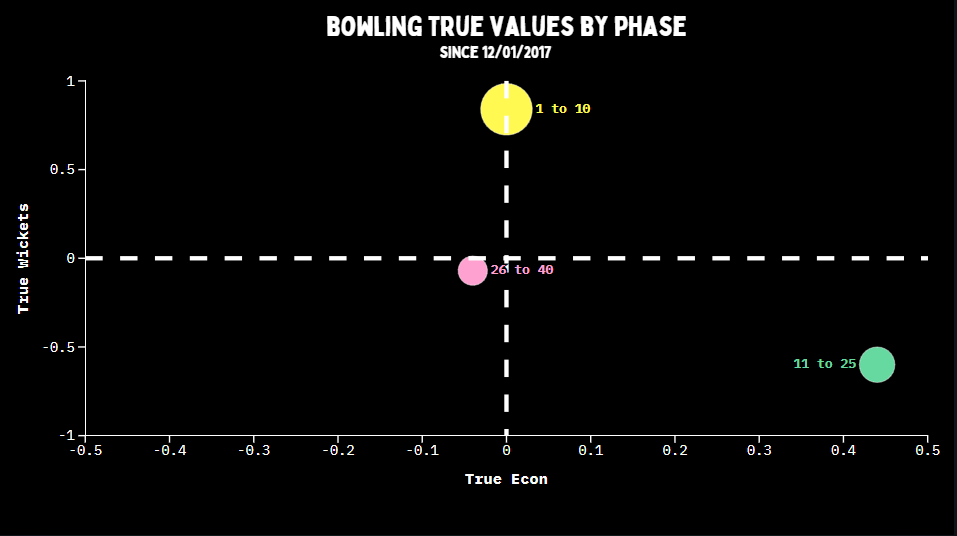
Most of the numbers we have are from her later career, as she tails off.
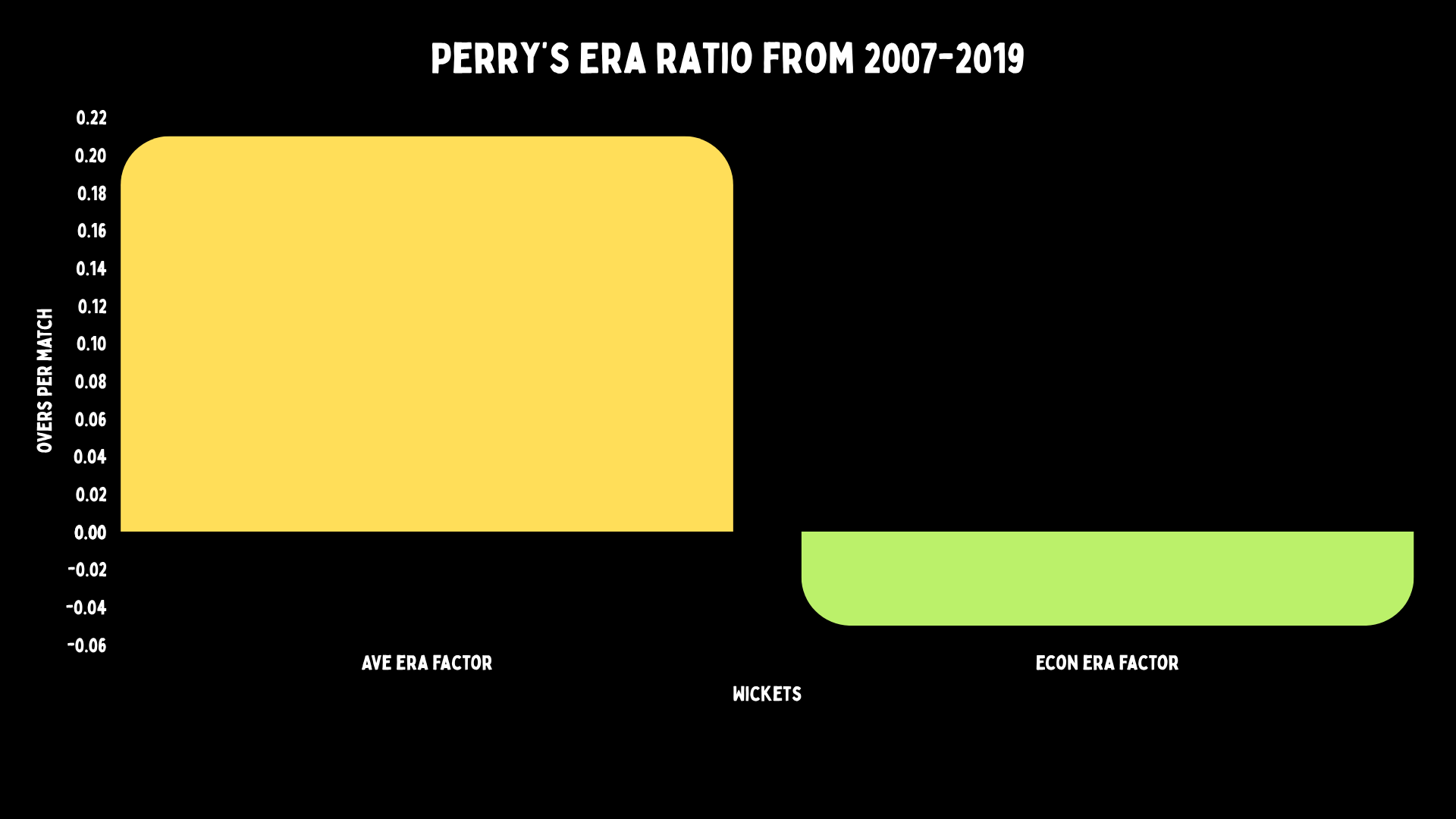
At her peak, she averages nearly five runs less than other seamers in the same era, making her 21% better than neutral, though she is 5% negative on economy.
So not perfect, but a clear star.
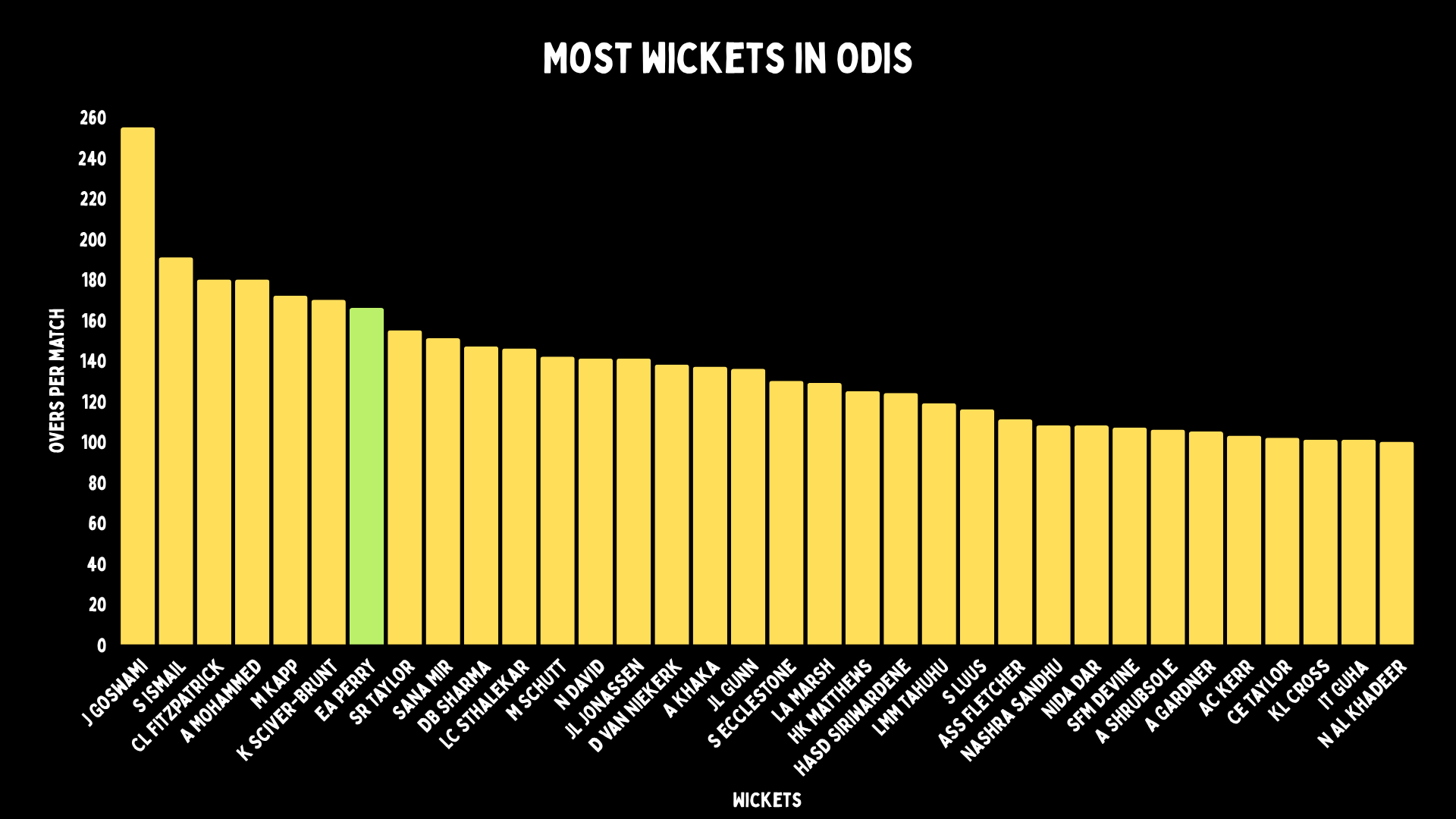
Perry also has the seventh-most wickets ever in ODIs. Even as her load eased recently, she remains one of the most-used bowlers of all time, with a fantastic 12-year run as a frontline seamer.
Like her batting, she is not perfect.
However, at various times, she is one of the best new-ball bowlers in the world, one of the fastest for a while too, and can deliver through the innings in other roles. This is not a perfect seamer, but she is clearly good enough to be one of the 30 greatest bowlers ever in women’s cricket.
***
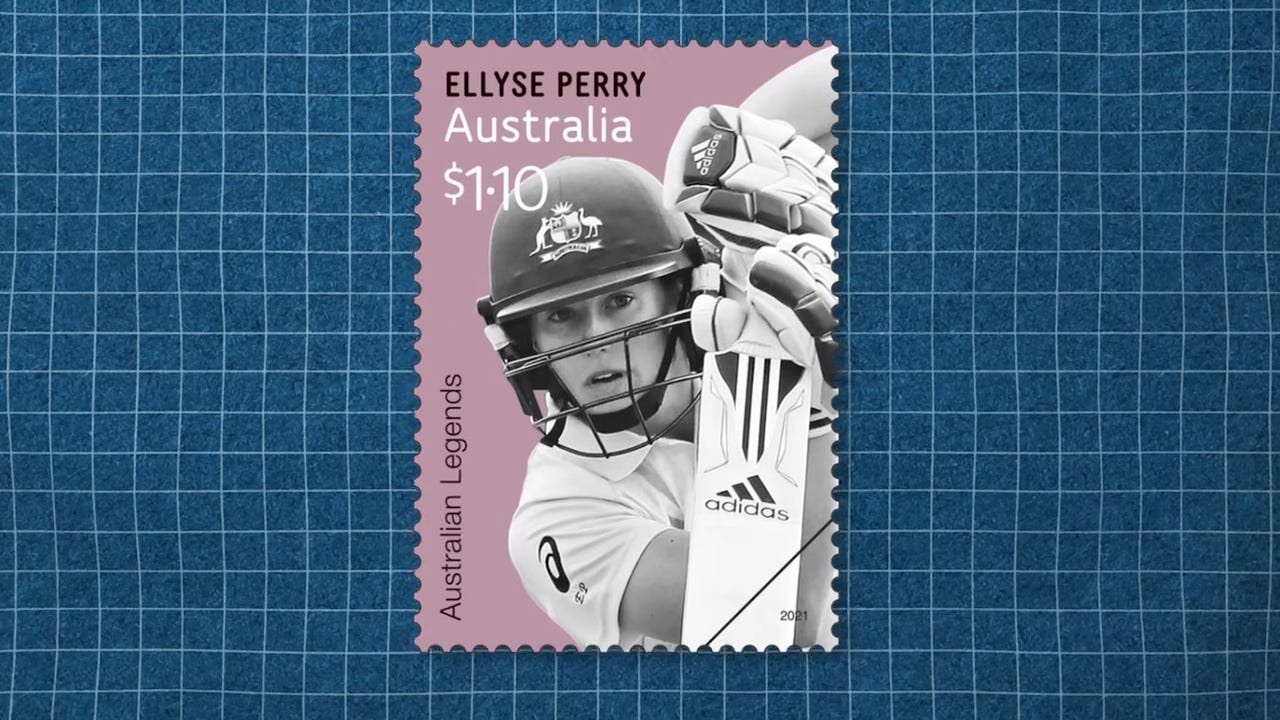
Ellyse Perry is on a stamp in Australia, every other player in that series was retired, she had barely turned 30 years old when they put her face on it.
She is one of the greatest batters to have ever lived - which is remarkable, as she begins her career as a bowler. There has never been another cricketer like her.
For Art of Batting, we ranked her as a top-ten batter, and she is in the top ten list of most wickets in women’s cricket.
That record is so weird. This is not a normal player; this is not even a genius player -this is the rarest breed of unicorn.
That’s even before you factor in that she was the face of women’s cricket when it had none. She is a cricketer and revolution in one package. The alpha, the omega, the everything.
And yet this almost mystical creature of a cricketer was dropped mid-career. Bradman was dropped once, after his first match. Warne was dropped twice, once early, and the other time when Australia were not sure his shoulder was allowing him to bowl right. Other legends are let go toward the end. There are reasons why some great players aren’t in always the team, but they aren’t really dropped.
At the age of 32, the Australian cricket team decides to drop their gold-encrusted, magic flying unicorn from T20s.
Some of that is the embarrassment of riches they have. But still, has any player of her talent ever been dropped like that?
It could break someone who had only ever known success. Instead, Perry uses it to be even better.
She goes away, thinks and works, then comes back a greater player. Just like that. As if it’s a switch. Like how she starts as a bowler and ends as a batter. It doesn’t matter what’s put in front of her, she just battles through it.
***
Perry played in two World Cups with broken bones.
In 2022, she plays as a specialist batter in the final after a stress fracture in her back stops her from bowling. So not only does she win multiple World Cups - she does it with broken bones, twice.
Most players would consider their career great if they won two major trophies when fully fit.
Her career has not been defined by injury, especially for someone who is used a lot in cricket due to being a seam bowling all-rounder. Not to mention starting so young at 16, so her body has a lot of time and miles on it, and yet she is still mostly fit.
But when she has an issue, it is fairly major.
Since that back fracture, she really hasn’t been an all-rounder.
The other issue comes in the 2020 World Cup. She manages, in one injury, to tear her ACL and rip her hamstring off the bone. Both can be 6–18 month injuries, and she does them at once.
Add that injury in 2013 with a broken ankle - or technically a bad stress fracture and you start to get a bigger idea of her troubles.
For a bowler, injuring your ankle, knee, hamstring, and back - all in potentially catastrophic ways - could really ruin your career. But she managed to play through it.
What is clear is that she has a crazy pain tolerance. When others simply can’t, Ellyse Perry can.
These injuries haven’t robbed her of a career, but of moments.
In 2020, women’s cricket has its grandest stage. For years, everything points toward a World Cup final at the MCG, with a concert by Katy Perry as well. The entire thing is designed to explode women’s cricket into the mainstream.
It is meant to scream, “How can you say no one watches women’s cricket if you can get 86,174 people into the MCG to watch it?”
This match simply doesn’t happen without Perry. She was the lighthouse for women’s cricket. And then on the biggest day, she couldn’t perform at her own party.
***
There are a lot of all-rounders in women’s cricket. The difference with her is that the quality is so incredibly high.
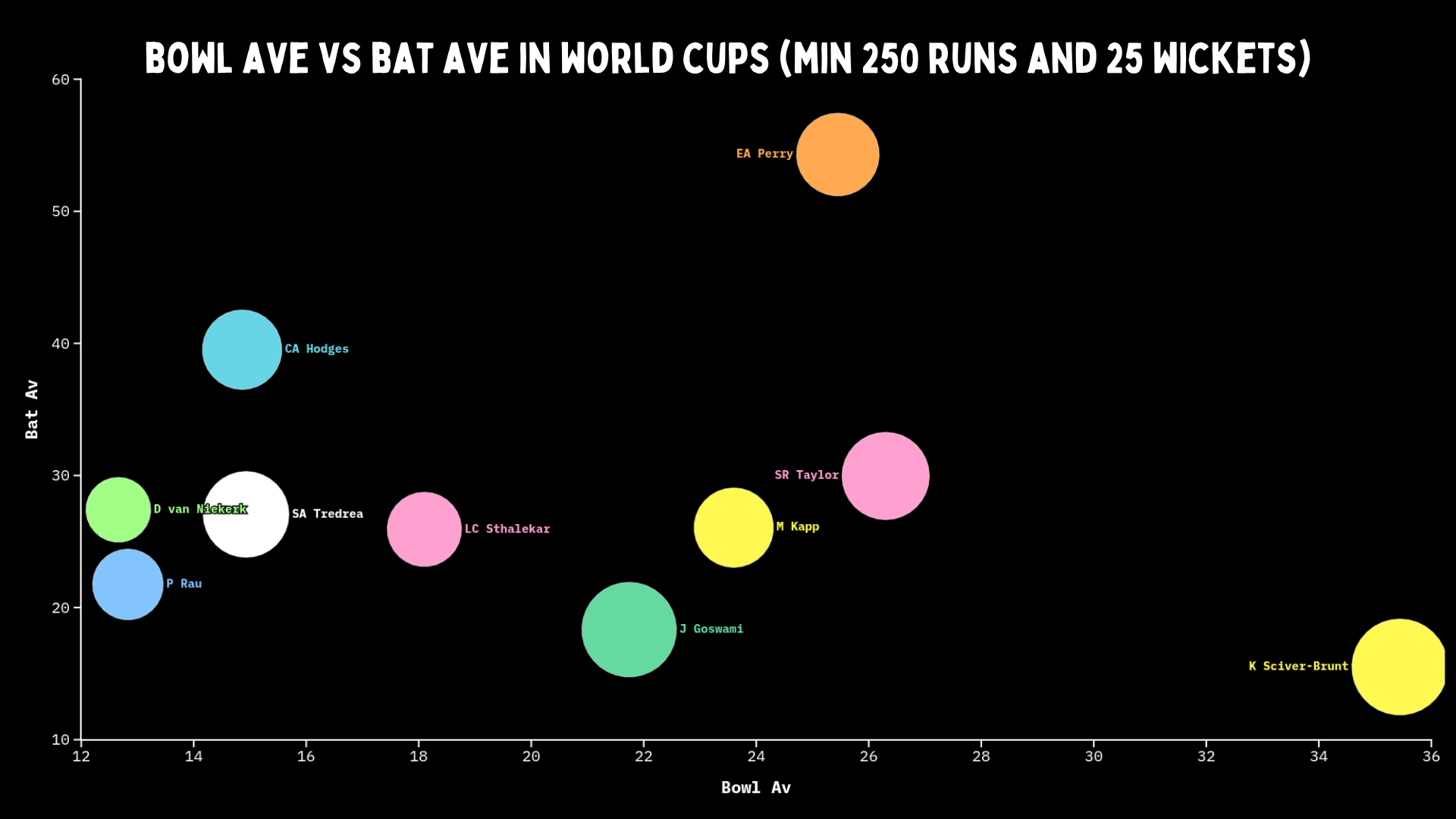
This is a list of everyone with 25 wickets or 250 runs in World Cups. It’s already a list that is hard to get on. Being that good on both sides of the ball is special.
Carole Hodges has an incredible record with her off-spin and can bat as well. She is the closest to Perry. But let’s compare her with the modern players.
Stafanie Taylor and Marizanne Kapp have legendary careers. They are top-order batters and frontline bowlers simultaneously. And compared to Perry, they look like worker bees to her queen.
And this is not from a small sample size. In ODIs, these are three of the five most-used options ever. Only the two Indian legends, Jhulan Goswami and Mithali Raj, separate them. So they are all leaned on to do an obscene amount of work by their teams.
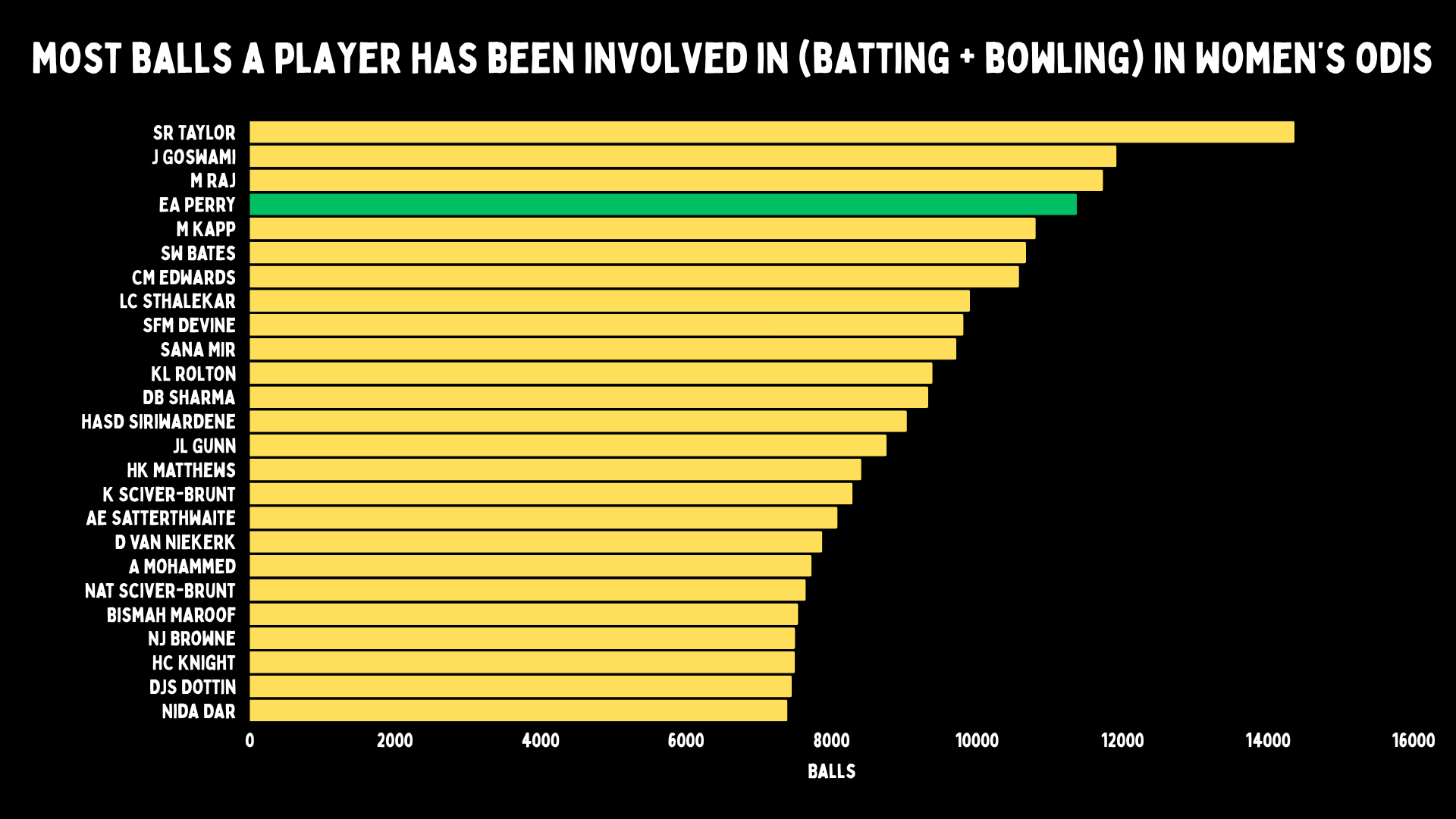
There are often all-rounders who have decent records because their usage is low. Perry’s is high, and it still doesn’t weaken her record.
The difference is that Perry isn’t a workhorse like Kapp or Stafanie. She is a thoroughbred champion who never stops running at top speed. Her toughness is hidden, because everything she does looks so effortless.
She sits in the conversation of all-time greats with either bat or ball - with slight flaws in both. But as a package, she is nearly perfect.
***
After Perry is retired hurt, India’s 330 is trickier for Australia. That great start leads to regular wickets, and with Perry in the dugout there seems to be a slight whiff of concern.
When Australia lose their sixth wicket, and that will be seventh if Perry can’t come back out.
But she does, to the surprise of no one.
Perry’s team needs her, so she pads up, comes out and knocks the ball around again.
India probably requires two more wickets, but as always, Perry locks her end up.
They only get one more, and with Sneh Rana bowling and six needed, Perry is suddenly fit and well enough to skip down the pitch and dump the ball over the rope.
It would be the greatest moment in someone else’s fantastic career. But it’s just another day where Perry had to overcome something to win a game, and she did it.
***
Sophie Devine has a cricket face. If you saw her buying ice cream at a fair or sweeping up at a truck stop, you’d see her and instantly think: that woman has played the game. It’s the quiet, pained, I’ve done this so many times movement of her eyes. Devine’s face screams cricket.
Ellyse Perry’s does not. Athletically, or even in the face, she doesn’t look like a cricketer. Devine is old cricket; it looks steeped in her. She moves like someone tough and not to be messed with.
Perry is the manic pixie dream girl created in a Cricket Australia lab.
In the 2010 World Cup final, for the last over, they are going head to head.
Perry bats at number ten in this match; her career has barely started. Yet she is bowling the final six deliveries where New Zealand’s Devine needs 14 runs to win.
It is unlikely, as only two overs in the entire match have allowed more than 10 runs on this turgid Bridgetown wicket. But one of them is the previous over, when Devine smashes Rene Farrell for a four and a six to take 15 from it.
The issue for the Kiwi legend is that she’s not on strike. So when Perry fumbles the first ball, she gifts a stolen strike change.
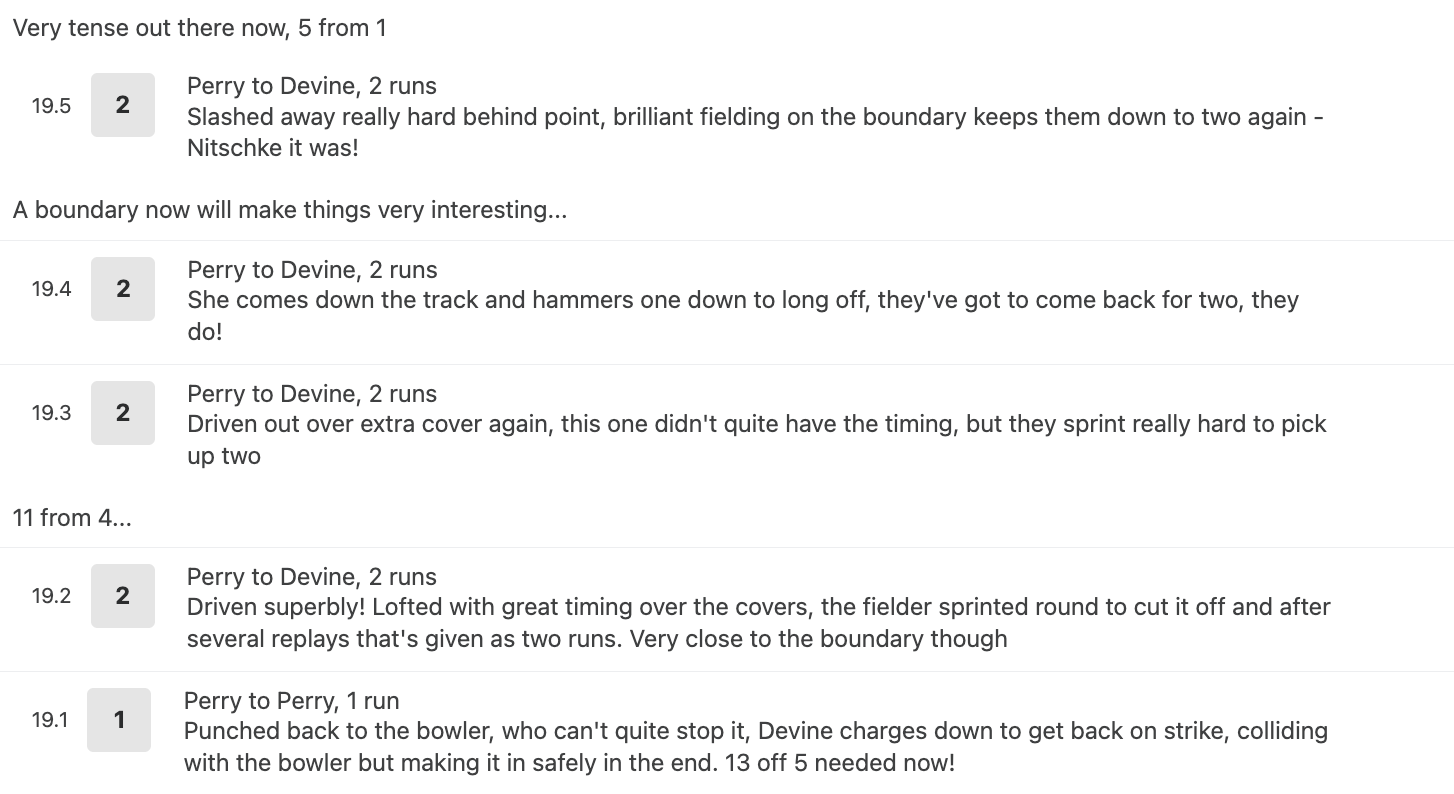
But Devine finds it hard to reach the boundary from Perry - a great save, a mishit, then a blatant steal, followed by another incredible save - ensures they score four successive twos while keeping Devine on strike
On the big screen, it reads: five runs from one ball required.
Perry’s over hasn’t been great; the fielders save her twice, and she allows Devine the strike early.
Her action has not been fully refined by Cricket Australia. She’s not yet the great she will become.
She slings the final ball down - very full, too low for Devine to get under it - so the Kiwi just hammers it straight. Not high enough to win the match, but hard enough to tie it.
Perry throws her foot at the ball. Not the boot that scores in the Football World Cup, but the one that, a few years later, will be broken.
That save wins a title.
Ellyse Perry can bat, bowl and field. Her feet have won two World Cups. The rest of her body wins six more and a Commonwealth Gold. She is so talented that for an entire generation and a half, most of us haven’t noticed her toughness.
Ellyse Perry can do everything, and on those rare days she can’t, she does them anyway.