


Buy your copy of 'The Art of Batting' here:
You may have seen a headline recently that said, ‘Agent banned for five years for corrupt approach to county coach’, or a variation of it. Let me tell you a couple of things I know about this, because I think you'll find it kind of wild.
The first one is that the agent's name is Moghees Ahmed.
He runs a group called the ICA. They've got quite a few players on their books, but are kind of small-time when it comes to major agencies. Their main work revolves around getting players into smaller leagues and T20 franchises.
Ahmed is a Pakistani agent, who lives mostly in the UK, and runs this agency. They do a lot of work in leagues, but they used to be big when it comes to Pakistani players. And while they may not be big-time anymore, at one time they had two of Pakistan’s major players in Misbah-ul-Haq and Saeed Ajmal.
And that’s when I met Ahmed. He reached out to me to ask if I wanted to interview Ajmal. I had always found Ajmal fascinating as a player, so I interviewed him for ESPNcricinfo, and spent a lot of time chatting with Ahmed.
So you can imagine my surprise when I wake up and I see that the ‘agent banned for five years for corrupt approach to county coach’ is Ahmed, who I’ve spent a lot of time chatting with, over the years.
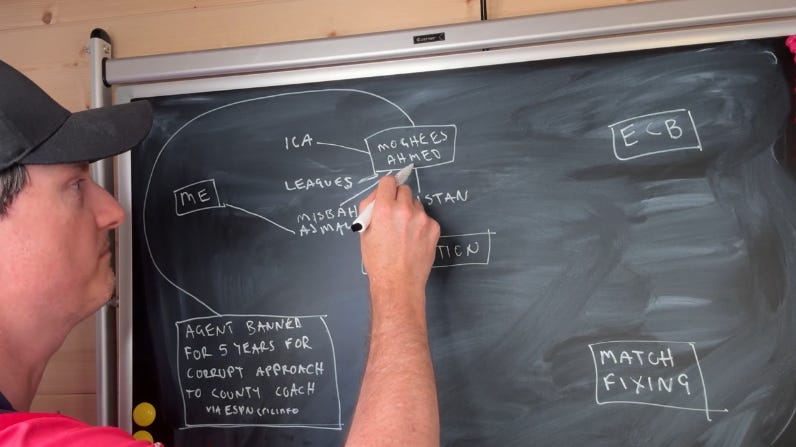
He has even been to my house.
The reason he came was a little bit baffling to me, even back then. I had a sports writing course called Fans with Laptops (not active at the moment, but will be active again very soon. We're just changing platforms with it.) I used to hold classes in my house sometimes, because it was easier. People would come over, and we'd spend a day talking about sports writing.
Ahmed came to one of those events. It was very interesting to have someone there who understood the players and what they needed, and he was very interested in narratives. I don’t remember if it was before or after this, but he actually hired me at ICA to come up with stats and narrative packages for players, to be able to sell them to leagues around the world. I had done this type of work with other agencies in the past, where they wanted some information or some nice paragraphs or any content, to send off to someone. But I’m pretty sure I did more of it with ICA than with anyone else.
It was a lot of fun because you'd find these players who weren't particularly well known, but they had a couple of micro skillsets, and you had to try and show coaches, owners or analysts from other teams why they would fit in well with their lineups.
But of course, with Ahmed in my house, me doing work for ICA and the Ajmal interview, I spent a lot of time with him.
At one stage, Ahmed also got me a job.
The Euro T20 league had a team called the Edinburgh Rocks. I still have the shirt. That league didn't end up going ahead, but because I worked with the Scottish coach at that time, I was offered the analyst job for Scotland. So in a way, Ahmed actually is the reason I worked with Cricket Scotland, even though he had nothing to do with that particular deal.
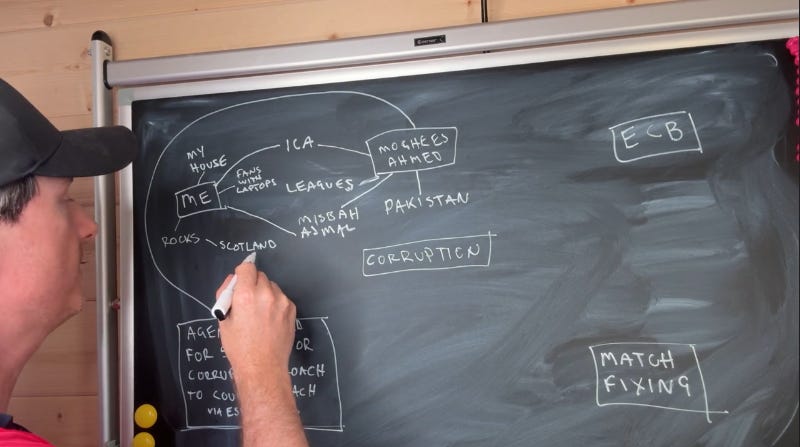
You can see how Ahmed overlaps quite a bit with me.
You might see the headline and this overlap and think, ‘Oh, that doesn’t sound very good’, but I was a lot more interested in this than most people would ever be. Because not only did I know Ahmed, but I’d had an equation with him.
Of course, Ahmed was an agent, and that was the main part of his business. And to be an agent in the UK, you actually have to be sanctioned by the ECB. That is a big part of it. A lot of people who try and represent players fall at that hurdle, whereas Ahmed had been doing it for quite some time. He was very well known within English cricket - probably more for Pakistan and league cricket.
In fact, if you look at what ICA did in league cricket, they would essentially keep their ears to the ground and find any opportunities, and even sell those on to other agents to say that ‘This player can go to this place, and that player can go to that place.’
They were very clever. There was a lot of bottom-dwelling, but they had so many irons in so many fires.
In fact, Ahmed offered me about two or three jobs, but every time he would offer me a job, it didn't seem to be the kind of opportunity I wanted. Either it was with a team who I didn't particularly trust the ownership group of, or it was in a league where I didn't even see a reason why I needed to be there as an analyst.
But it showed that he was very active, knew a lot of different people, and he also had the accreditation. All these things made him a completely legit person within the cricket industry.
How does all of this lead us to match-fixing? Because if you read the headline ‘agent banned for five years for corrupt approach to county cricket coach’ - that sounds like match-fixing, right? And, of course, that comes directly from the ECB.
They had their own trial, and they have found Ahmed guilty. It's important to say that he has maintained his innocence all the way through. This was completely a situation of the witness versus the accused.
But at the trial, Ahmed did have his own legal team. It wasn't like he was left alone. It was one lot of lawyers, versus another lot of lawyers. And then there was a committee who came up with a decision, and they decided that he would be banned.
The conditions under which he was banned were for match-fixing, and they mentioned a few other precedents while they were giving him in this ban.
