



Buy The Art of Batting here:
“I don’t know, it’s just one of those things within the rules of the game, and that’s how it is. It’s happened to the highest level and I’m sure it’s happened to the lowest as well.”
Can you guess who said this, and when? No, it wasn’t Alex Carey at Lord’s after his moment of infamy.
This was his protagonist, Jonny Bairstow, back in a county game in 2014, after he stumped Samit Patel. He actually waited for the batter to lift his foot in the air before taking the bails off.


Yet Carey’s similar actions on day five at Lord’s in the 2023 Ashes almost burn the place down. The gentlemen were not gentle. Carey found out what many internationals have before; when a story goes out of the cricket bubble, your life changes.
Stuart Broad walked in to bat next. He came up to the Aussie wicketkeeper and dropped the famous, “That’s all you’ll ever be remembered for” line.
“If you hate Carey, shoes off” chants echoed from the Western Terrace at Headingley in the next match. This wasn’t Yorkshire vs Notts. This was the Ashes, and Carey had turned it into a football match.
In the second innings of that game, Carey drags on when he tries to leave the ball and is bowled. He makes 200 runs in nine innings that summer. Even in the previous Ashes, he didn’t make many.
Until this series, Stuart Broad had a point. Alex Carey was known for a clever morally divisive run out at the place where they wrote the laws he did not break.
This series is changing that script. Every time Australia’s top-order goes up in flames, Alex Carey is the answer. He is also the man willing to stand up to fast bowlers to keep the Bazball shuffle in check. Carey is more than a controversial stumping; he’s Australia’s firefighter.
***
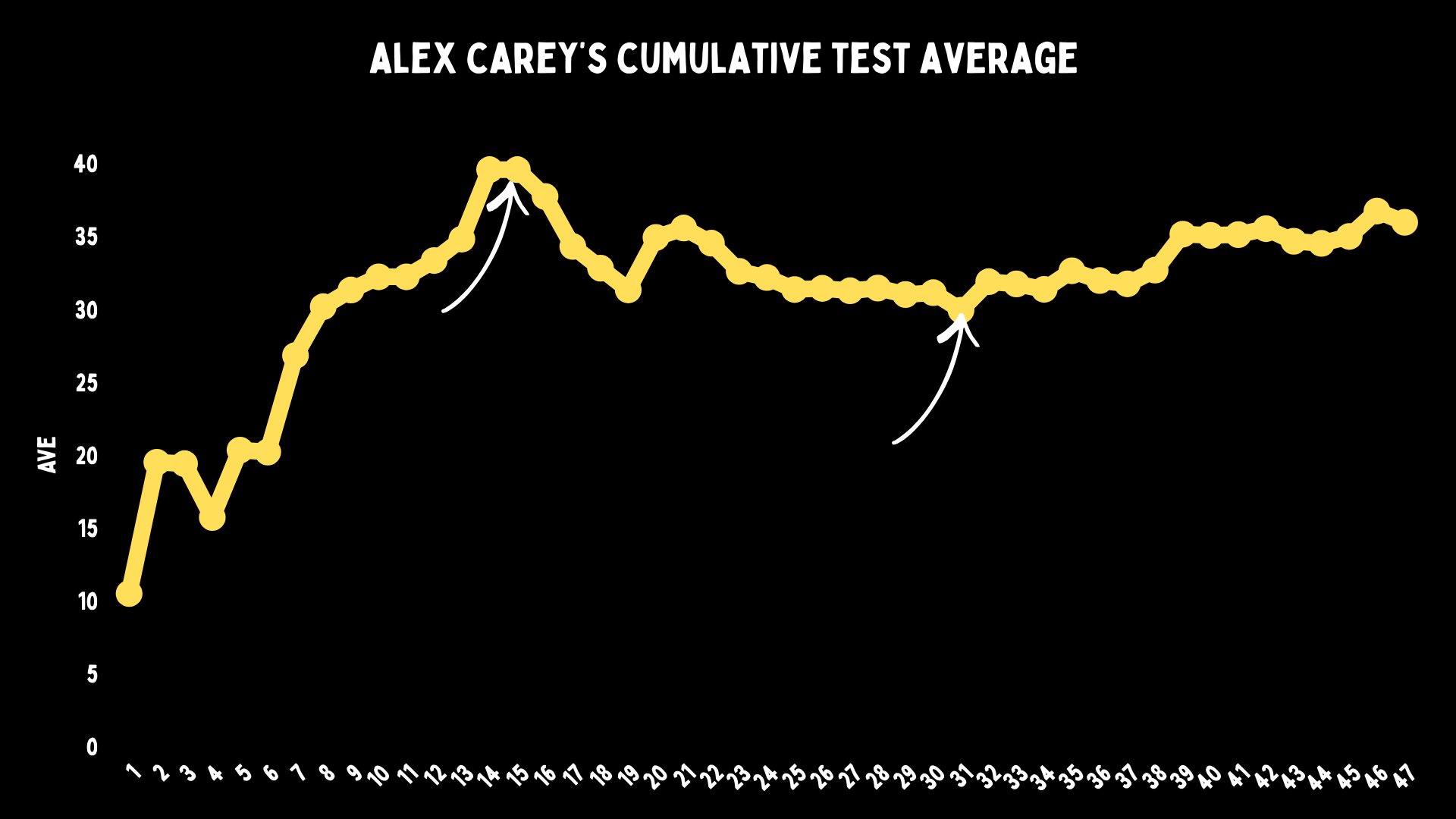
One of the funniest Carey stats is that before he fell in the pool in the Karachi hotel in 2022, he had an average of only 20 in his first ten innings. According to Fox Cricket’s Nic Savage, he would average 84.2 from that point till almost the end of the year.

Carey as a Test batter was born again in the hotel pool.
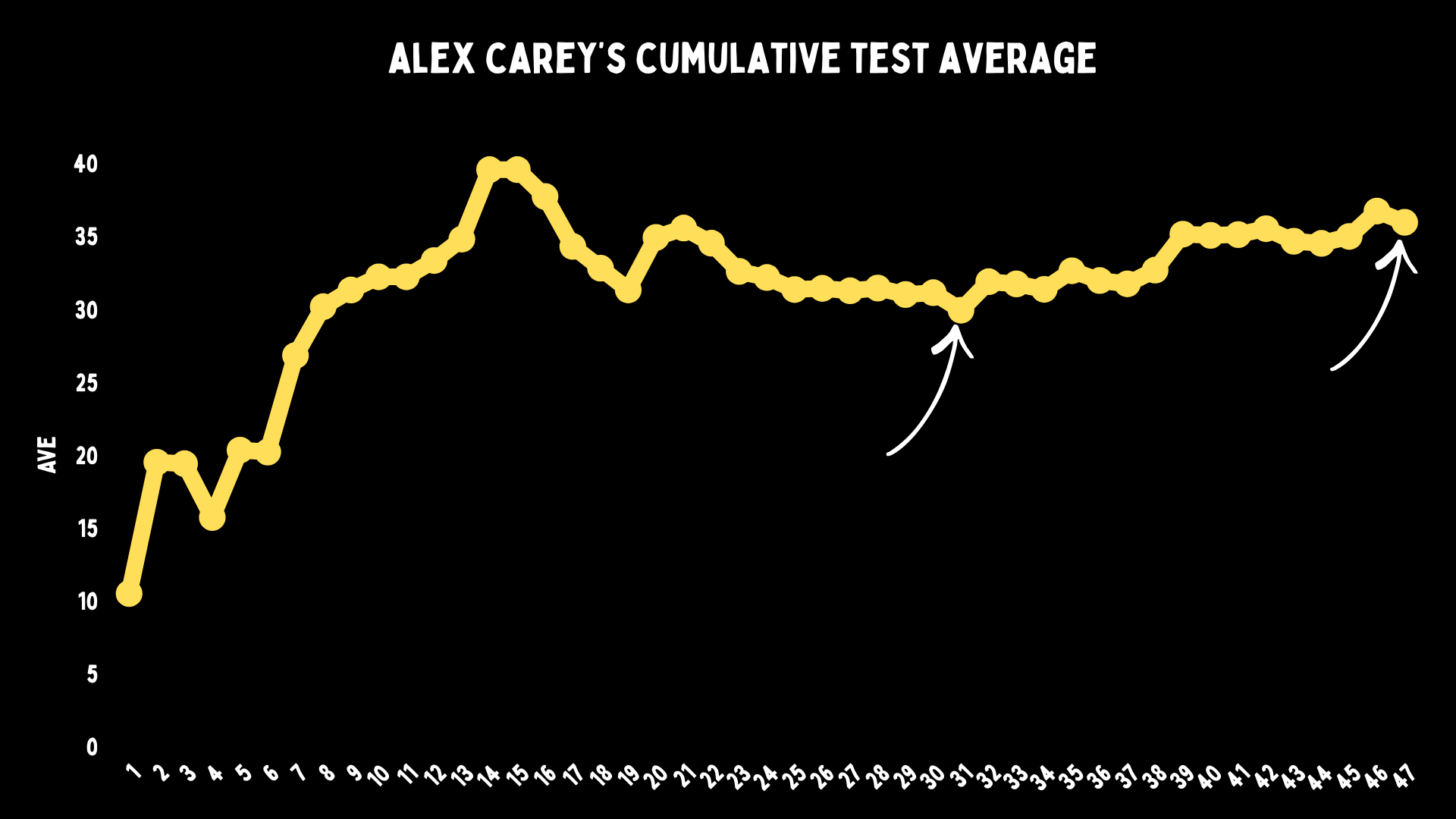
Australia liked Carey as a player, but it felt like they were trying to manage him out of their lineup to get more batting for ages. Josh Inglis was always lurking stage right. But Carey kept stepping up. And his Boxing Day hundred took his career mark to just below 40 - almost doubling those early career struggles.
But it’s not entirely been an exponential rise. After the first Test of the New Zealand tour in 2024, his average dropped below 30. When he visited India, he really struggled to make any runs. His unhealthy obsession with the reverse sweep cost him a trifecta of wickets.
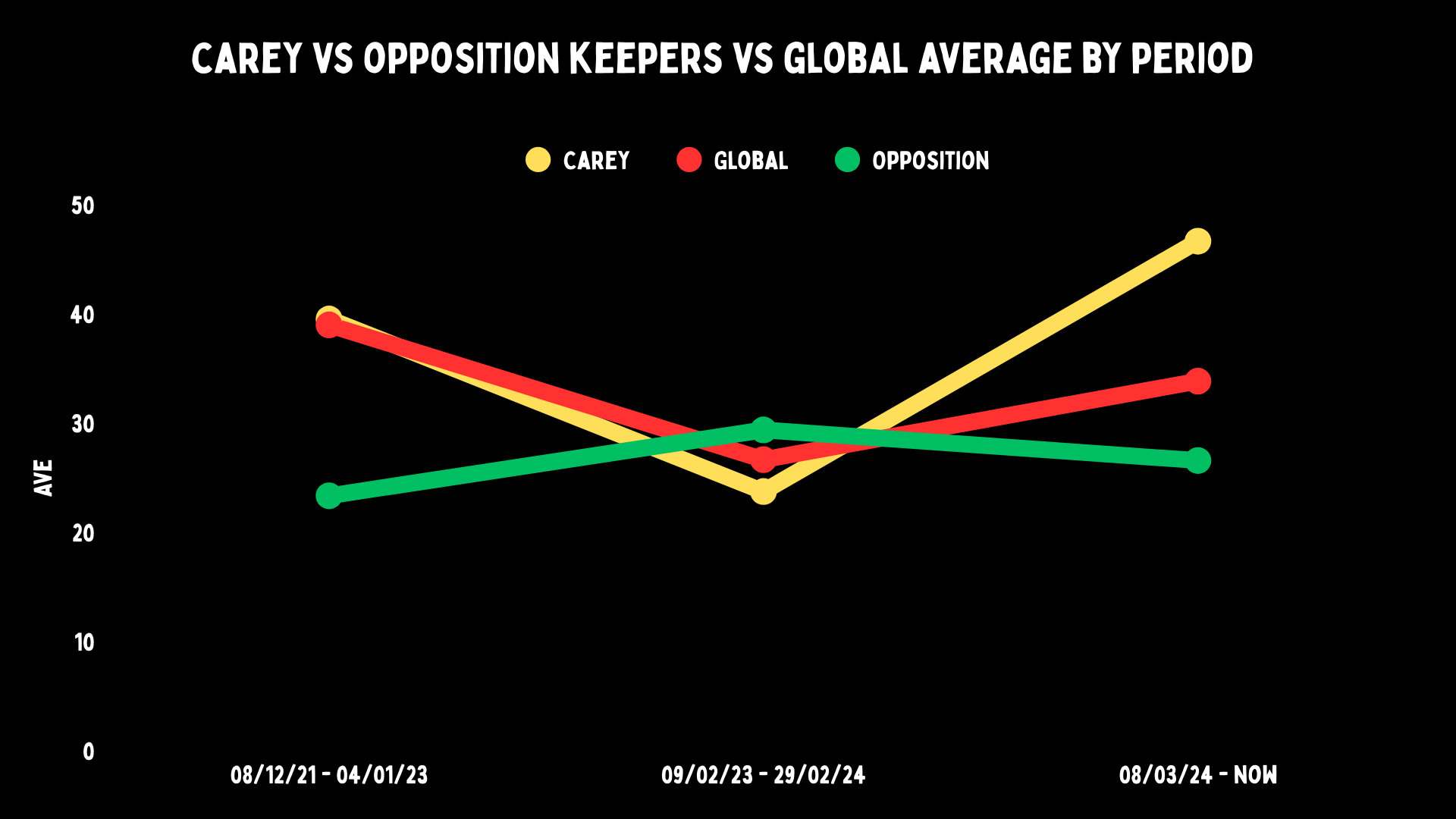
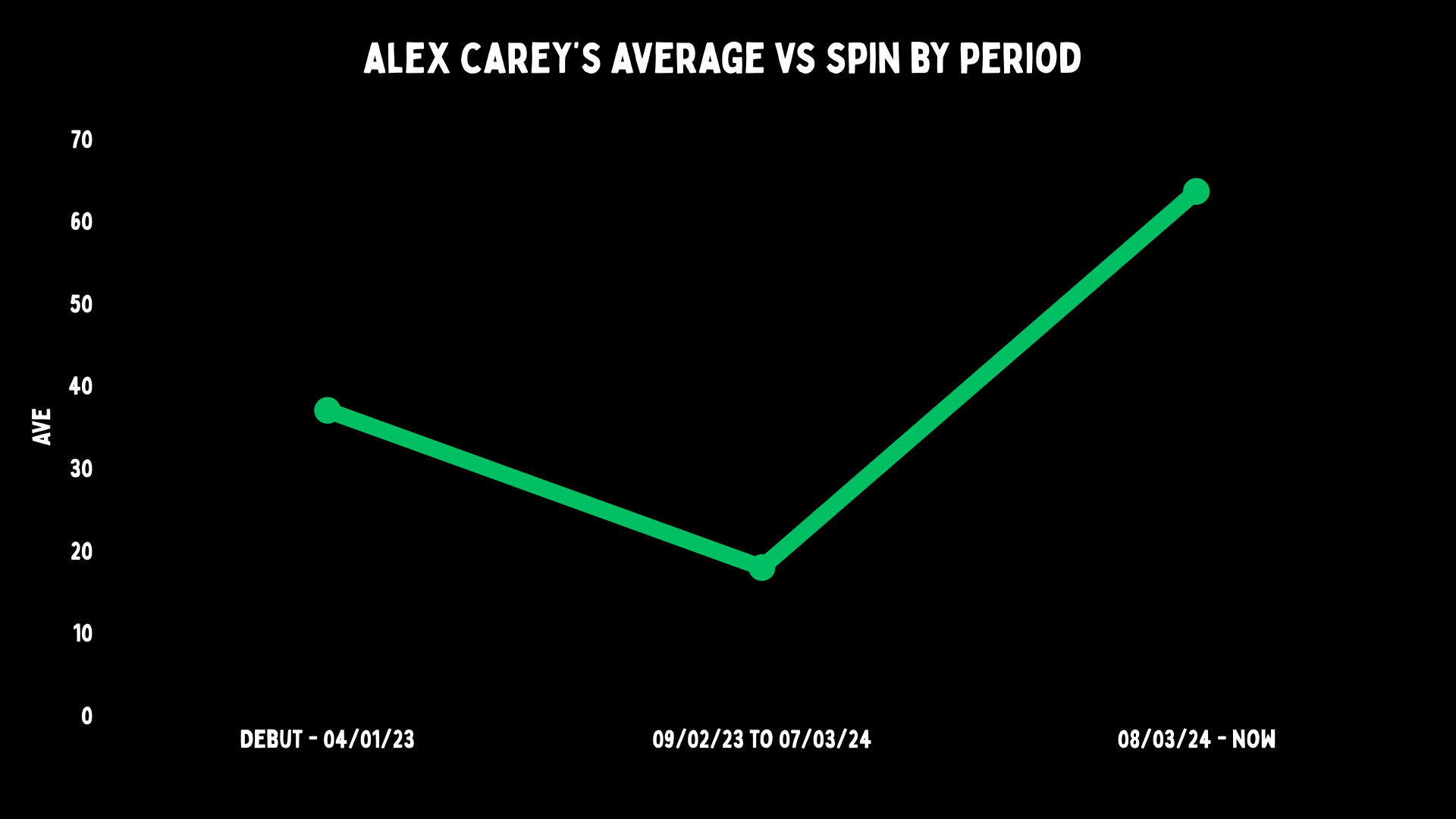
His career is a mess. There are four different time periods here, including the pool. But to have a comparable sample size of games, we divide our analysis in three parts: debut till SA 2022/23 series, BGT 2022/23 till first NZ Test & second NZ Test onwards.
When he started, he outperformed the keepers in his games by a mile. But he was close to the global average. That makes sense too, as in 2022 we saw Rishabh Pant, Tom Blundell and Litton Das make loads of runs. After the end of that purple patch, Carey was worse than the opposition glovemen. He scored almost six runs per wicket less than the global mean. And now, he is a clear standout.
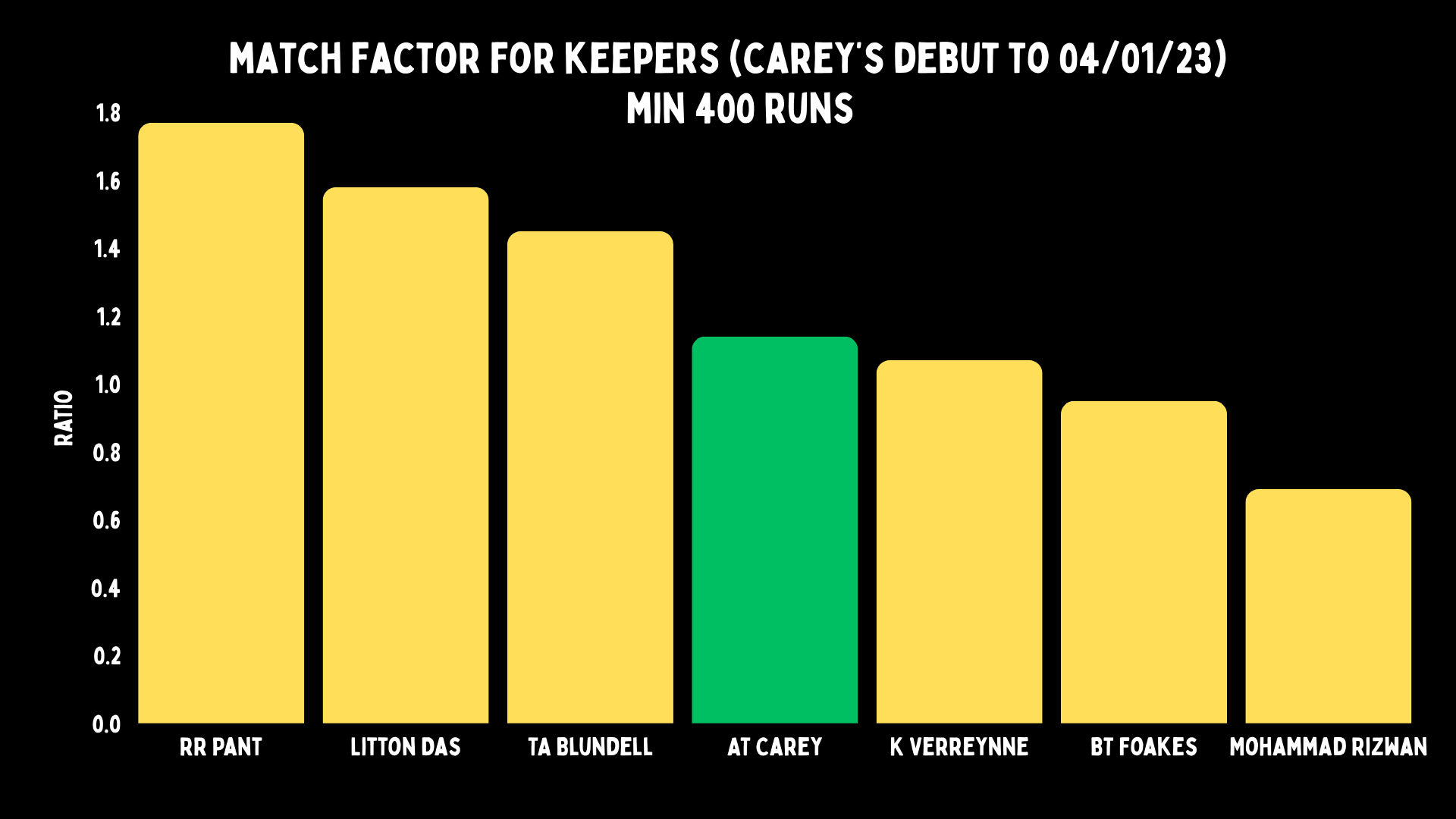
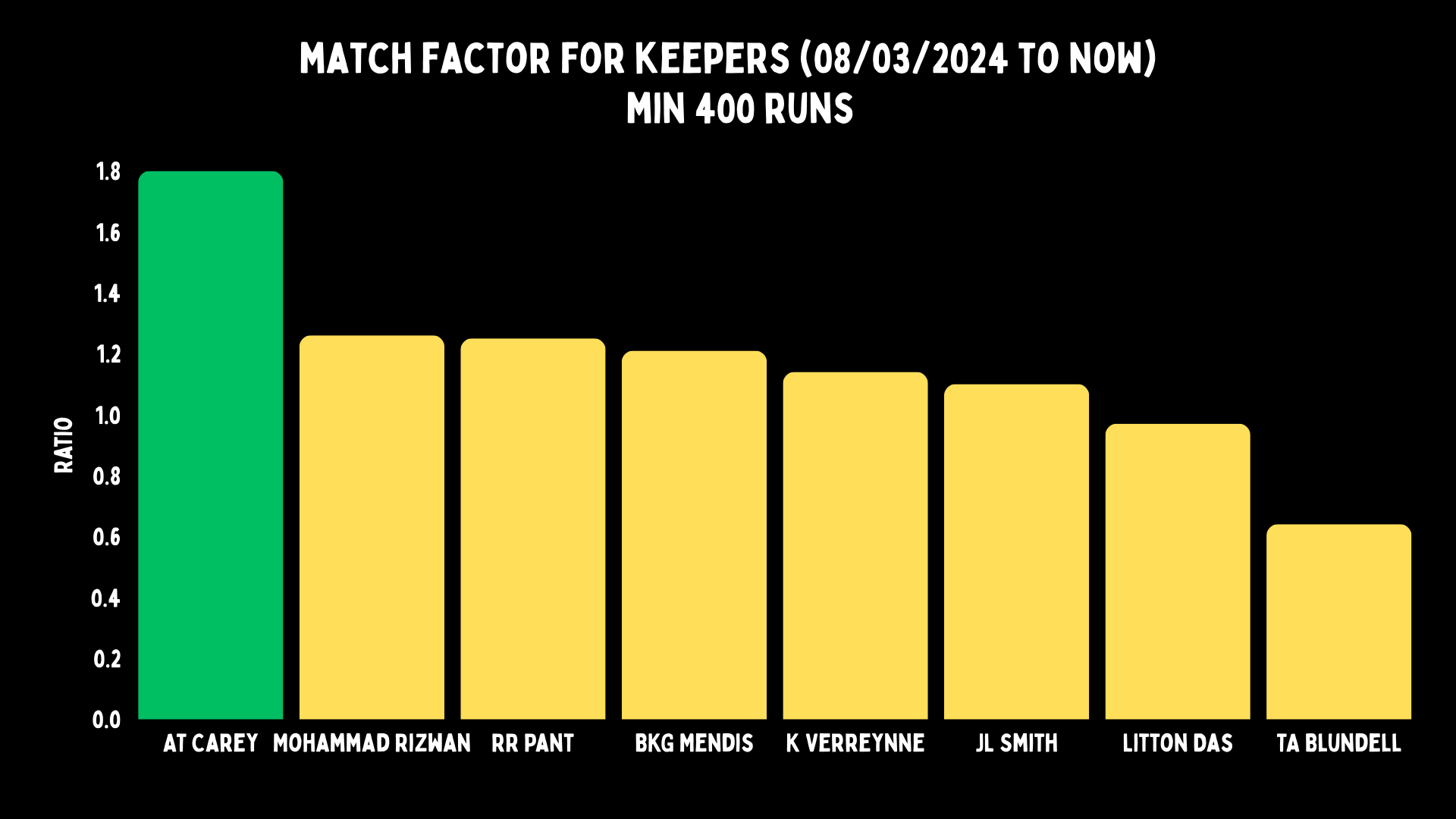
We also need to look at the match factor. In that first period, he was 14% better than the other top seven batters in his games. That is good, but there were a few doing this job better.
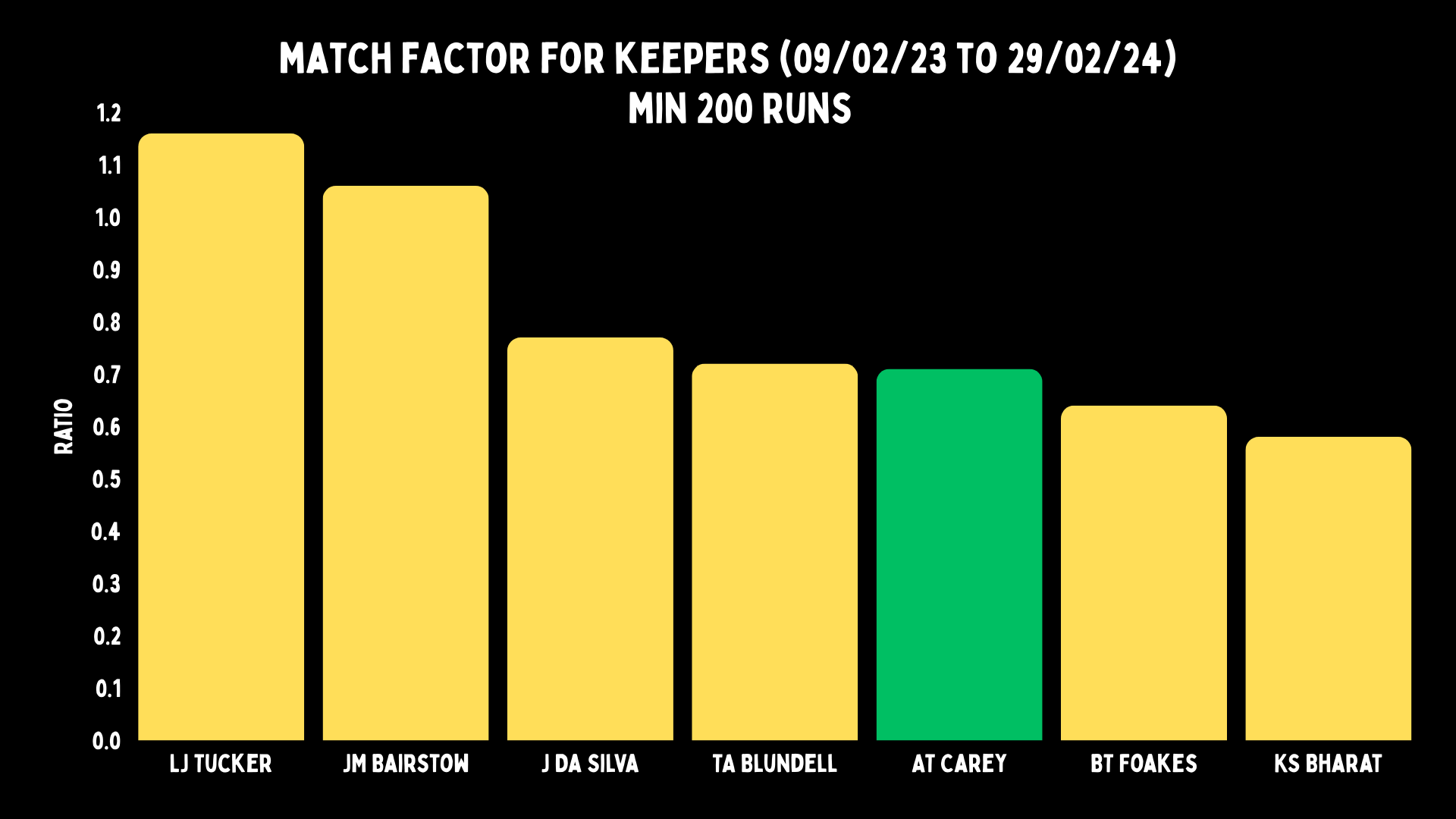
During his lean patch, he was 29% worse. Only, Ben Foakes and KS Bharat struggled more. But Foakes is known for his keeping skills, while Bharat was a stop-gap option for India in Pant’s absence.
But since stealing a Test match from New Zealand, he’s been incredible. Not even Pant, Jamie Smith or Kusal Mendis can catch up with his incredible ratio of 1.8. The turnaround has been like one of his innings; fast and life-changing.
He has added six runs on his career average after his current run of form. Yet, he still feels like a pugnacious, earnest keeper, not a full-time batter. He still has Carey energy, but top-order runs.
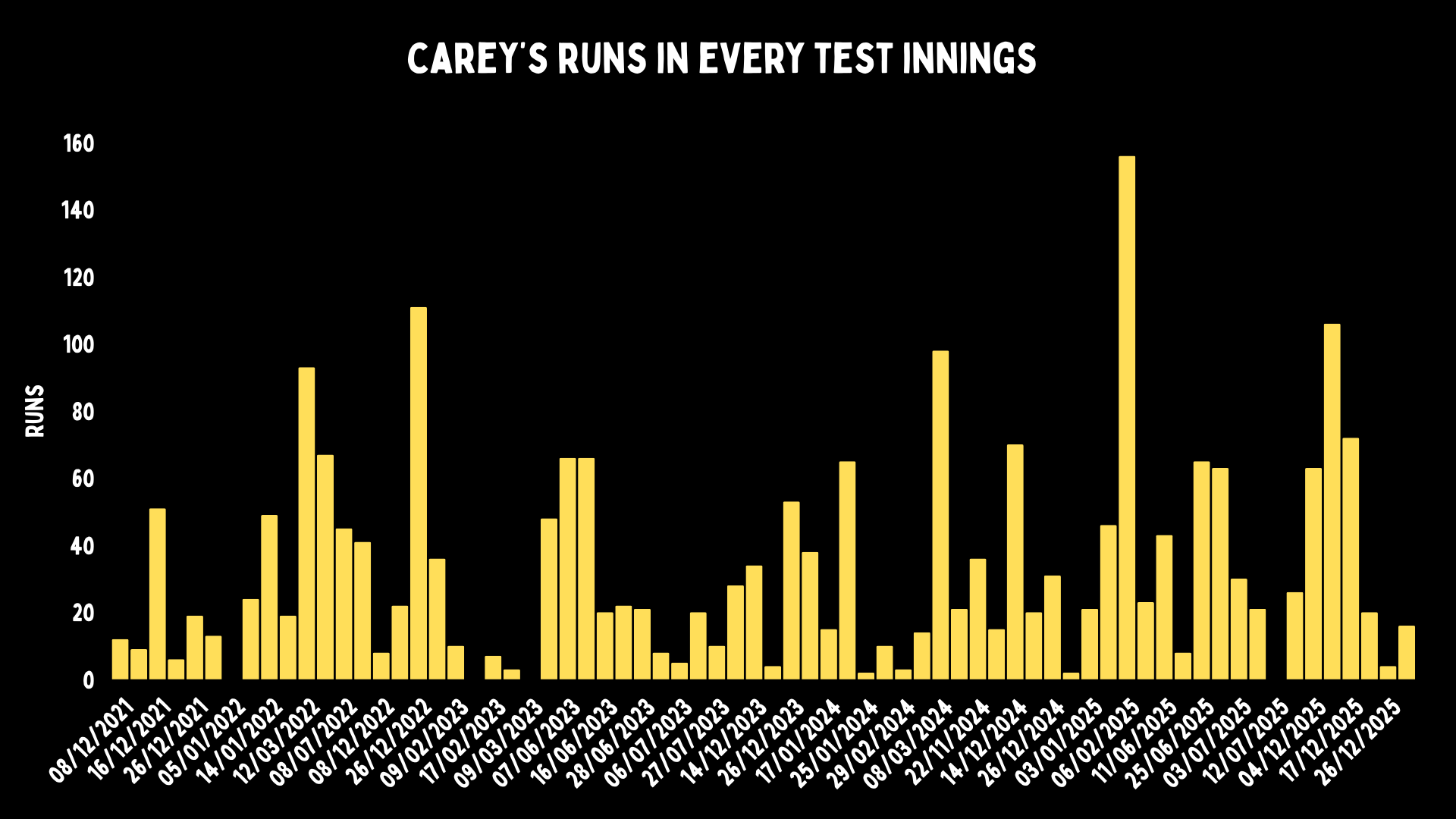
The big change is hundreds. In his first 56 knocks, there was only one. Now, he has three in 72. That means Australia can trust him a lot more.
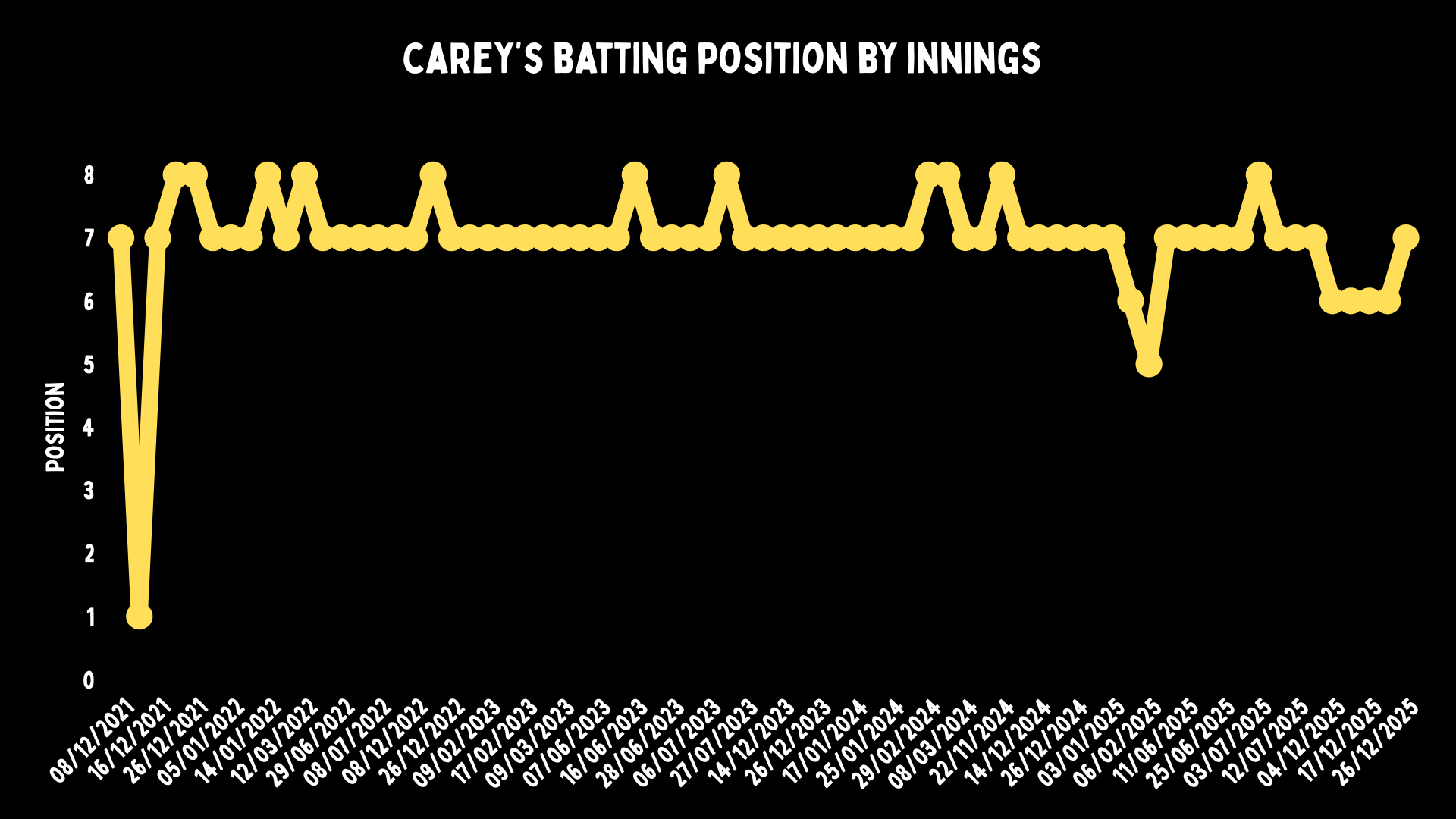
Carey batted in the top six only once (when he opened in the second innings of his debut Test) till the last Aussie summer. In part, because Australia were never convinced of his batting. Since then, he has done the job six times, scoring 463 runs with two centuries and two fifties to his name. That means he gives his team flexibility in a way he never could at number seven. At the moment, it is moonlighting as a top six player, but even that is handy.
Drawing parallels with a previous home Ashes, Carey’s contributions have been 2013/14 Brad Haddin-like, as another left-arm Mitchell destroys the visitors. If we look at the most runs by an Aussie keeper in home Ashes, Carey’s 25/26 is one of the five with 300 or more runs. If he makes 54 runs in the next innings, that will give him second spot. All that in a low-scoring series as well.
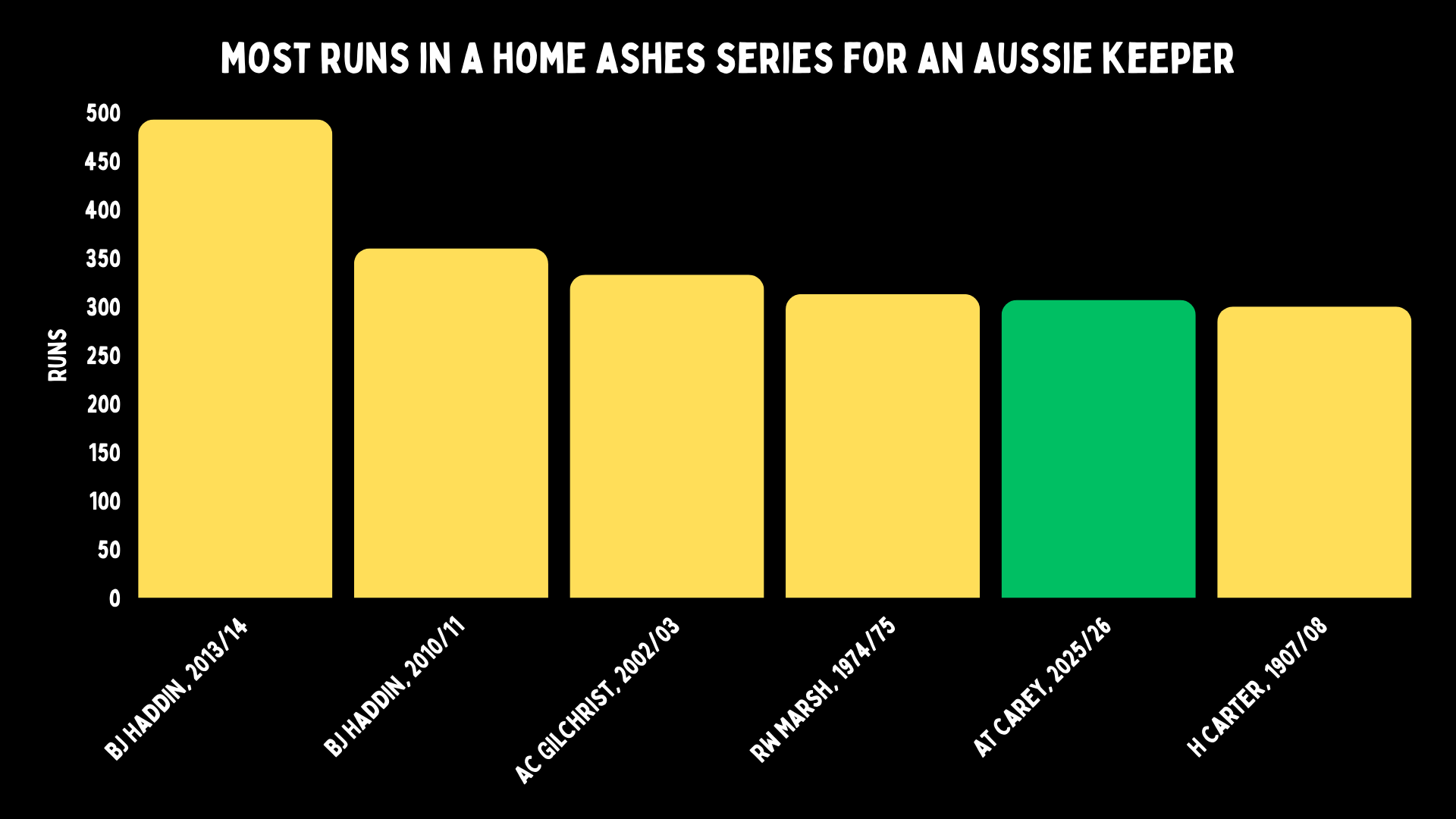
In fact, just average and runs don’t work here. We need match factor to bring in the conditions, and on that Carey is in the same league as New South Wales’ Hanson “Sammy” Carter and Adam Gilchrist. Only Haddin is a cut above them all.
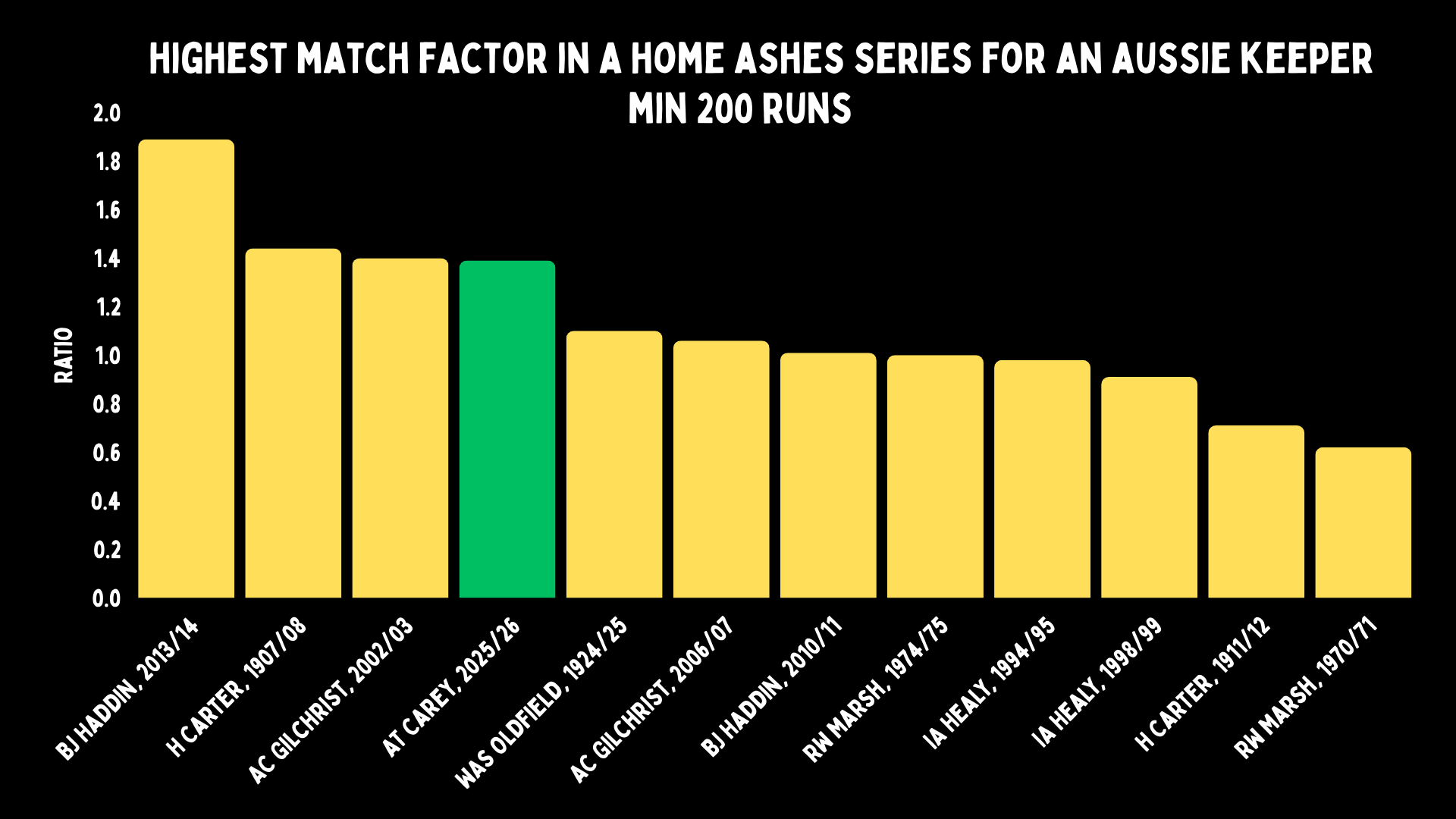
You are doing well when after a couple of Tests your keeping is going viral, and your batting is almost as good. He’s not a modern-day batter-keeper like Jamie Smith or Rishabh Pant. He’s much closer to keeper-batter.
Standing up to the stumps this Ashes has been as important as his runs. In the pink-ball Test at Brisbane for Scott Boland and Michael Neser he trapped England to the crease. Don’t be fooled by how easy he made it look, though. He’s talked about how he never practised in the nets because of how dangerous it can be.
As a keeper, he had the most dismissals in 2025, and is the only one to have more than four a game on average. Of course, that is an indictment of the all-time great bowling attack he plays with, but this passes the eye test. Adelaide will be remembered for the runs; there were six catches and a stumping too. Christchurch 2024 was also a landmark game with the glove because he took ten catches, a feat only achieved seven other times. He doesn’t concede too many byes, or fumble much at all.


When we did the Most Improved Player essay, we mentioned Carey among the memorable performers whose numbers didn’t change a lot on our timelines. Since March 2024, he absolutely has to be in that conversation, especially when we factor in the wicketkeeping. Maybe he is the Most Improved Wicketkeeper Bat.
Australia had one eye on Josh Inglis for a long time, playing him as a specialist batter with Carey in the side.

In Adelaide, Inglis played again just to bat, but Australia had him at number seven. Carey was elevated above him at six. It is a small change in the order, but it’s a huge tick for the South Australian.

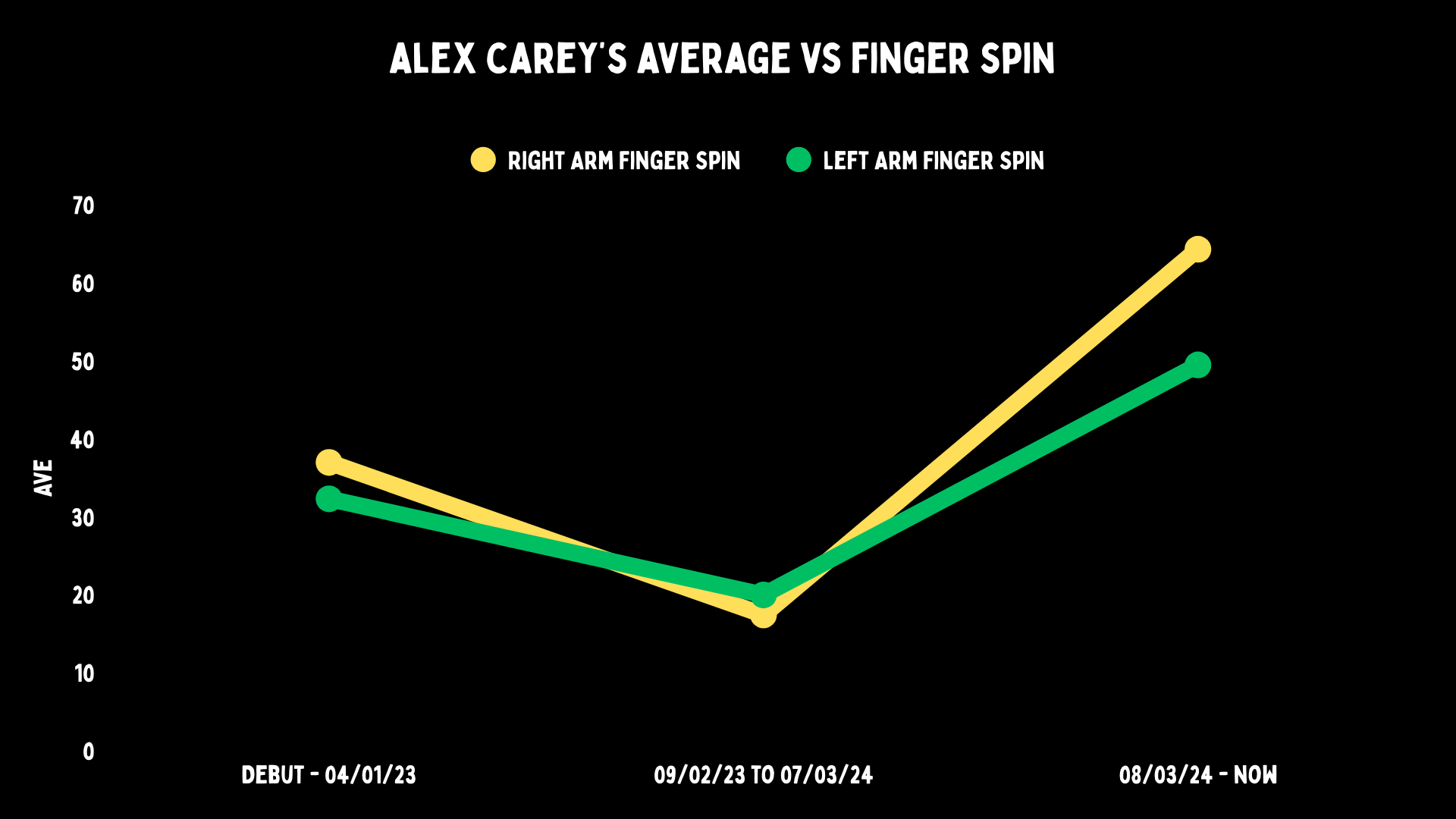
But Carey has earned everything he’s got. In his first 15 Tests, Carey averaged 37 versus spin. He did well versus the turning ball in Pakistan, but those pitches had barely any help for living bowlers. He was okay in Sri Lanka, however, it was at home where he got out to spin more often than in Asia.
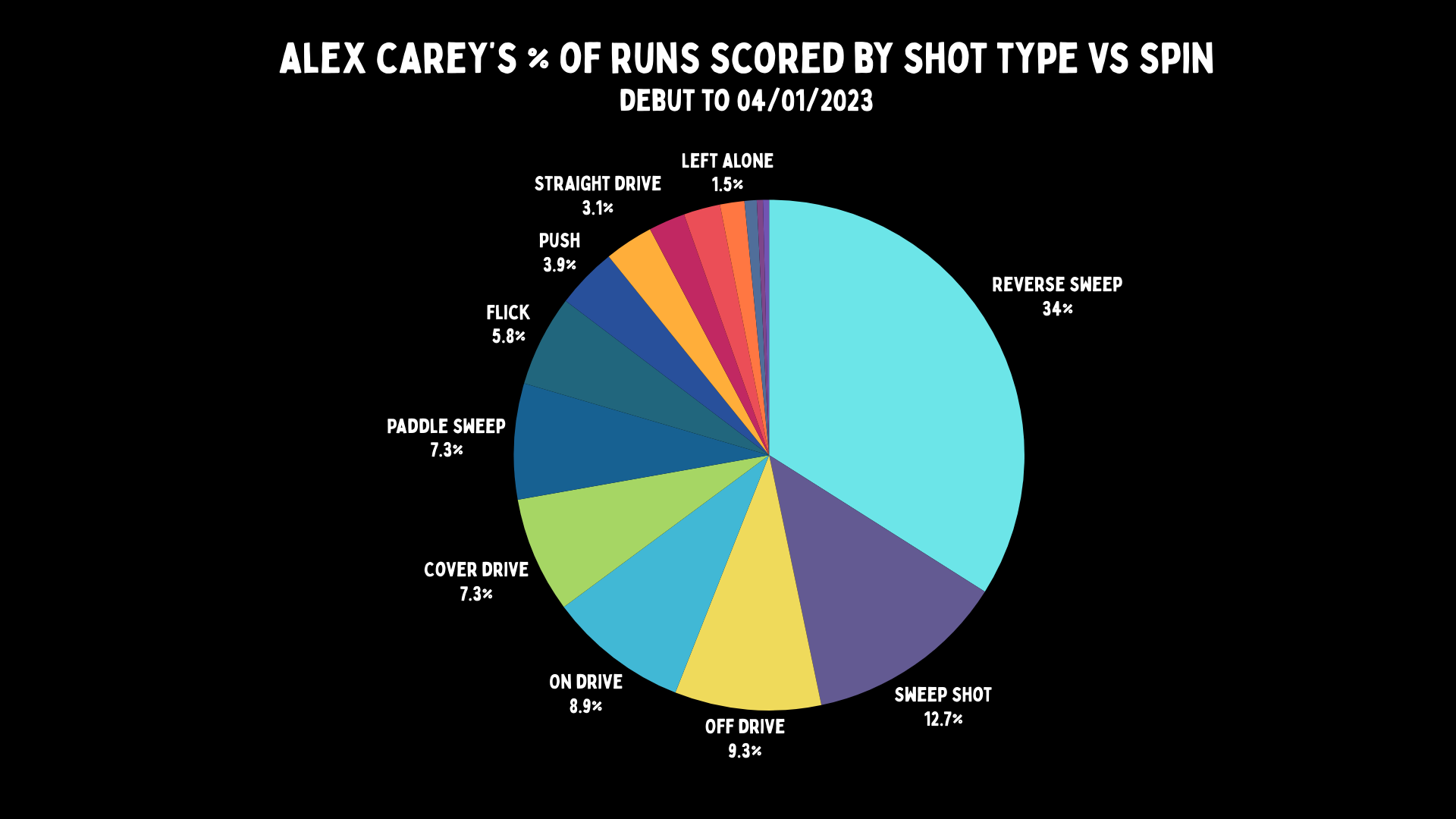
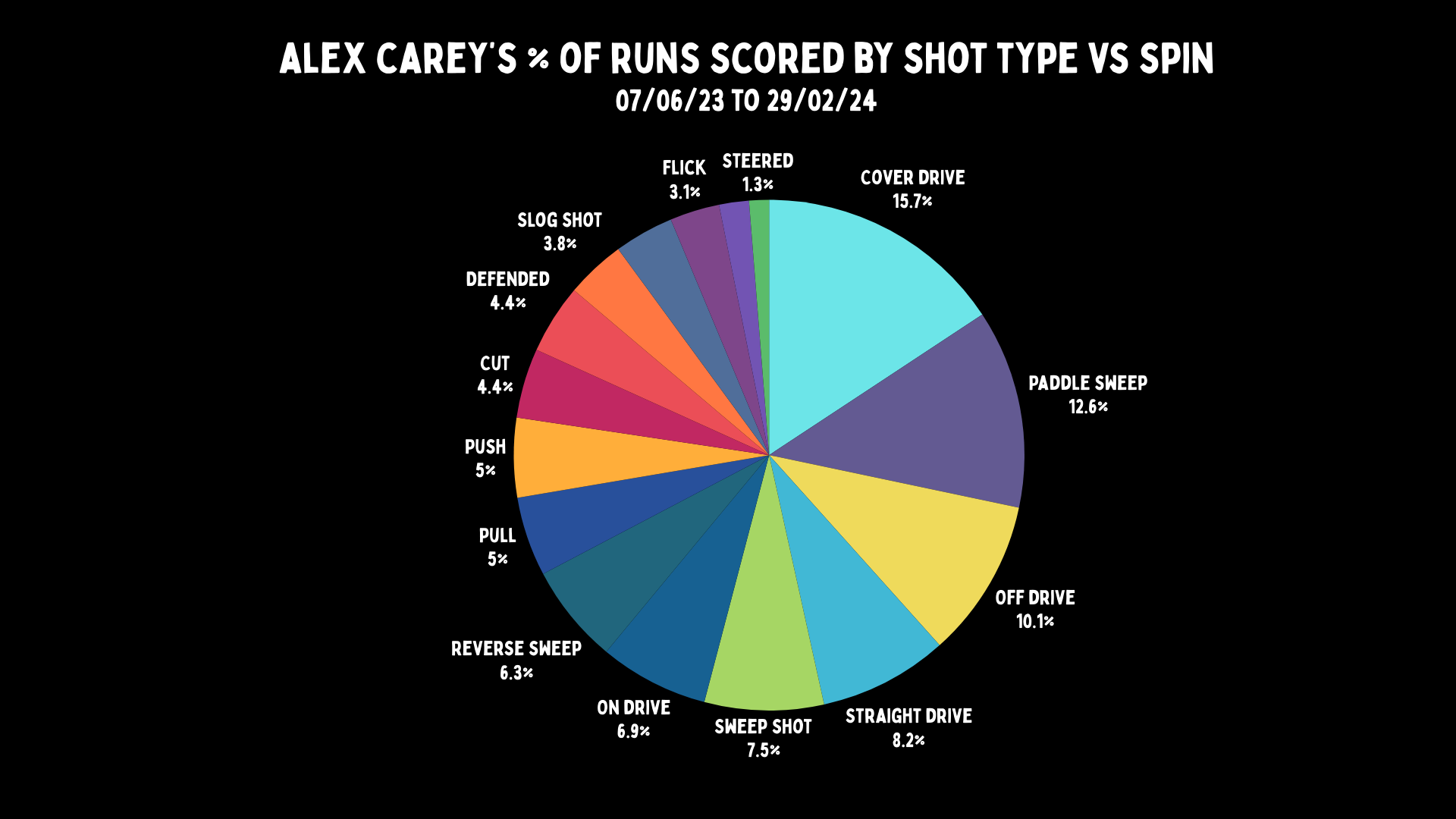
His main scoring option was the reverse sweep, yielding him 34% of all his runs against the tweakers for just one dismissal. And he played it in all three countries. But teams worked him out, and eventually when he got to India he became a walking reverse wicket.
That seems to have been an important part of his career. Carey is an interesting cricketer, in that he was a professional Australian rules footballer, before turning to cricket. That tells us a lot about him. His athleticism is exceptional, but so is his tenacity. Most players can’t make it in another sport when they fail at the first one after the age of 18. But he’s also a problem solver and a proper professional, doing whatever is needed to make his career work.
So after that series, he really cuts down the reverse sweep obsession and adds more scoring options: the various drives and the paddle sweep. Even the conventional sweep isn’t used as frequently.
Since the Christchurch Test, his average has risen exponentially to 64. Most of the spin he faced was in Sri Lanka and at home with this more rounded game, and it worked well.
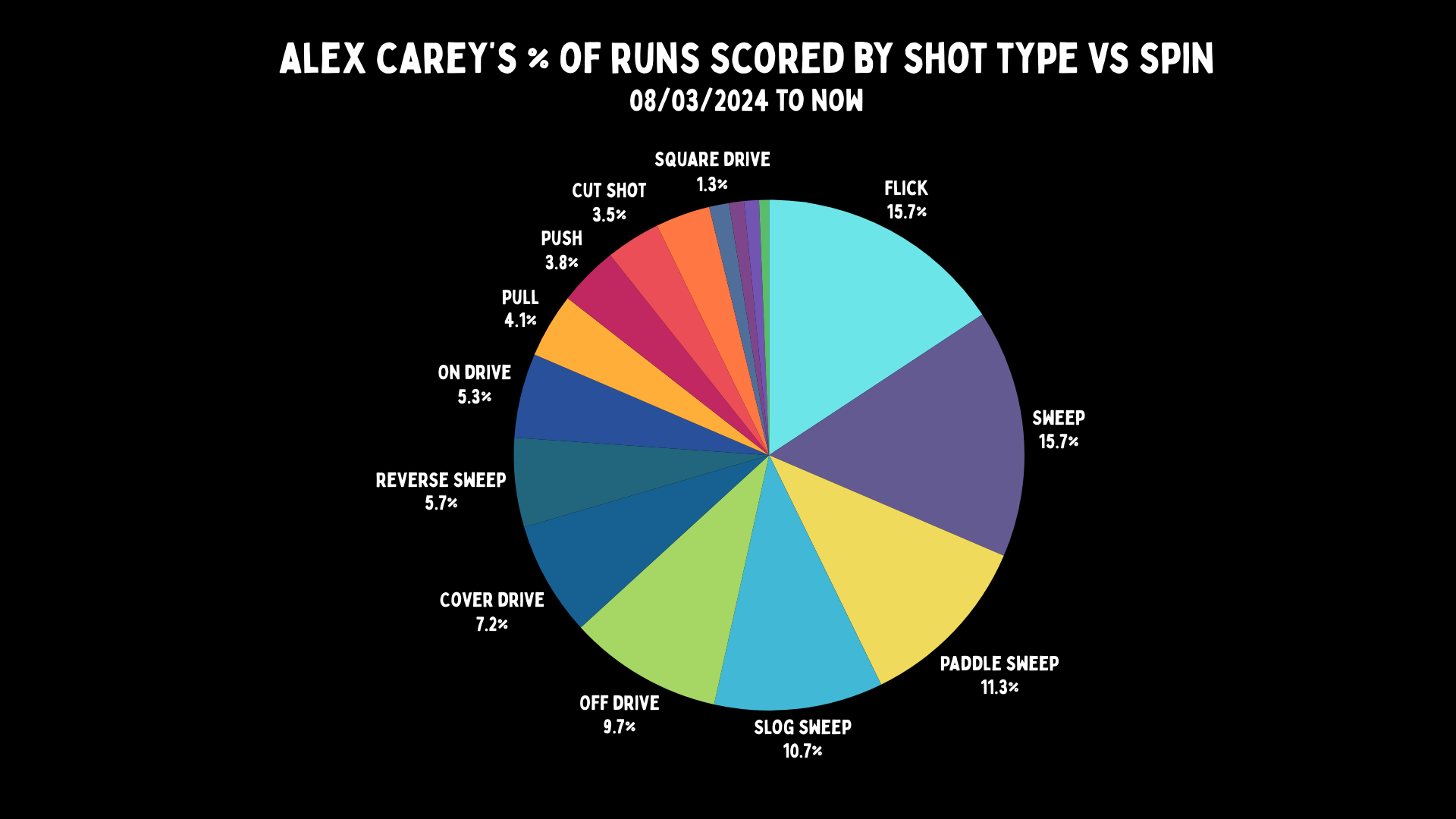
He has shown significant improvement against offspin in particular, which is always trickier for a leftie. Against SLAs, he uses the conventional sweep, but brings out the paddle and slog sweeps for the offies. He can also flick the ball to rotate strike against both.
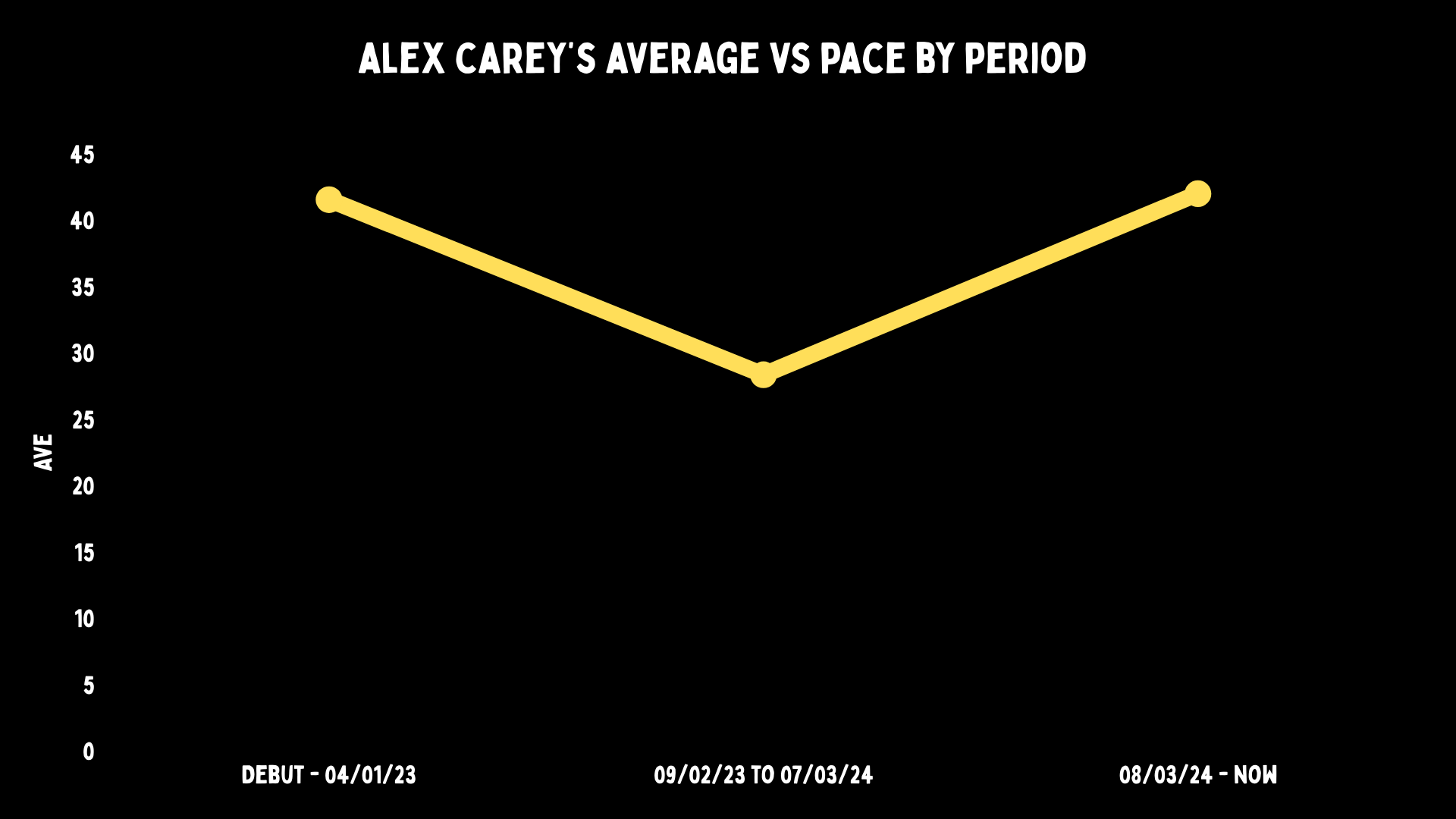
But his troubles were more than the turning ball. When he wasn’t amongst the runs, his average versus pace did drop below 30.
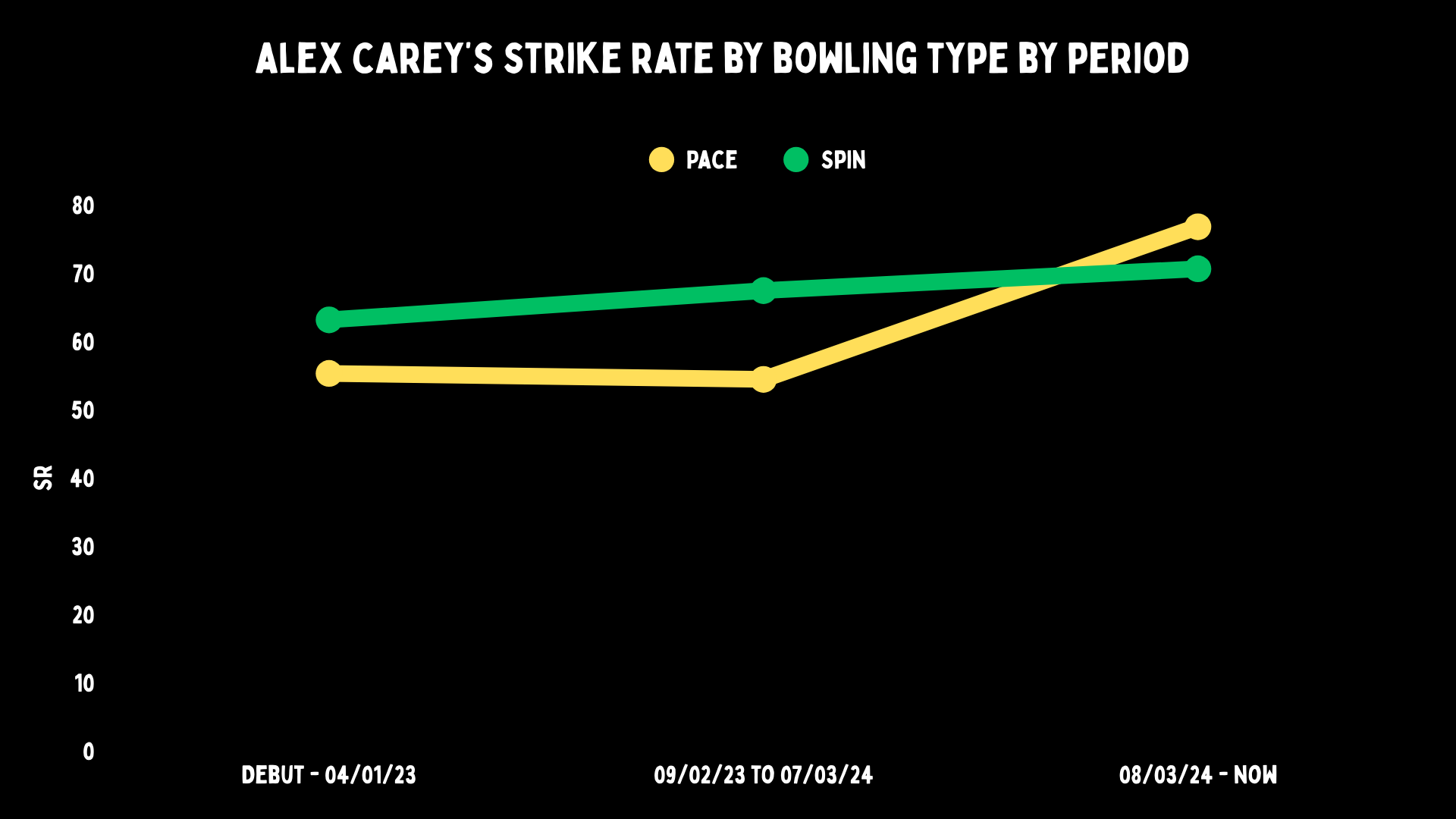
But the change there seems to be attacking. He struck the ball at 55 when he started, compared to a Travis Head-esque 77 right now. That’s a tectonic shift in the approach.
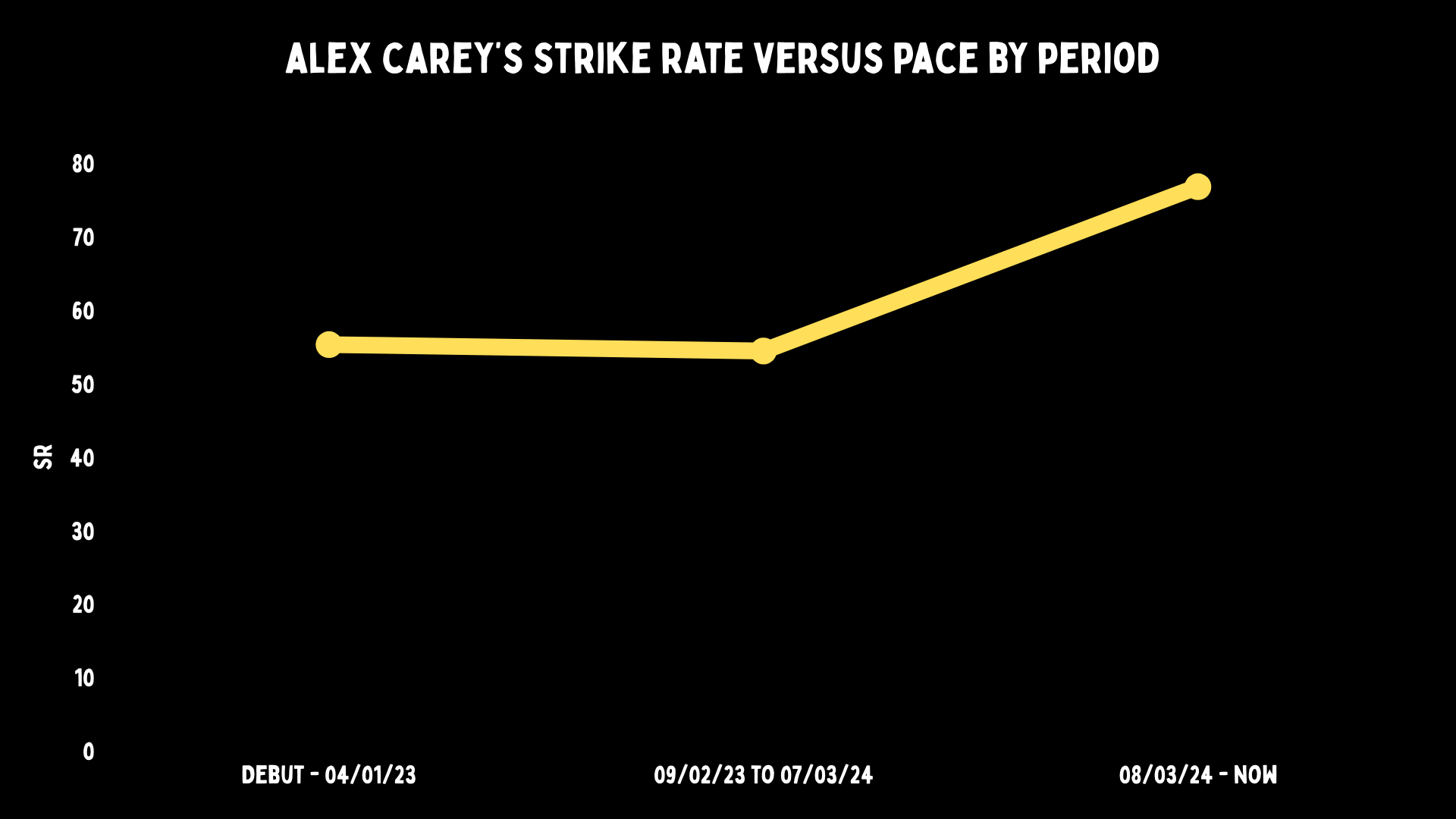
That makes more sense for the way he plays. Earlier he looked tentative, and unsure. The new Carey is a pro that keeps the opposition off kilter.
He’s also upped his scoring rate versus spin, albeit much less dramatically. But it’s fascinating that for two-thirds of his career, he had a better strike rate versus spin, and now it’s the pacers whom he rattles off runs more quickly.
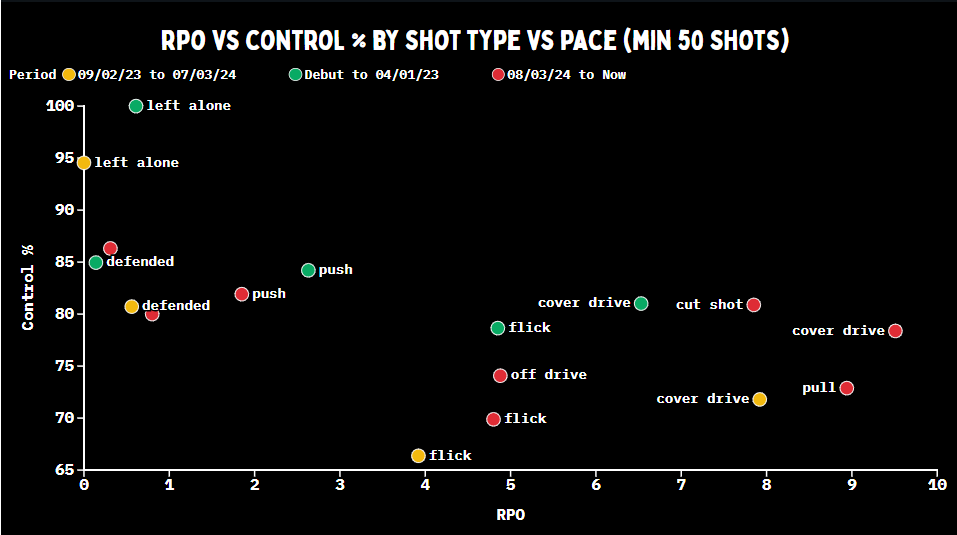
The cover drive and the flick have always been his two major scoring options - the former to score boundaries, the latter to easily knock the ball around. But the cut is increasingly becoming important, and he plays it as an attacking shot against good balls. He’s shelved the pull, and the poke at the ball outside off; now he punches and slashes. Teams need to make a calculation: keep the slips in and allow two or three quick boundaries, or defend the rope.
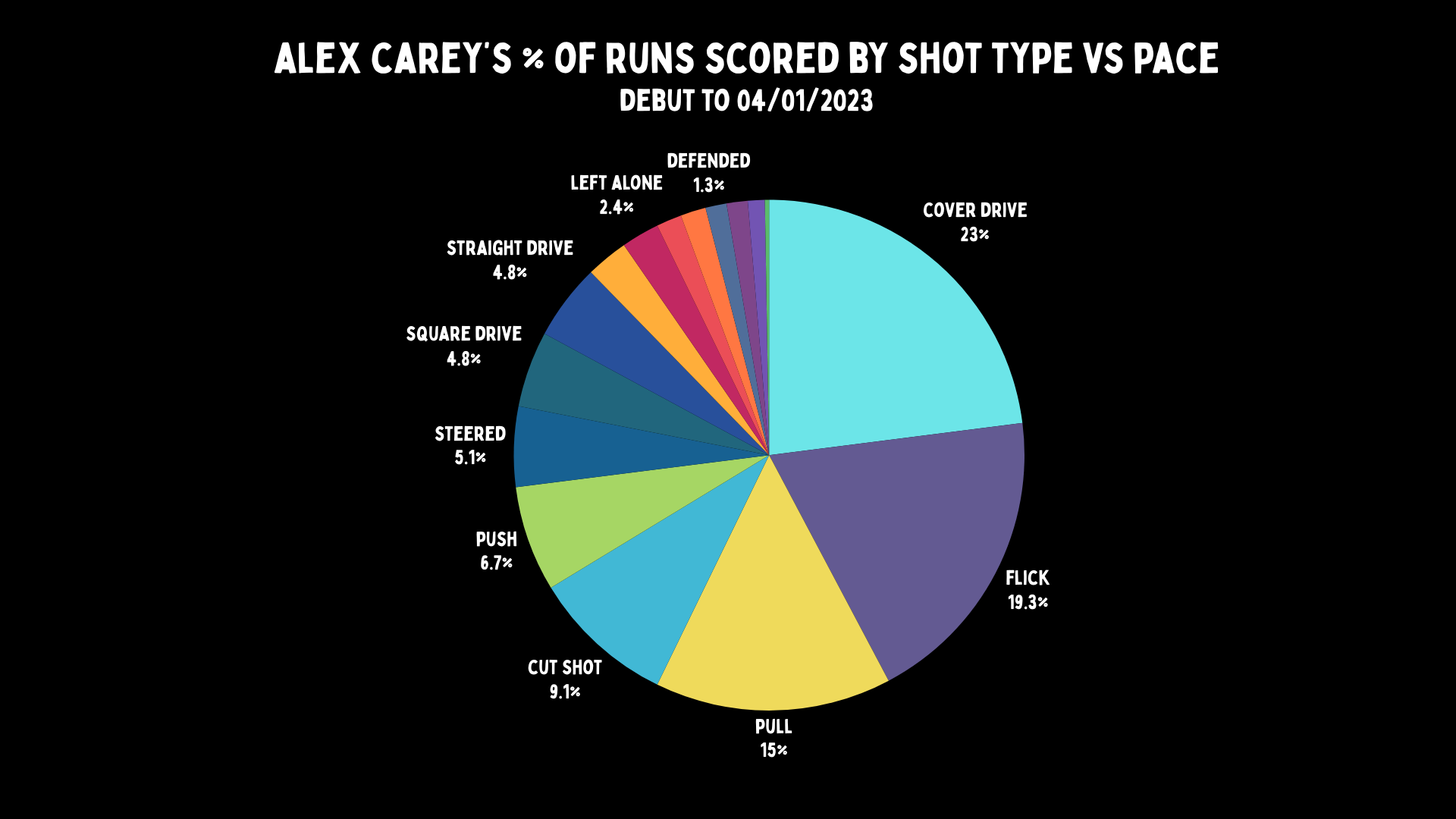
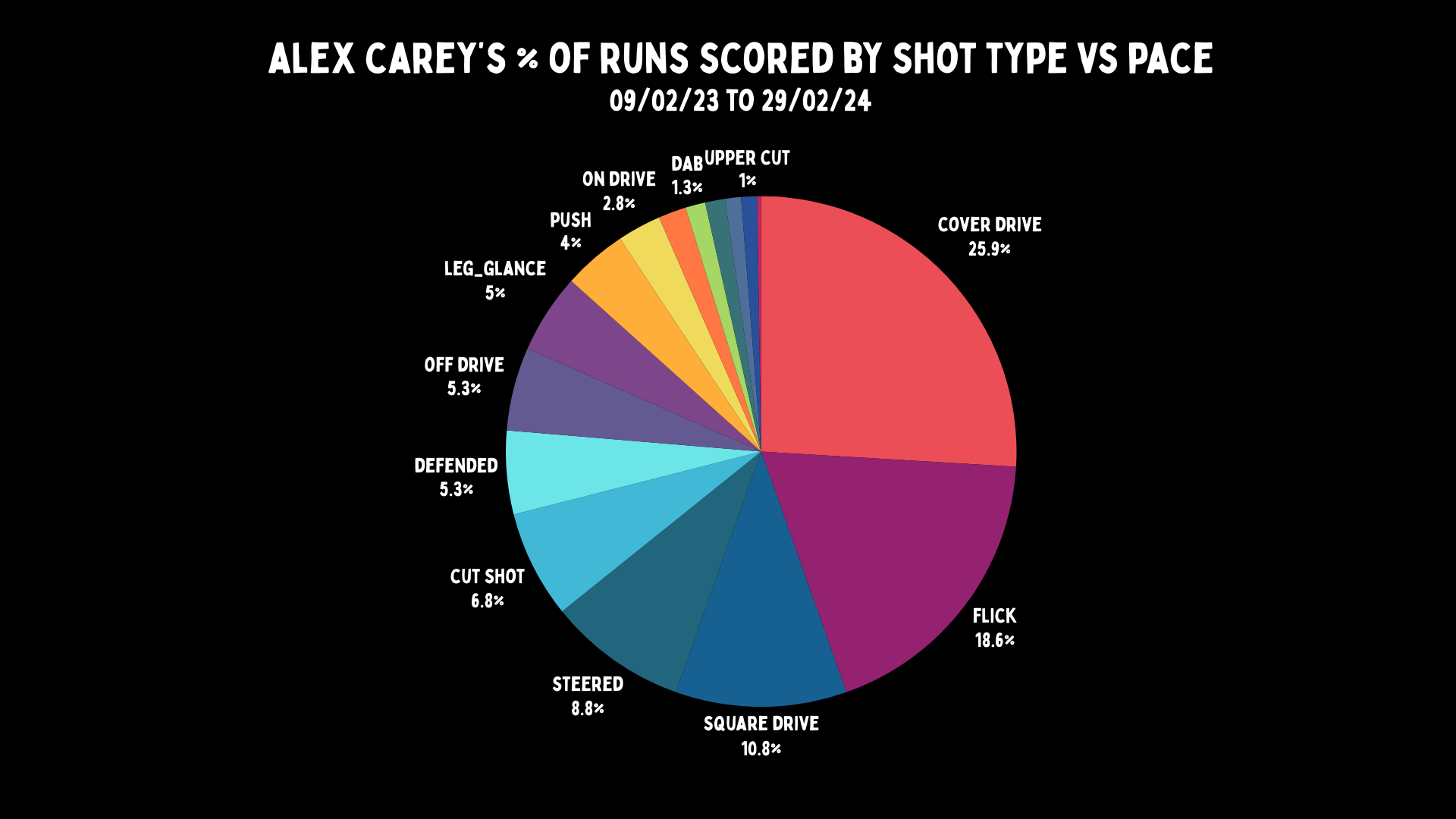
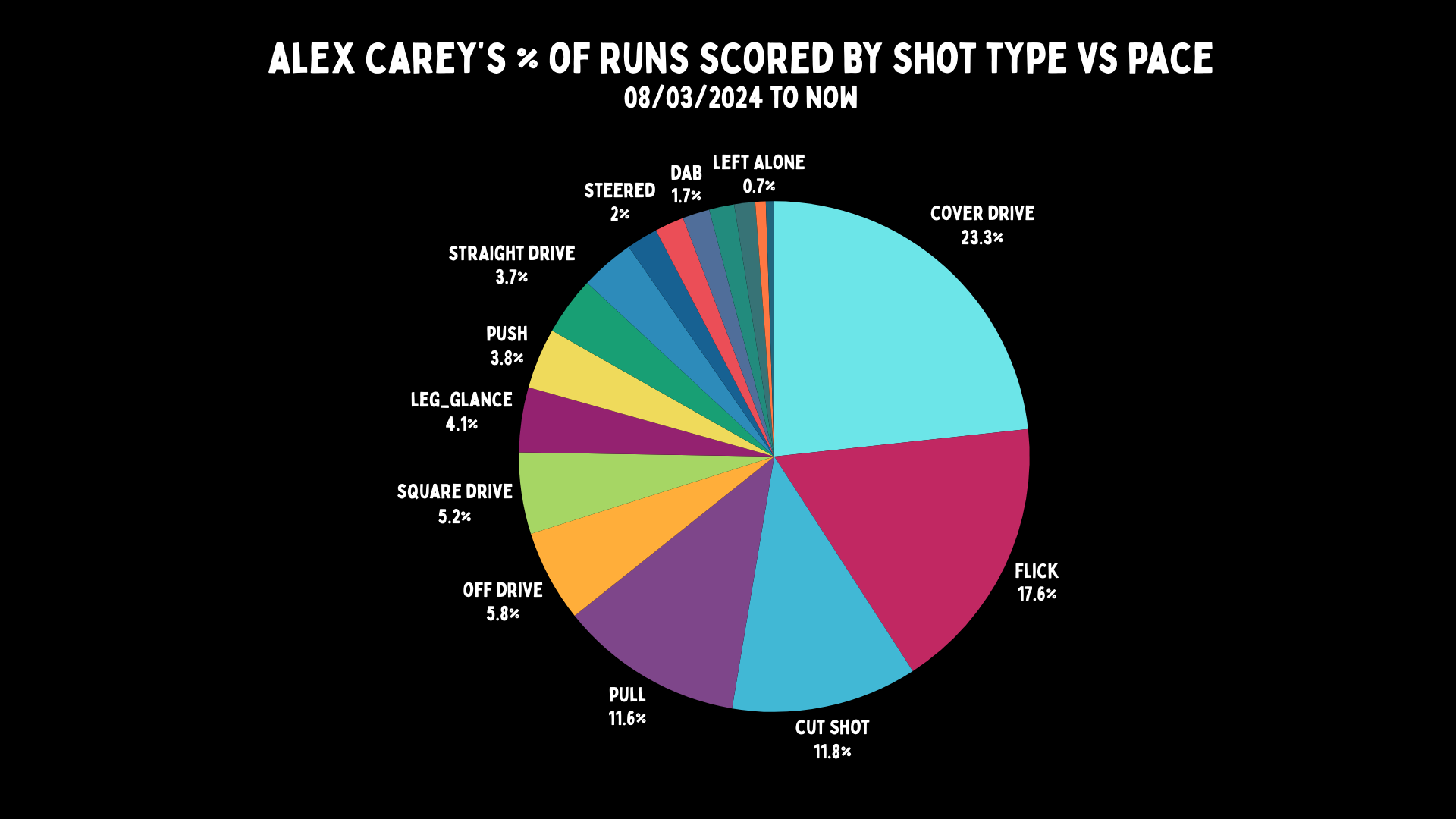
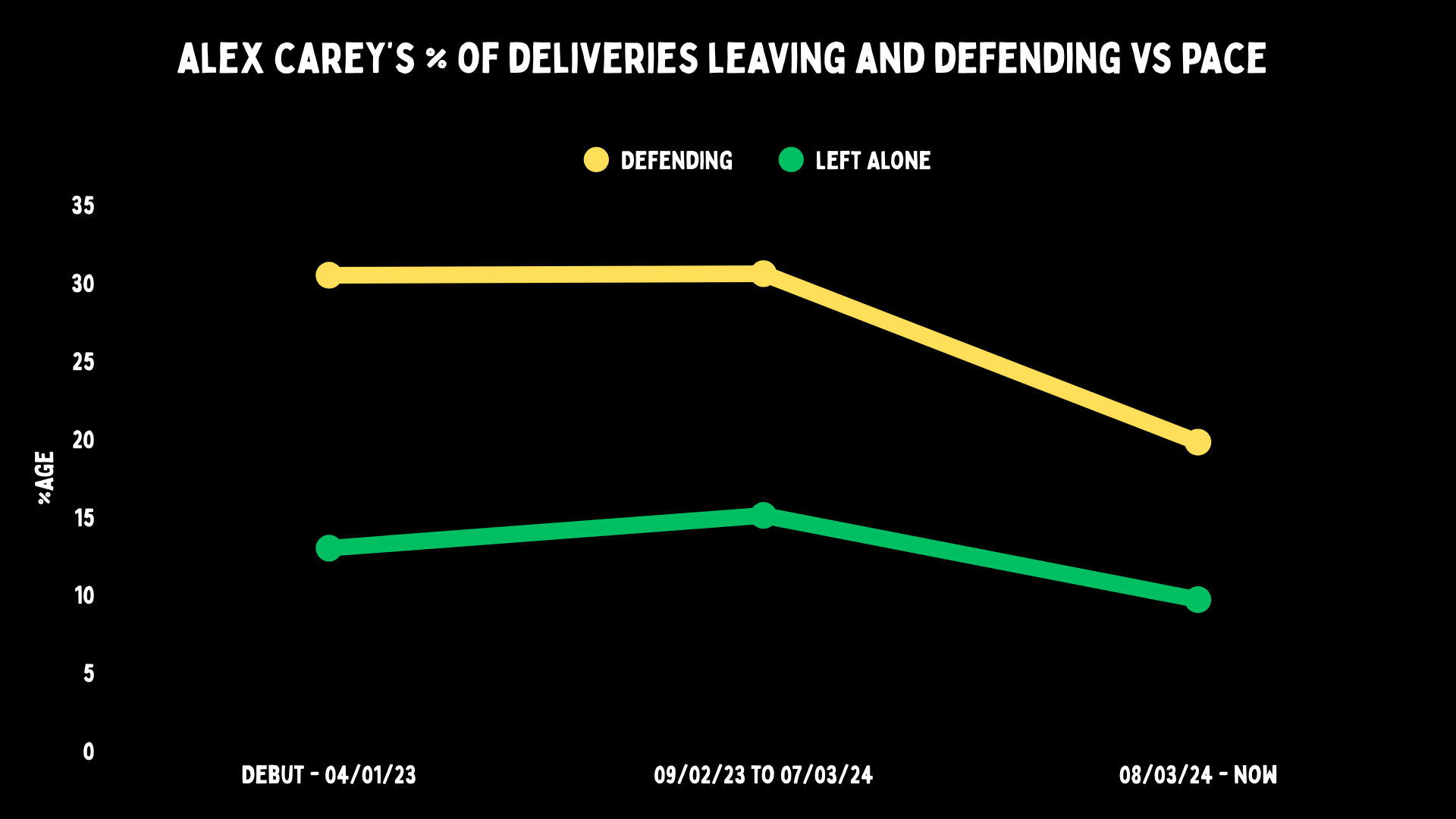
To prove that, he is making more mistakes when defending and leaving than he ever has. But by punishing more balls, the field isn’t there to pounce on his errors.
And he isn’t defending as much. He kind of has that ‘90s keeper energy, which is that they know their batting is not airtight, so they play their shots on the way out.
Carey has become a less controlled but more dangerous version of his early-career self against pace, while moving away from the temptation of compulsively reverse sweeping spinners. He is more of a moving threat against pace, and versus spin he has added new weapons.
***
And how he’s used his skills has been truly remarkable. If we were to list out all the times he has saved Australia, it would be longer than one of his cameos before the Karachi pool.
The new Carey emerged in Christchurch, when he stole a chase against the Kiwis. Australia really didn’t deserve to win that match, Carey did. In Galle, he was promoted to bat at five, and he dominated a partnership where the guy he was with was relegated to spectator. That player was Steve Smith, and the two of them won the match. A low-scoring match at Grenada was set up by Carey when he couldn’t stop scoring boundaries. No one else in the game could score runs at all. Even his 43 against South Africa in the WTC final was huge, being that Australia were 73/7 at one point. And when they lose the pink-ball Test at the Gabba, Carey makes a rapid 65 off 49 in the first innings when they are 54/5 in the 12th over.
Carey does feel like the press button in case of emergency for Australian batting right now. You can see the pattern; these are all counter-attacking knocks. His way to troubleshoot out of a tough situation is to fight fire with fire. Australia have been in trouble a lot, and Carey has been the man to help them almost every time.
His third Test hundred, on his homeground, follows a similar script. Australia win the toss and bat first, but Carey’s in to bat in the 25th over after the hosts gift England two wickets in quick succession. But what’s interesting is that even though he strikes in the mid-70s, he only hits eight fours and a six. So this is a bit like the Galle hundred, in that his running between the wickets was the highlight.
It is that eagerness that has always shone with him. He has the hustle of a keeper, with the boundaries of a hitter. And depending on what he needs, he is smart enough to often use the right option.
Because of this, Carey has become a ride or die player for Australia. He’s doing this in an era when their top-order has been made of flammable material - Steve Smith has been a surprise opener, and Cameron Green is still ‘in progress’.
When Australia’s top seven batters don’t make a lot of runs, he steps up. And he’s been in these situations more than 60% of the time. Him and Beau Webster have been cricketers and firefighters at the same time.
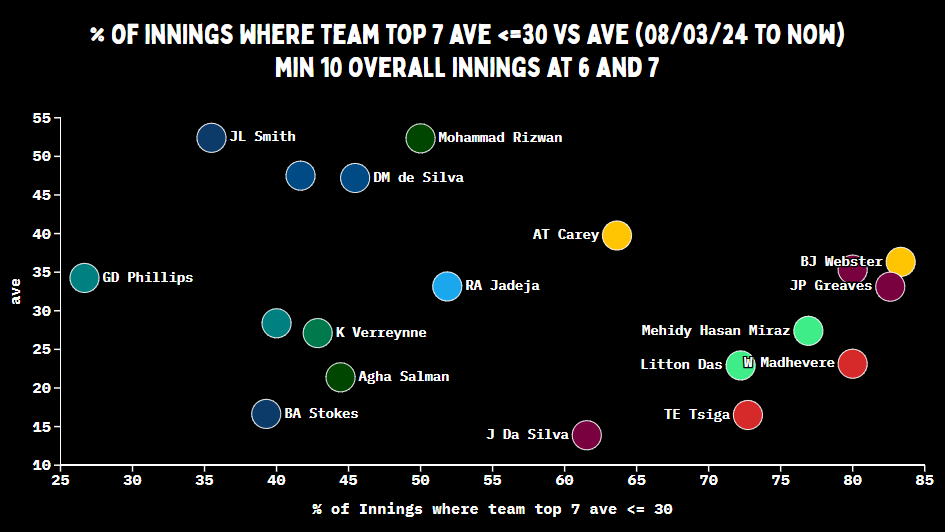
Carey is playing the Adam Gilchrist role, but instead of coming in with 200 on the board, it’s closer to 100. Game after game he arrives after a top-order stumble, and he’s holding them up so that the bowlers can win the games, like Haddin in 13/14 Ashes. It’s like Australian quicks only need one batter to be good.
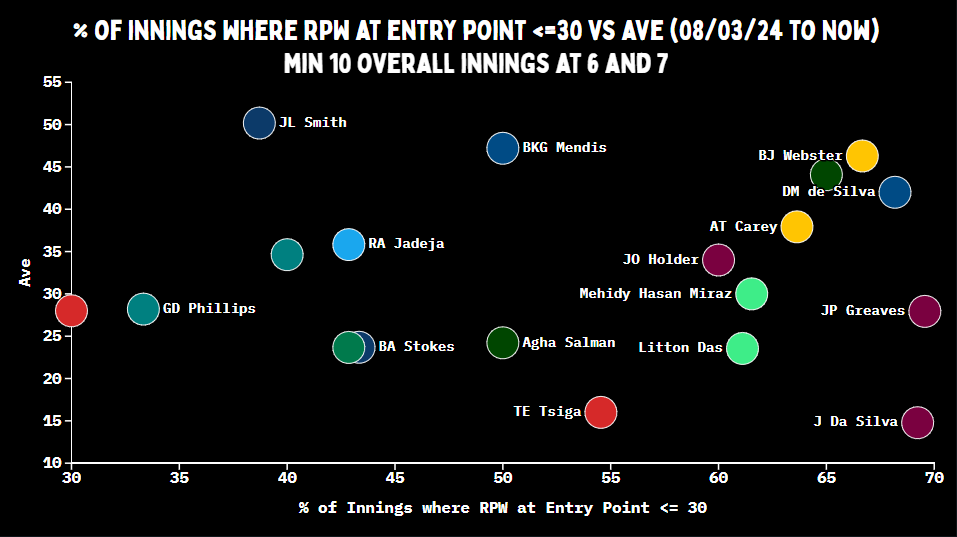
In low-scoring matches, Carey scores 45% quicker than his teammates. Otherwise, he’s just slightly above par. So when they shit the bed, he quickly changes the sheets, puts them in the wash, and then dries them before mum can find out.
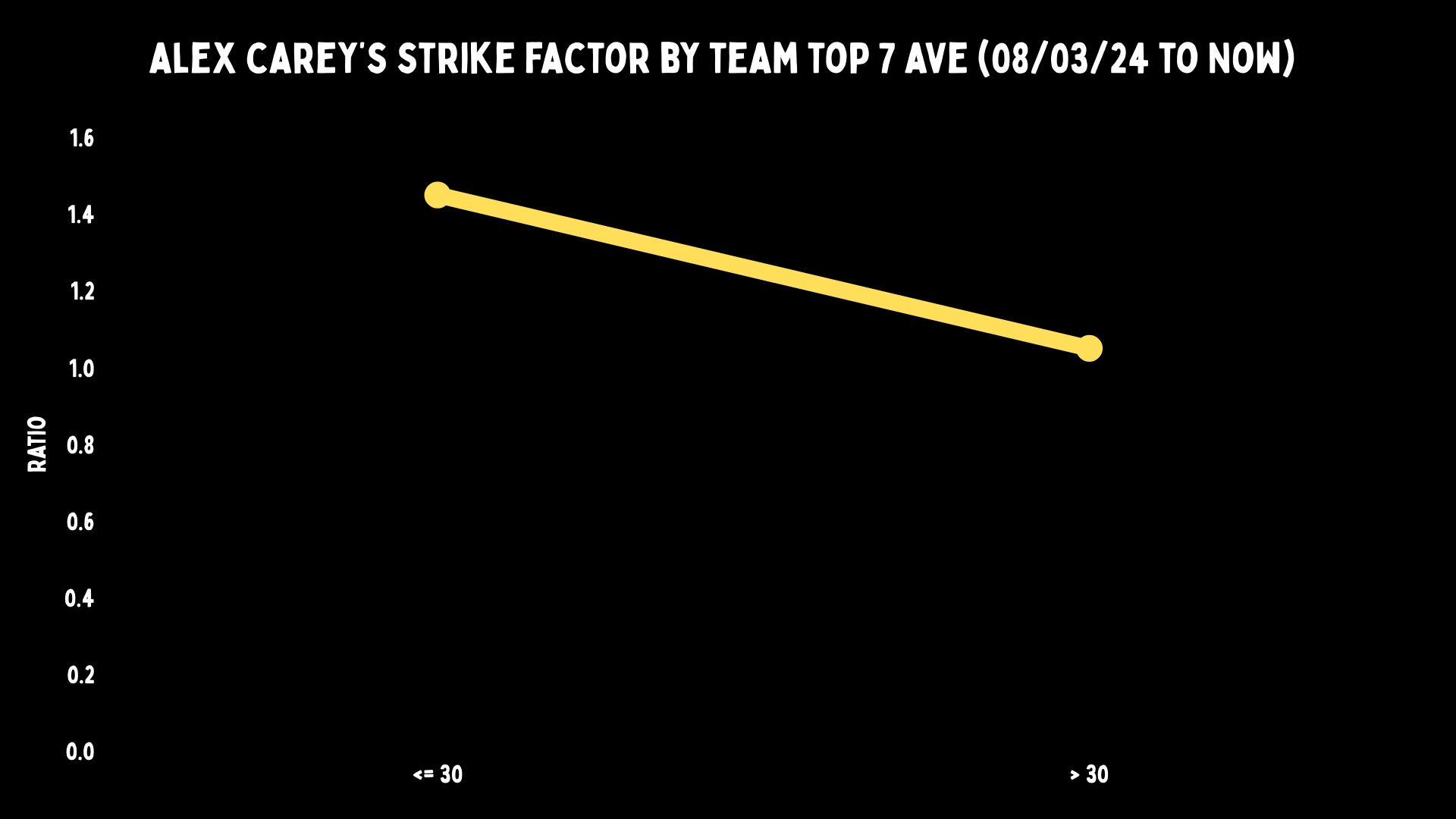
Carey has gone from a liability to one of the best crisis batters in the middle order right now. Whatever water they use in that Karachi pool, it certainly changed him.
But even in his best batting (and maybe keeping) series, he has accidentally found a way to be controversial.
The South Australian was batting on 72 when England appealed for a caught behind. The on-field umpire thought it was not out, so the visitors reviewed it. But Snicko made an error, and Carey would play on.
“I thought there was a bit of a feather or some sort of noise when it passed the bat. It looked a bit funny on the replay, didn’t it, with the noise coming early?” It was a genuine response from him, but with the history, it felt like a beautiful troll. Whether he meant it or not, he was fighting fire with fire.
But this time it was quickly forgotten, because his batting and keeping has been incredible. When it comes to Alex Carey, Stuart Broad might have gone early, as it might end up being this Ashes that he’ll be remembered for.
Great article, many thanks. However, he now has a new problem to solve as England have worked out how to catch his aerial flick at leg slip. I'd assume the shot is instinctive but he'll need to work out how to cut it out or keep it on the deck. Based on your analysis, I'd guess he will succeed. Do you agree?