


Steve Smith has PTSD from camera flashes.
When the Australian captain comes into the press conference to admit to Sandpapergate, it sounds like machine-gun repetition. And since then, Smith told Code Sports that the sound of this triggers him. Not only that, he no longer likes cameras.
There are hundreds of thousands, maybe millions, of photos of Steven Devereux Smith.
Australia cheated, as many cricket teams had before, but did so in a way that went beyond sport, and entered culture. Smith became a global pariah. The face of cheating. And every photo of him came with a shutter click and since then he’s had literal flashbacks.
This is a team that has lived through an era of weirdness together. They have scars, from sandpaper and beyond.
Many have come of age at the same time. Travis Head and Marnus Labuschagne are 32, and at the young end of the core group, while Nathan Lyon is 38. In between them are seven more players. Australia has a team of mid-thirties players, with the wounds and wisdom that come with that.
Coach Andrew McDonald has talked about needing to address Australia’s “age profile”.
Australian fans are already looking to the next generation, but the brain trust of this system seems to have decided on one last dance. A magical year where they have to play every other great side, and have the chance at two major ICC trophies.
This generation has won a couple of World Cups and a WTC. But it doesn’t feel like enough. They are at least one WTC short. And they haven’t won an Ashes in the UK, or a BGT away. This is a team that is competing with the ghosts of Australia’s past. They want all the glory, not some of it.
But there are creaks and groans, because hips are not as solid. Just For Men darkens some hair, others show their grey. The physio team may need to be doubled. Steve Smith started this series worried about mental issues, and by the end, it was physical.
This year was always going to be one last job before retirement. Their heist has begun, but so far, nothing has gone to plan.
***
Pat Cummins is fast.
And it has been a long time since anyone has said that. At Durban for the first Test, it is noticeable that his speeds are up there with Mitch Starc and Anrich Nortje. He has not been at this level for quite a while.
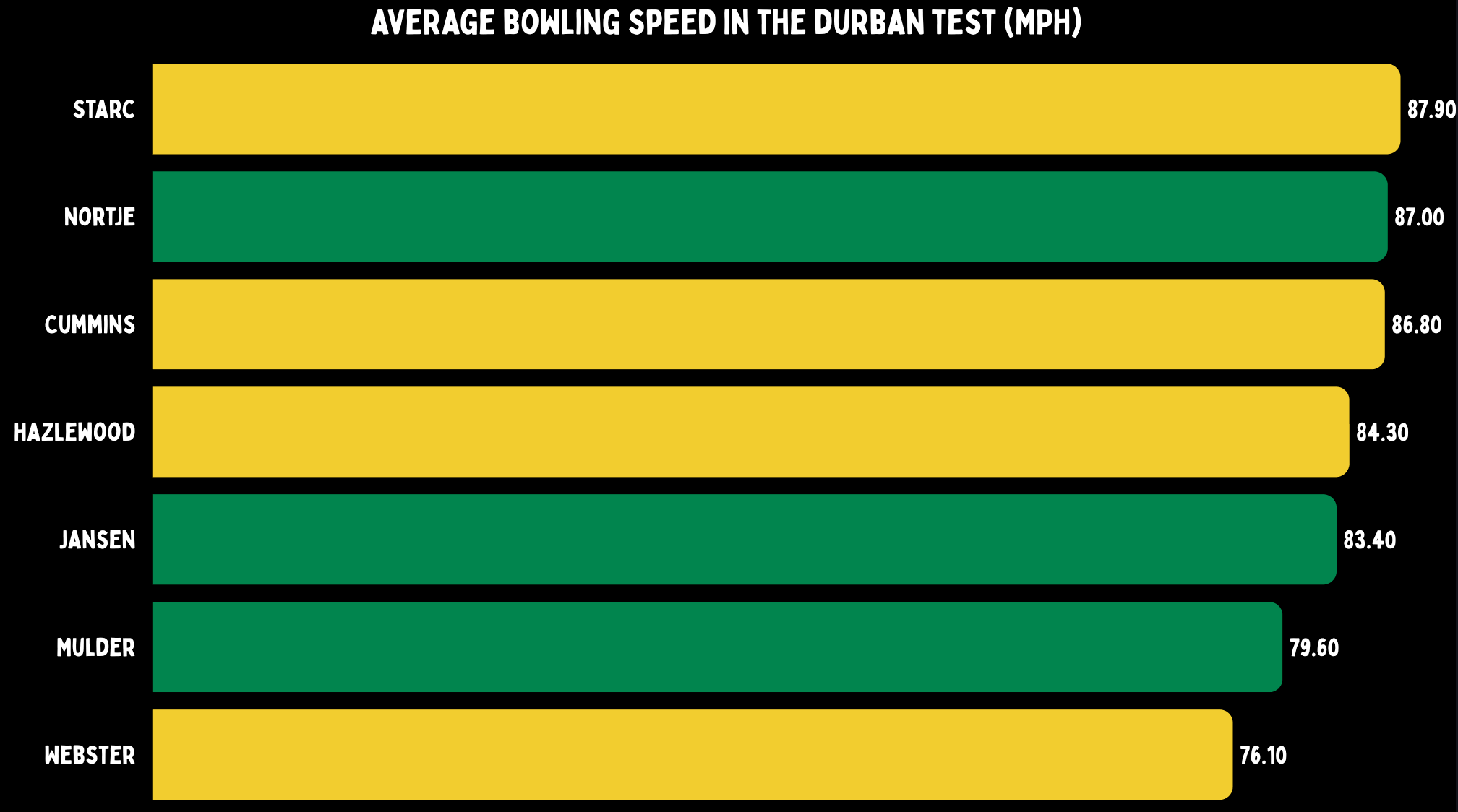
Before the series, he admitted this was the first time he’s felt fully fit in years. Pat Cummins is a collection of scar tissue, and a missing tip of his finger from when he was a child.
Cummins’ back has probably been MRI’d more than he’s taken Test wickets. He’s also had lots of heel issues, and hip as well. At one stage, his wrist went. Like all quicks, he’s done a side muscle too. And his ankle has little structural integrity. That’s finger, back, heel, side, hip, wrist and ankle. Pat Cummins’ existence as a bowler is a miracle of modern science.
So to see him flying in at Durban, it felt like something special, the lesser-spotted Pat Cummins fast bowler. In the second innings, he took Tristan Stubbs, picking up his fourth victim of the match, helping set up the victory for Australia.
He then delivered 372 balls without a wicket. That is not one of the worst runs ever; in fact, it doesn’t even make the top list. But most of these bowlers don’t average under 23 in Tests.
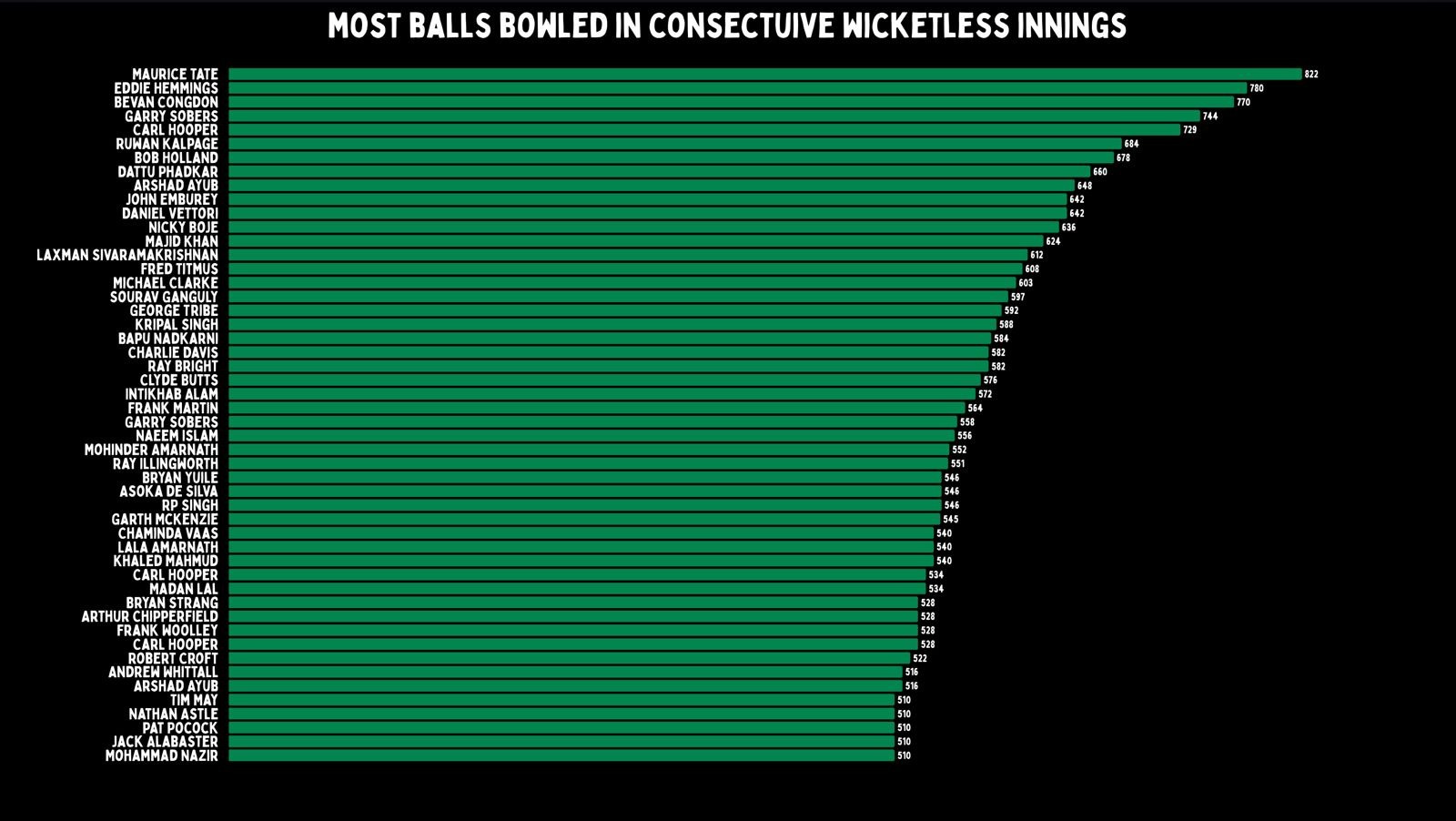
For a moment, it looked like Australia had Starc at his best, and Cummins fully fit. But the old grey mare ain’t what she used to be, and soon, Cummins was back to mid-130s.
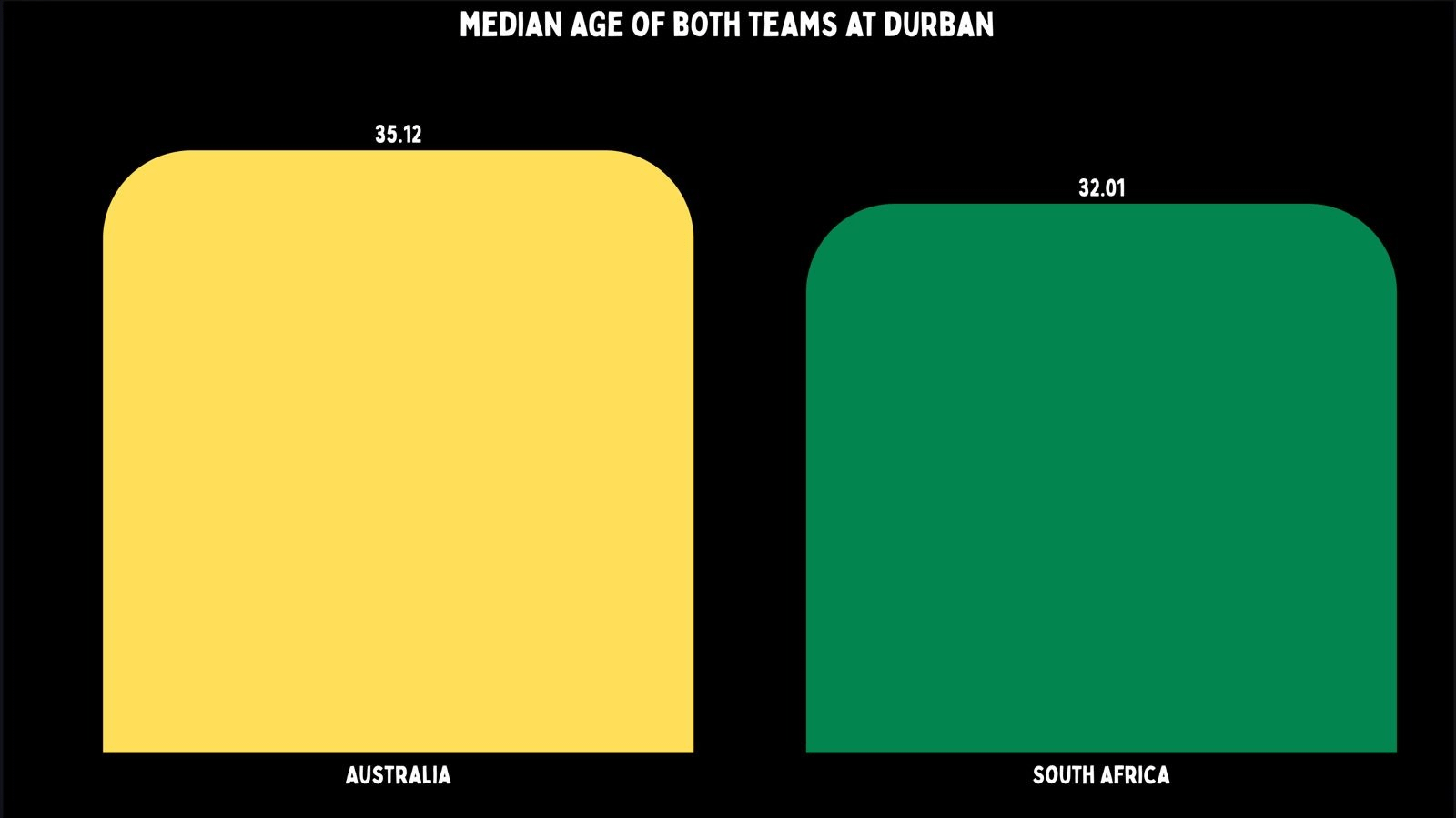
Australia won that Test on the back of Matt Renshaw, a rare younger player in a team where the median age is 35. There was a timeline where the Queenslander was part of this generation; instead, he’s spent most of his time watching them.
This team has not been keen for fresh meat; in fact, they chose Nic Maddinson from the cancer ward before this series. But Renshaw was so good with bat, and shockingly, ball, that he changed the match.
Australia needed it, because they were nowhere near their best: Starc, Head and Smith had little to do with the result. It isn’t often you win a Test by more than 200 runs and still use eight bowlers.
This was a good result for Australia, but it was a terrible match by the Kagiso Rabada-less South Africans.
This was supposed to be a fiery match; the fans were bringing sandpaper, and the hosts were going to show why they won the World Test Championship. In the end, it was a yawn, as the old professionals ground out an easy win.
The WTC final loss at Lord’s hurt the Australians. They thought they were the better side. They were ahead in the game until Lungi Ngidi’s spell. Even after, they never thought South Africa could chase. And to be fair, they had nothing but evidence to back that up.
Coming to South Africa, picking Maddinson as their opener to ragebait every former cricketer with social media and then losing would have been too much. But they won, and easily, despite being 121/6 in the first dig.
It felt like coming home for this team. Sure, there are questions over batting and selections, but this side hadn’t lost a series in a long time. This was them remembering that. And they enjoyed it. The comeback, a new guy making runs, and on the last day, they ended South Africa’s innings with reverse swing. Which considering Sandpapergate, was pretty funny.
1-0, and closure. Love it when a plan comes together.
For the next match they played their shots off the field, dropping Nathan Lyon for Scott Boland. This started on the West Indies tour, but it continued into the Ashes. Lyon is a proud man with an ironic nickname that he’s bowled into reality. Of all the Australian players he is the oldest, and looks it. He never truly looked young; he was born a 30-year-old. But the facial hair is grey, and so is what’s left of his hair. His face is aging faster than his teammates.
Lyon would be annoyed if he was dropped for Matt Kuhnemann and Todd Murphy, but he might understand Australia’s push for youth. He’s not just grumpy about missing Tests, he’s fighting for his craft. Lyon isn’t being replaced; his position has been downsized to part-time. A specialist, so part of the gang, but only needed for bank vault jobs.
When there is no role, he is out of the team, and spends lots of time telling microphones that he does not like it.
Compare that to Keshav Maharaj who also lost his spot. He’s been nearly as automatic as Lyon, though not for as long. He’s also a major piece in the leadership structure, being a vice-captain of the ODI team. Yet, we heard almost nothing from him about it. He understood that Harmer’s use against the left-handers was higher, and that was it.
Ubuntu is a Zulu word that basically means, “I am because We are”. This South African team have that, the whole is more important than the parts.
Australian cricket has always been built on something similar. In most countries, cricket leans towards an individual sport with a team aspect; in Australia, it’s badge first. But even then, as an Australian official told me once, Aussie cricketers play their first ten Tests for their country, and the rest are theirs.
Nathan Lyon’s ego screams when he’s left out.
An aging team, by definition, has other things on their minds. Children, mortgages, investments, injuries and when they plan on launching their podcast. For this to work, the team need to come together for one last go, where the we is more than the me. At 20 when you think playing for your country is like going to war, that works fine. But in your late 30s, a person has to build this up and buy in.
That is not to say Lyon hasn’t, but that every single player, with the coaches and selectors needs to be on the same page.
Under Pat Cummins, they have really shared a common pragmatic approach. Throw in coach Andrew McDonald and head of selectors George Bailey, and there is a three-headed business consultancy vibe. These masterminds looked at the schedule and decided against blooding younger players, and instead went with their major attribute, age and experience.
That seemed fine after two days in the second Test at Gqeberha; they couldn’t lose the series. The old guard had come together, with some weather help. South Africa were 97/5 over two waterlogged days. A draw, which was the most likely result, was unfolding without them really doing anything. One win, one draw. The veterans followed their blueprint.
All they had to do was stick with the plan.
Temba Bavuma wasn’t pushing on with the strike rate, and outside of a self-appointed attack from Marco Jansen, South Africa seemed completely oblivious to how much time they’d lost. The Australians, led by Cummins (according to Simon Harmer on the Grade Cricketer), told Bavuma as much. They believed South Africa was batting to where there was only one option in the match, a draw, ensuring Australia couldn’t lose the series.
There was even some truth in it: South Africa batted so long they only had four overs at the openers. But they still took a wicket. On the following day, they added 13 more, as Australia were bowled out for 99.
The tourists had the rain, and South Africa’s long innings, and still only just limped to drinks on day five before falling apart.
This was the only time they set the Boland Bomb in the series; he delivered, the rest didn’t.
Perhaps the most embarrassing thing was that this was not the worst loss in this run of Tests.
In Darwin they finally allowed Bangladesh to play in their country; they then won the toss and elected to collapse to Hasan Mahmud. Their bowlers got nowhere near the amount of movement as Bangladesh’s batting went past 400. Which they have not done since.
That was a disaster of PR, the team they refused to play because ‘they weren’t good enough’, owning them. But in cricket terms, it was at least the first Test at the start of this epic run. The Australian team, like an elderly man getting out of bed in the morning, just needed to stretch and have a couple of stiff coffees and then they’d be fine.
But the loss to Bangladesh, when paired with Nic Maddinson’s selection and this collapse in Gqeberha, was starting to look less like Australia were a bowling team. And more like they were ONLY bowling. In both of those matches, the seamers didn’t step up as a unit, and the rest of the team was almost legless.
Scott Boland being sent out as a nightwatch twice in a day does not project the image of thorough professionalism and winning edge that this team wants to show.
Now it was 1-1, and 2-2 in the last four matches to start this colossal 20-Test period.
In Robert Burns’s poem ‘To a Mouse’ he writes,
“In proving foresight may be vain:
The best laid schemes o’ Mice an’ Men
Gang aft agley,
An’ lea’e us nought but grief an’ pain”
It is more commonly spoken as “the best-laid plans of mice and men often go awry”. But Burns meant it as: a mouse has no past, only the present. Whereas with humans, we tend to look back.
Athletes at their best are like the mouse: they are brilliant at living in the moment. Their entire lives are reacting to things going wrong. Do you know how many times Scott Boland had to fail and lose before any of us ever heard his name? Alex Carey was a footnote of a football club that barely existed. And Cameron Green has lived a career and a half before turning 30.
But over enough time, there are so many losses, they become hard to forget. And a lifetime of umpire’s calls, dropped catches, phantom noises, painful runouts adds up. If you stare at an old athlete, you can see the trauma. They want to be the mouse, but they become the man.
And when you near the end, you know every missed chance may not come back around. The Australian team’s inner mouse is gone.
For Cape Town, Nic Maddinson was flying home, Beau Webster had been replaced by Cooper Connolly, and Scott Boland was reawarded with a rest for being Australia’s dominant bowler and second-best bat. It felt like the crew was falling apart.
Three changes doesn’t scream we know what we’re doing. But it wasn’t really one selection that made you look up, but more the combination of dropping Boland to reselect Lyon, then bowling first.
At lunch on day one, it looked like a horrendous decision, but smart planning and patience brought them back, before Mitch Starc and the magic second new ball ended South Africa.
Australia then opened the batting with their two number fives and went about handling South Africa’s attack. When Josh Inglis and Alex Carey handled the second new ball, Australia were, according to the market, an 80% chance of winning the game. They were nearly the same when Aiden Markram drove a catch to mid-off. And when Matthew Breetzke added one more false pull shot to South Africa’s pile, it was 80% again.
The vault door was ajar; all they had to do was push.
For the third time in the series, Australia were massively in front. If their quartet finish the innings, series secured. They did not.
The blood seemed to drain from the attack, and all South Africa had to do was stop playing pull shots and handle Lyon out of the rough well. Then Australia’s bowlers had no idea what to do. Starc was the only one with energy and verve. With the wobbleball toothless on this pitch, Cummins went to the short ball but couldn’t get the ball up. Hazlewood looked like he was still sick from the previous Test. And Lyon was often replaced by Matt Renshaw, which is perhaps worse than being dropped.
This is a bowling group where they are patient, and also rarely have to be. They will sit in and wait for the mistake, and for one partnership, South Africa didn’t make any. Australia were essentially bowling for run outs, and that’s how they closed.
This attack looked like a dog that knew the bowl was full, but the trip there was too far.
But there were theoretically plenty of chances for the Australian team to win, or even draw the match. Plan A was the two left-handers to keep Simon Harmer from attacking the footmarks to the righties. That ended through a poor Rabada ball.
Then it was the Marnus Labuschagne redemption arc. Like the boxer who keeps getting punched in the head, his trainers pushed him out there telling him this was the time he’d come good. Labuschagne rode his horse straight into the last chance saloon, but sadly for him, his steed bolted straight through the back and ended up stuck in pig shit.
Plan C was TravBall. But a lazy drive ended that.
They followed that by Green desperate to get off strike by any means necessary, which ended in a Josh Inglis run out.
Plan E was a counter-attack from either of their two middle-order southpaws, both failed almost instantly.
So they were down to the final idea. Go for the draw early by each player choosing an end to bat from. They sent in Starc to face Harmer, the best offspinner (and maybe any kind) in the world, while Green faced seamers on a flat pitch at the other end.
If you are keeping up, this was Plan F. And that is exactly what it was.
Starc was out to Harmer, and eventually Green would be too. Australia passed only 100 thanks to Cummins and Lyon’s batting, which looked very easy, considering the score.
South Africa won the series 2-1; Australia’s beginning of their last job before retirement now read 2-3.
To SuperSport after play, Cummins said he was relatively happy with how Australia played.

And you can see why, coming to South Africa and giving yourself a genuine chance to win is a positive. Playing good enough cricket to be in front in all three Tests shows good signs. There are positives to take. But being in a position where you should not have lost the series and you did, after being so incredibly in front in all three matches, is also bad. So there are negatives to take.
Even if the team is happy with how they played, the WTC final is further away. No one loves it when a plan does not come together.
***
Steve Smith gets a bouncer from Anrich Nortje on his fourth delivery for Australia’s second innings at Durban. He drops his head early, but also jumps off the ground. Meaning his head is in the way. The ball strikes the helmet and they jog for a leg bye.
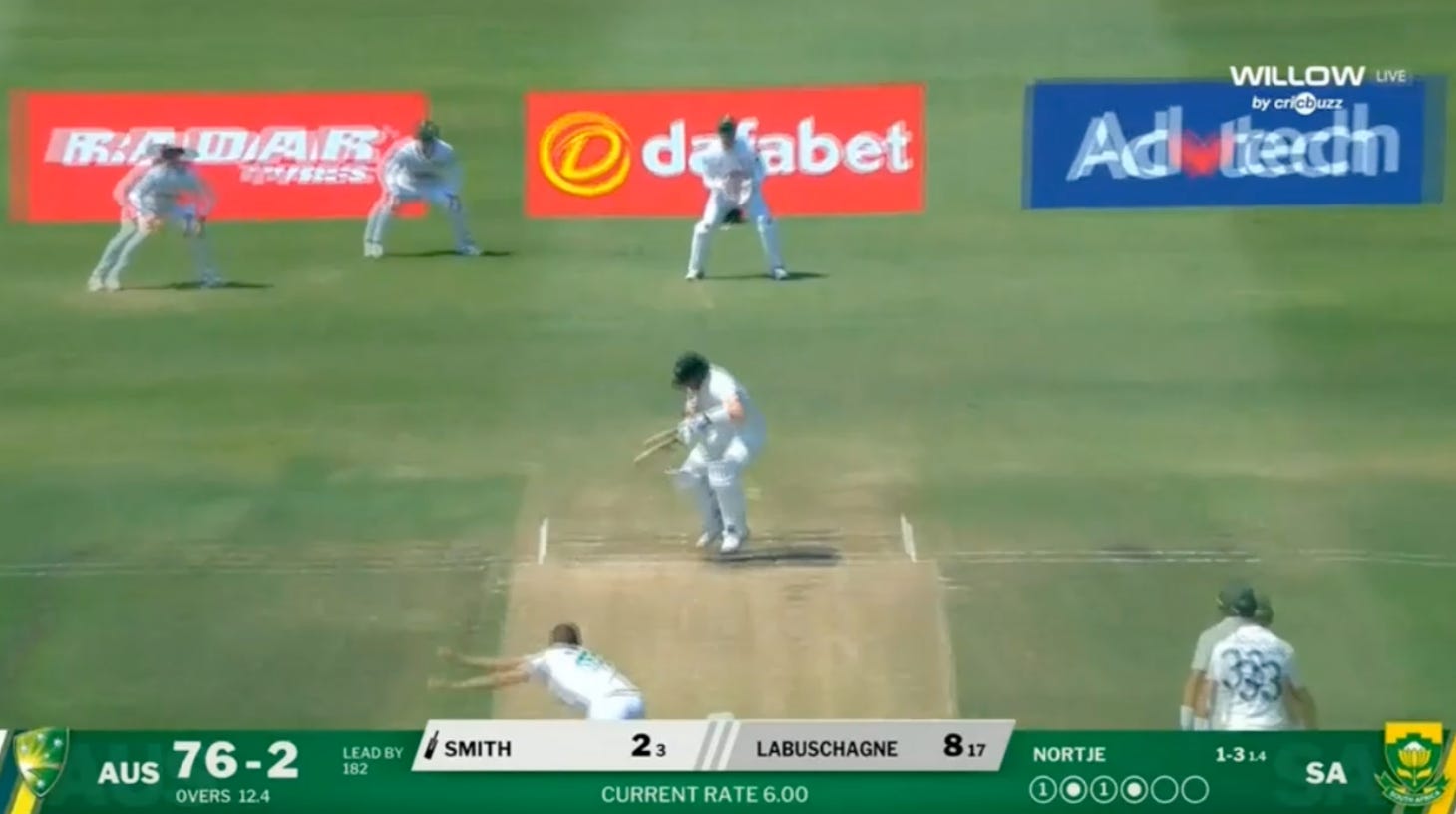
The physio comes out, and Smith is cleared to keep batting.
A few overs later Nortje is standing mid pitch, scrunching his face up. Smith has just played an offside slog. A swipe, a slash, a swipe slash. It’s not a Smith shot and he ends up with the back of the bat pointing towards the bowler.
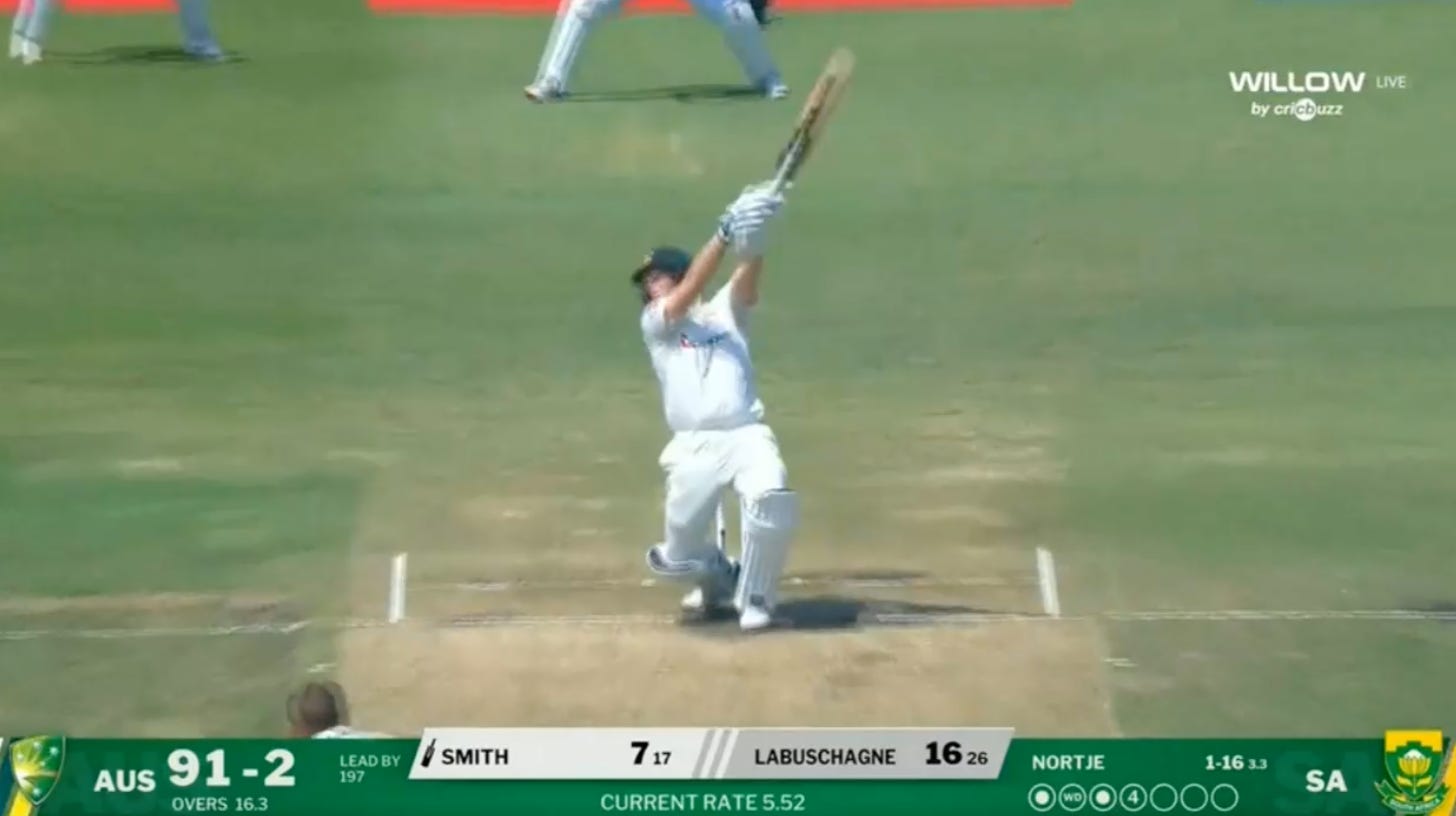
In 2019, after the Jofra Archer hit on the head, Smith also didn’t show immediate signs of a concussion, but then batted in a strange way. This time, it was less so, but again, there was a mania in his strokeplay. He would eventually be caught on the long on boundary, trying to hit the ball over Marco Jansen’s head, having only just cleared him a moment earlier. It just didn’t feel like classic Smith.
In the first innings, he was struck on the hand by Marco Jansen, then the following ball was out.
At Gqeberha, Smith is wearing reflective tape under his eyes to help his vision. He became one of the greatest to ever bat without this. But now he needs all the help he can get.
Another good short delivery from Nortje has him playing without watching the ball.
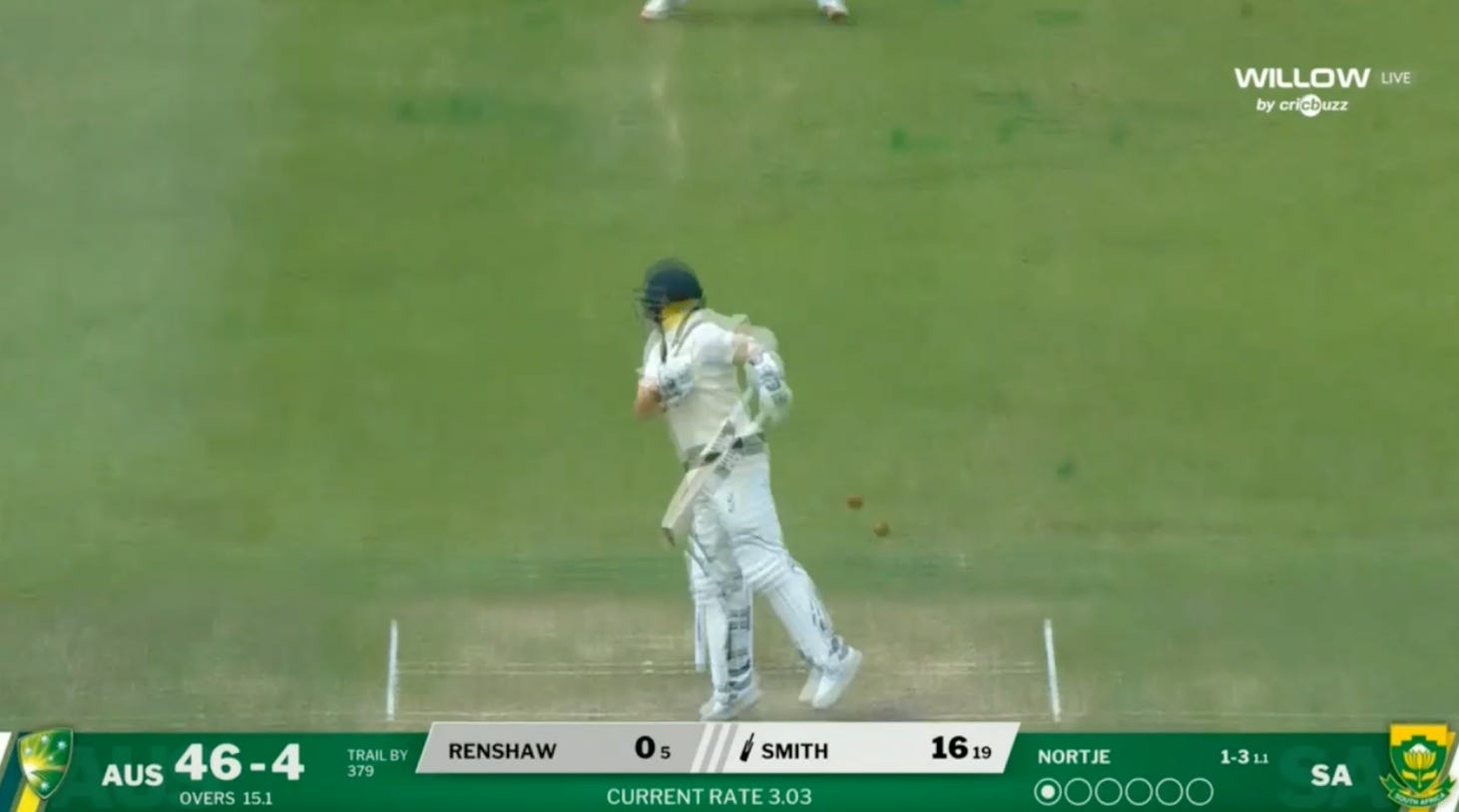
Later in his innings, he starts standing weirdly on the legside of the ball. His front foot looks almost painted in the wrong place.
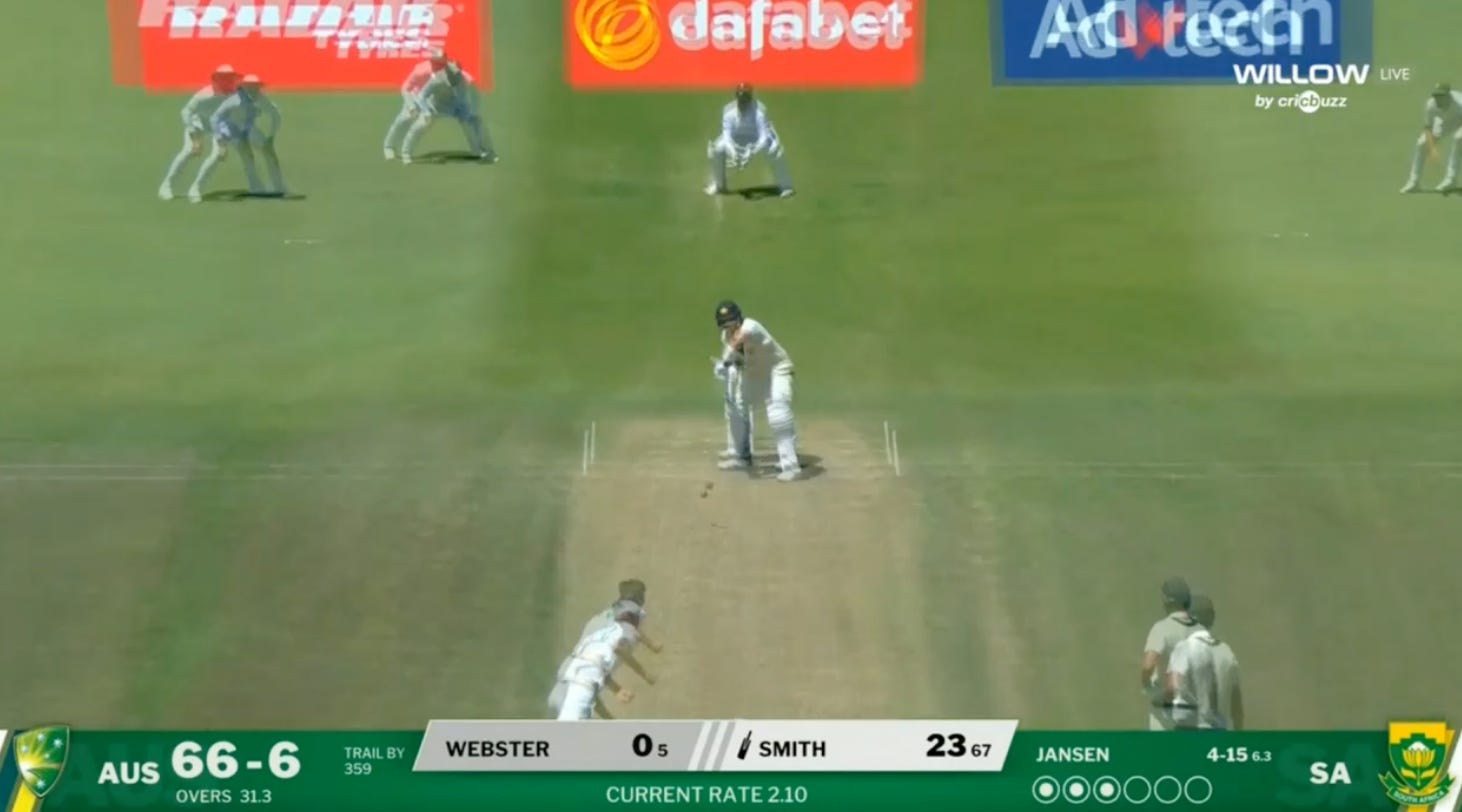
Eventually, he will be outside the leg stump entirely playing the ball through the offside.
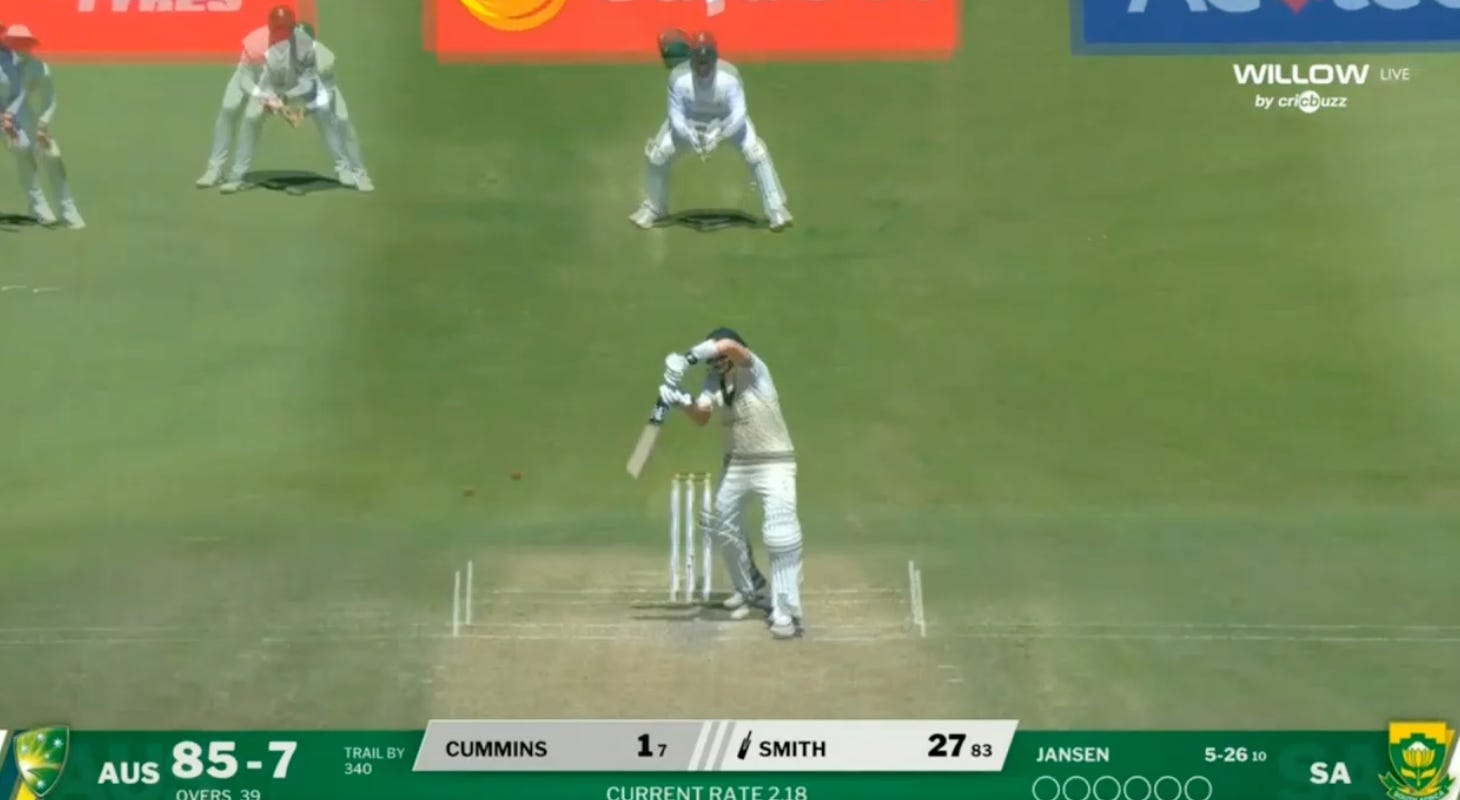
Shortly after, the physio starts manipulating his neck. Smith is being operated like a Muppet, his neck is being bent over to check for structural integrity. His movements from here on in are strained, and eventually a Wiaan Mulder delivery takes him.
In the second innings, he is greeted to the crease with a surprising Wiaan Mulder bouncer, after his injury means he has to come in at number seven.
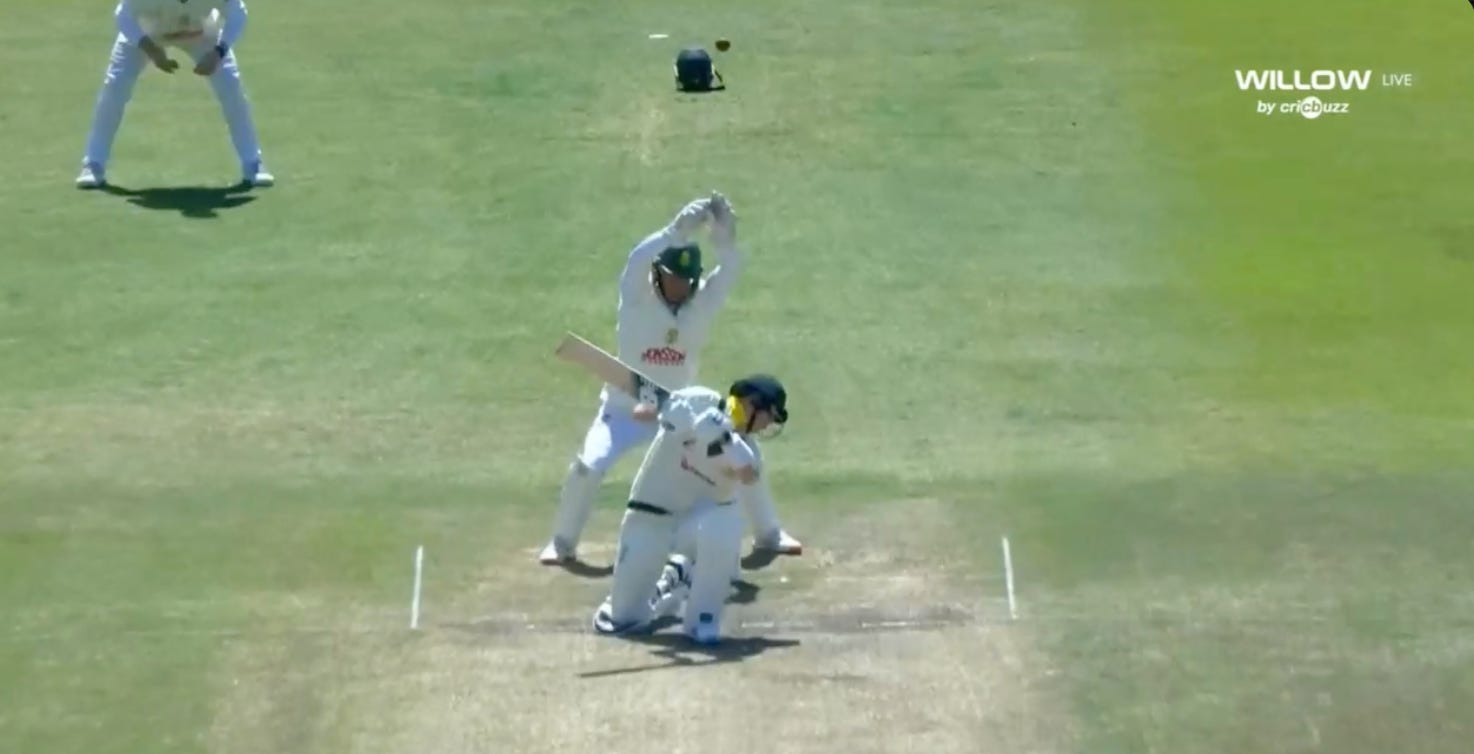
Australia are batting for a draw, Smith is three from 20 when Kagiso Rabada drops one short. He pulls it straight up and is gone.
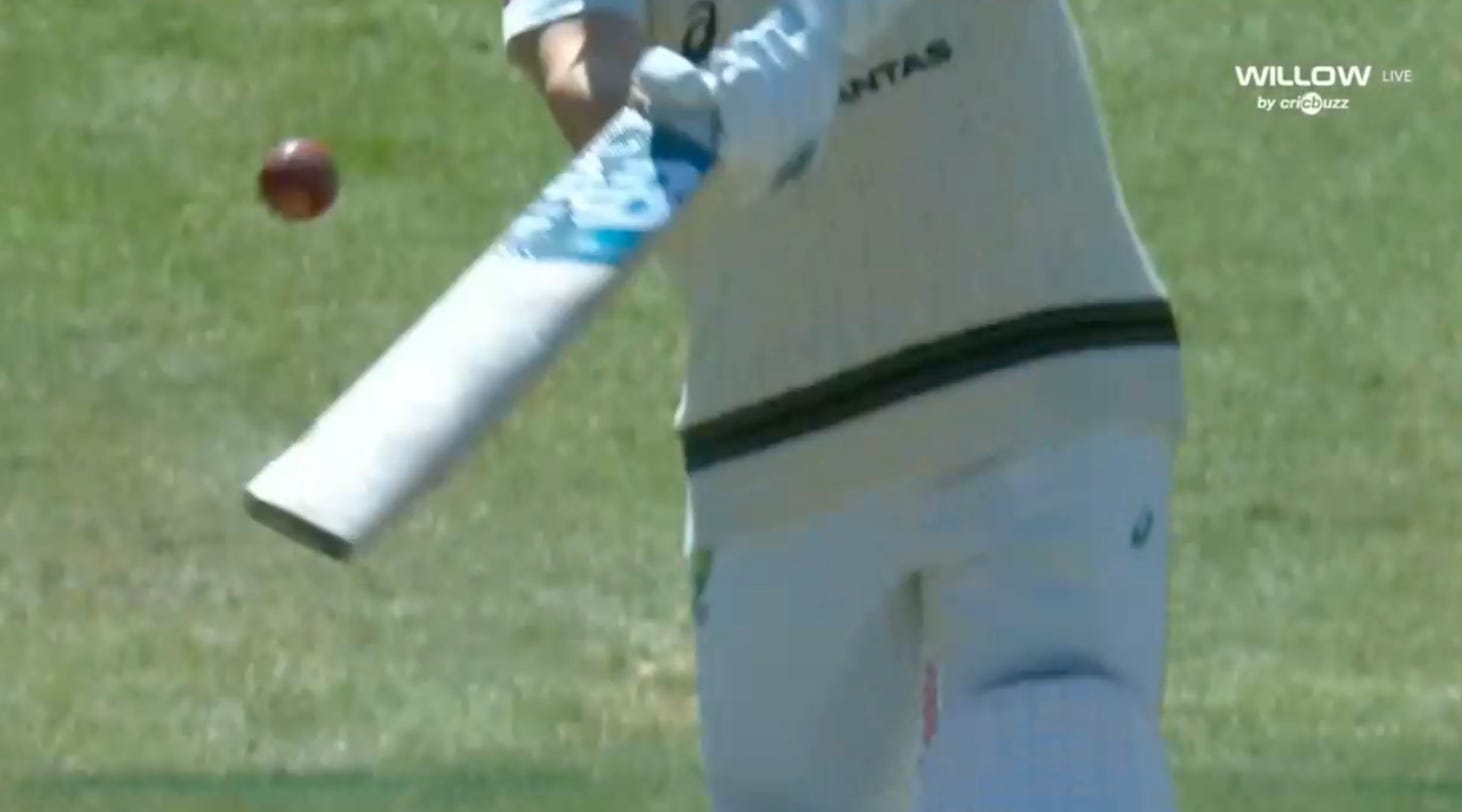
For the third Test, Smith’s neck keeps him out. SEN discuss whether the Australian camp is happy he’s not made himself available. To stop the rumours, Cricket Australia release further information of an MRI on day two, “Steve Smith developed neck pain on Day 4 of the second Test in Gqeberha last week. Subsequent MRI imaging confirmed a cervical facet joint injury. Due to this and his limited range of motion, he was unfit to participate in the current Test.”
Smith is not the player of 2019; the short ball affects him in many ways. His body is not what it once was, his eyes need help, his neck the same. That is what happens when you age.
This is an old team. There is lots of scar tissue.