


Cam Green and Josh Inglis have a shared psychosis.
Simon Harmer is bowling into the venomous pit of hell known as the footmarks, and Australia are playing it like invisible laser sharks are jumping at them. Inglis launches a reverse sweep first ball, which he misses by a yard. He is playing at a delivery that is not there. A psychological reaction to his own terror.
Soon after, Marques Ackerman fumbles at silly point. It is a South African mistake. He reads the ball off Green’s bat, and goes to his right, before it spins off the Newlands surface and darts left.
Instantly, as if there were some form of telepathy, Green and Inglis take off. They see a run where no one does. Two men have decided something exists when it simply doesn’t. It is a ghost, a phantom, or shared psychosis.
They have somehow ended up with a delusional disorder, where two seemingly healthy human beings now both believe in this chimaera of their own making. Both are of one mind.
The French call this shared psychosis a folie à deux.
The Australians call it a run out.
***
Matt Renshaw was strangled down the legside.
That is the right term. But South Africa hadn’t laid a trap. It was a terrible ball, fired past the pads from Kagiso Rabada. No one is planning this; it’s when you get it wrong.
Ryan Rickelton is off to save the byes, and Renshaw is trying to reach the ball. Usually, that is what happens. The keeper scrambles, the bowler holds his hand up, and the batter is annoyed he couldn’t get something on it to pick up free runs.
Renshaw is not the most important wicket; his partner Travis Head is.
But this is a day when left-handers matter, because offspinner Simon Harmer can poison the well with evil footmarks. Also, Renshaw plays the offie well. He can bat all day, rotate the strike; he could be the perfect player on this wicket.
This is not that day. Instead, he finds the edge, and that finds the keeper. Australia had plans and theories. They would have talked about mental resilience and war-like energy. And their first wicket is a mistaken yawn.
Marnus Labuschagne charges down the stairs. He is a man on a near-literal mission. He barely notices Renshaw; this is more than just winning the game for him, this is his livelihood. A failure here will count quadruple.
On the journey out, he stops at the boundary Toblerone, squats for a few seconds. This is it, he is ready, visualising, having a moment of reflection, whatever it is. This is his time.
When he gets a full toss, he smashes it to the boundary. Sure, it is not where he was aiming it, but he’s off. Then he has one final delivery to handle from Rabada.
It’s outside off stump. Labuschagne sees a ball that cannot hit the stumps. This is the fifth day; the ball has barely seamed once in that time. He lifts his bat confidently, knowing this delivery will pass a long way from danger. But it doesn’t. And potentially the last thing Labuschagne is going to do in Test cricket for a long time is hold his bat high, and be given out LBW.
Kagiso Rabada is back, Marnus Labuschagne is gone, maybe forever.
On day two, the South African great was spraying the ball everywhere, and then off the field (with his illness) doing the same thing. At one point, he bowled with what looked like a bloated belly that small children get when they are sick.
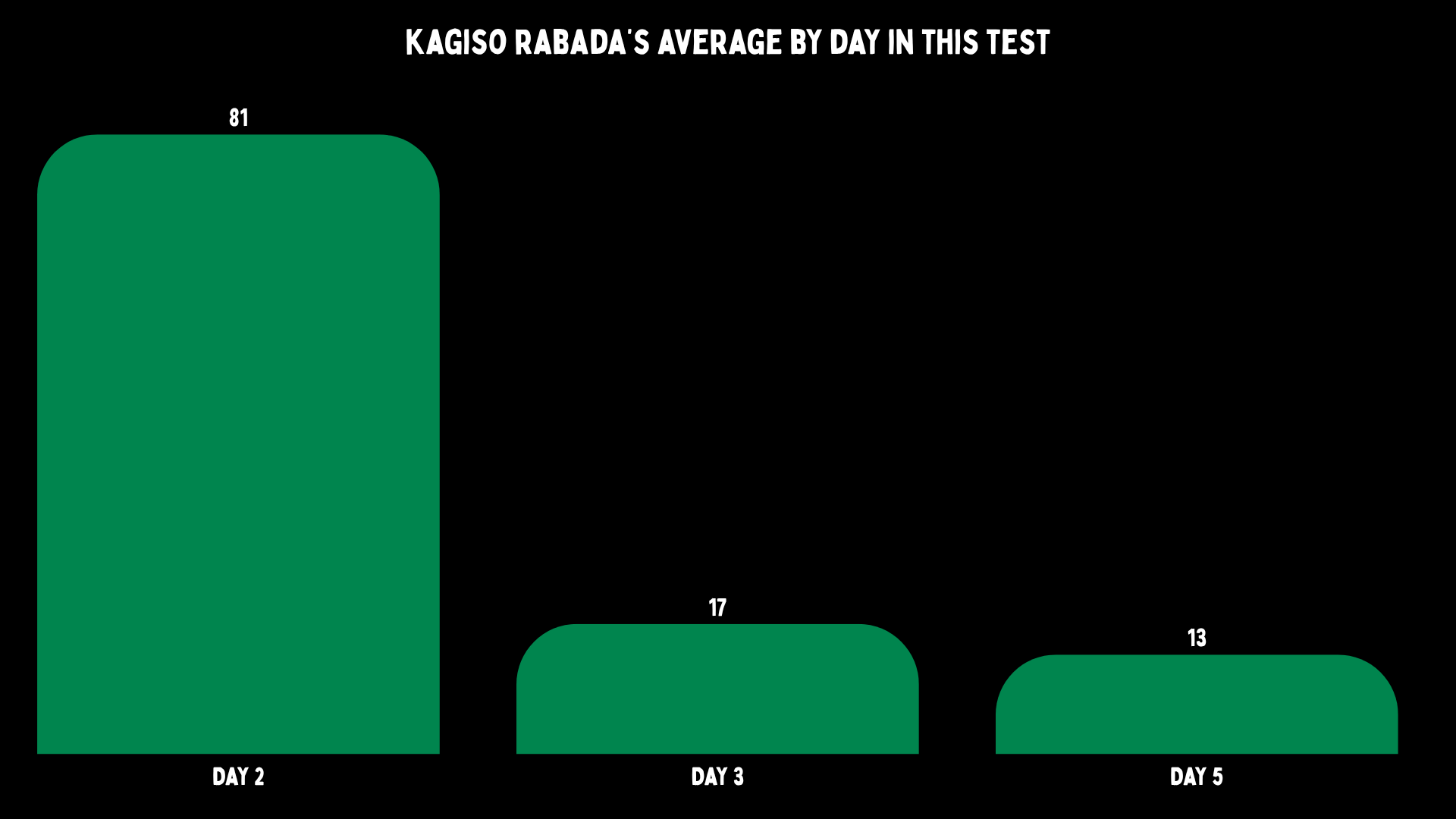
That version of him is a ghost. Rabada is changing the surface with his presence, and is bowling to Head - the best flayer of express bowling in the world. This is the final boss showdown we were promised. It’s one-all, day five, series and legacies on the line.
A ball flies past the Aussie edge, and both men share a glance.
Rabada is bowling fresh, with a brand new ball, in the morning. All huge advantages, and Rabada beats the bat constantly. Even on the first few days, we never saw that many balls moving around. Australia didn’t beat the bat this much in two sessions on day four.
Head sees Rabada is on, so when there is a full wide one, he effortlessly times it to deep point, and the fielder on the rope gives up almost immediately. The Head South Africa have feared has arrived.
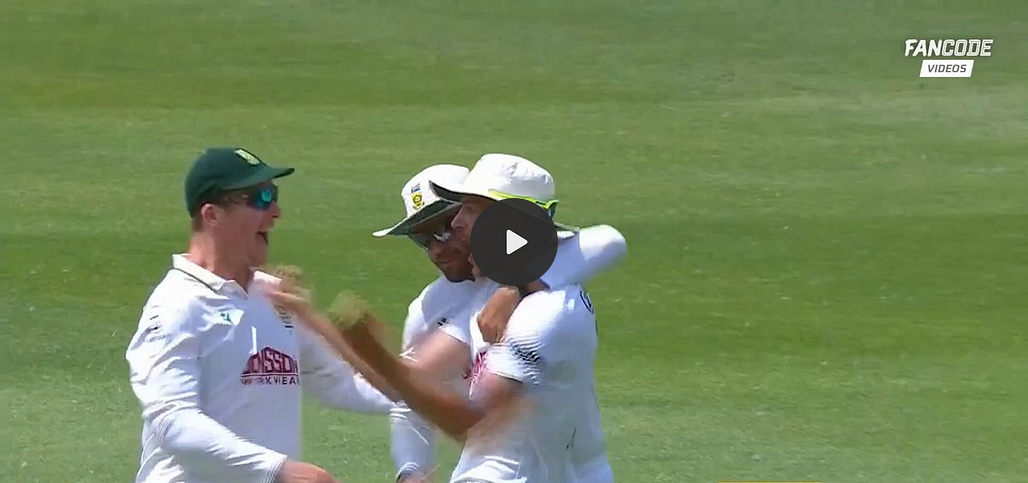
Rabada goes wide and full again, but it moves. Enough this time to take the edge of a flat-footed Head, and the chance is caught by Marco Jansen. The giant fast bowler imitates how Head celebrated his own wicket the day before.

Then Jansen bangs one in short, and Green defends it off his glove. He is so shaken up he doesn’t follow the ball that bounces back towards the stumps, almost oblivious to the fact it curls around them like a snake. He’s lost in a moment and is almost bowled from behind.
It is madness. Australia are three down, and Simon Harmer hasn’t warmed up.
His first and second wickets are not balls in the footmarks. Alex Carey watched Ryan Rickelton play Nathan Lyon for a day and learned nothing. He reverse sweeps another catch to Jansen. Cooper Connolly comes in for his first scary moment in Tests, and wafts second ball at a delivery he nicks behind.
Ackerman pointed out days ago that this pitch was tough to start on, but hard to be dismissed on after you’re set. Australia wouldn’t know; they are six wickets down before the locals fully arrive at the ground. The wicket is friendlier to bowling than at any point in the game. But it’s not a horrorshow; except in their minds.
No one got in, so no one stayed in.
What went through the heads of Connolly and Carey as they watched Nathan Lyon stroke on-drives from Gerald Coetzee’s thunderbolts and back-foot cover slaps off the early-innings destroyer Rabada?
Australia’s best partnerships, such as they were, came six, seven and eight wickets down. The bowling unit that carries the team also outbatted their top order. It was not until the tail came in that there was any prying needed for wickets.
Until that point, the big bad villain was not really in the South African bowling, even for all the brutality from Rabada, but in the demented hive mind of Australia.
***
After Ackerman fumbles the original block from Green, he sprints off. This is where Australia find their make-believe run.
This is not a fielding position from which everyone always turns and dashes. But Ackerman’s made a mistake, and has realised there is no one beyond him. So he dashes.
This is the moment that Green and Inglis seem to see the ball travelling further than it has. Two steps from the batters (or the fielder) and it’s clear there is what Marnus would call “no run”. Ackerman’s only decision is which end. But he doesn’t know that, because he’s sprinting in the other direction.
There is screaming and shouting; Harmer points at an end, it’s impossible to say which. Ackerman picks up the ball in his right hand but manages to twist his body around to throw back to the keeper, and Australia’s imaginary run becomes their real fourth wicket.
All to get Cam Green off strike when Simon Harmer was bowling.
A run out of Inglis, your first-innings centurion, is pretty wild. But they upped it.
Mitch Starc comes in to bat ahead of Pat Cummins.
Their batting order can be flexible; they often mix and match it as they are probably both good enough to bat at eight, without being so much better than each other. But Starc has come out here because Australia want a left-hander to face Harmer to stop the offie from hitting the footmarks and attacking the poor right-handed victims.
Then what follows is extraordinary. Australia’s new number eight, a southpaw, is facing the offspinner on a turning wicket, so that their allrounder talisman-in-waiting can be shielded from the spinner. More than two-thirds of the day remains when Australian batters seemingly pick an end to park the bus.
And it’s justified. Green is batting against Harmer as if there is a nuclear bomb made of spiders coming out of the footmarks. At one point, he charges down the wicket to try to meet the ball, he gets it on the full, and hits it back to Harmer’s low left hand, and he shockingly spills the chance. But it shows how tepid and panicky Green is, even when Harmer isn’t landing the ball.
So apparently, the only choice is a surprise promotion of your number nine, and then the decision that your number four is no longer good enough to face the offspinner.
Now, there is precedent for this from the same team.
“In Ranchi almost a decade ago, Australia had to survive a day five against R Ashwin and Ravi Jadeja with footmarks. They were 23/2 overnight; the next day that was 63/4. They were in trouble. But then Peter Handscomb made a very smart decision: what if I face all the balls from one end?
This was an incredibly flat wicket; the two teams passed 1000 runs in the first innings combined. But with the footmarks, it was a very different surface. Only because of them. And they were all outside the left-handers’ offstump at one end, and Jadeja could rip the ball back into them.
So Handscomb just batted from that end, and the footmarks meant little. Australia only lost two more wickets and drew easily.”
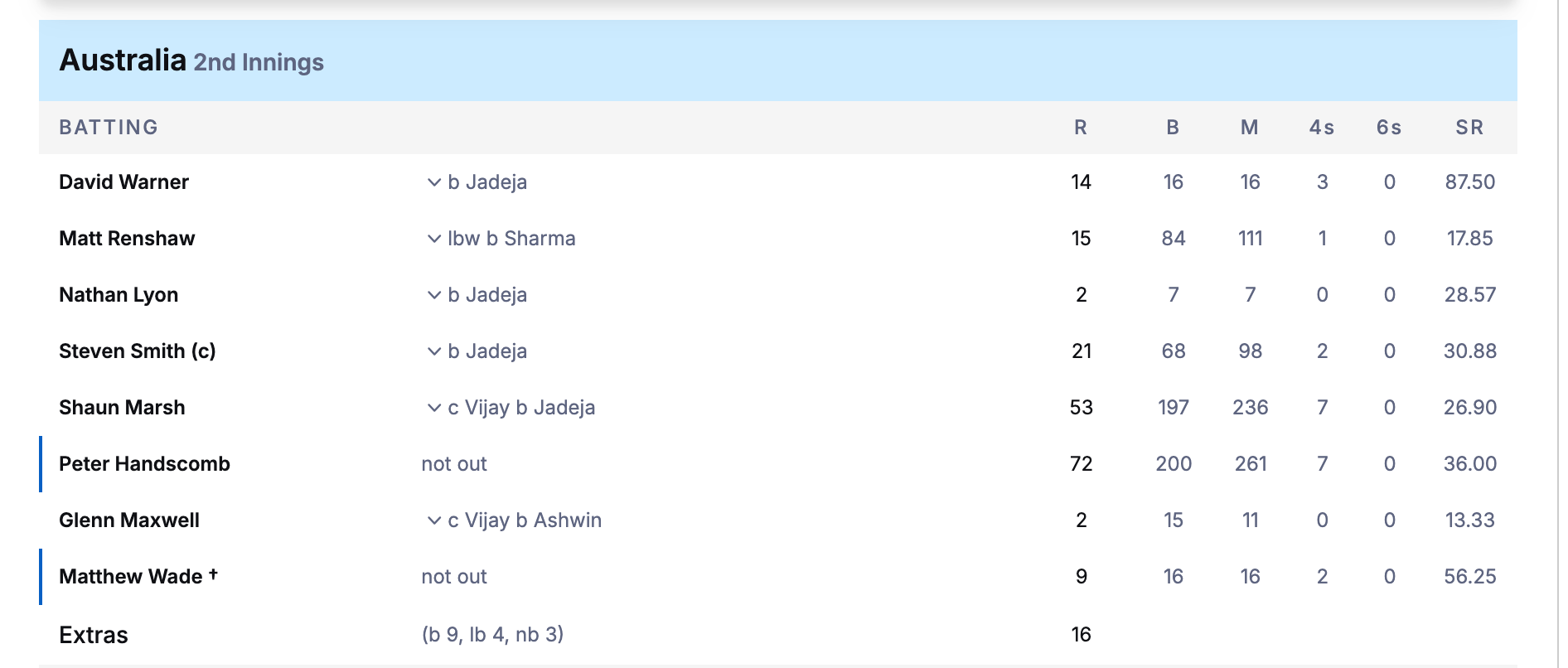
There are a few major differences here. At that point, Jadeja had already taken David Warner with one of these balls spitting out of the rough. That is very different from Lyon not getting many wickets from this strategy, and Harmer actually having two victims, both left-handers, off the normal part of the surface.
But the other difference is that Peter Handscomb was a professional batter and spin specialist. I repeat, Starc is a number nine.
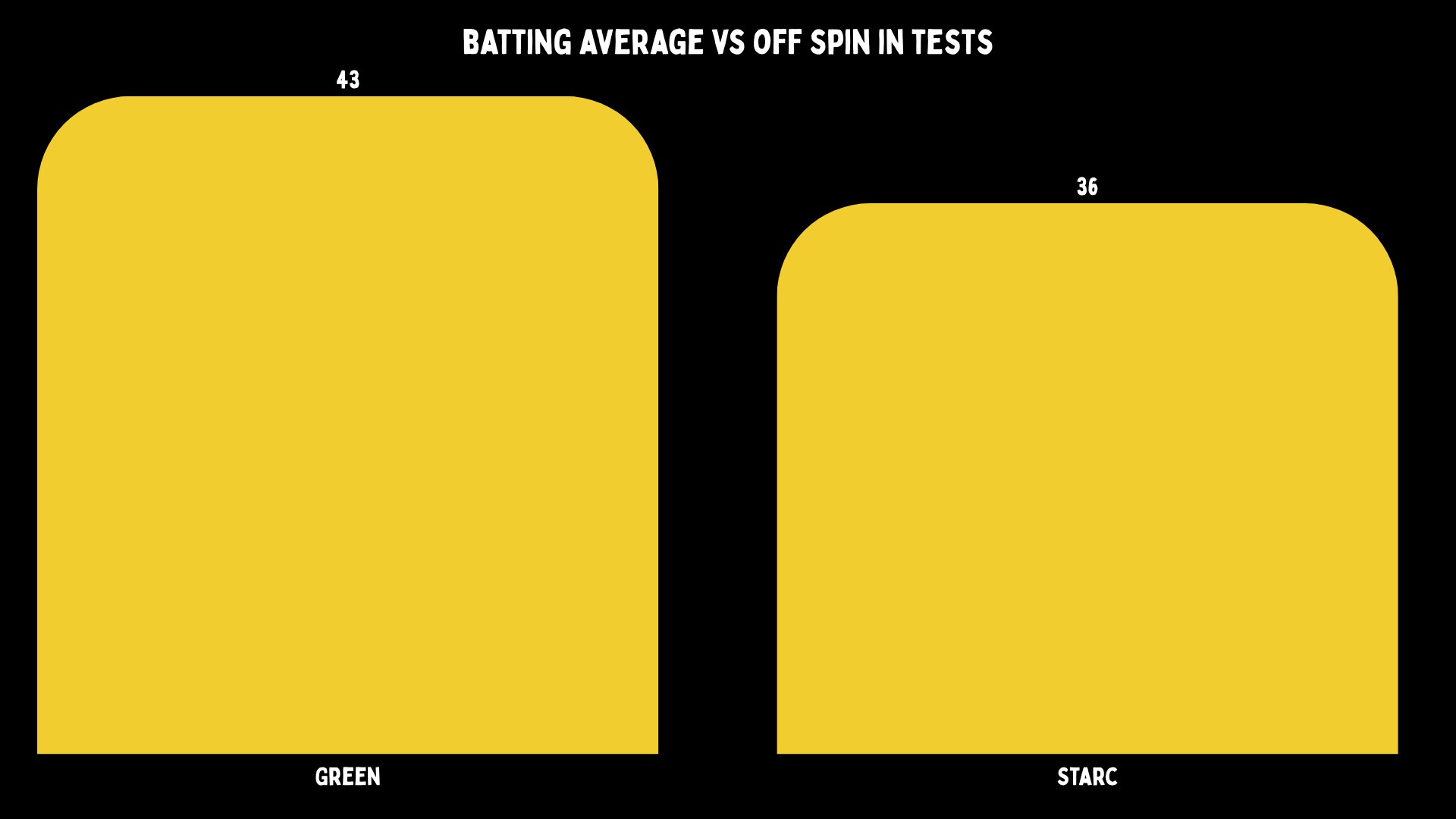
However, the big fast bowler actually averages 36 in Tests against offspin. Which is pretty good.
The kicker to this story is that Green averages 43.
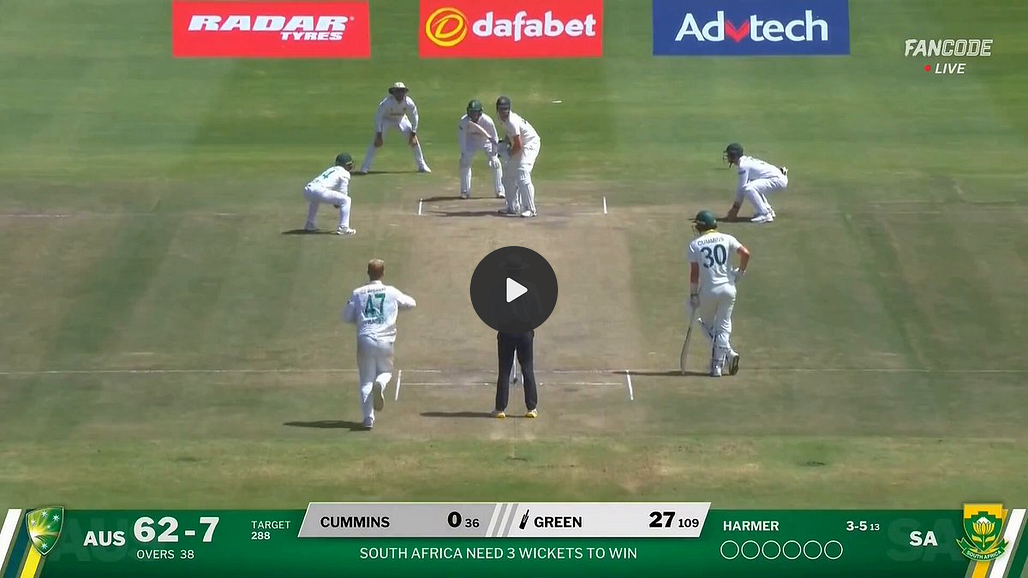
Australia’s number four was being protected by a tail-ender from the big bad scary South African spinner with more than 60 overs left in the day. When Cummins came out, they did the same thing. Turning down singles so poor Green wouldn’t be stuck at Harmer’s end.
Tired bowlers protecting their top-order player. As if bowling was not enough, now they were all-day nightwatch.
The Australian team decided that their current number four did not have the technical skills to handle the offspinner’s rough. On a pitch where Australia knew the ball would spin, they won the toss, allowing Harmer to finally use the footmarks that Starc created.
The result of all this in-crease gerrymandering? Mitch Starc got a poor ball from Harmer that he hit into his pad and was caught. Cam Green eagerly ran at one from Harmer to stop it bouncing and was bowled before he would have been stumped. For all his worries about the pit of ninja cobras striking from the surface, ‘twas the flight that did him.
This is an experienced team, with plenty of legends, potential coaches and weathered professionals. They like to come together and make pragmatic and reasoned decisions as a group. And then they selected a spinner, gave him the first innings, then asked their number nine to protect a batter.
When it is two people sharing the same delusion, that is when it is called folie à deux. If there are three people, it’s called folie à trois, add a fourth, and it’s folie à quatre. What about when it is eleven people? That is called folie à plusieurs.
In English, we call this the madness of several. A collective of psychopathological behaviour.
In cricket, we call this a collapse.