


Australia destroyed Pakistan in a Test in 1984 - and yet it is the scary bedtime story that Aussie fans have swapped ever since.
Pakistan batted first and Dennis Lillee’s four-wicket haul helped Australia mop them up cheaply enough. Then Greg Chappell made 182, and Lillee went back out to add another four, as their keeper Rod Marsh took five catches. The Australians eventallty won by 10 wickets. It was the fifth Test, and it secured them the series.
A big win, against a quickly improving side. Job done, get the beers ready.
However, Australia weren’t celebrating the win. They were toasting three players who retired at the same time: Greg Chappell, Rod Marsh and Dennis Lillee.
Their best bat, their best bowler, and the keeper. If a cricket team had a spine, it would look like this, and these three men, good enough for fantastic performances in their last matches, just yanked it out.
Australian cricket collapsed.
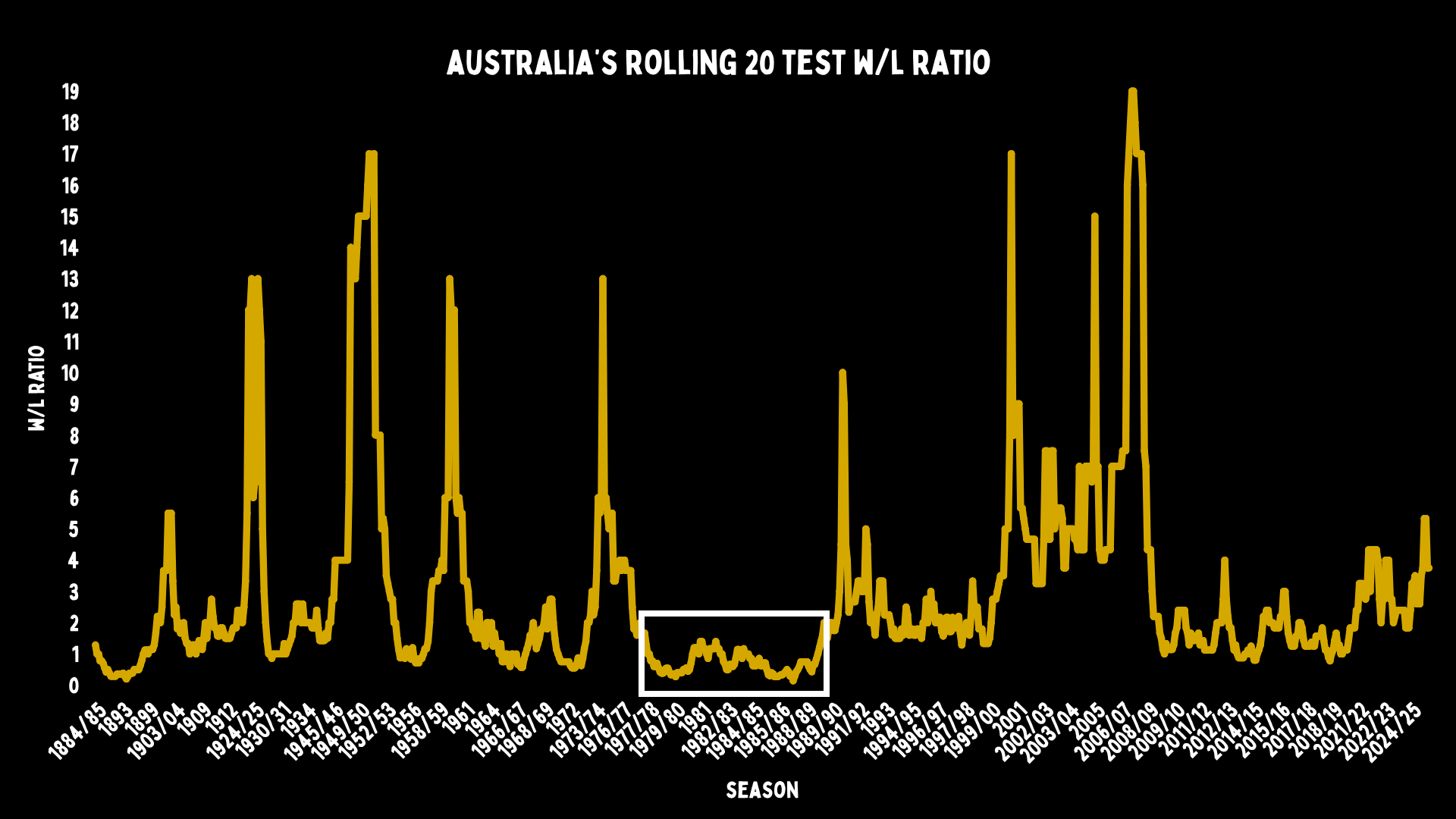
In the next eight series, they didn’t win any. That included their first home loss to New Zealand and an Ashes beating that wouldn’t happen again for generations. This was Australia’s worst period in Tests. Their rolling win/loss ratio for 20 matches dropped to 0.14; they had never been under 0.2 before.
They had been poor during and after World Series Cricket - especially by their standards - but this was an all-time low. Australia had never been this bad, and it happened even though they were not playing West Indies or Pakistan, who were the two best teams in the world. Australian cricket had been kept competent by the old guard, and when it went, there was nothing left.
As often happens in a period like this, it was the bowling.
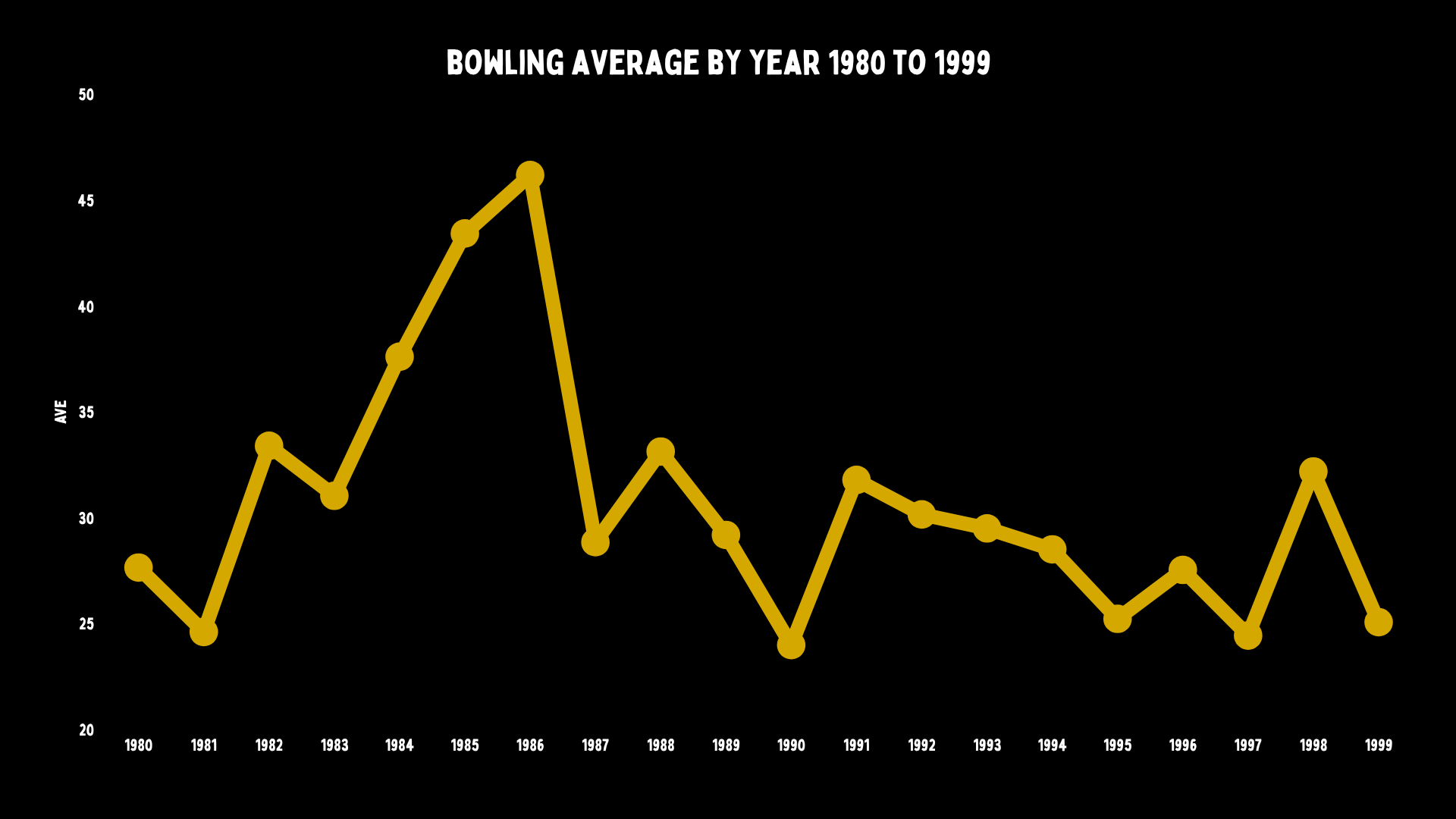
When Dennis Lillee retired, Australia stopped taking wickets. From 1980 until the year 2000 they had three years averaging more than 35 with the ball: 1984, ‘85 and ‘86. By 1987 it was over, and slowly Australia built themselves not just into a good cricket team, but arguably the best of all time.
So it was a happy ending.
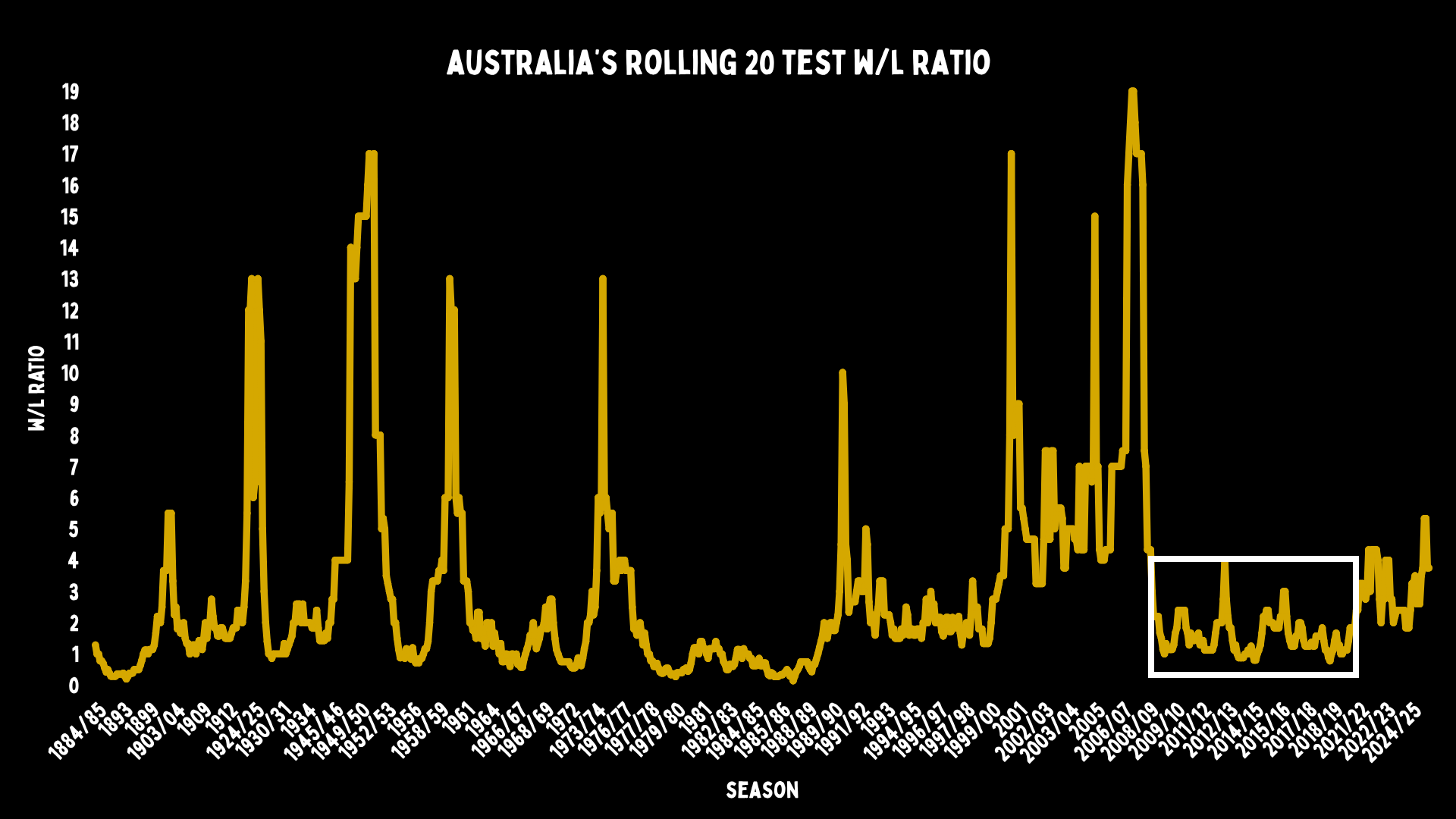
But Australia never forgot what it was like during that period. A team used to winning lost all the time, and it haunted them, even in their greatest period. Especially when they realised that Shane Warne and Glenn McGrath were basically the same age.
The same kind of drop-off happened, albeit from a freakishly high mark. But there, Australia lost McGrath and Warne in the same Test, where Justin Langer went as well. Then Adam Gilchrist was gone not long after. And despite being way younger, Jason Gillespie lost his athleticism a year before. So Australia had two solid studies on what happens when you have a generation of greats all going at the same time.
So for no reason at all, let me put down these random people’s birthdates:
Pat Cummins – born 8 May 1993
Josh Hazlewood – born 8 January 1991
James Pattinson – born 3 May 1990
Mitchell Starc – born 30 January 1990
Nathan Lyon – born 20 November 1987
Yes, despite the fear, the worry and the planning, it is happening again.
There’s a new American sports phrase called “two-timeline.” The concept is old, even if the name is new. It is when you have a team that is really good, maybe has already won, but you’re also looking to protect the next generation of the side so that they continue to be good.
The Golden State Warriors tried it in the NBA a couple of years ago. They ended up with three high draft picks, and instead of trading them for talent around their ageing core, they selected young prospects to secure the future. But the draft players never helped for another run at a title, and the older players started to age out.
As it currently stands, the next generation is mostly no longer on their roster, and their legends are either old or finished.
Two timelines is the dream; the issue is, you are risking your present and it’s hard to really commit to the future. Most teams want to do this when they are good, but usually, it fails.
Think of the three greatest modern cricket sides: Australia of 1995-2007, South Africa of 2005-2013 and India 2015-2024. All of them had plans to regen their side on the run. But no matter how they tried, they couldn’t keep it up; great players aged out, and even the very talented ones behind them couldn’t keep it going.
The West Indies of the 1980s is the big outlier; their original four pacemen moved on, and they replaced them with four more like it was nothing. Viv Richards retired, and Brian Lara made his debut.
But was that planning, or was it just how talent sometimes works? West Indies had never had that level of bowling depth before, or since. But they had it twice in a row then.
Australia in this period may not have had the level of success of the other sides, but they have a generation that is all of similar age who will leave the game if not together, then at least close to each other.
And I’ve heard and read many things about how Australia should fix this. But here’s the thing: I don’t really know how they would do that.
In franchise leagues it can be done: trade or transfer a big player when you think their stock is at its highest, and use what you get back to restock quickly and go again. Of course it can, and often does, go wrong. But it’s possible to do.
But Australia can’t trade Hazlewood to India for some young batters, Lyon to England for the rights to Ben Stokes, or offload Scott Boland to a team desperate for instant success, to take a flyer on some raw talent.
So Australia’s only option is to grandfather in the change, by finding a chance to play a bunch of youngsters. But even when they’ve had injuries to quicks, look who has come in. Scott Boland who is 37, Michael Neser who is 36, Brendon Doggett who is 32, and Jhye Richardson who is 29.
They’re making a clear decision: they want to win, now, for as long as they can. But also, again, look at those ages. They are the backups, but they are also old.
For the batting, I am not sure they really have backups; their two most recent additions are two 31-year-olds: Josh Inglis and Jake Weatherald. There are younger options in Cooper Connolly, Sam Konstas and Nathan McSweeney. You could try one of them, but that would not really change the issue. And two of them have already had some chances. If they had worked, they’d be in the team. It’s not as if the Australians are making lots of runs.
The spinners are the most interesting option: Todd Murphy is 25, and Matt Kuhnemann is 29. With Lyon’s injury, they could have made their debut against Bangladesh, but with the offie back to fitness and needing match practice, they’re stuck there.
Australia could pension off Boland and Lyon; and with Usman Khawaja retired, it opens up three spots. Jhye Richardson becomes first-choice back-up seamer (when fit). Todd Murphy found some form in the most recent Sheffield Shield, so he comes in for less crucial matches, and Cooper Connolly comes into the number six or seven position.
But what would that do? Does it revolutionise the team? Murphy is a good prospect, although the chances of him replacing Lyon’s career are nearly 500-1. Connolly had an incredible IPL, but also before that was struggling a lot. Even if either of these guys came good, it’s probably two or three years away. And with Richardson, he doesn’t change things much, unless he is fit.
So the changes Australia can make are largely around the margins. But the issue is that over the next year(ish), they are playing 20 (or even 21) Tests.
Bangladesh (home): 2
South Africa (away): 3
New Zealand (home): 4
India (away): 5
England (home, MCG 150th anniversary): 1
WTC Final (Maybe): 1
England (away): 5
This is perhaps the most hardcore year any team has had. And it’s not even just normal weird; the two one-off matches make it even stranger.
Knowing the pragmatic thinking of leaders Cummins, George Bailey and Andrew McDonald, I can see why they’d just play for the now.
And looking at the squad to play Bangladesh, they are trying to win their matches this year, and less concerned with the future. They are committed on this timeline. The future is not for them.
This is probably not what most people think, but the way I would look at this is: they’re not really keeping out many great young prospects, and they have a chance of beating South Africa in South Africa, India in India, and of winning the Ashes and the World Test Championship. If they had a bunch of youthful bowlers pushing through, I might feel differently. But I think the best idea is to ride this current bowling lineup until the end.
And it might only be this one year. Which is unlike anything else.
Their decision to make this call is not the real issue, whichever side you are on.
The actual problem is the lack of talent coming through, with the fact that those five bowlers they had - Cummins, Hazlewood, Pattinson, Starc and Lyon - were all more or less the same age.
Obviously Pattinson never made it as his body fell apart, but it is incredible that Australia had three world-class bowlers born within a year of each other. With Lyon born three years earlier, which puts him on a similar timeline as a spinner. Add in Cummins two years later, and it’s a truly remarkable position to be in.
It also means that for the last ten years they had one of the most complete bowling attacks around, and there was little chance of bringing in others. But let’s be honest, they didn’t really find anyone either. This is one of the luckiest situations a team can ever find itself in - until it isn’t.
And that is the reality they are living through now.
Hazlewood feels like he might have many soft-tissue injuries before retirement. Lyon is one more major incident away from the end. Cummins has played a lot, but also had stress fractures. So only Starc has been the iron man. But if you have four bowlers in their mid-to-late 30s, having three with fairly serious physical issues is a problem.
What is the over/under line on them playing together as a foursome again - maybe five more matches?
When they are not fit, they will have to bring in others. But maybe that means more Richardson than Boland. Otherwise, it’s going to be more of the same.
It seems like Australia has two timelines to choose from, but maybe there is only one.
This generation was blessed with a harmonious bowling attack, and one way or another, nothing else came. It seems like their choice is to ride it until it’s done.
When it’s over, they will be worse. But there was little they could do about that. That is just what happens sometimes. Australia win a lot, then their bowlers age out, and they have to re-start. They live the dream, survive the nightmare, and go again.
I would be very surprised if the change doesn't come this year