



Recently, Ben Stokes and I intersected after midnight.
At talkSPORT, Matt Prior, Jon Norman and I chatted about how Jacob Bethell was not a number three, and how he really should be batting down the order. It was a fairly normal discussion, well for me at least.
Then talkSPORT put up a clip on Instagram, and next thing you know, it found a late-night doomscrolling former England captain.
For what happened next, how about we let social media member Kieran Hyde explain:
“So talkSPORT have put a clip out today, and it’s Jarrod Kimber talking about Jacob Bethell. He’s a cricket journalist for talkSPORT, and in the video he says that Jacob Bethell looks a million dollars when the pitch is flat and the ball’s not doing anything. But when the ball’s doing something, he looks like he can’t hit to run.
Who’s that repost? Ben Stokes reposting that?”
Yes, this actually happened.
“By Stokes reposting this, I think we’re all very clear that Key and McCullum were very pro-Bethell at number three. Let’s throw him in. While Stokes was probably, ‘Let’s keep Pope in. He’s done the job before. We’re gonna keep Pope.’”
This is a valid theory, but we must always remember Hanlon’s Razor, “Never attribute to malice that which is adequately explained by stupidity.”
What I think happened is probably Stokes was up late at night looking at Instagram well beyond his former team’s curfew, and he accidentally shared the video.
Because it is very possible that Stokes just pressed the wrong button on his phone. It is also possible that he, like me, is obsessed with this new trend.
It feels like a new world order. Right now, teams feel like they have to enter a match with a real fifth bowler. We want wickets, as many of them as we can stuff in our pockets, fuck the consequences. But there is an aftermath from this; we are seeing the death of the specialist number six, and the sacrifice of young batters at three.
***
Six batters, four bowlers and a keeper, 6/4/1. The two greatest teams ever, Australia and the West Indies dominated cricket with this.
Yet weirdly, the ideal team is not this. That is when you can find an allrounder who can transform your team into six batters, five bowlers and one keeper. 6/5/1. Mathematically, this makes no sense, but that is what Jacques Kallis, Ian Botham and Garfield Sobers make it feel like. They bend the reality of cricket.
It is why, for generations, teams have searched for these unicorns, despite the fact that only one player has averaged less than 30 with the ball and 40 plus when batting.
The 1980s and 90s revolution into keepers who bat has actually led us to a different formation, 6 batters, 5 bowlers, or 6/5.
Of course, there is an extreme version of that. Some of Gautam Gambhir’s recent lineups for team India have been - 5 batters, three all rounders, three bowlers, which in his head is 8 batters and six bowlers (8/6). But really ends up being more like seven batters and four bowlers.
South Africa pioneered lineups like this more than 100 years ago and did it again in the 90s after their readmission. They had Kallis, Shaun Pollock, Lance Klusener, Brian McMillan and whatever Nicky Boje was. Bob Woolmer was their coach, with a big old brain, and again the idea was that they had eight batters and six bowlers, but again the reality didn’t quite match that. It was more like 7/4.
And these eight-batter lineups aren’t often that successful, as you end up with part-timer bowlers who are moonlighting as frontline, or worse, so many bowlers that no one ever gets into rhythm at all.
What modern teams have worked out, though, is that you need to take 20 wickets to win a match. Which sounds weird, but was not always the aim in heavy draw eras. The priority in cricket wasn’t to win but rather to not lose.
Compare that to the gambling you see in the WTC era, as teams attack for results. And the final change is back-to-back Tests. Four bowlers get tired far quicker. Plus it allows bowlers to deliver closer to their max zone for more spells. Teams don’t like to rest their best bowlers for games; they would rather use them within.
That means selection has changed, and sides ensure they have a decent fifth bowling option in most matches.
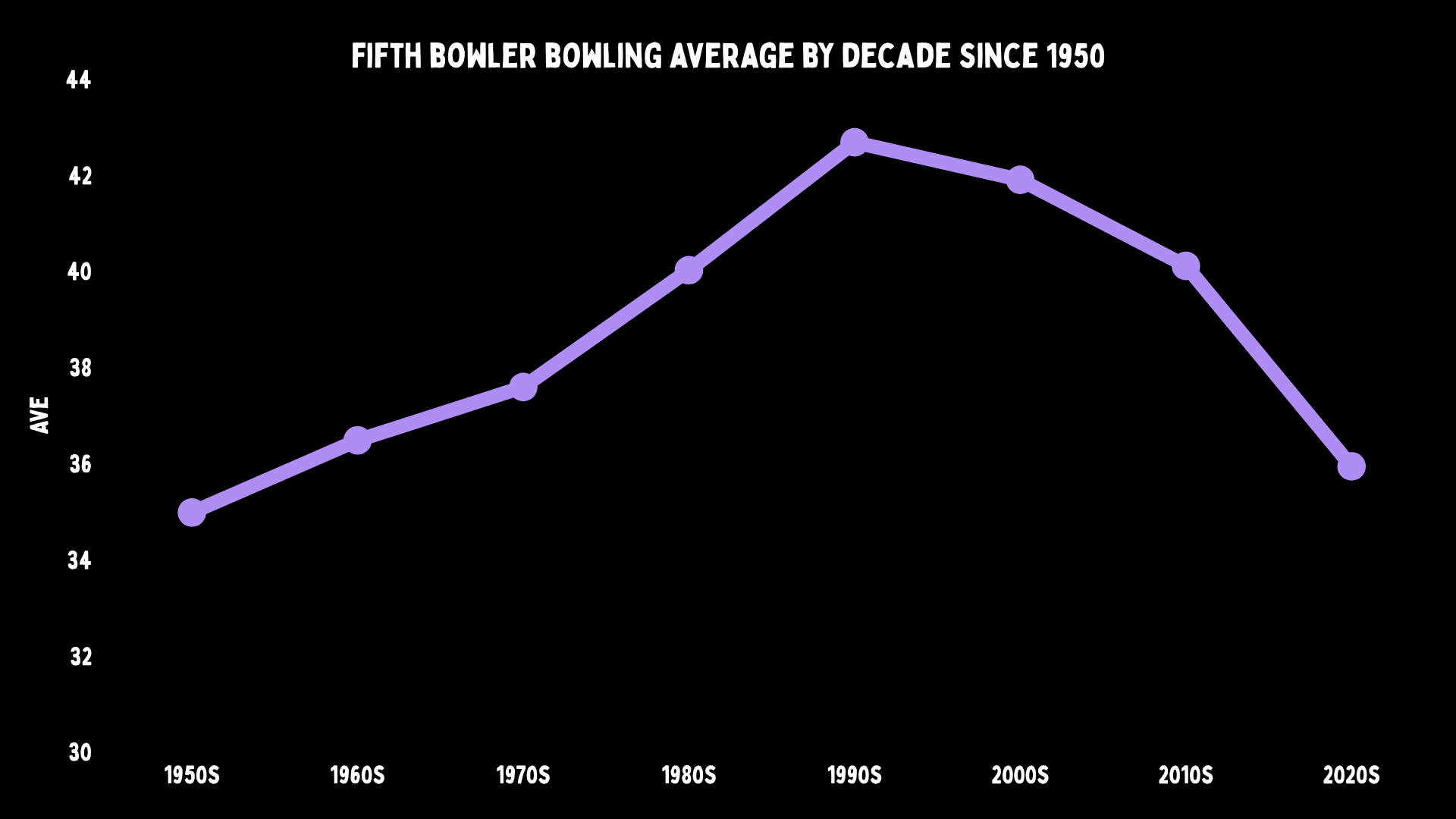
With an average of 35, this has been the best decade for the fifth bowlers since the 1950s. Even Australia, who didn’t feel the need to have a fifth bowler in the 2000s, have regularly fielded Mitchell Marsh, Cameron Green, Beau Webster and sometimes multiple all-rounders in the same game. This is really something Australia haven’t done since the 1960s.
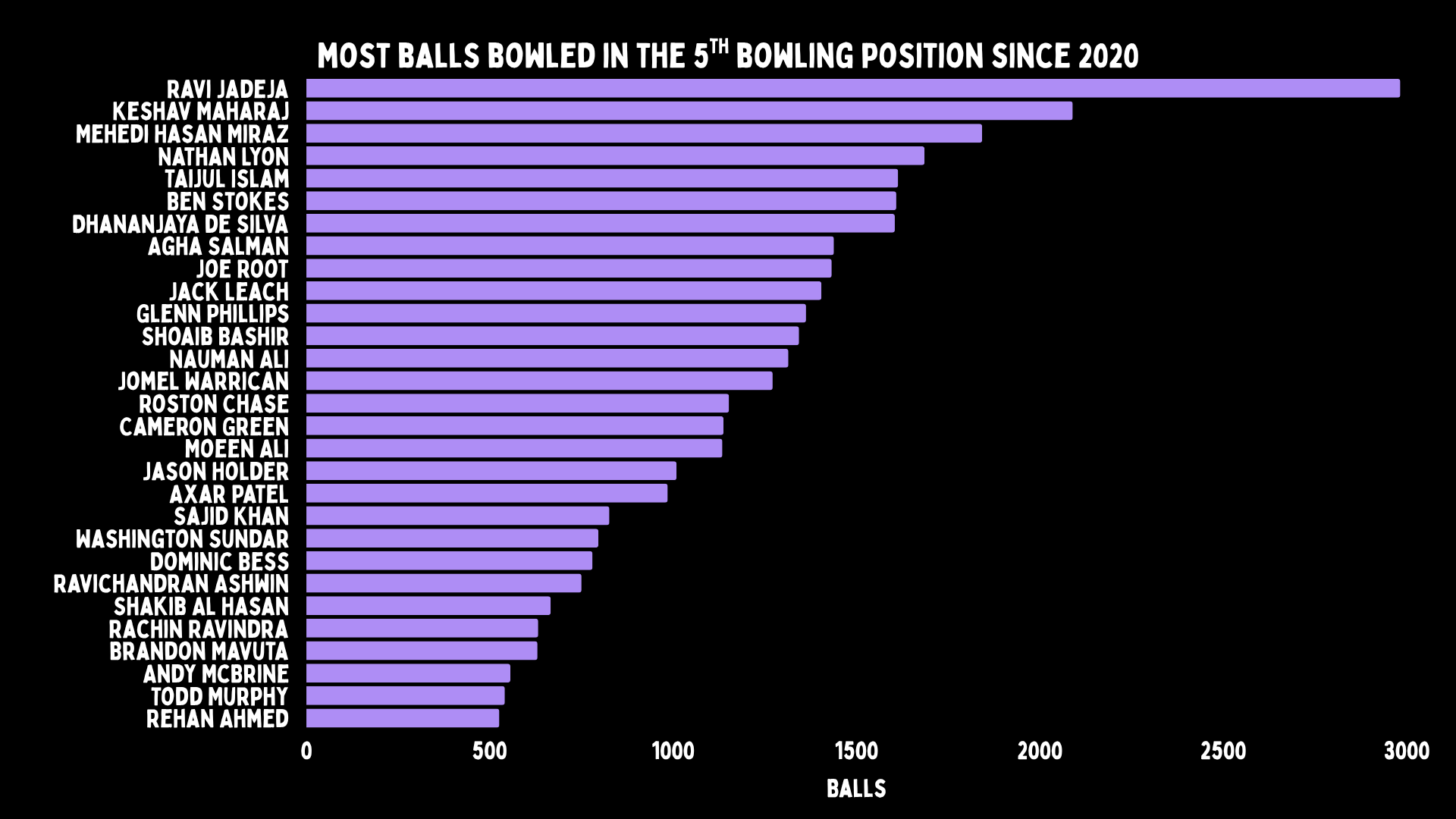
Other teams have gone extreme at times; England with Ben Stokes, Moeen Ali, Sam Curran and Chris Woakes, and India with Ravindra Jadeja, Axar Patel, Nitish Kumar Reddy and Washington Sundar.
But the fun one is South Africa with Wiaan Mulder and Marco Jansen. Even though Jansen doesn’t always bowl in the fifth position, his ability (or at least the experiment) to bat in the top seven allowed South Africa to have five genuine bowling options.
That is all anyone wants now, but it was not always the case.
In a traditional Test team since World War II, the best batters occupied the top four - often specialists. The wicketkeeper batted at seven, because unlike now teams actually used to pick keepers who could keep. Leaving numbers five and six as the two weakest specialist batters in the side.
That structure limited bowling options and made taking 20 wickets harder, but it came with a significant benefit: it gave younger batters a sheltered entry point into Test cricket. A team could blood a promising player at five or six, let them acclimatise for a year or two, and push them up the order once they were ready or if a spot opened up. Think of it as a graduate programme: you identify potential early, invest in it, and trust that in time they will take over from an ageing top four.
Mark Butcher batted at number six once, and couldn’t believe how much easier it was. Most players say the same. Old ball and tired bowlers make it the easiest and most forgiving positions to bat.
It isn’t a job without complications; the second new ball often appears, batting with the tail is a skill, big totals are hard to find and they often have to bat to the theme of the game more than top order players.
So there are issues there, but let’s look closer at them.
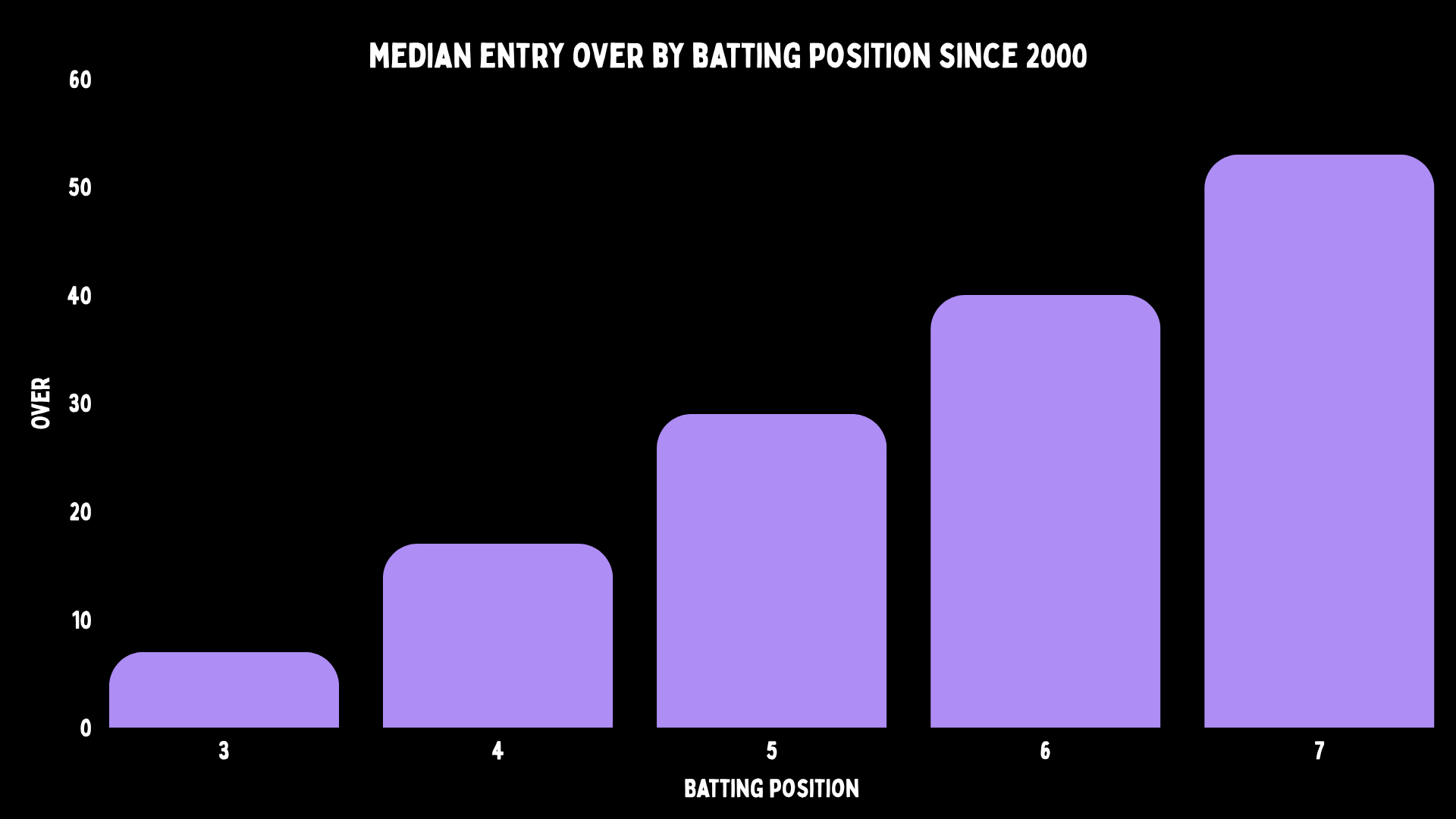
Since 2000, the median entry point for a number six batter is around the 40th over. By the time new ball arrives, a number six is well and truly in. This is not the issue people think it is.
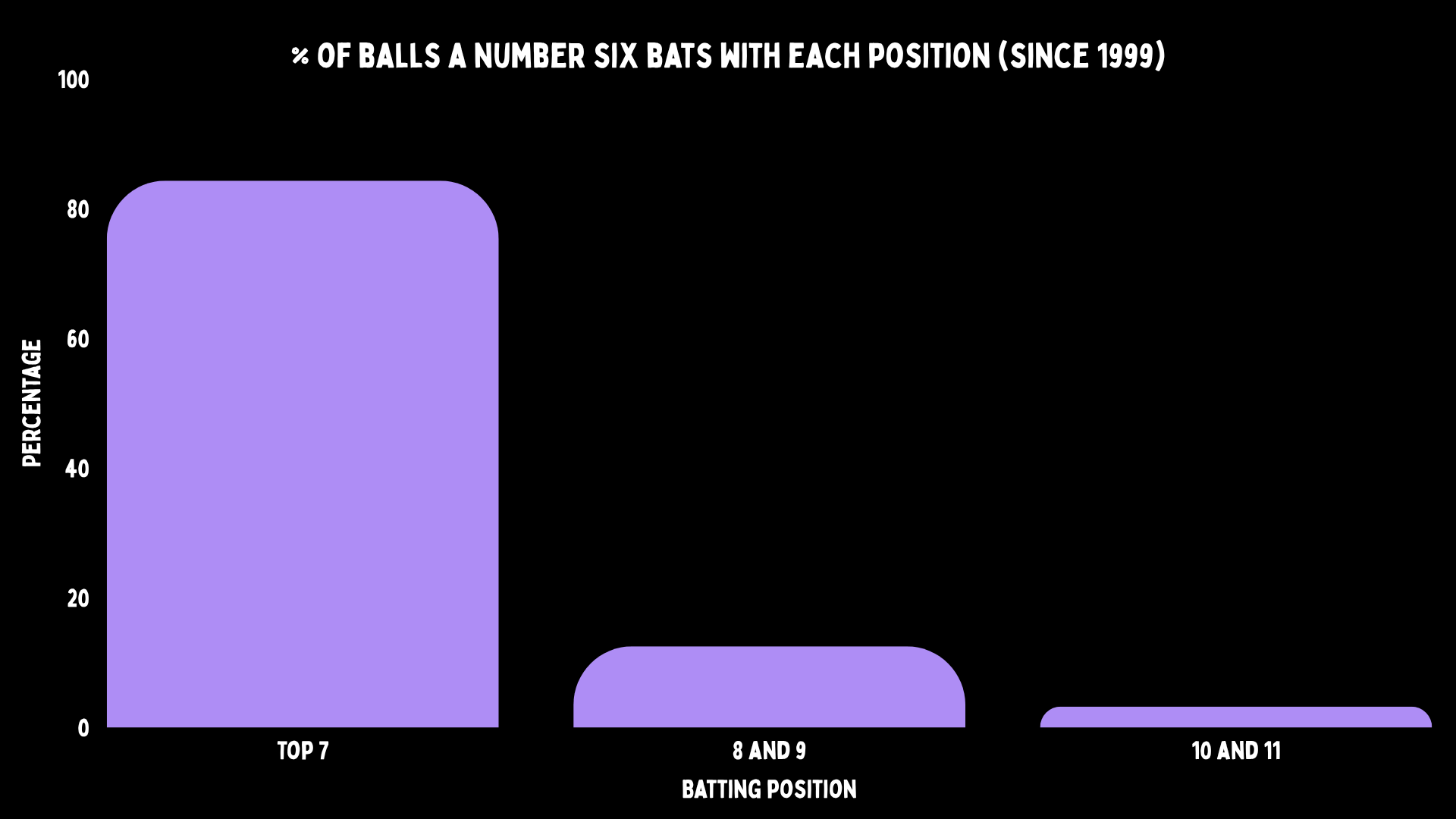
Batting with the tail can be tough, but it’s rare that a number six is actually in with ten and eleven. And batting with seven, eight and nine is actually fairly normal. Number sixes bat 84% of the time with the top seven, 13% with number eight and nine and only 3% with number ten and eleven.
Obviously, it is true that players don’t score as many huge totals at six, and for averages, that is not ideal. However, they get double the amount of not outs as openers. So it does even out.
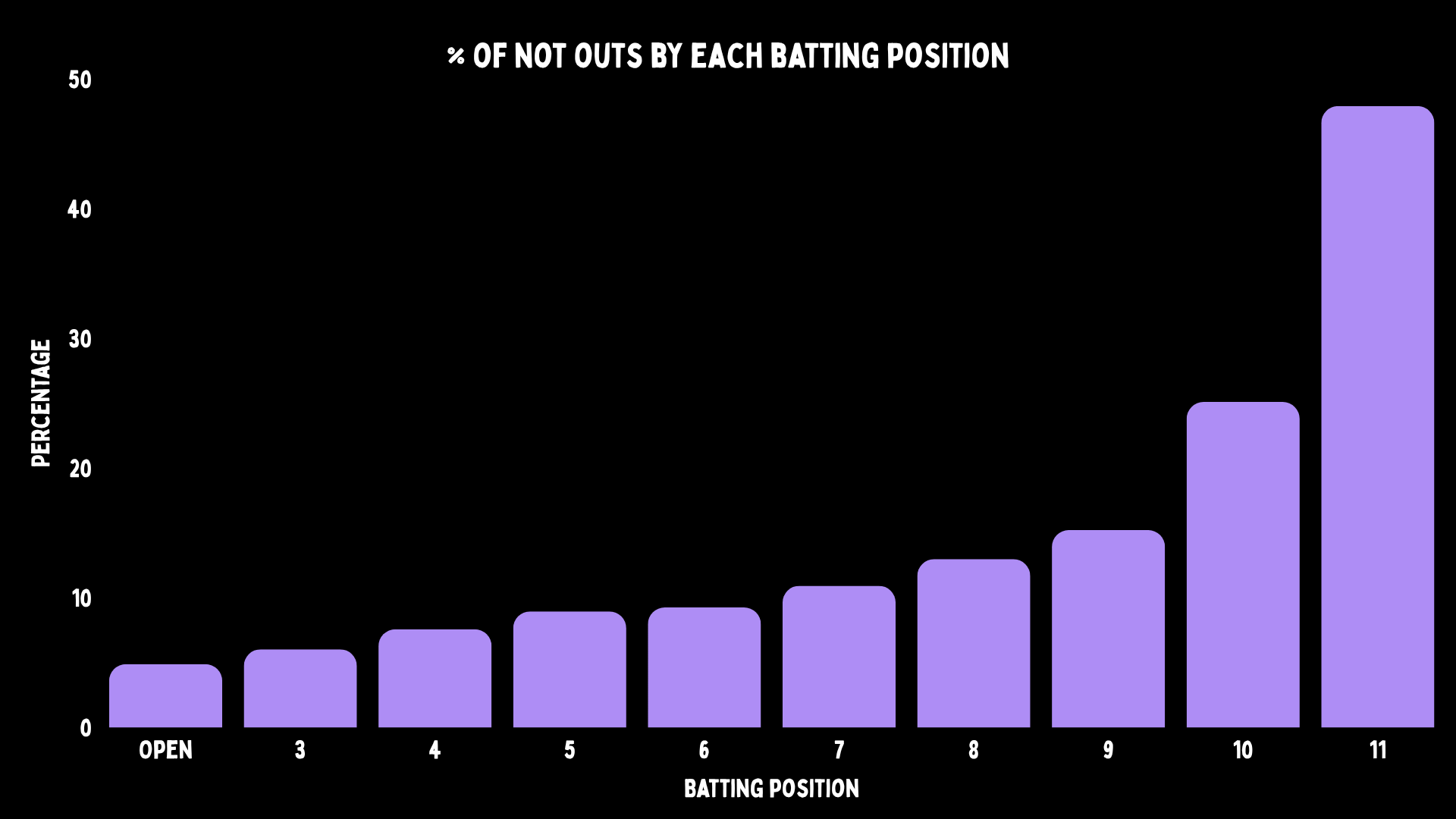
But if you bat at six, you are the least likely player to convert a start to a hundred of the batters. And by a lot. This is precisely why you don’t want your best bat there. They can’t maximise their scores, whereas at three and four they can.
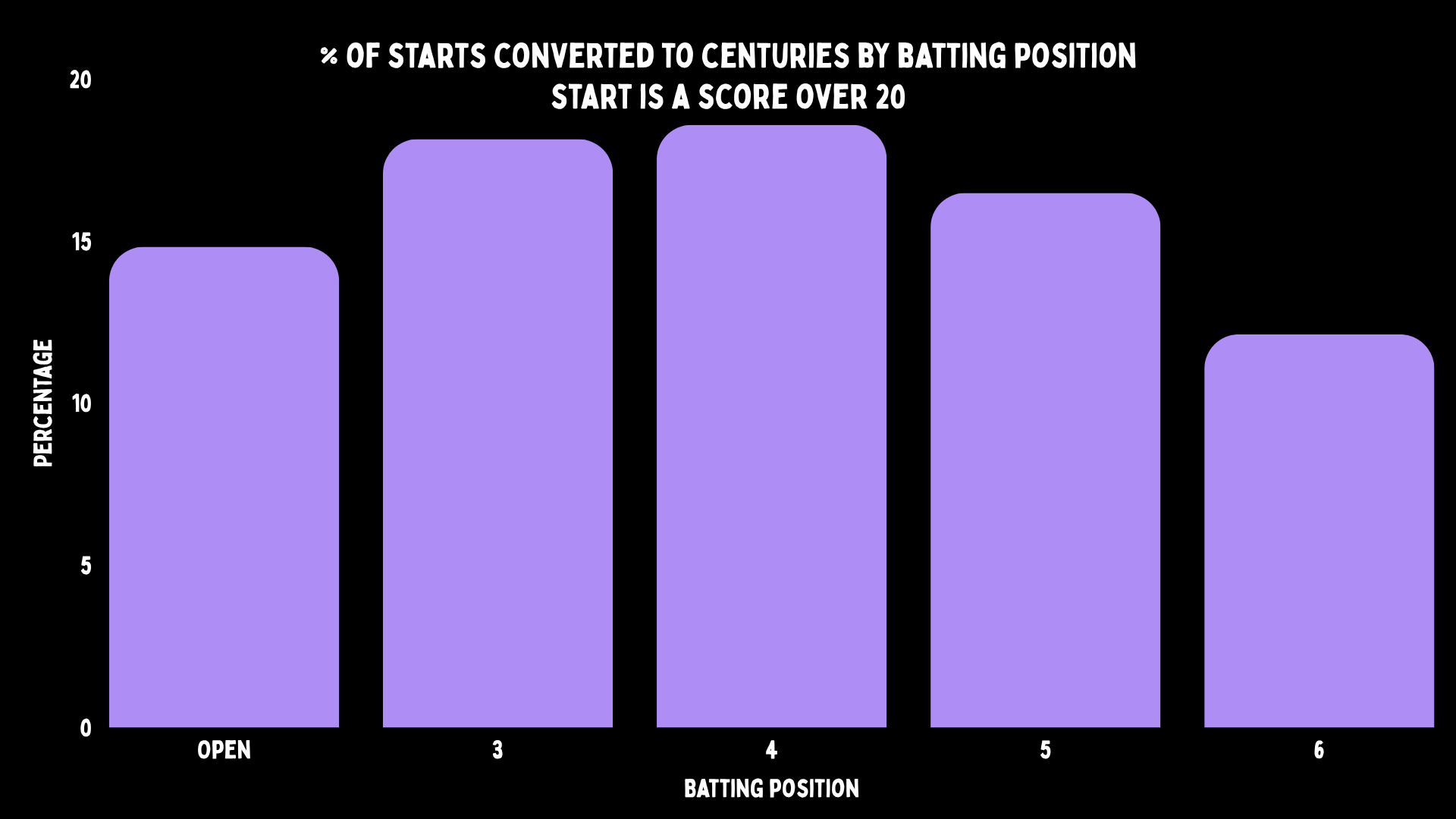
For years, the number six spot was used in two ways. For a player with a second skill like keeping or bowling, or as a graduate position for young players coming through.
Just under half of the highest scorers ever at positions three and four began their careers batting at five or six in their first twenty innings. Or, to rephrase that, nearly half of the great number threes and fours in Test history started at a position that teams are now handing to all-rounders and wicket-keepers.
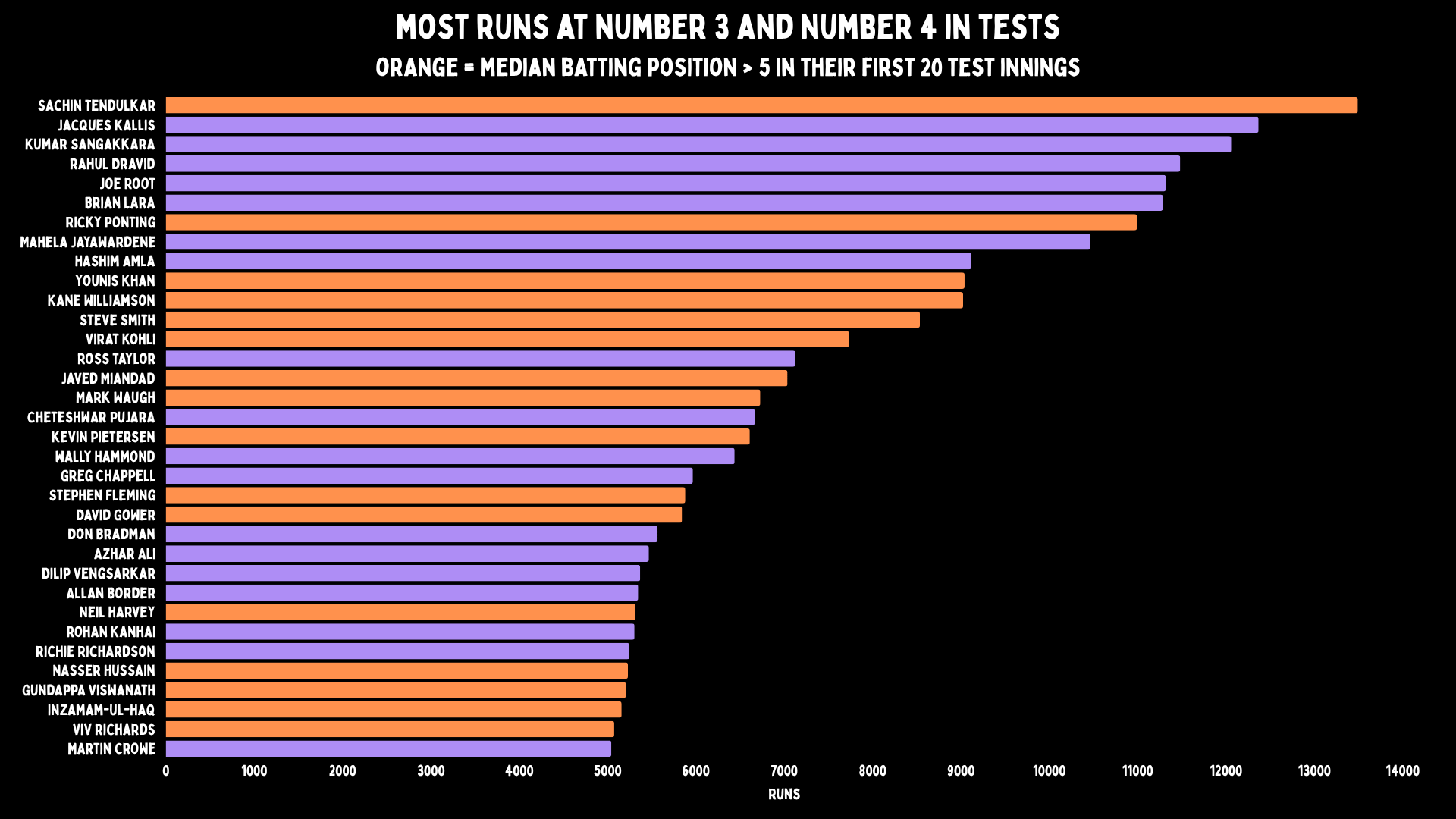
We didn’t include openers in this list because the adjustment to Test cricket is less steep for them. The way first-class teams are set up, the openers face the opposition’s best bowlers. Whereas, for a number three or four, the drop in quality from the new ball bowlers to the first and second change in first class cricket is far more pronounced than it is at Test level. That is precisely why they needed the cushion of batting at six to find their feet.
Let’s take Ricky Ponting and Virat Kohli as examples. Both were already batting at four for Tasmania and Delhi respectively.
