


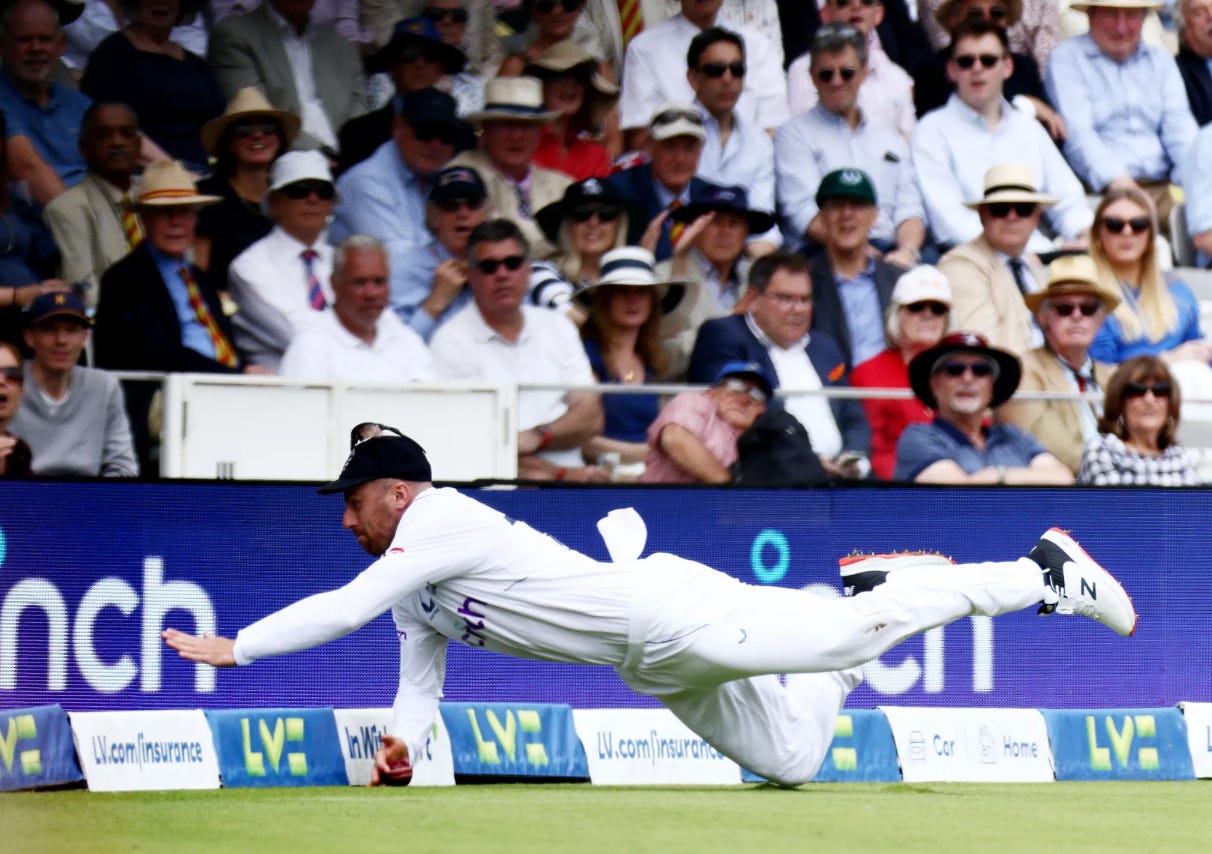
Jack Leach is launching himself at the Lord’s pavilion. Most of the members are still settling into their seats, and yet their spinner is desperate to save a boundary on the first morning of the Test. A few months earlier, Leach would have just followed the ball, let it hit the rope, and gone back to his spot.
But this is one of the most important sessions in Test history. We don’t know it yet, but this is almost another sport being born.
The fans and media don’t know that either, which is why it looks so bizarre when Leach throws himself headfirst at the ball, in a violent, slightly unathletic way.
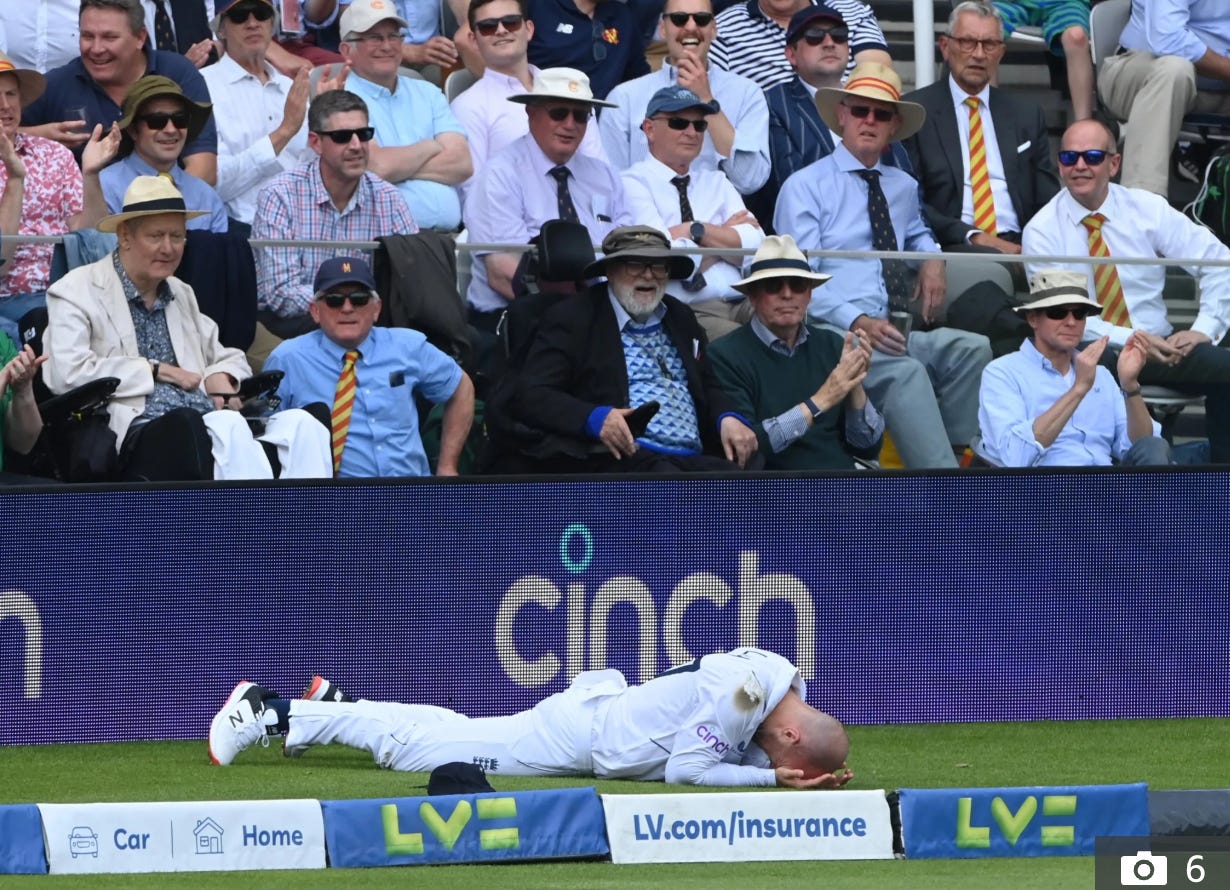
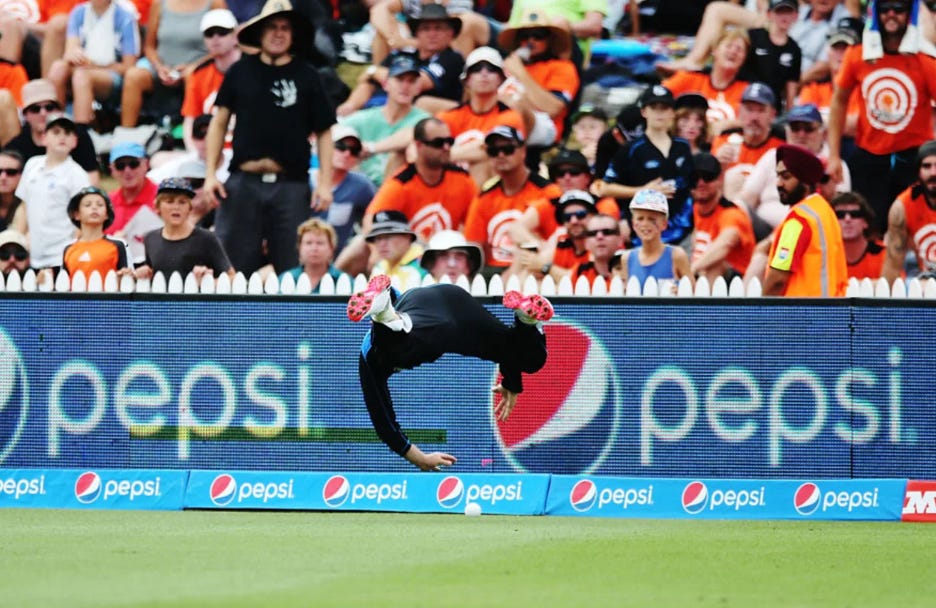
It’s nothing like the way Brendon McCullum used to do it. No player was better at launching himself headfirst at cricket balls than the Kiwi great. No fear, ever, every moment worth risking his body for. And he’d already told England the team under him would play the same way for this Test, the first of his reign. That’s why we have the Lord’s Leach launch.
But while Englishman is a very decent left-arm spinner, athletically he and McCullum are different kinds of mammals. In the act of his slidey, awkward dive, he cracks his head and concusses himself.
This is the first morning of Bazball. England’s opening act is knocking out their own spinner. McCullum wanted them to play like him. Leach tried as hard as he could. And failed.
Cults are intoxicating, and that’s how the followers get so drunk.
***
There are two Bazballs.
The first is the England team’s mantra and religious doctrine, though they hate the name. Let’s be honest, it was basically a cult. That Bazball grates on people. It’s arrogant, and often nonsensical: an England player saying they wished the opposition had scored more, because they fancied chasing 500. Claiming they play a more enjoyable game, and are therefore winning on some other plane entirely.
The second Bazball is a noun. As the Collins Dictionary defines it: “a style of Test cricket in which the batting side attempts to gain the initiative by playing in a highly aggressive manner.”
By the end, it was hard to take the cult version seriously. England got drunk on it, lost matches, and said a lot of stupid things. That nonsense got mixed in with the noun, which was a genuinely incredible style of cricket, and probably overdue.
This week an English cricket fan called Oscar Trimboli sent me an email. He’d put McCullum’s coaching career through the AI models and come back with a 27-page report. One thing is worth noting, McCullum took over when England were ranked fifth. He leaves with them ranked fifth.

That’s the frame for everything that follows: the hype, the myth, the bluster. A flawed team had a great run, and finished back roughly where it started, because the holes were always there.
They started well. Their first series was against a WTC-holding New Zealand side who didn’t know what hit them, helped by post-COVID Dukes balls going soft in English conditions, letting them whack bowlers everywhere. Whatever the cause, the impression stuck with everyone watching.

Next was the one-off Test against India that never should have existed. Another chase. Four Tests in, the hype was enormous, before an ordinary South African side rolled them in the fifth. It was a series England could have lost outright, if Dean Elgar hadn’t chosen to bat first at Old Trafford and been bowled out. Instead, England won that game, and the next, and the bumps got missed by most people watching.
What came next was extraordinary: a Pakistan side that had only ever believed in draws, forced into results on the flattest wickets in world cricket. It doesn’t sound like much unless you’d actually watched Test cricket in Pakistan before. It got more attention for the 500-run opening day than for what it actually broke.
Pakistan were poor. But what England did there was something we didn’t know was possible, a few months after doing something else new.
Before most sides had faced England once, New Zealand got a second go, and for a Test and a half were smacked completely. Then a strange call: England enforced the follow-on, partly, by their own admission, to free up days for drinking/golf. New Zealand were bowled out for 209 first time round, but nothing in the pitch said send them back in. Kane Williamson made maybe his greatest hundred, the Kiwis got in front, and set England 258, which they fell one run short of.
So: wins at home and away they shouldn’t have had, and a loss from an almost impossible position. But that was invisible because of New Zealand’s weird timezones.
After beating Ireland, it was time for the Ashes, and Bazball may have found both its peak and its flaw in one day. Zak Crawley smashing a four off the first ball of the series was the peak. Declaring on day one at Edgbaston with Joe Root still in was the flaw.
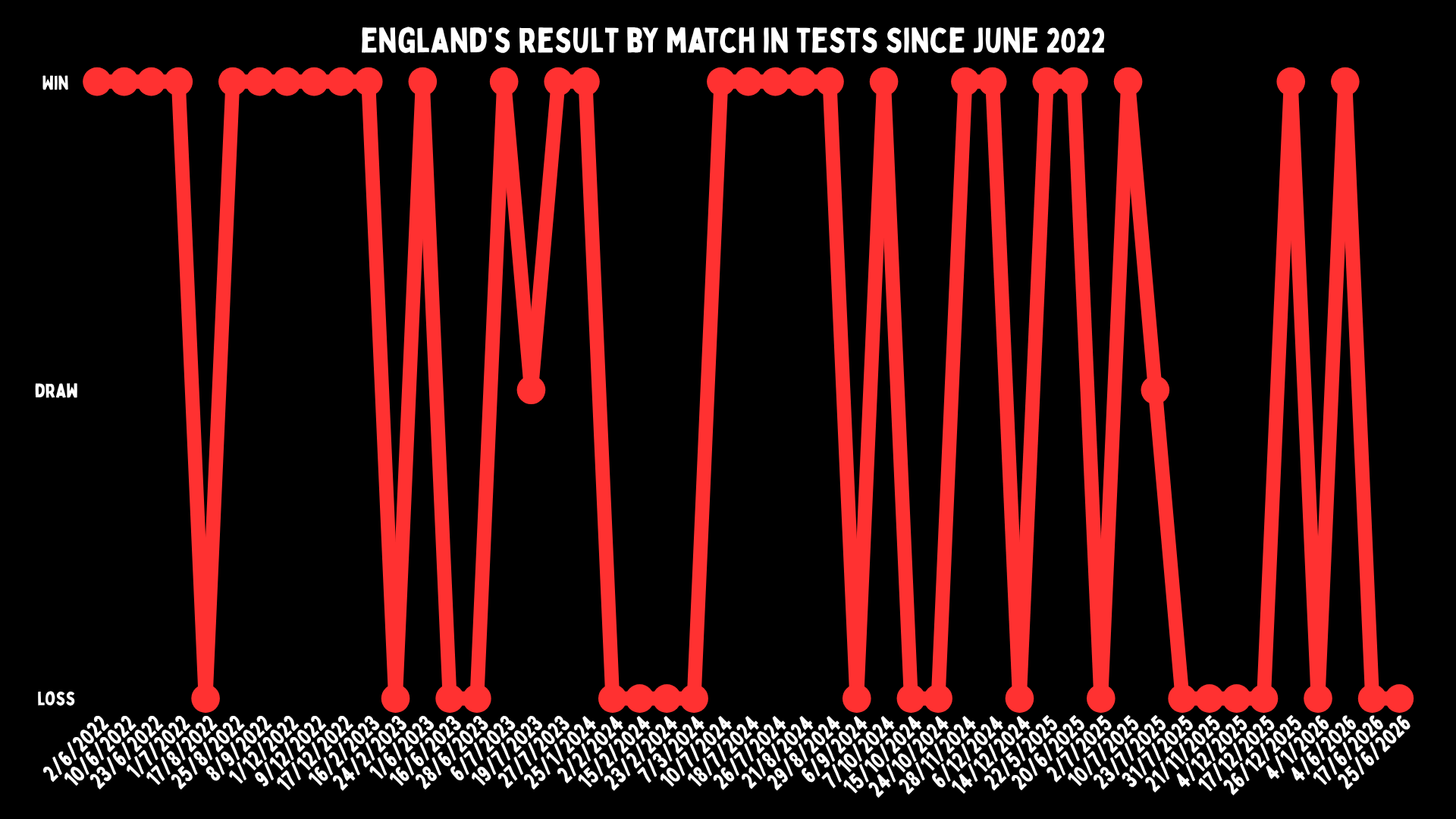
And yet England should have won that Test if not for an epic eighth-wicket stand. The next one turned less on Bairstow’s batting than on his feet, and they still ran Australia close. They won at Leeds. So two close losses and a win, then they started thumping Australia at Old Trafford before rain ended it all.
There’s a version of this summer where England win the series and Bazball goes from a cult to the new national religion. Instead, rain in Manchester turned it into a draw. Ironic, for a team that didn’t believe a match could survive five days without a result.
This is also where “Moral Winners” started doing the rounds. That is the cult in full voice.
But if you go back to the noun, this idea began as a way to fix a flawed batting line-up that was so much better against the white ball. However, by 2023, though, their limited-overs form had fallen off a cliff, and Bazball had become the personality by default: a cult running through every part of the operation.
They were “saving Test cricket” (from whom, exactly, was never clear), and doing it while leaving a string of good-looking corpse innings behind them. Crawley could fail and still get the champagne and cigars. Failure didn’t seem to matter any more. Stories about players being unconscious in bars became routine. The team seemed to exist to win, or lose, as fast as possible, to leave more time for drinking and golf. A side that used to run on analysts and professionalism was now high on vibes and entertainment.
India, like Australia before them, never bought it. These were the same flawed players, with no surprises left in the method - England were by now telling opponents their plans in advance. So when Ollie Pope, the least obvious Bazballer on the roster, engineered a win over India using two work experience spinners, it shook them. India had planned for Bazball twice, and were 0-2. But four matches later, all of India’s plans worked fine, and England hit their first real losing streak.
The belief was starting to disappear.
But then England won a load against West Indies and Sri Lanka the following summer, which they might have even without Bazball. That is the trap, because a team of their ranking should always win these series.

Trimboli’s numbers show England have mostly sat around 3.5 in the rankings since 2000. This wasn’t Bazball working, it was just a better team winning.
But despite the bumps, Bazball was still seen as a big deal. But some of that was that McCullum arrived as a hero before he began. The 2015–19 white-ball era was built on what he’d already done with New Zealand; he won two World Cups before he’d coached an England net session.
By 2024, Bazball had separated English cricket into three camps: the true believers, the cautiously pessimistic, and the suppressive persons.
The believers drank the Kool-Aid as fast as the top order chased totals: every win, real or moral, counted. Simon Jordan had me on his show during the away Ashes still believing, even as England were visibly falling apart. The cautiously pessimistic wanted the dream but with caveats. Essentially Bazball with brains, but couldn’t quite look past the cracks. And the non-believers, some from day one, others peeling off after the New Zealand follow-on or the Edgbaston declaration or somewhere deep in the India series.

What nobody could argue with, even when the team was genuinely bad, was that every single moment was watchable: the most doomscrollable team in the sport.
The second Pakistan tour might be the most important series they played. They could have won the home Ashes. Barely anyone watched the New Zealand draw. Everyone loses to India over there.
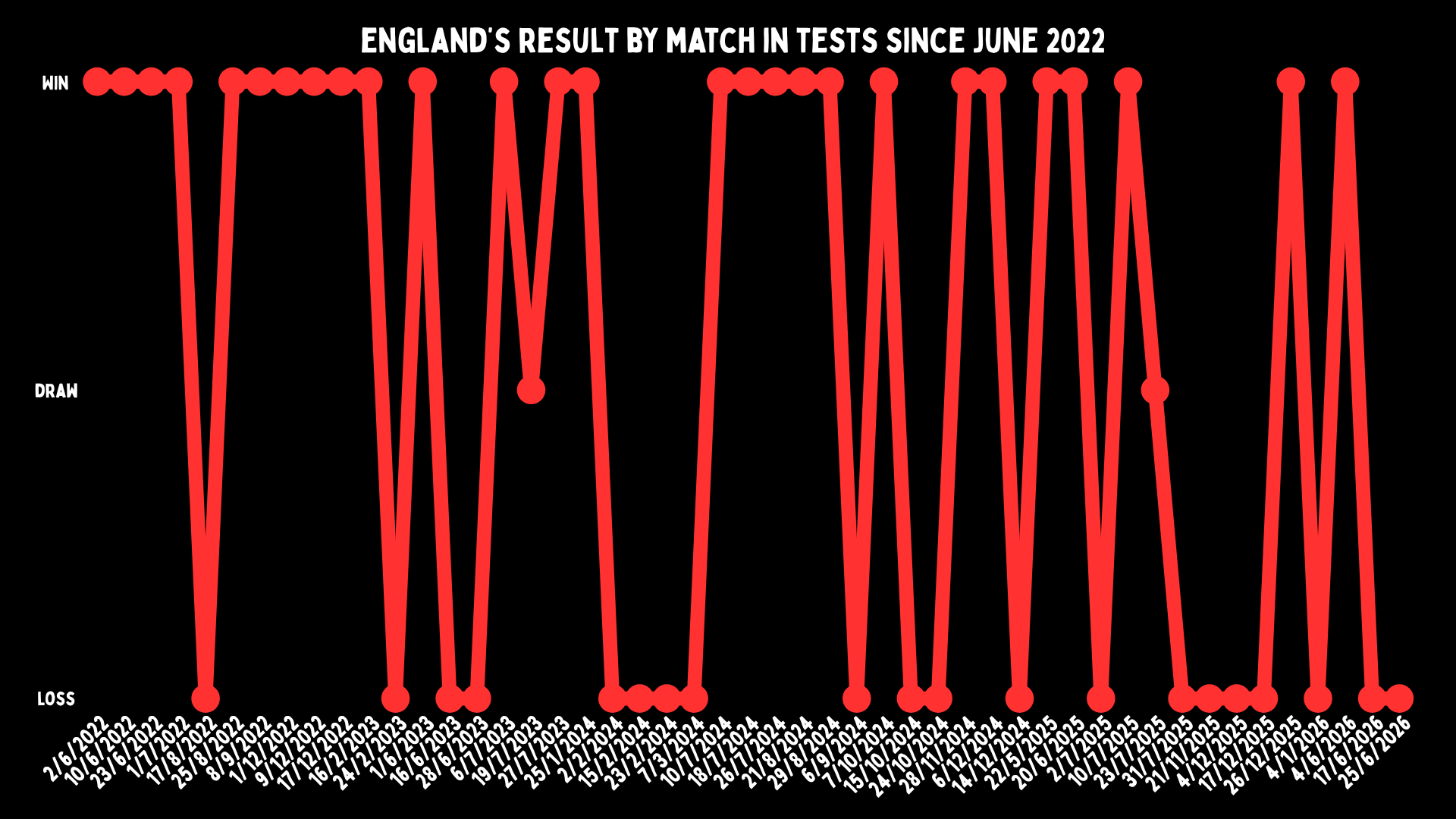
But England did something psychological to Pakistan on that first tour. So when they want back and made 800 runs in an innings in the first Test of 2024, it broke something in the home side. Pakistan responded by going as extreme as England, but with the pitch: patio heaters, giant fans, whatever it took to make it turn.
It worked. The raging pitches shut Bazball down completely, and it looked, for a moment, like the doubters calling this a flat-pitch style of cricket had a point. But by then teams had also stopped being afraid of England, which mattered just as much.
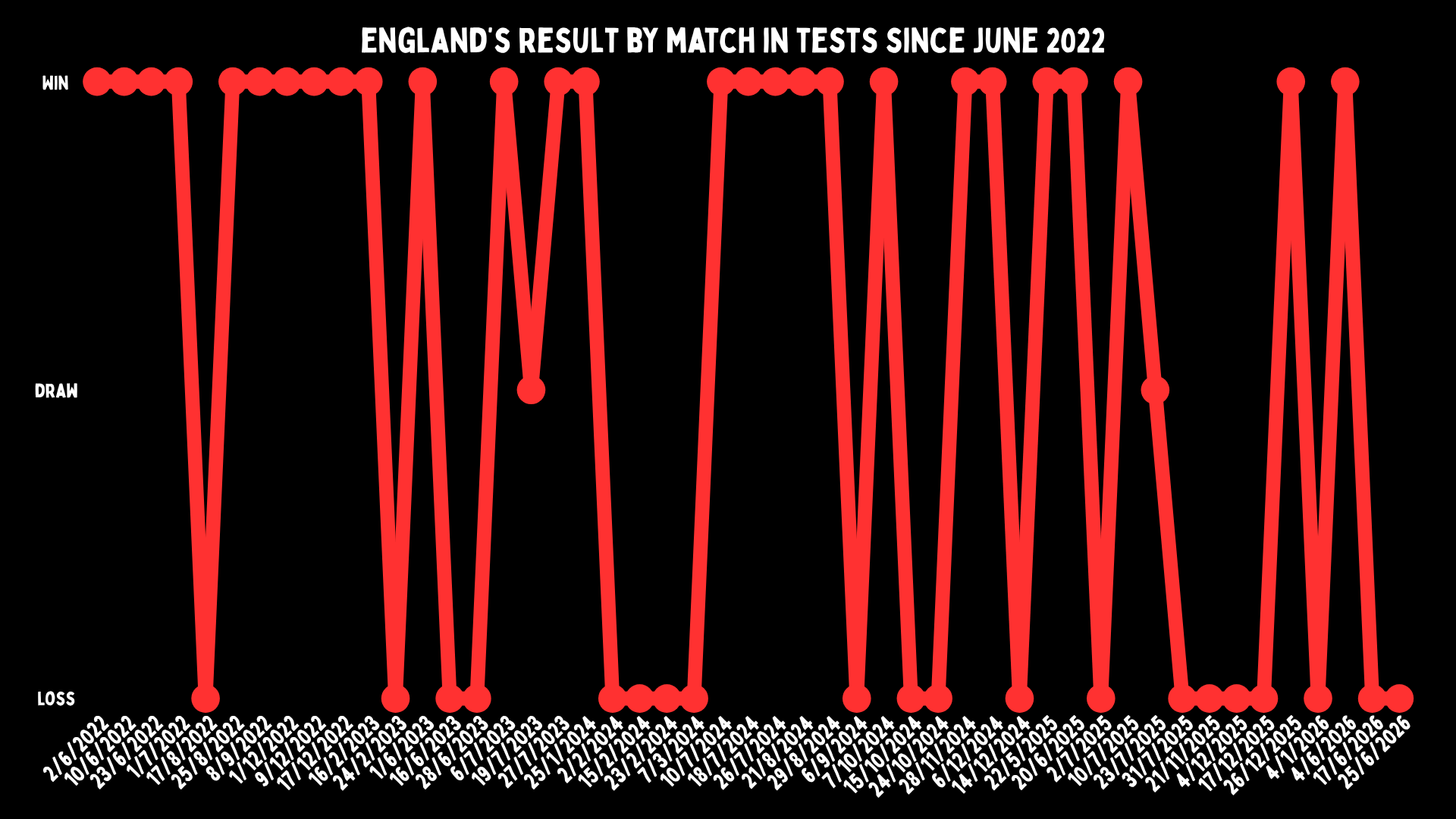
Starting with the Oval loss to Sri Lanka in 2024, England have won eight of 21. The Pakistan series was the tipping point. They got in front of India at home yet never closed it out. Then they went to Australia believing piss and vinegar would be enough, and came home with one of the most embarrassing losses in Ashes history. Not an easy list to make.
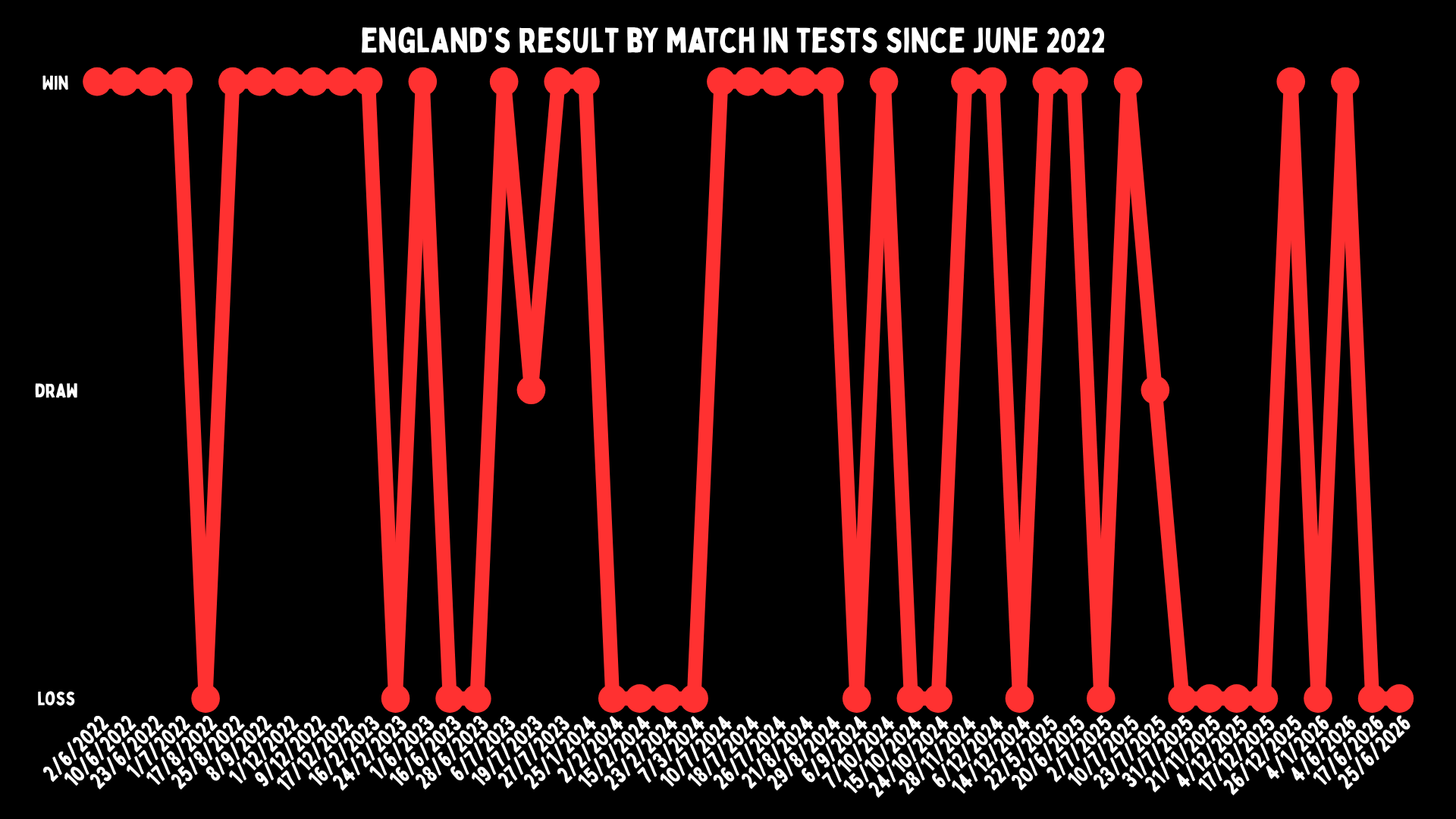
By this stage, the cult was already running out of believers. McCullum’s comments were laughed at, Rob Key’s attempts at justification were pathetic, and Ben Stokes seemed to want to defend with the bat.
The era ended, fittingly, against the team that started it: New Zealand, in a series McCullum’s England went 1-0 up and still lost. Stokes retired, McCullum lasted only a few weeks more. And after all the hype and weirdness, the era was done.
The cult was over.
But the noun lives on.
Since McCullum, runs per over in Test cricket have gone up across the board, and it’s not just the men’s game. The women’s format has sped up too. The entire sport got an adrenaline boost. On the strategic idea alone, freedom, risk, a new way of reading red-ball cricket, I’d argue Test cricket is better for Bazball.


I can’t make the same case for the England cricket team. Their future might be better for having opened themselves up to new ideas. But right now, in the present tense, they still don’t have a settled top three, a spinner, and a bowling attack that fully makes sense. They beat the teams they’d probably have beaten anyway, and lost to the ones better than them. Simple, and somehow also not simple at all.
England put their entire cricket culture in a blender, changed everything that could be changed, handed their cult leader the keys, and ended up, more or less, back where they started.
To understand how, you have to understand him.
***
McCullum leads from the front. He plays hard, on and off the field: part super-human, the kind of man who makes other men want to be him, and makes them believe, for a while, that they can be.
That’s his strength as a coach, and his weakness. He wants a team of micro-McCullums. Almost nobody can actually be him.
But that isn’t the whole story. He’s a genuine tactical genuis, sees the game in ways very few coaches do, even if he can’t always explain how he got there. He was clearly sharper working alongside someone like Mike Hesson, who kept the basics covered while McCullum chased the ideas.
At England, he was paired with another Baz-shaped figure in Ben Stokes. When two men like that are in charge, everyone else follows. He told England he had a plan, and they didn’t just hand him the keys to the house, they signed the deeds over. When McCullum said jump, England launched themselves.
Those jumps were exciting. Genuinely, it was nothing like English cricket had produced ever before. So they went, headfirst, at the boundary, exactly like their hero always had.
When they were flying, it felt like everything English cricket had ever wanted to be.
When they hit the ground, it hurt.
Bazball is dead. Long live Bazball.
Good piece, the only part I disagree with is where it says BM is a “tactical genius”. I don’t think that’s the case at all. His batting, captaincy and coaching has all been incredibly one dimensional - attack and throw caution to the wind. There’s zero nuance. He was batting like that as a kid for NZ in the early 2000s. He just wants to attack and impose himself, it’s force of personality and belief and sometimes it works. But tactical genius it is not. It’s also overlooked that his test captaincy for NZ was not great - 11 wins in 31 tests. He presided over an Australian test series disaster with possibly the strongest NZ team to tour there since the mid 80s and was criticised by Australian pundits for too many funky field placings and bowling changes.