



You may not know it, but this is who every Englishman wanted to be in the 1980s. This is their idea of peak masculinity.
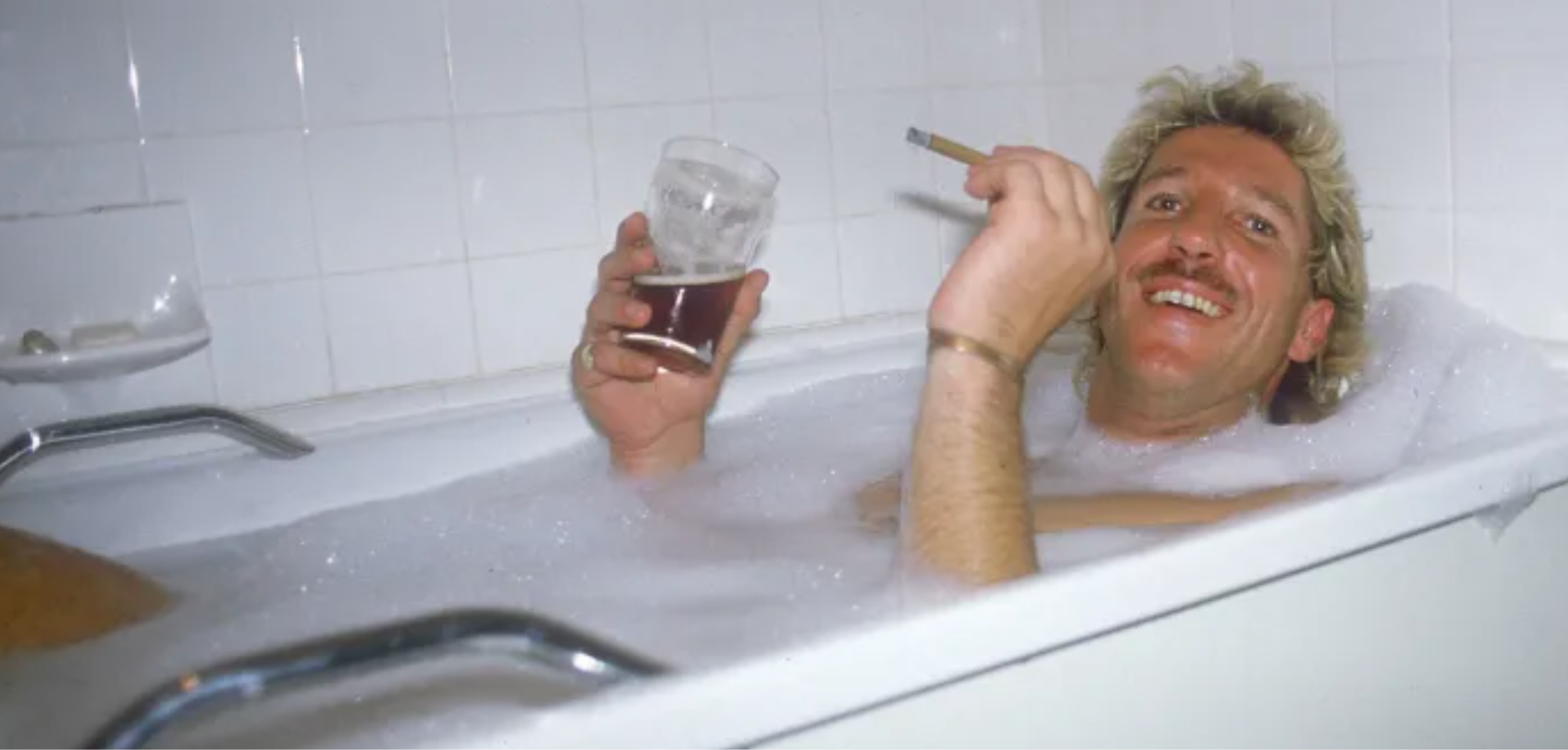
This is the great man explaining how he doesn’t help with his kids. “I was asked if I changed nappies and I said no”. He goes on ,“I spent time on the road in hotels, airplanes, coaches and around the world. If you want to send me the nappies to the post, I’ll wash them and send them back”.
There can be only one Ian “Beefy” Botham.
Yet, England spent all the 90s searching for the next one. Despite the fact that there is only one man in the history of the game with 10 Test hundreds and 15 five wicket hauls. Not only that, Botham actually has 14 tons and 27 hauls.
Botham truly is a one of one. For years, the search for ‘the next Botham’ became a punchline.
However, after him, they only went and found two more world class all-rounders.
Freddie Flintoff was a vibe, before the word was even used. Since retiring, he has arguably become even more famous. He has his own Ashes, and was pretty good in the most famous one too.
Then we end up with Ben Stokes, who mid-career asked James Bond director Sam Mendes to make a film about him.
These men are not famous cricketers, they are famous, despite being cricketers. Bad boys with rough edges and colourful resumes. And when they are good, everyone in the country notices. Three cricketers have won the BBC Sports Personality of the Year award since 1975. Ian Botham 1981, Andrew Flintoff 2005 and Ben Stokes 2019.
The important thing is the years. England all-rounders win Ashes and World Cups, then are given roses for life.
For the rest of the World, England’s obsession with the Ashes is like that one friend that keeps telling you Harry Potter is the best series ever, despite the fact that it is also the only one they have ever actually finished.
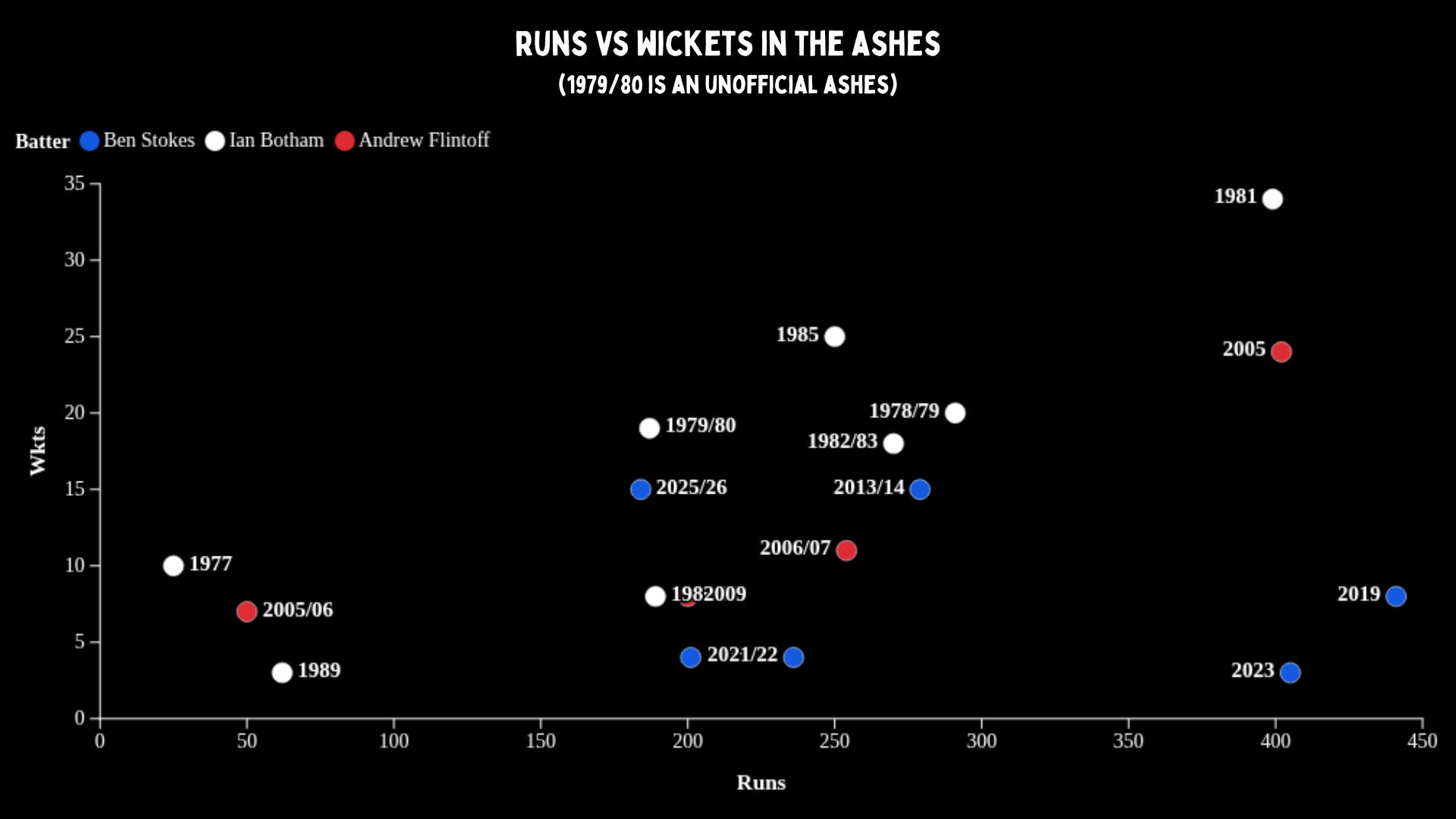
1981 is Botham’s Ashes. His Headingley performance is one of the greatest all-round games we’ve ever seen. The man was a run short of 400, and took 34 wickets. He averaged 36 with the bat and 21 with the ball. He was also England’s leading run-scorer and wicket-taker when they lost 3-0 on the away tour in 1979/80.
Freddie Flintoff had the 2005 Ashes where he scored over 400 runs and took 24 wickets. He was only behind Shane Warne on wickets and Kevin Pietersen and Marcus Trescothick on runs. In 2009, he won the game with the ball at Lord’s on the last day, and ran out Ricky Ponting at the Oval to finish the series.
Ben Stokes at Headingley played one of the greatest innings in Test history. It may not have been the best innings that year, and it still might be the second-best performance ever. He struggled with the ball, though in very Stokes fashion does bowl a grueling 15 over spell at Headingley. That series, which was the same year he helped them win the 2019 World Cup, he made 441 runs at an average of 55 including two centuries. However, unlike the other two, he didn’t win the Urn.
So all three had series and moments that stopped the nation.
This is not the list of the three greatest English players of all time, but this is the group of players that Englishmen most wanted to be. You can say Alastair Cook was a better player than Stokes if you want, but no one who owns a St George’s flag wants to be the opener over the ginger genius.
This is a very special group of players within English cricket culture. They are forever linked. England’s golden talismans. One was a freak, but they somehow cloned two more.
***
On raw stats, Ian Botham clearly has the best bowling average. With the bat, they’re all roughly in the same territory.
But you can’t take averages at face value, especially for all-rounders. They require context.
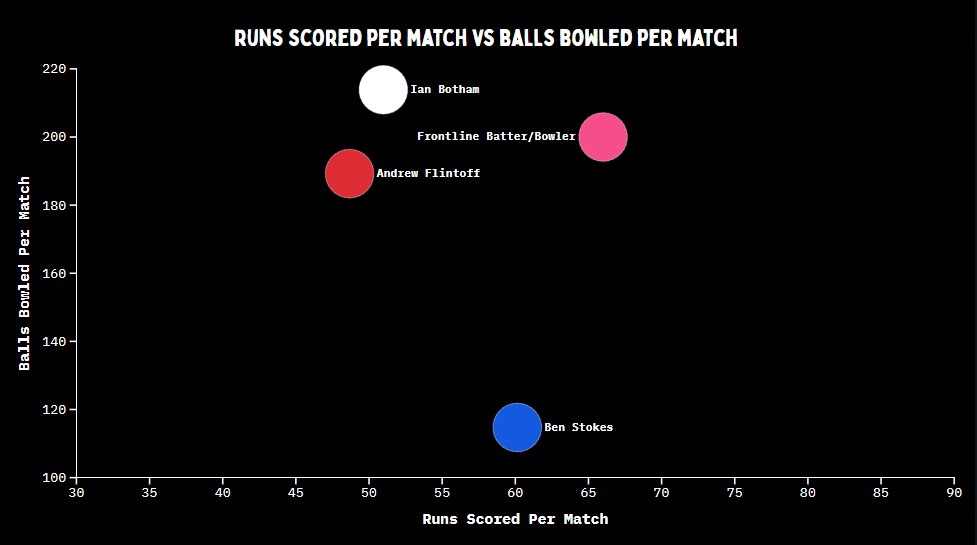
A top six batter roughly scores 66 runs a game. None of them match the baseline, though Stokes is the closest. And he does have a higher innings per Test ratio, so he’s more likely to bat twice in a game. Part of that is down to the era he’s played in and Bazball’s result oriented nature. Flintoff is the only one of the three with less than thirty runs per knock, but they’re all in the 29 to 33 bracket.
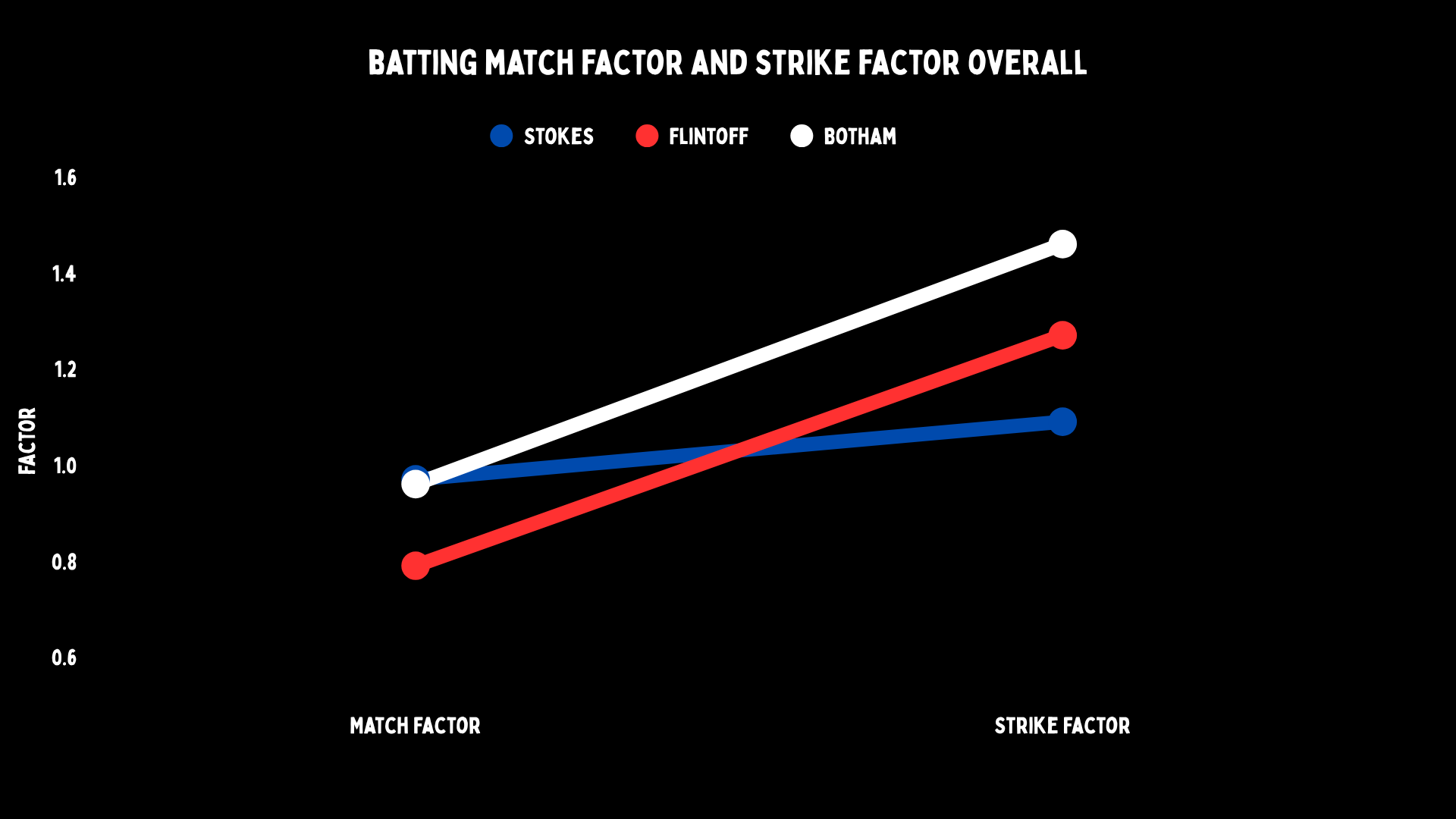
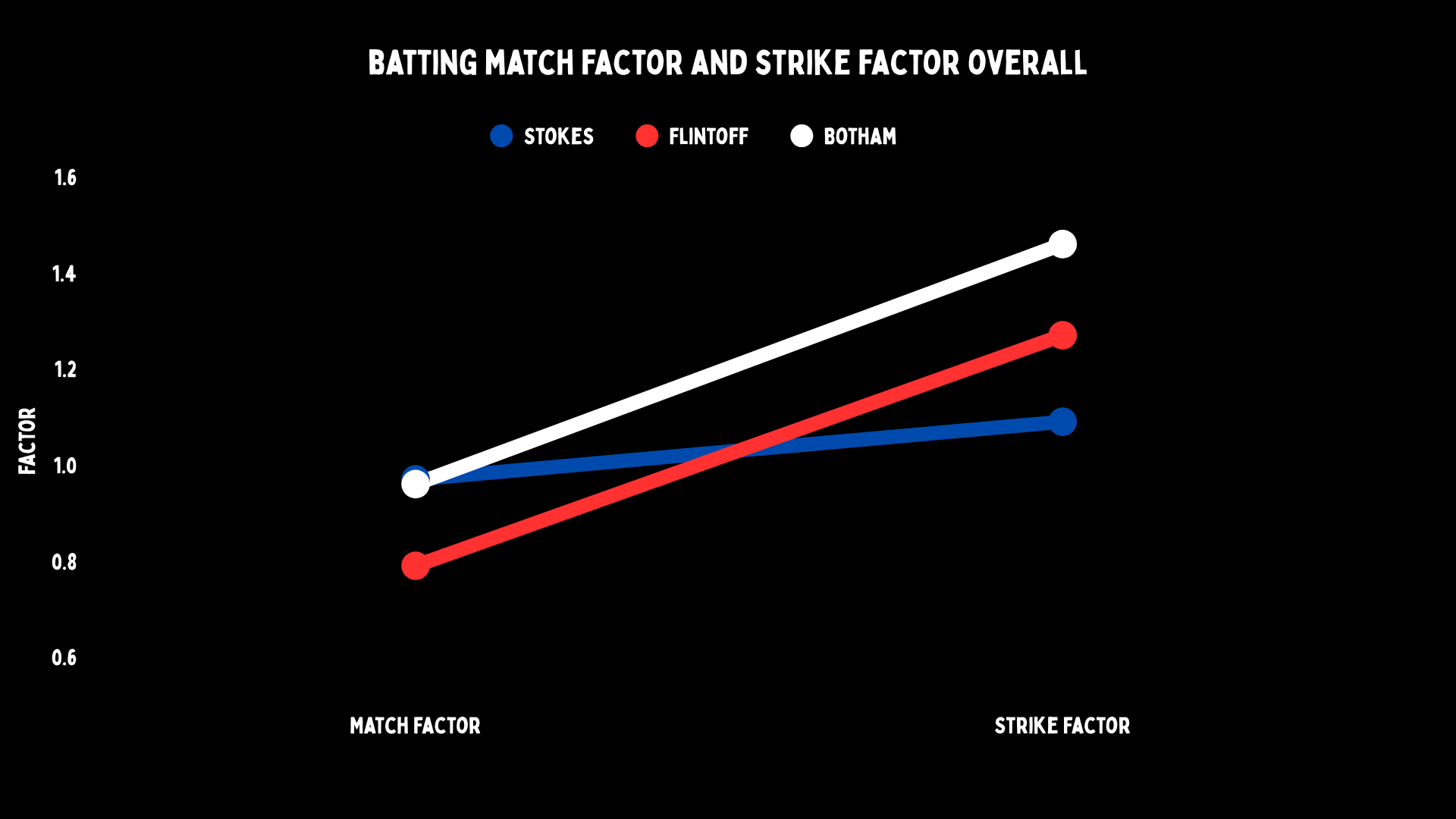
None of them particularly shine on batting match factor either with all being below neutral. Stokes and Botham are both about 0.97 and 0.96 respectively, while Flintoff is 21% worse than the other top six batters in his games. This makes sense; Flintoff had periods where he was a proper batter, but a lot of time he struggled. His average is almost 32, but it was a great batting era.
All three mainly batted at number six. This is very important because an all-rounder at that position allows the team to play five bowlers without compromising the batting. So they accomplished a huge goal, and in Stokes and Botham’s case, without giving much back in terms of batting.
But they were different eras. Botham played when they were keeper-batters, not batter-keepers. And in fact, he played with Bob Taylor, who was pretty much a specialist keeper. Flintoff allowed Geraint Jones to bat at seven. Stokes allowed England to play Jonny Bairstow or Jos Buttler at seven (sometimes both in the same XI, let’s not go there). Botham allowed for a great keeper, Flintoff and Stokes got an extra bowler into the side.
Great all-rounders are shapeshifters, all three of them did that.
Batting in the same position is fine, but it depends on your era or team. It’s very different entering when the ball is soft compared to walking in when the ball is moving. Where ball data is known, only Shakib Al Hasan with a median entry over of 29 had an earlier walk in coming at four down than Stokes’ at 33. For a number six, this is what the US Marines would call, in the shit.
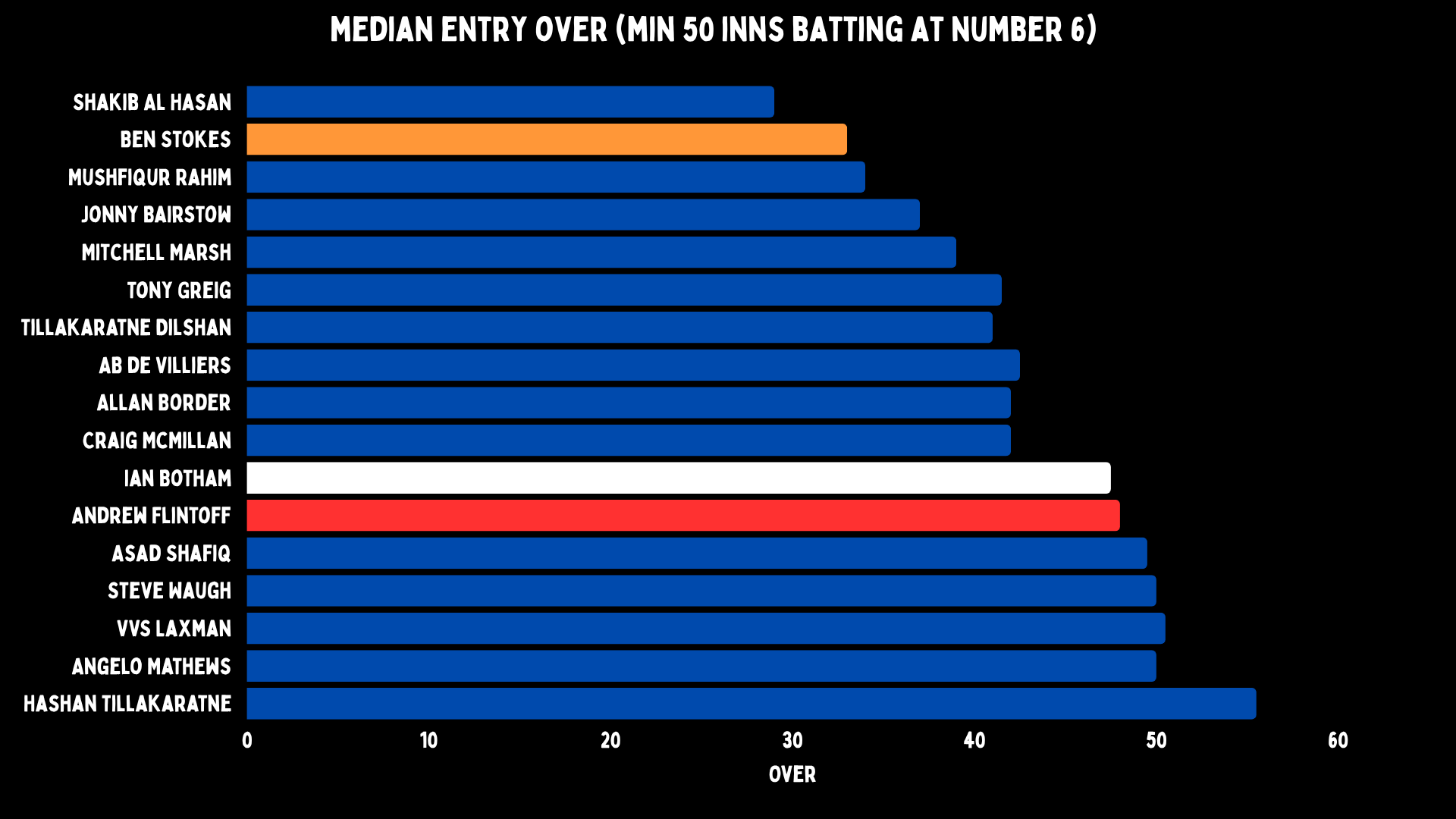
Botham and Flintoff are at around 48 overs. However, due to the prosaic way England played cricket in the 80s, Botham came in when the ball was older, but the scores were almost identical. (For Beefy, 127/4 and Ben’s was 124/4). Both their top fives averaged around 36. Flintoff played with the strongest batting lineup, where they averaged 42. That was England’s greatest modern era with the bat.
They’re all quick scorers, but Stokes is actually the slowest on strike factor. Bazball plays a part in that; he showed them how to attack in the first few matches and then actually went back to his normal speed. Flintoff could smash the ball, but Botham did it the best.
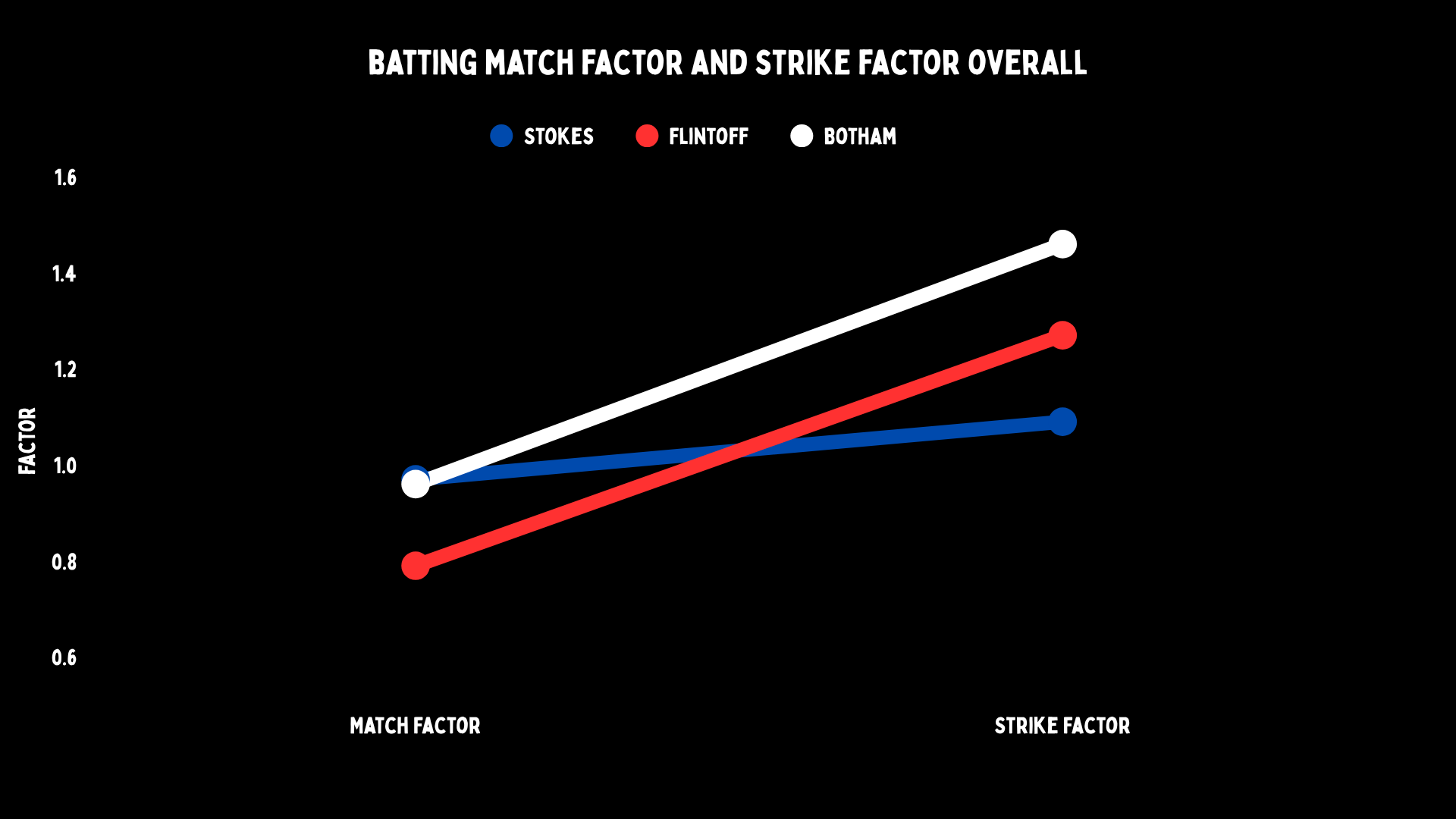
He was a genuine big hitter in an era when only Viv Richards and Kapil Dev smashed the ball harder.
Home and away has a very interesting pattern. Botham was extremely even, while Freddie and Stokes made almost all their runs in England. Stokes is basically a frontline batter at home, but then drops off.
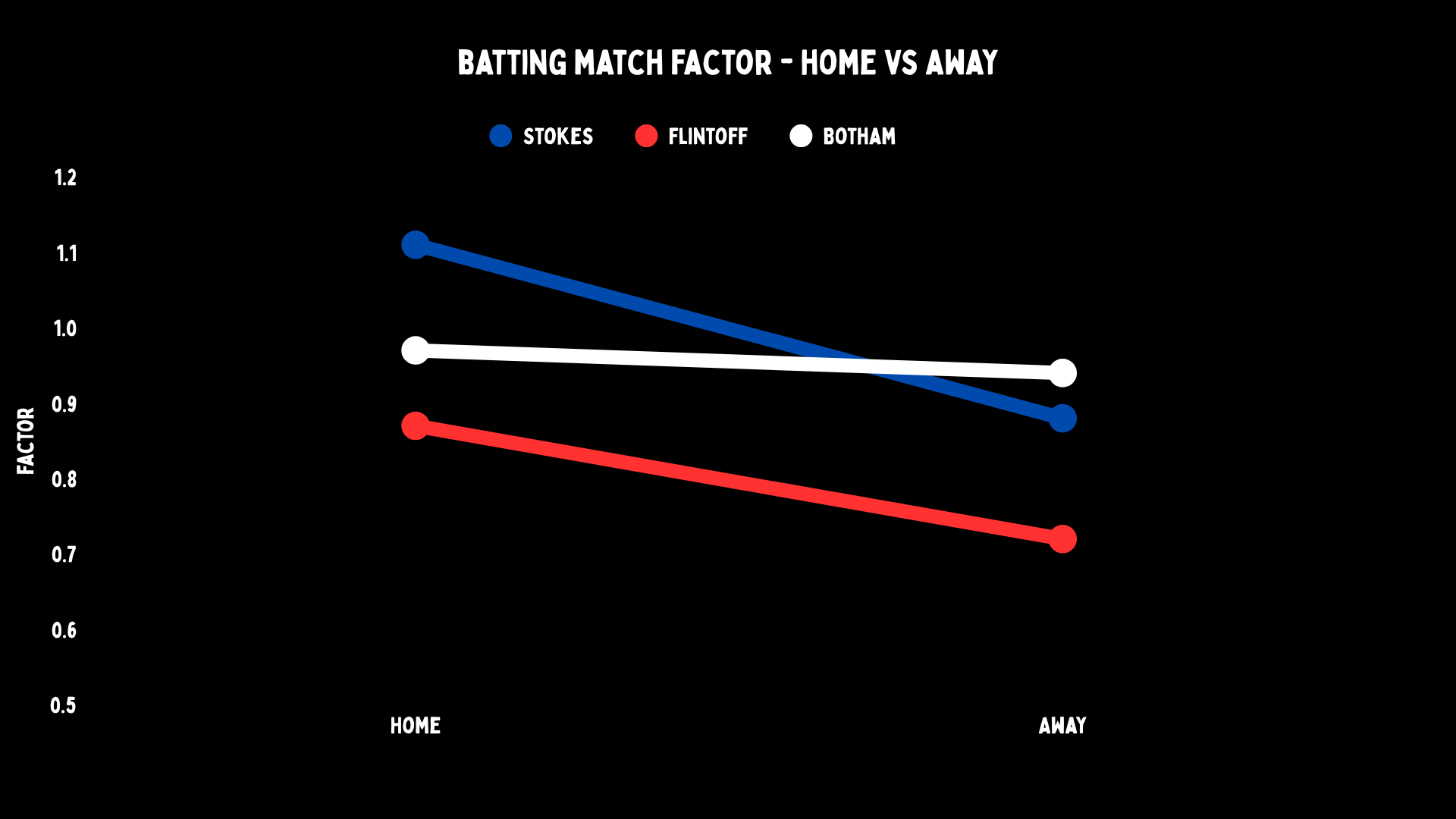
Flintoff was not really an all-rounder on the road, he was more of a handy bat, perhaps like R Ashwin.
One of the key narratives about Stokes is that he performs when his team falls apart. The man certainly has iconic knocks, but how does it stand up over an entire career? He performs 25% better in the games where the average is under 30, and you’d certainly take that from your all-rounder. He did like it, in the shit.
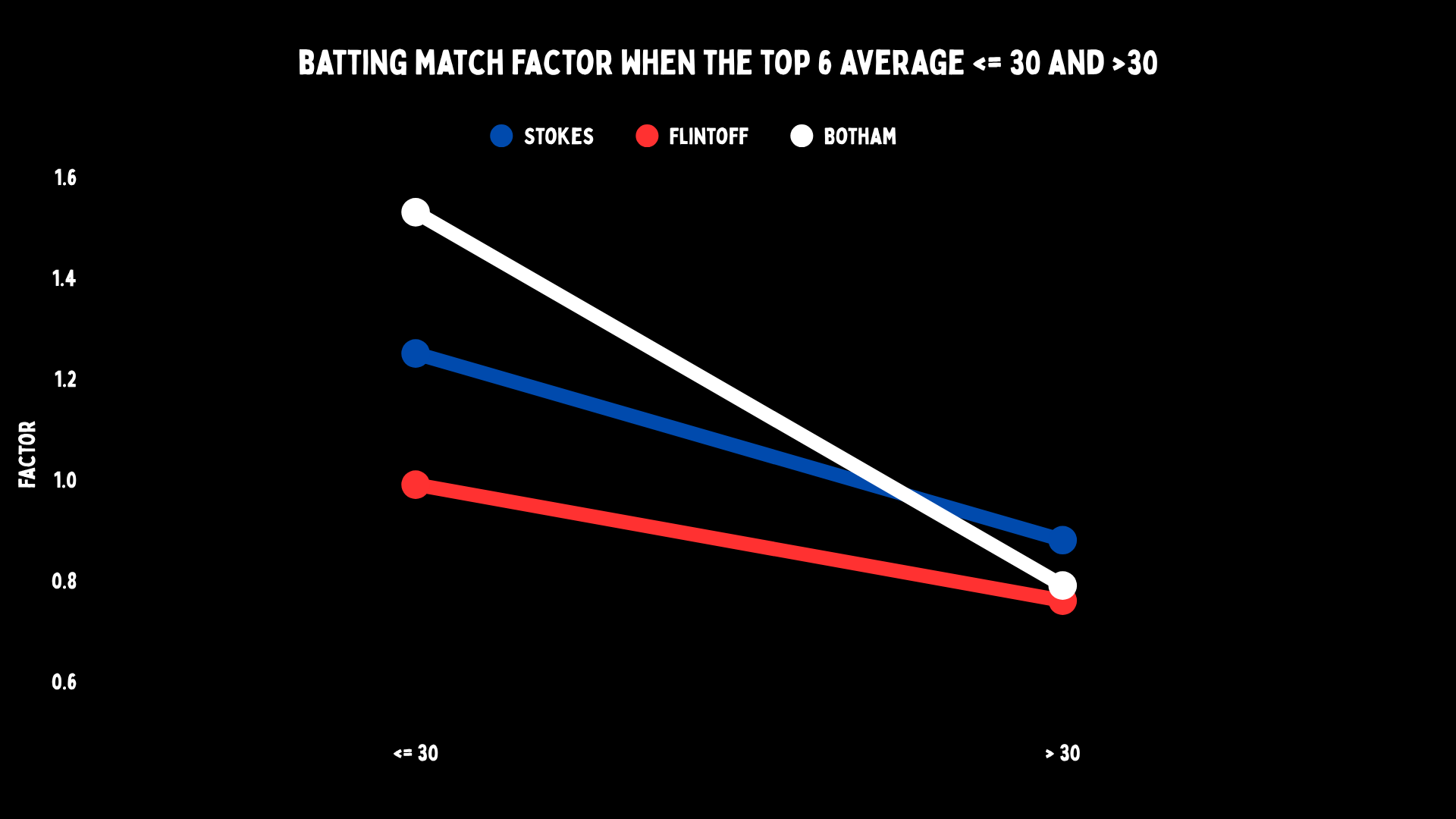
But Botham did it even better. And of course, Headingley 1981 will always be famous for his 149* after the follow-on.
But notice how none of them are great at cashing in when the others also make runs. And that is an important skill for any frontline Test batter, even if it is considered statpadding. The difference between mediocre batters and greats often comes down to the ability to statpad.
All three of them needed drama, juice and energy, otherwise batting got a little boring or mundane to them. They wanted to have to put on their capes to save the day.
Australian Keith Miller was famous for only trying with the bat when needed. So this is a popular all-rounder trait.
