



More teams have left the IPL. A team won a lot of games in the first half, then sort of mirrored that in the back half and couldn’t make it.
We have interesting teams to have a look at. Why they didn’t win this year, whether they were supposed to this year, or how well they did towards the end and it didn’t matter anyway.
This is part two of the IPL Exit Interviews.
CSK
Chennai Super Kings were involved in the biggest pre-season trade, as they bagged Sanju Samson in exchange for Ravindra Jadeja and Sam Curran. The deal was made official in November 2025, so well before his Player of the Tournament at the T20 World Cup. We said in last year’s exit interview that they had some exciting mid-season signings, plus they signed two young Indian talents - Kartik Sharma and Prashant Veer - for a combined sum of INR 28.4 crores. They were missing Nathan Ellis though, which made us worry about their death bowling.
They were close to a par batting team in the middle and death overs, but in the first six they were 20% short of par on our team map ratios. That was mainly down to skipper Ruturaj Gaikwad having the worst IPL season of his career. Specifically in the powerplay, he went at under 130 and was dismissed every 19 balls. Even Sanju Samson, who had a solid year overall, got past the powerplay only four out of 14 times. Ayush Mhatre and Urvil Patel gave a bunch of brisk starts, but their output wasn’t enough to make up for the big names faltering.
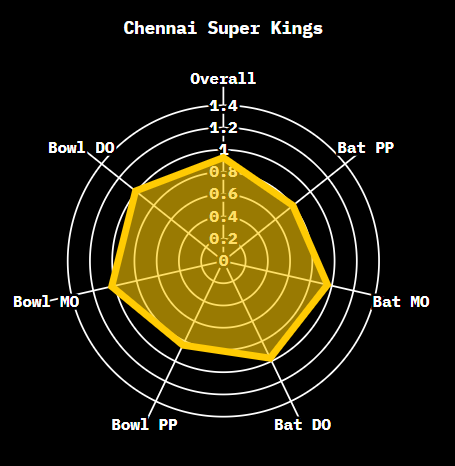
Of course, Samson was their best middle overs batter when he made it there, but the one who spent the most time was Kartik Sharma. He was slower than the mean in that phase, but he did hit sixes - 13 of them in 164 balls. However, he would often struggle to get off strike. They got sufficient game time from a young player they seemingly rate, so that’s a plus. Shivam Dube, Dewald Brevis and Sarfaraz Khan were disappointing.
Dube did get much better at the death, scoring 120 off 66 balls for only two dismissals. Kartik and Samson were also good for the limited deliveries they faced in the final four overs.
CSK struggled in the powerplay on the other side of the ball too. They only took 16 wickets in this phase across the league stage, which was equal to Kolkata. And only Delhi struck fewer times. Mukesh Choudhary was their most impressive quick. Anshul Kamboj bowled the most, but he went at more than ten an over and struck once every 25.4 deliveries. Khaleel Ahmed (before his injury) and Akeal Hosein choked the flow of runs. Matt Henry and Spencer Johnson combined went for plenty.
Their middle overs bowling was the highlight of the season, thanks to Jamie Overton and Noor Ahmad. They combined for 23 wickets between them, both going at around eight an over from 7 to 16. Akeal was impactful again, Gurjapneet Singh bowled a fair bit but was under-par both on true economy and wickets. Mukesh was also frugal in this period, though Kamboj went for runs.
Kamboj and Overton were their main bowlers at the death. The former took loads of wickets - 13 of them in 20.1 overs, and was a plus on economy too. Overton didn’t take bags of wickets, but he was more miserly.
They had a 4-3 record at home, defending totals versus DC and KKR and chasing against MI and LSG. Two of the losses were against GT and SRH, who have made the playoffs. So it was certainly better than their away run, but not even close to their most dominant years when they used to win over 70% of their matches at Chepauk.
Their bowling actually held up better than expected coming in, and their core batters were pretty much a let down outside of Samson, who himself wasn’t as consistent as you’d expect your star player to be.
Much like Rishabh Pant and Hardik Pandya, Ruturaj Gaikwad’s captaincy has been under the scanner as well. His own lack of intent with the bat - especially against SRH in a high-stakes clash - was a major talking point. Also, why did they keep benching Akeal from time to time?
To be fair to the CSK management, they had to deal with injuries throughout the year. And they did perform better than last year. But not making the playoffs thrice in a row is a failure for a team whose entire brand was making them regularly.
DC
Delhi’s biggest buy at the auction was Auqib Nabi, who has been the most successful first-class bowler for India over the last couple of seasons. He also had a solid SMAT season. Apart from spending INR 8.4 crores on him, they acquired the likes of Pathum Nissanka, David Miller, Lungi Ngidi and Ben Duckett (who pulled out). They perhaps got Nabi to fill the gap in their new ball bowling, but they again didn’t have a proven high-intent powerplay batter to partner KL once Duckett was out. Of course, Mitchell Starc also joined after the first eight games.
A bit like CSK and KKR, Delhi’s weakest spot this season has also been powerplay batting and bowling. They are a staggering 23% worse than expected, which adds up given they’ve lost lots of early wickets while still scoring at a slow pace. While KL Rahul had a solid season overall, he only struck at slightly more than 150 in the first six overs. Pathum Nissanka was better than him in powerplay, especially as he kept finding fours, but he’s a batter of the same profile as KL and not an uber-attacking opener. Nitish Rana also struggled to get off strike or find the boundary.
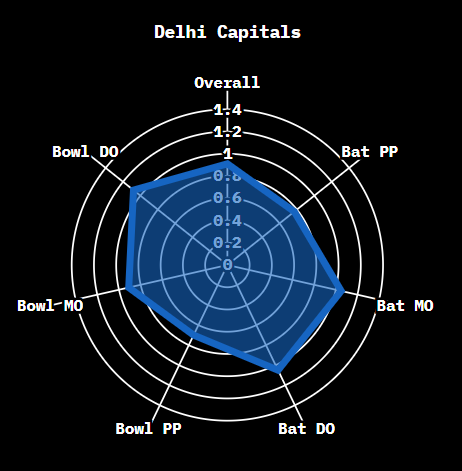
And Delhi had overlapping roles in their middle order too with both David Miller and Tristan Stubbs, who we have now established as finishing anchors. Stubbs was excellent at rotating strike, but he simply did not hit boundaries from overs 7 to 16. Miller was above average at hitting fours and singles, but under-par at the rest. The fact that they’re 5% ahead of par in this period is mainly thanks to KL Rahul’s outstanding season in the middle overs. Sameer Rizvi is a slow starter, but he played a couple of match-winning knocks in the first two games of the league, and Nitish Rana was also useful in this phase thrice.
In the final four overs, they are 5% better than par. Miller ups his strike rate big time, while Ashutosh Sharma is their highest and fastest run-getter here. Crazy that the latter wasn’t always a starter. But Stubbs again is below par on boundaries, which his true strike rate of -15 reflects quite well. That’s surprising when you consider that he hits at the end.
Lungi Ngidi and Axar Patel stemmed the flow of runs in the powerplay, but neither of them were strike bowling options. Mukesh Kumar, Auqib Nabi, Mitchell Starc and Kyle Jamieson all had a true economy close to or worse than -1.
Axar and Ngidi were also their best bowlers in the middle, but nobody else had that level of impact. Kuldeep Yadav struggled to contain and take wickets, while T Natarajan went at more than 11 and a half runs per over.
Their death bowling was the most productive phase. Ngidi was again the standout, conceding less than eight an over. Natarajan’s relative and raw numbers also improved at the back end. Mukesh was expensive, while Starc was 7/63 in 6 overs.
Their fielding was also shoddy. Cricket by JB’s Praatibh worked out that they had the second-costliest drops in the competition at the halfway stage. It’s also worth mentioning KL Rahul’s wicket-keeping wasn’t the most efficient either; he often fumbled and missed run outs.

Delhi have a pathetic 2-5 record at home; the worst in the entire competition along with Mumbai and Lucknow. They won their first and last games, but went winless for five straight matches in the middle. That was a huge dent to their playoff chances this year. Coach Hemang Badani clearly said they did not have control over the home wickets.
Madhav Tiwari played for Delhi towards the end of the league stage, and he looks like a solid option worth investing in. He can potentially provide them the balance they miss, especially if Axar’s batting is a concern next year too. Sahil Parakh is a young but high-intent batter, so it will be interesting to see what they make of him.
They have not made the playoffs since the IPL became a ten team league in 2022. But apart from 2023, Delhi are pretty much stuck as a mid-table team. They’re consistent, but consistently mediocre. If they want to break this streak for good, they really need high-impact players at the top on both sides of the ball.
KKR
KKR came to the 2026 IPL auction with the highest purse. Their big money signings were Cameron Green, Matheesha Pathirana and Mustafizur Rahman. We know why Fizz didn’t make it, but Pathirana ended up bowling only eight balls this year. Their main Indian quick, Harshit Rana, was also ruled out. They got Finn Allen and Tim Seifert for 3.5 crores combined - an absolute bargain after the T20 World Cup. However, they never really paired the latter two together, as Ajinkya Rahane was the captain.
Their weakest phase with the bat was the powerplay, where they were 22% worse than expected. Rahane faced the most deliveries, and struck at less than 130. Angkrish Raghuvanshi and Cameron Green were also slow at the start. Finn Allen was dropped after the first five matches, where he made 81 runs at 193, but he played two huge knocks after he was back. He struck in the 180s in the first six overs, but it came at the cost of nine dismissals during the field restrictions.
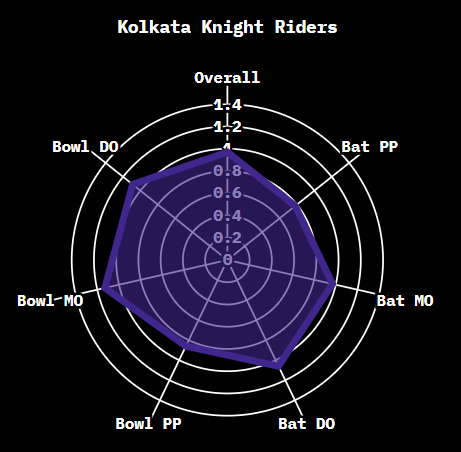
KKR’s major concern in 2025 was their middle overs batting. According to our team maps, this time they performed 3% worse than the mean in those ten overs. But the craziest stat here is that Allen scored 142 off 50 balls the two times he made it past the powerplay. Raghuvanshi scored the most runs, while Green was also really solid. Though Green’s running between the wickets was pretty terrible at times. However, Rinku Singh, Rovman Powell, Ramandeep Singh and Rahane would often get stuck.
And in truth, they had three incredible games in the middle overs, but they were far from flawless.
Rinku, though, was their best batter at the death. He added 154 runs off 76 deliveries without being dismissed, and he even bailed his team out of trouble twice. Green only scored at eight an over, while Raghuvanshi went at more than two runs a ball.
Similarly, Kolkata failed to put the pressure back on with the new ball. Vaibhav Arora was their highest-usage bowler, and he neither saved runs, nor took plenty of wickets. Narine contained runs (again), while Tyagi took a few wickets but was expensive. They also used Green here, and that didn’t work out either. 28-year-old Saurabh Dubey looks like an exciting option for the future though.
The spin duo made it really hard for teams to score off them in the middle overs, while Tyagi was also at his miserly best in this phase. Anukul Roy and Green also took wickets, which meant they were still strong from overs 7 to 16. It’s fair to say this drove their comeback to a large extent.
True stats love their death bowling too, but I think that’s more of a mixed bag. They’ve often entered here when the game is either already lost or won. Arora was their most economical bowler at the end, while Tyagi was more hot and cold.
At home, they had a 3-3 record plus a washout against Punjab. They beat two eventual playoff teams in RR and GT, and won against MI too. LSG was a game they could have won if not for Mukul Choudhary playing an otherworldly knock. But SRH smashed them by 65 runs, while DC also got over the line by 40 runs (albeit in a dead rubber). They were 2-4 at home last time, so they got one extra win. But that’s clearly not enough to challenge for a playoffs spot.
I think Green had a promising year overall, and there aren’t loads of all-rounders around. So they need to decide if they want to back him, or if they can change their overseas combinations - because they’re spending a lot on him. But they also really need to invest in new ball batting and bowling, plus a spin-basher for the middle overs.
Maybe the change needs to start from the top. If they move on from Ajinkya Rahane, maybe they could actually field the opening pair that played a big role in New Zealand reaching the T20 World Cup final.
PBKS
What even happened here? But before we try to break down the madness, let’s look at what they did in the auctions.
They almost ran it back. However, they didn’t have Josh Inglis, who played a pivotal role at No.3. Instead, they signed Cooper Connolly, who played in that position the entire year. Ben Dwarshius was their other major overseas acquisition.
Team maps suggest that they were 18% better than par in the batting powerplay. On raw numbers, they’re not massively different from SRH. They did lose three wickets in this phase thrice during their losing streak - versus GT, SRH and RCB - though.
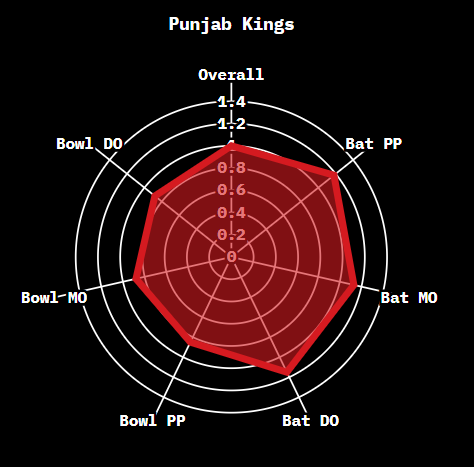
Priyansh Arya averaged 32 at 214. Prabhsimran Singh only got out four times in this phase and scored at ten an over. Connolly was a very slow starter though, striking in the 130s. And usually Shreyas wasn’t at his best either when he was in early.
But Connolly improved big time once the field was spread out. Prabhsimran didn’t always stay in for too long, but he also continued to go for it. However, their best middle overs batter was Shreyas Iyer, who had a balls per dismissal rate of 42 and had a strike rate of 176. Suryansh Shedge also played a great knock in this part of the innings. Hence, it was another productive period for them.
At the death, Marcus Stoinis slapped the ball around at 236, while Shashank Singh almost made two runs a ball. Connolly also scored really fast from limited deliveries, though most of it was in the game he got a hundred when it was pretty much over. But Shreyas didn’t score at the ruthless rate he did last season, and Marco Jansen didn’t step up either in this period.
So their batting was largely not a concern. But there are some things to look at like Connolly starting slow, or teams working out how to plan for Arya. Suryansh Shedge was also a positive for them, and they made that change once Nehal Wadhera clearly looked out of sorts.
However, their bowling was a mess. They were both expensive and not striking enough with the new ball. Arshdeep did take 7 wickets in 28 overs at an economy of 9.3, but the rest combined for 10 in nearly double the overs.
And their woes continued through the middle as well. Only Yuzvendra Chahal was able to strike consistently - despite all the drops off his bowling - and not be too expensive. Once again, Jansen or Xavier Bartlett just didn’t take enough wickets. And Arshdeep or Vijaykumar Vyshak didn’t have a great time either.
Each of Arshdeep, Jansen and Bartlett - their top three bowlers at the death in terms of usage - conceded more than 11 an over. Plus Ferguson also went for 56 in his four. Vyshak was the only promising bowler here.
Punjab had a 3-4 record at home, but importantly three of those losses were at Dharamshala. The Delhi and Mumbai games were close defeats, and had they won one of those, they might have been in the top four once again. Even against RR at Mullanpur, it wasn’t a straightforward loss, though their first win against GT at the same venue also went down to the wire.
Another thing that passed everyone’s eye test was their terrible fielding. Let’s go back to Praatibh’s piece, where he says their drops were the costliest after the first half of the league stage, but they also shelled them the most. Shashank Singh in particular did not have a good time.
I don’t think they need to be reactionary with their batting, but they really have to sort out their bowling. Remember, they’ve spent 36 crores on Arshdeep Singh and Yuzvendra Chahal combined, and they honestly haven’t given those levels of returns across both seasons. And if Stoinis doesn’t add much with the ball, isn’t 11 crores overspending? Marco Jansen also hasn’t yet maximized his talent in white-ball cricket, so they’ll hope they get a great year out of him too next time.
The best way to sum up Punjab Kings’ season is that they had the best batting RPO and the worst bowling run rate at the end of the league stage. They went from 6 wins in 7 to losing as many on the bounce before they finally won their last one. But their fate was then in the hands of the other teams, and Rajasthan made the cut ahead of them.
And that is why they truly deserved that fifth spot.