



If you are old enough to have found yourself in a couple of jobs, you will understand what an exit interview is. When you start, there is so much hope and excitement. But exit interviews are the coldest cup of coffee being poured on your head just before you give up your security pass and are escorted from the premises.
That is what we provide here. Cold cups of coffee on the coldest teams in the league.
Where did it all go wrong? Did it ever go right? And what can they do next year?
Welcome to the LSG and MI exit interviews.
LSG
Before the start of the season, the big LSG question was about the bowling lineup they would eventually assemble. They had signed Wanindu Hasaranga for INR 2 crores at the auction, but a hamstring tear meant he was out.
While their powerplay batting looks ridiculously good on this team map here, there are meteor-sized caveats. Against MI, RCB and CSK from May 4 to 12, they made 90/1, 68/0 & 91/1 in the first six overs. But before the Mumbai game, they had already lost six out of eight, which then became seven in nine. Not to downplay those efforts, but was it perhaps a bit too late? In fact, the opening pair of Mitchell Marsh and Aiden Markram did a solid job last year, but we only saw them at the top four times this season. Josh Inglis coming in when they were all but done for the year certainly hurt them, as he could have played instead of the out-of-form Nicholas Pooran.
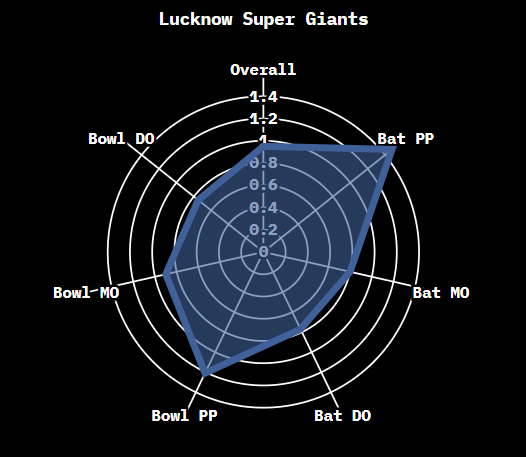
Last year, we said in the exit interview that they overperformed thanks to Nicholas Pooran being incredible early on. We also added that it’s basically impossible for Rishabh Pant to have that bad a year. Well, the latter ended up happening again, and now there’s a massive question mark on his T20 utility.
Combine that with Pooran’s all-time poor season, and your batting lineup is a staggering 20% worse than par from overs 7 to 16. Till the time they were mathematically alive in the competition, none of their batters struck at 150 in that phase. Even at the end of the batting innings, they often lost wickets and were also not able to accelerate. Though Mukul Choudhary did win them a game out of nowhere at the death.
Visiting teams have really struggled in the powerplay when they’ve come to Ekana. The bowling ratios show us that their pace attack was a real threat with the new ball. Mohammed Shami stepped up as the veteran, but the find of the tournament was Prince Yadav. Of course, Mohsin Khan was also dangerous in the limited games he played, but we remember his 2022 season as well.
Prince was excellent across phases, but LSG as a bowling unit couldn’t back up their new ball impact afterwards. Digvesh Rathi had a terrific first season, but this time he was more expensive and didn’t strike as often. Mayank Yadav also didn’t appear to be at his absolute best this time, though he barely played - two of his games were after they had the E next to their name. And Avesh Khan also struggled a lot.
At home, they went 2-5 last time, and this time too it’s 2-4. They lost the first four, before finally beating RCB and CSK - the latter once they were officially out of the league. They couldn’t chase 160 versus RR, and even though they took early wickets against Delhi, that ended up being a comfortable win for the visitors. Perhaps the KKR super-over game could have swung their way, but in truth, they never looked like they had a proper chasing template in that game.
Honestly, the biggest issue was just that they had Mohammed Shami at No.8 for the majority of the year. That’s just too shallow a batting lineup in the impact sub era, especially when two of your major players are horribly out of touch. You need to plan much better for these scenarios, though perhaps a fit Hasaranga would have helped with that.
So what happens next year? Is Rishabh Pant better off without captaincy? And have we just seen too many cooks in the LSG camp? Maybe they need their owner to scold them more.
Their new ball bowling was strong, and they’ve got heaps of Indian quicks. But the major concern still is that they lacked an identity; if they are a bowling team, surely that has to continue after the fielding restrictions. All year I asked, how is this team trying to win games. And next year, they need an answer to that.
MI
Mumbai Indians came to the tournament with one of the strongest teams on paper. They didn’t change their core squad - which made the playoffs - from last year, adding Sherfane Rutherford, Shardul Thakur and Mayank Markande via cash trades, and Quinton de Kock in the auction.
MI didn’t have a positive impact with the bat in the first 16 overs of the innings. Their overall stats in the powerplay actually look better than the team map here shows, but the true values don’t love them because Wankhede has been a high-scoring venue.
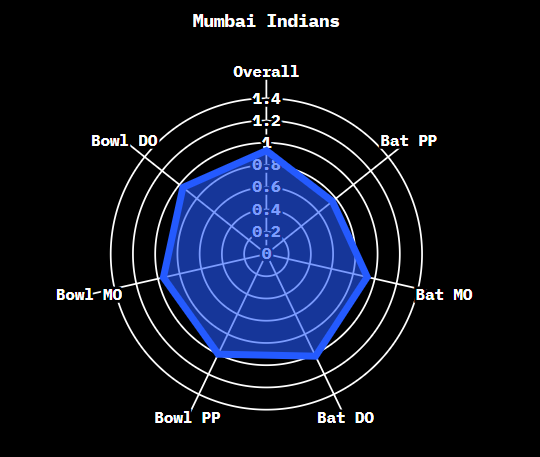
In the five games Rohit was out, they tried three different opening partnerships, and only once did they get off to a strong start. Occasionally, one of the openers (mainly Ryan Rickelton) carrying on has bailed them out in the middle overs. And one reason for the slight plus at the end has to be Tilak Varma’s incredible acceleration when he made a hundred.
The only side with better new ball numbers than them last season was the title-winning RCB. Trent Boult and Deepak Chahar took early wickets at solid economy rates, but this time they combined for 3/197 in 16 overs till they were officially eliminated from the tournament. Hardik Pandya also conceded nearly three runs per over more than expected.
AM Ghazanfar was their only real wicket-taking threat early on. That, plus Bumrah still not being hit might be why MI are 2% better than par in the first six overs according to the team maps. On raw numbers, their economy was the worst for any team till May 12.
MI were also an incredible middle-overs bowling unit last time. Again, Mitchell Santner was solid till he was around, but Hardik didn’t strike as often, and Jasprit Bumrah just wasn’t close to that level.
Even at the end in 2025, they had both Bumrah and Boult firing. This time, they’ve struggled with wickets in final overs, but they also haven’t contained as well as in previous seasons. And in truth, it’s hard to do much at the end if you’re already behind the game by then.
If there’s a fact that tells us a lot about their chaotic year, it’s that till the RCB game, Corbin Bosch was their highest wicket-taker among the quicks. Yes, the same Bosch who only bowled 55 deliveries till then.
They had a 2-4 record at home, beating KKR to begin the season and LSG later on. They chased pretty well in those games thanks to the opening pair of Rohit & Rickelton. But arch-rivals CSK thrashed them by more than 100 runs, they failed to defend 195 against PBKS and 243 versus SRH, and even the RCB loss appears to be. Last season they went 5-2 at Wankhede, so it has been a pretty significant drop-off.
But essentially, the two biggest differences from that year were Suryakumar Yadav and Bumrah going from all-time great level years to not even ending up with par performances. SKY carried them in the middle overs, and Bumrah was an all-phase unicorn in 2025. But this time, he just struggled to pick any wickets across phases, even though scoring off him was still difficult.
There is still not a clear answer as to what Tilak’s ideal entry point should be - perhaps hitting pace at the death? And not only was Hardik diabolical at the end of games, but also in the middle. Even his bowling dropped off significantly, and there are massive question marks on his captaincy moves.
One thing I liked is that they worked out early on this was not their year. Of course, Will Jacks’ unavailability also caused balance issues. They used 24 players, trying to see if they could find a combo, which they didn’t, but it also allowed them to blood newer players.
What Mumbai proved this is year is when all your senior players lose form at once, it doesn’t matter how good you are on paper, because you’ve just set it alight.