


It’s almost as if Laura Wolvaardt is trying to hypnotise herself. She gets into a comfortable position on the bench, clears her mind, and focuses on the ball. Then she watches the green golf ball bounce up and down on her bat.
She picked the practice up at an U19 tournament. She saw a teammate doing it before a match and then tried it out. She scored good runs in the match and a superstition was born. It was only later that it ceased being a superstition and developed into a routine. Wolvaardt used different balls at first. Then Lizelle Lee gave her the green golf ball in 2020. She has used that one since.
After two minutes of self-hypnosis, Wolvaardt dons her helmet, tucks the bat under her arm, and wears her gloves as she strides out to face Nat Sciver-Brunt and England. The South African captain doesn’t need a sighter before she gets going. She captivates spectators as she leans into a Lauren Bell half-volley and launches her innings with a cover drive to the boundary.
To say that Wolvaardt followed that boundary with a brilliant innings sounds like an understatement. She cuts, she pulls, she sweeps, and time stands still when she punches the ball through the covers. Fans will pay just to watch Wolvaardt play a cover drive. The crowd present at Guwahati is treated to it several times and she plunders 42 runs from it.
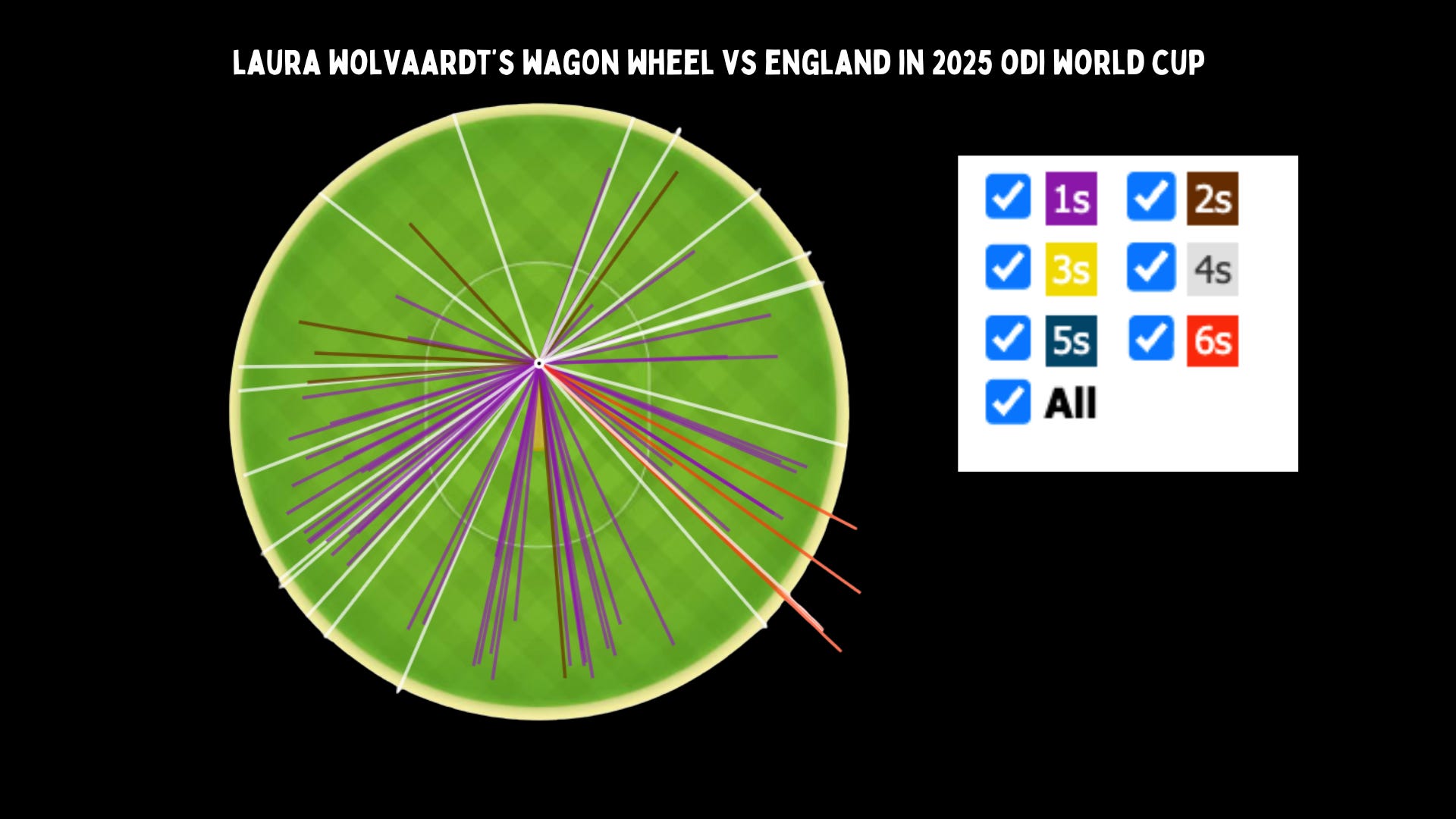
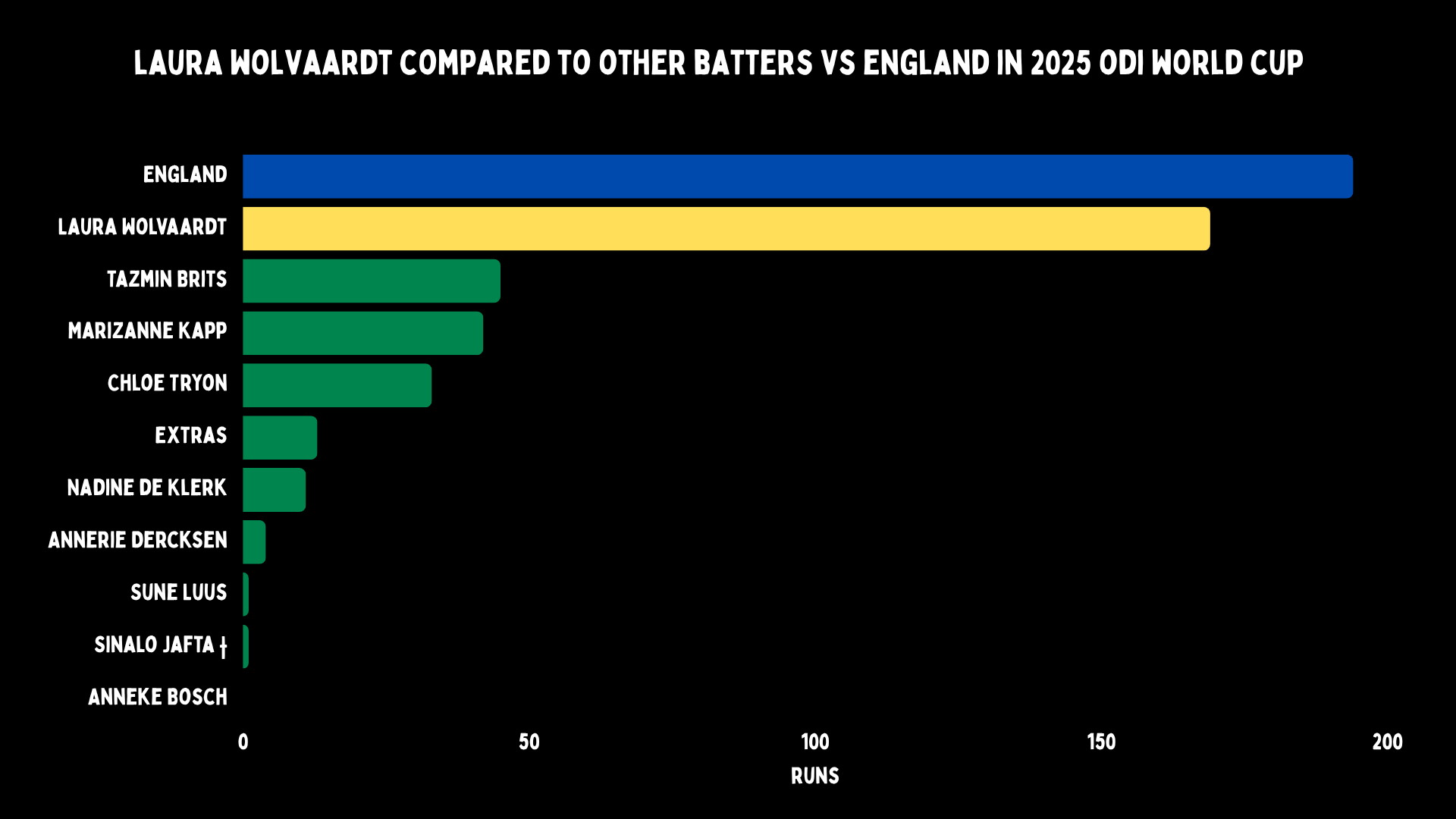
South Africa makes 319 runs and 53% of them come from Wolvaardt’s bat. None of her teammates makes more than 45 runs. England, on the other hand, combine to reach a total only 25 runs more than Wolvaardt’s 169, which features 20 fours and 4 sixes.
Four days later, South Africa struggle to read the Indian spinners at the DY Patil and collapse in a heap. Wolvaardt ignores the storm around her, side steps the debris of wickets, and cruises to a 98-ball 101. South Africa had an outside chance of winning as long as she was out in the middle. She is the seventh wicket to fall, and their title hopes perish with her exit.
The twin tons make her the first South African player to score back-to-back centuries at an ICC ODI World Cup. The milestone is one of the many firsts Wolvaardt has racked in her international career.
***
Wolvaardt’s journey began in the dark ages of women’s cricket in South Africa. The women’s national team performed out of sight and the media did not give them a voice. It took extraordinary circumstances for them to get in the news. She didn’t know of any women cricketers, so she looked up to Herschelle Gibbs, Jacques Kallis, AB de Villiers, and Quinton de Kock.
There was no pipeline for emerging talent. Young girls found the game through playing with boys and then headed straight into the U19 side if they had the ability, before making a professional debut. Wolvaardt was so good that she made her inter-provincial U19 debut at 11.
Her mother had to travel with her to Jo’burg and slept with her at a guest house because she was too young to be with the team. Wolvaardt only joined the team for meetings and at the ground for training or matches. Her highest score at the tournament was a 43-ball 25. She was one of only two batters who got beyond the 20-run mark. Saarah Smith top-scored with a 64-ball 30.
Wolvaardt struck two fours in her 48-minute stay at the crease. There is no information on whether the fours were off cover drives, but it is safe to assume that they were. She might not have had the power to split the field at will, but at 11, she was already proficient in the cover drive.
Wolvaardt started working with Laurie Ward when she was five. Ward had Pitch Vision recording equipment and a screen in her nets. Wolvaardt would always consult it after unfurling one to see if she had nailed it. She didn’t stop until she was MCC Manual perfect.
She made her Western Province senior debut two years later. Wolvaardt had developed a little more strength, and she registered her first half-century for them shortly afterwards. The national team was not far off, and CSA called her up at 16-years-old. Wolvaardt scored her first WODI half-century in her second match and raised her bat to celebrate her maiden century in her seventh outing.
Her brilliance was easy to see. She was the future. It wasn’t long before the country was demanding more of her time, so the teenager started cutting school to serve them. Most sports inclined teenagers revel at such a proposition. Not Laura Wolvaardt. She dreamt of becoming a medical doctor, so she took schoolwork on the road.
She also fooled around with music. But she found her calling in ODI cricket. She has outperformed all who came before her and is showing those that will come after that there are no limits. Wolvaardt has the most hundreds, most fifties, and most runs for South Africa. There is no point in comparing her stats to those of her countrywomen.
Wolvaardt’s peers are the best in the world. Only six women have scored 5000 or more WODI runs since the inception of the format. She is fifth on that list. She is tied with Suzie Bates for the third most centuries in the format. Wolvaardt also highest boasts the best average among the 10 top scorers and slips to second, behind Meg Lanning, when you expand the list to 20.
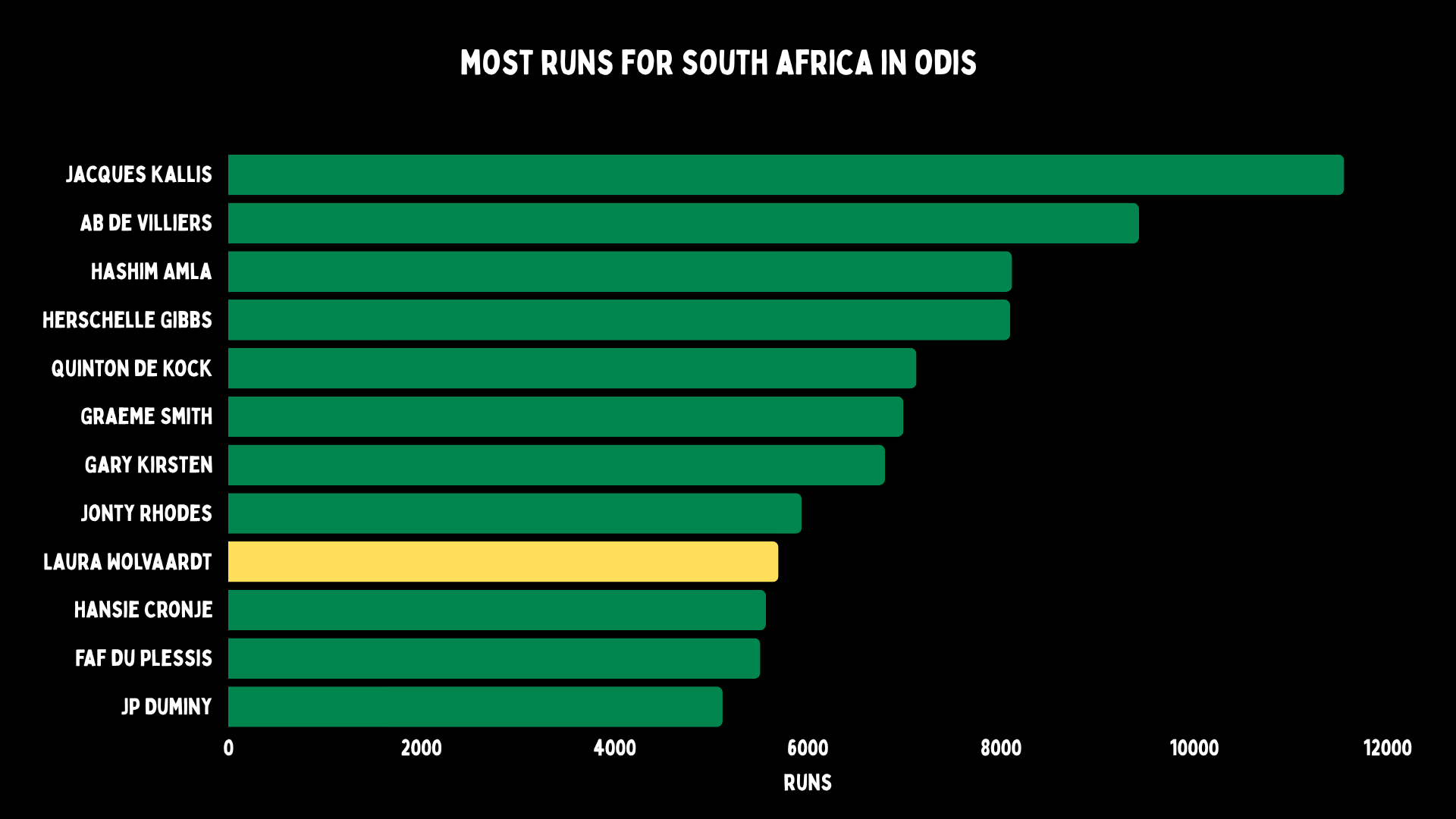
But Wolvaardt isn’t just a WODI great. She is a South African ODI legend. The 27-year-old’s tally of 5695 runs places her at number nine on the all-time list of South Africans with the most runs in 50-over cricket. She is just 240 runs behind Jonty Rhodes who accumulated 5935 runs in his 11-year ODI career. She will pass him in five or six innings if she bats to her overall average, and in just four if she bats as she has been for the last couple of years.
***
The social media universe disagrees on a lot of things but one of the few things that unites them is the beauty and elegance of Wolvaardt’s cover drive. Many believe it deserves a spot in the Louvre.
However, her greatest strength was also her biggest weakness. Teams worked out that her inclination to go for the cover drive exposed her to bowled and lbw dismissals when the ball was swinging. Then caught behind when it stopped moving. The first port of call for Wolvaardt and her coaches was to tweak her footwork.
Her left foot closed her off from accessing more shots. Therefore, improving where it landed didn’t just open her up to more shots, lending her a 360-degree approach – it also improved her contact points, improved her bat flow, and took care of the bowled and lbw dismissals against the swinging ball. It also took care of the caught behinds when it stopped moving.
Wolvaardt’s centuries against England and India in the semifinal and final of the 2025 ICC Women’s World Cup are great examples of the fruits of the technical change. India attacked the line of off-stump and the channel just outside it. Wolvaardt feasted off those deliveries. England on the other hand, targeted the stumps, and Wolvaardt opened up the leg side.
The technical tweak was one of a few changes that Wolvaardt made from late 2023, when South Africa decided that they wanted to move away from their conservative brand of cricket to a more ‘exciting and positive’ approach. The South African captain, whom many have described as always looking for ways to improve her game, bought into the plan.
Wolvaardt went from good to great. She spent the first seven years of her career grappling with adolescence, trying to understand herself as an individual, and then develop as a player while opening for South Africa. She showed glimpses of her ceiling with the five centuries.
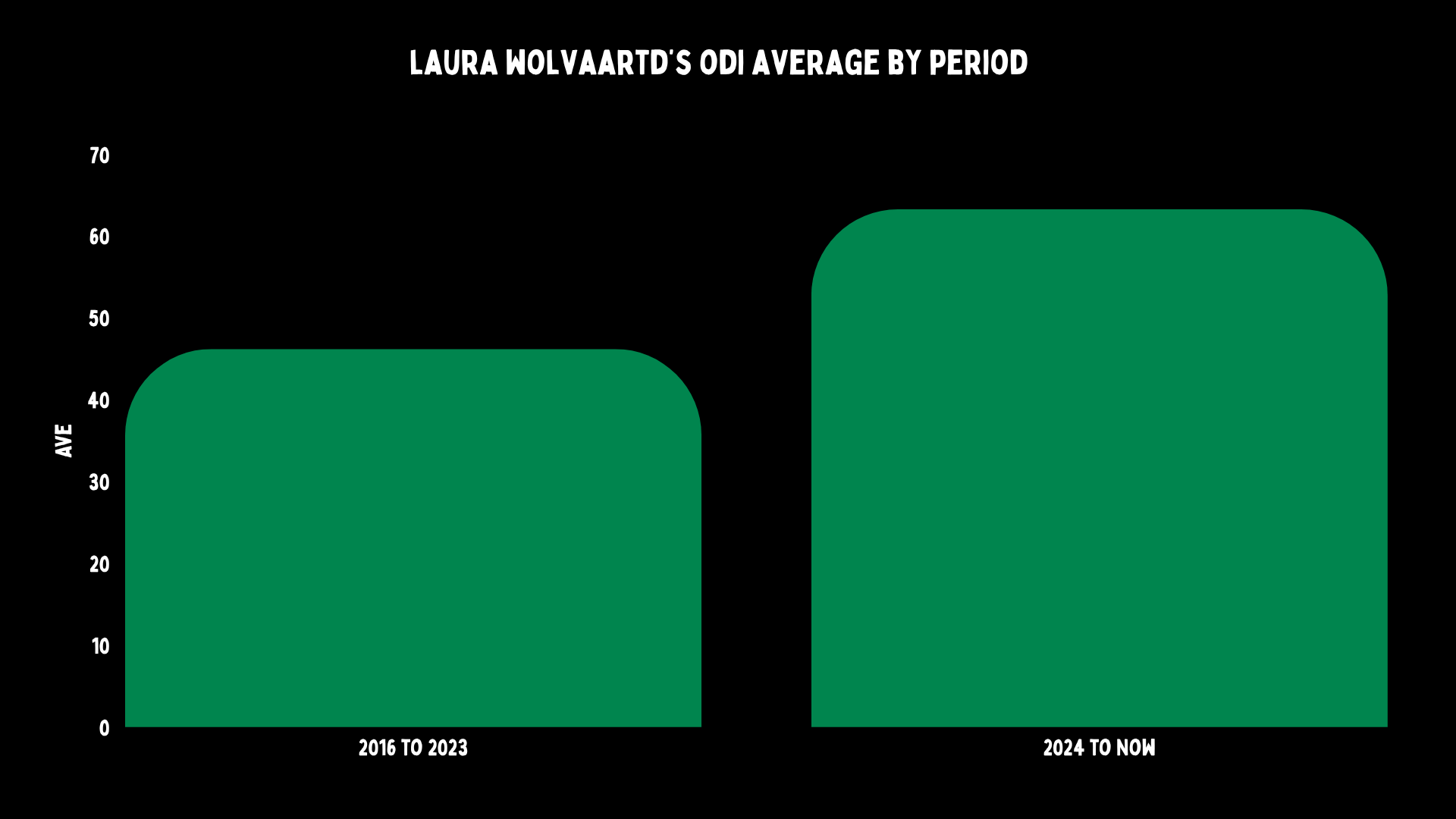
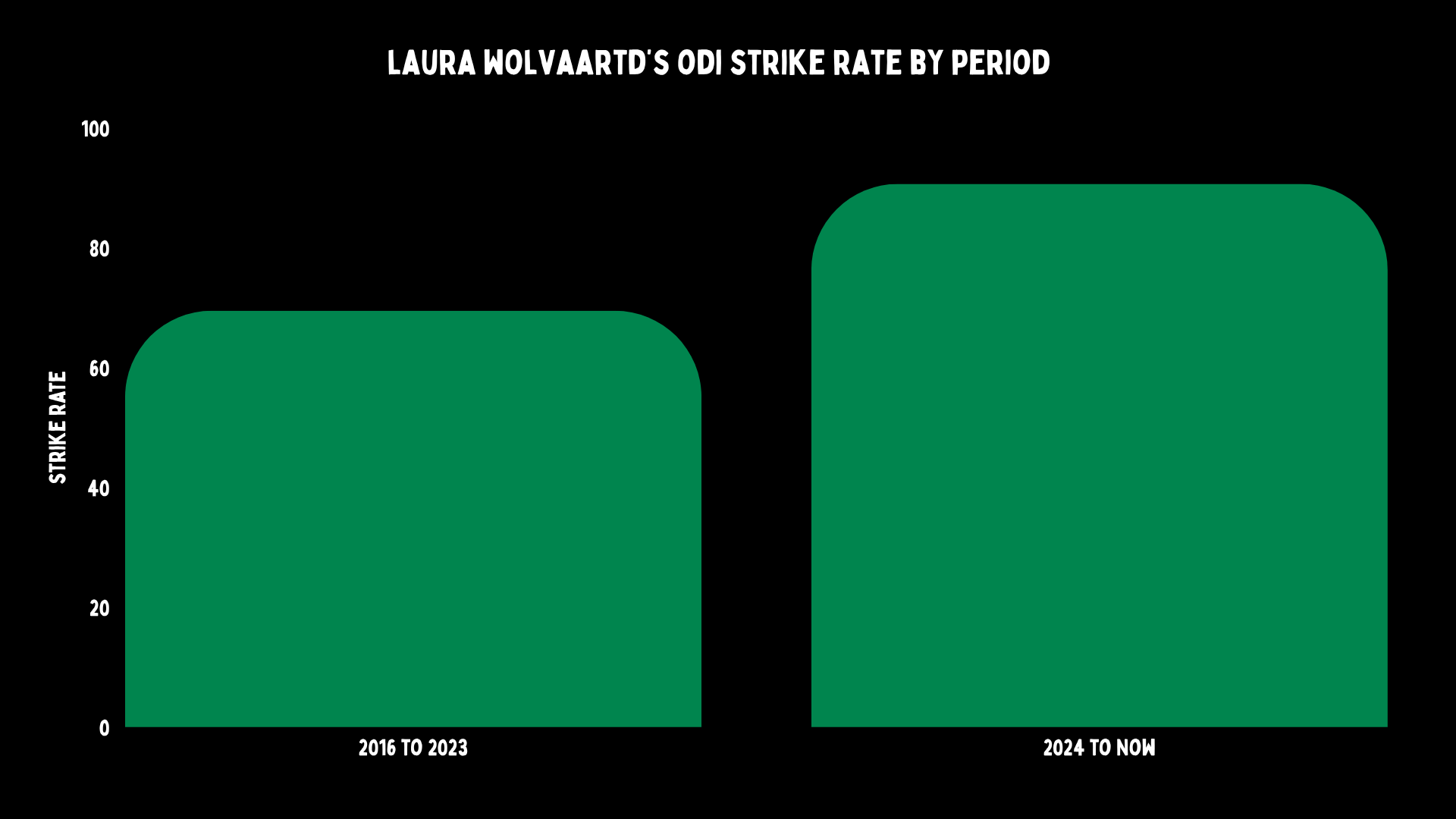
Wolvaardt has been living up to her potential since the tweak. She has scored eight hundreds and nine half-centuries since January 2024. Her average of 63.3 is brilliant, while her strike rate of 90.7 is a long way from her pedestrian pace in her early years.
The change didn’t just help her 50-over game, it also pushed her T20I game forward. From her debut to the end of 2023, Wolvaardt made 1362 runs at an average of 34 while striking at a modest 110.9. The South African skipper supersized her batting since the start of 2024.
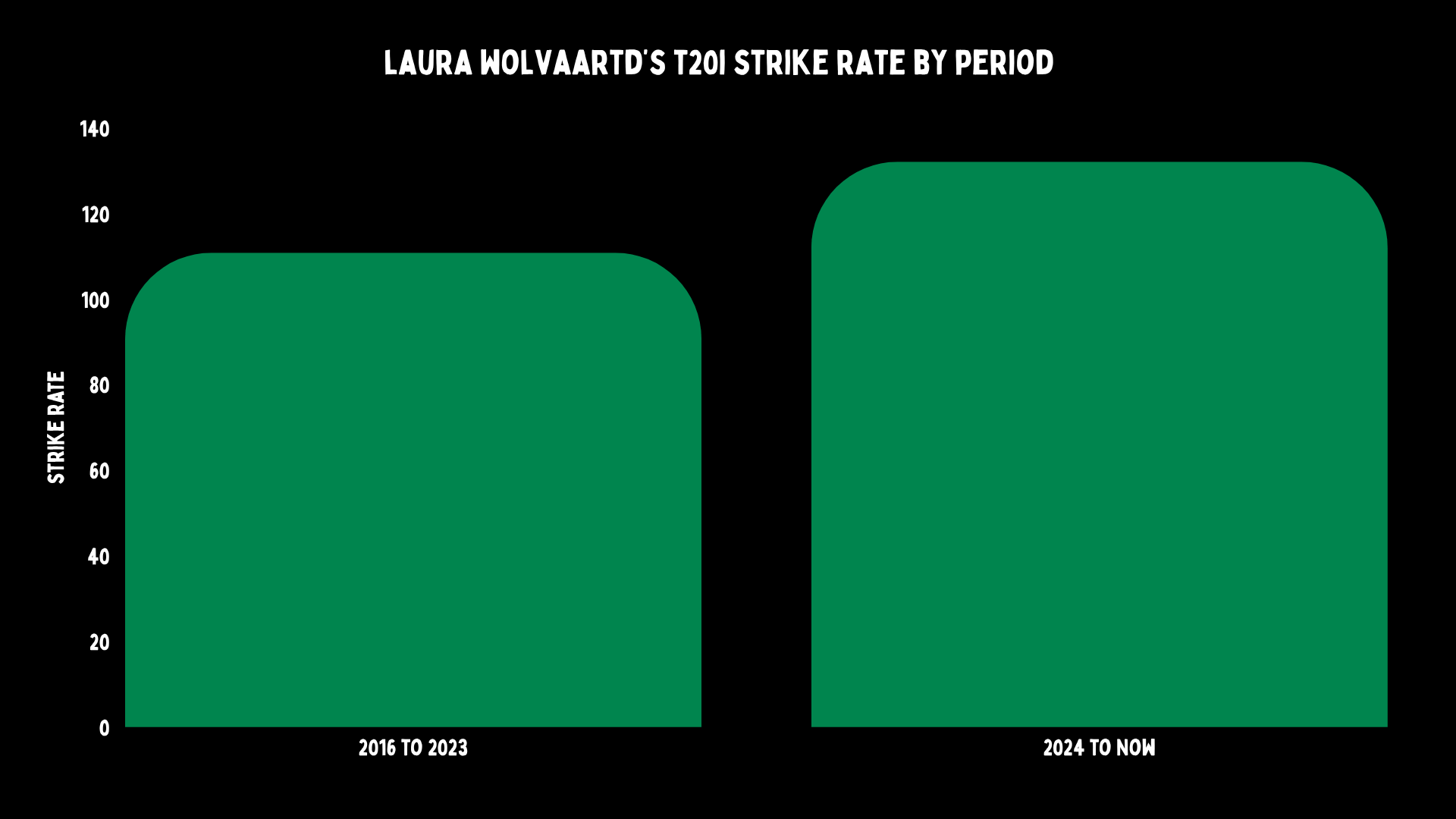
Wolvaardt almost doubled what she managed in seven years in less than two. She crammed 1163 runs into the period between January 2024 and August 2026. It’s not just more runs, it’s more runs at a faster rate. Wolvaardt has averaged 41.5 runs at 132.
It is not a coincidence that her evolution coincided with South Africa women closing the gap between them and the leading teams. South Africa scored at just over 4.5 runs an over in 50-over cricket in the first seven years of Wolvaardt’s career. They have been cruising at over five and a half since January 2024. Laura Wolvaardt’s intent has permeated all parts of the team.
In many ways, it is apt that the person who evolved from girl to woman at the top of the order for South Africa is leading their transformation.
***
Laura Wolvaardt the player has changed. She first took guard as a pre-teen with a beautiful cover drive. She grew into a one-dimensional international cricketer. Now, she is no longer easy to tie down at the crease. She has a plethora of options at her disposal. England and India learned that first hand. But Laura Wolvaardt the individual has stayed the same. She is the same reserved pre-adolescent girl who walked into the Western Province u19 dressing room.
Maybe her two minutes with the golf ball and the bat is her way of keeping herself attached to the girl who left school to pursue a cricket dream. Maybe that is what keeps her grounded. On the other hand, it could be her way of releasing stress before walking out to bat. And if there is anyone who gets hypnotised, it’s not her. It is the spectators who watch her in full flow as she peels one of her glorious cover drives.
Brilliant article that cements exactly what I was seeing when I witnessed her live in NZ earlier this year: quite simply the most technically correct, tall driver of the ball that you will ever see.