



(You can find any explanations regarding our advanced metrics here.)
What I am about to call MS Dhoni should come with some trigger warnings. It will not be well received by all. It should come with a ‘Not Safe For Work’ label.
But it is also something that should have been done a long time ago.
The term ‘anchor’ first started being used in the 1980s. It was really the first role we had in white-ball cricket, even before all the balls were of that colour. In the 1990s, we added the term ‘finisher’.
Both of these words came from Australian cricket. Geoff Marsh (father of Shaun and Mitch) was the anchor, even if Desmond Haynes also played the same role before. Then came Michael Bevan as the finisher, a player who was made for the final 25 overs of an ODI, to either finish the innings or the match.
The first role is seen as a negative, not least because coaches kept pushing players into it when they had other things they could give. It is holding back your best player, punching full tosses down the field for one, and doing the unsexy work of batting.
But the finisher - who doesn’t want to be that guy? Most of Bevan’s batting was earnest running between wickets, a geometrical understanding of fielding angles, and the odd checked, perfectly timed boundary. There was nothing sexy about it.
But when Bevan’s gym body was thrusting his hands towards the sky while his exceptionally white teeth glistened in the SCG light towers, it was a glorious thing to behold.


If Bevan got some love for this back in the 90s, what happened to Dhoni in his role as the finisher was another universe entirely.
Dhoni hit the 2011 World Cup six.
But even before that, he had hair. Bharat Sundaresan’s book on Dhoni has about 25 pages on it. He was a different character, almost seemingly alien to Indian cricket culture at the time. While the entire conversation about cricket got so loud, he managed to remain quiet. But then he hit sixes, won World Cups and also took over the IPL. He was a one man vibe, bordering on a religion at his peak.
This broad-chested big-hitter really did sex cricket up in many ways.
So the next sentence is about to hit very hard, and some of you might want to sit down or hold on to something, maybe even get AI to reshape it into something more acceptable.
MS Dhoni is a finisher, but he is also an anchor. He is a finishing anchor.
***
The Ranchi keeper has gone into another realm of fame which is beyond cricket. He doesn’t play away games, because every ground in India (and anywhere he would play) are full of his fans. Not of his team, of him. His leadership, charisma and wicketkeeping also form part of the conversation.
As does the talk of him finishing.
Find any blog on cricket online and someone will say great things about the man. And that is fine, but at Good Areas, we’ve never met a player we didn’t want to nerd out on.
We’ve covered his chasing before: what makes him different and why that works. Like how he defers risks in the middle overs, tries to be 10 off 10, and then strike at two runs a ball at the death. It is not unique, but it’s still rare after everyone in the world has seen him.
In our minds though, this pattern is the very definition of a finishing anchor.
A traditional anchor in T20 cricket meets the following criteria: has a really high average, bats at a par or below-par strike rate for most of the innings, and then bashes the death overs when they’re set.
Virat Kohli is clearly one of the best known anchors ever. These two have completely different roles and completely different entry points, yet they both have a lot of similarities.
Even though it’s not evident from the raw numbers, both Kohli and Dhoni have a similar approach to constructing a T20 innings. They take time to get set, defer risks in the middle overs and try to maximise the death overs. The reason you never notice it with Dhoni and do so with Kohli is because Dhoni essentially chops off the initial period. So you see less of the “slow” period with him.
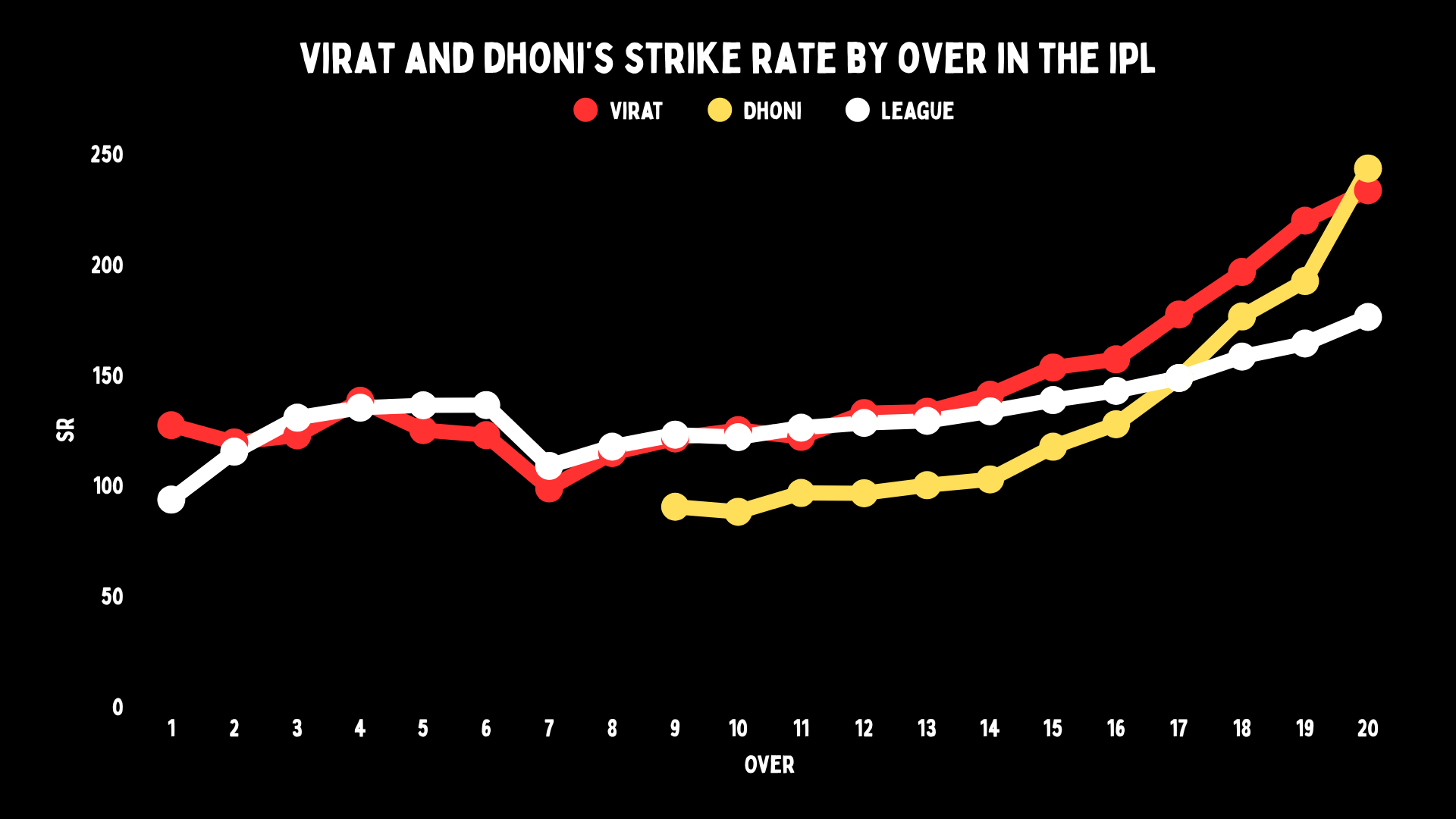
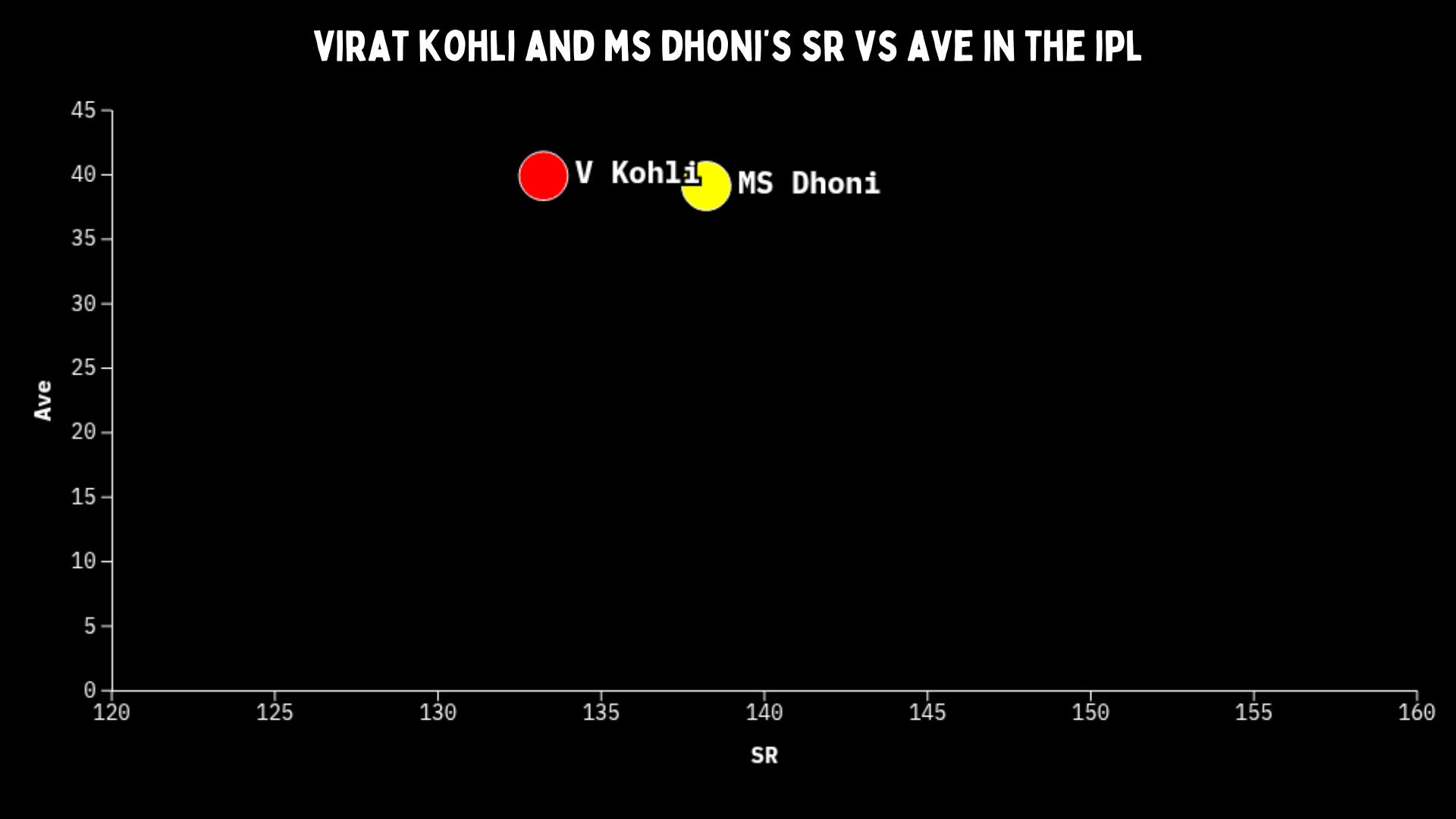
If we take a look at their raw values, Kohli and Dhoni both average around 39 whereas Dhoni strikes faster with a strike rate of 137 compared to Kohli’s 133. But the overs Kohli bats in are slower.
When you compare their true strike rates, things change. Kohli has a true strike rate of 3, while Dhoni has a true strike rate of 0. This accounts for venues too, so Dhoni is worse than Kohli despite playing in a harder home ground. But Dhoni’s true average is 19 compared to Kohli’s 11.
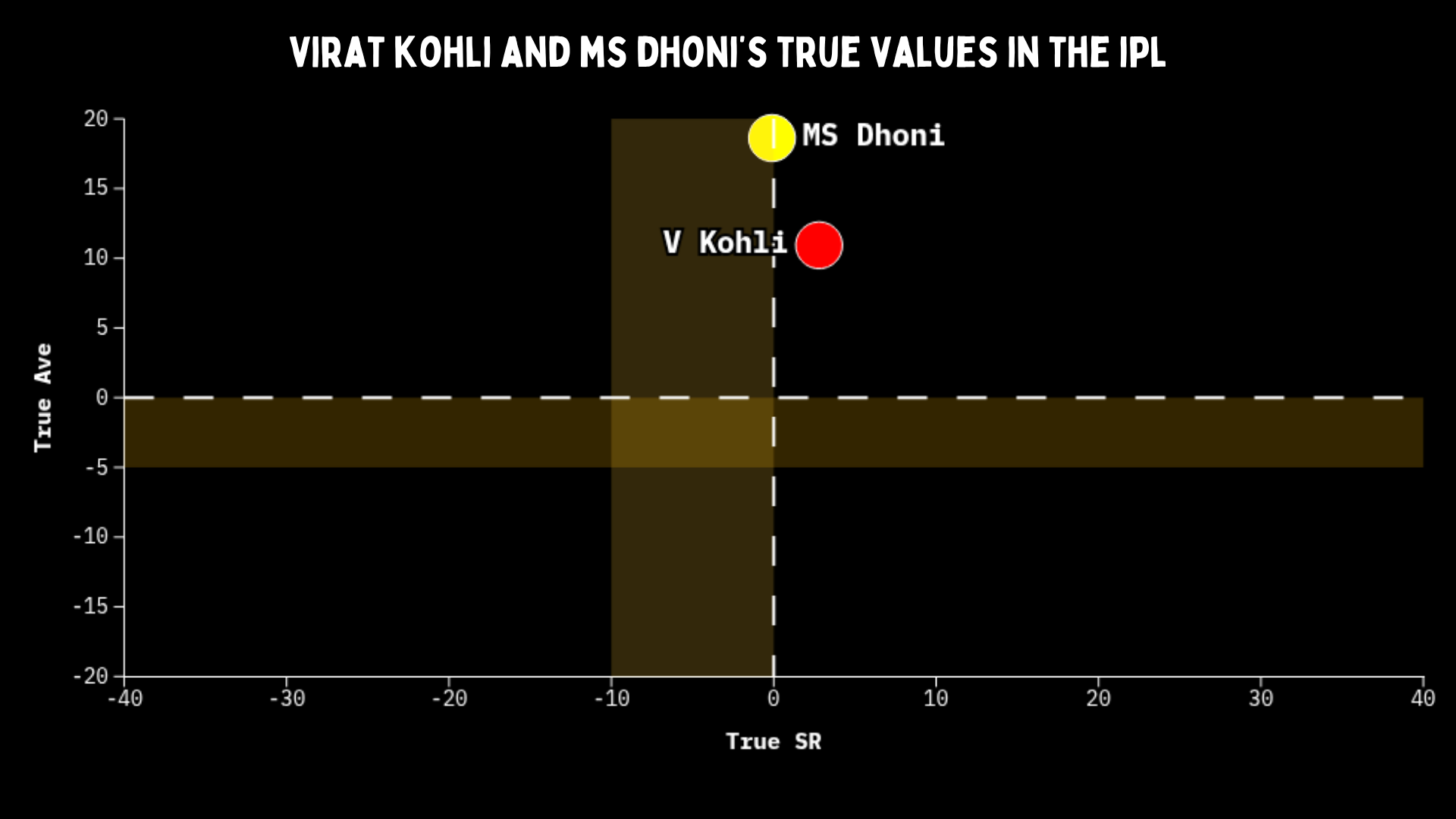
So, Kohli is the faster batter, and Dhoni is better at not getting out. That is the opposite of how people see them. Context in limited overs really changes everything.
On the anchor list - high average, check. Neutral or below par strike rate, check. Bashes the death overs, check. That’s all the criteria met for a batter to be considered an anchor. And since Dhoni is a finisher, the finishing anchor was born.
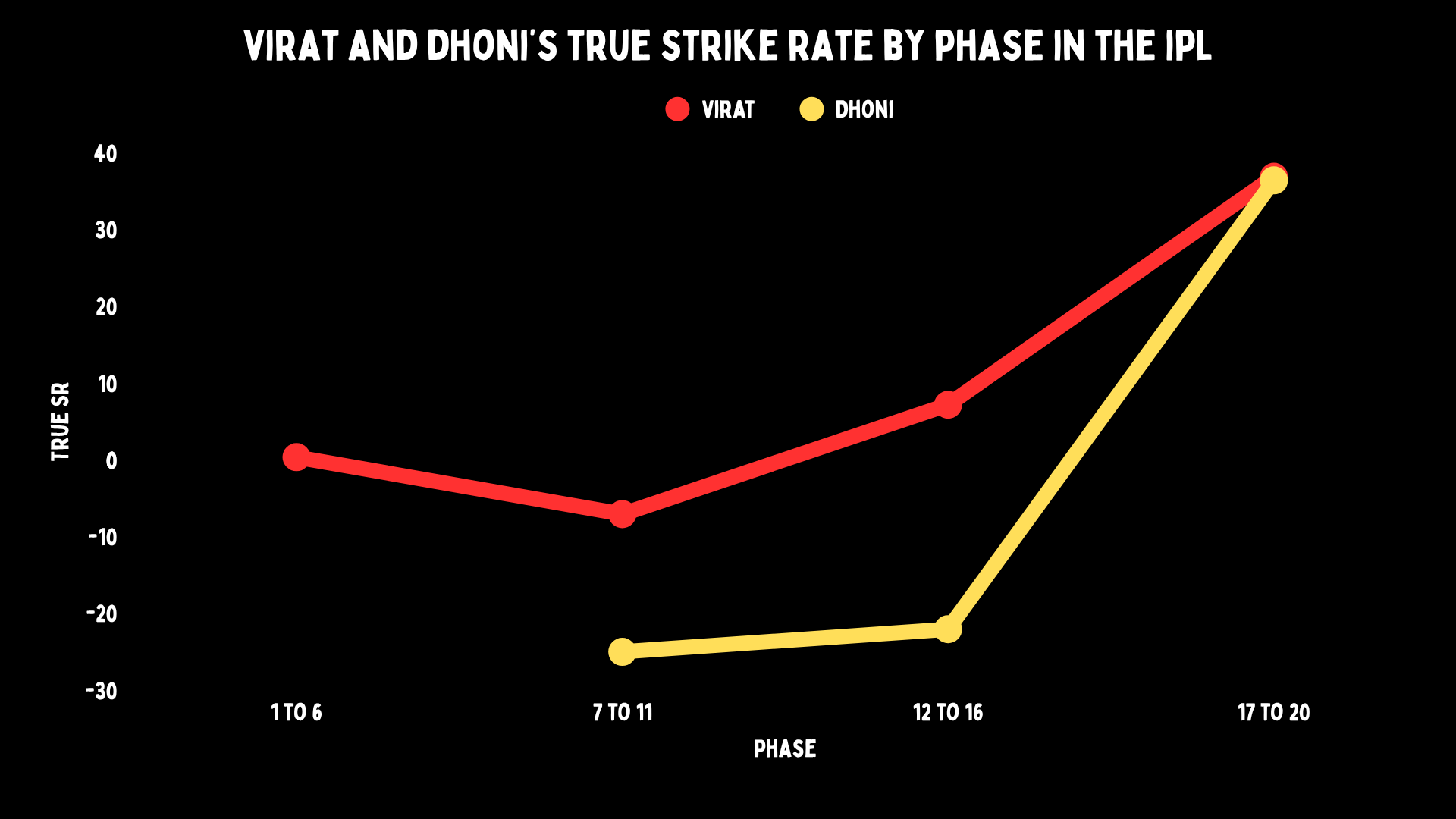
But there is a cricketing reason for his style. One of the great ironies of Dhoni’s career is that despite playing for a team centered around spin, and being one of the best captains and wicketkeepers of the turning ball, he wasn’t good at striking it.
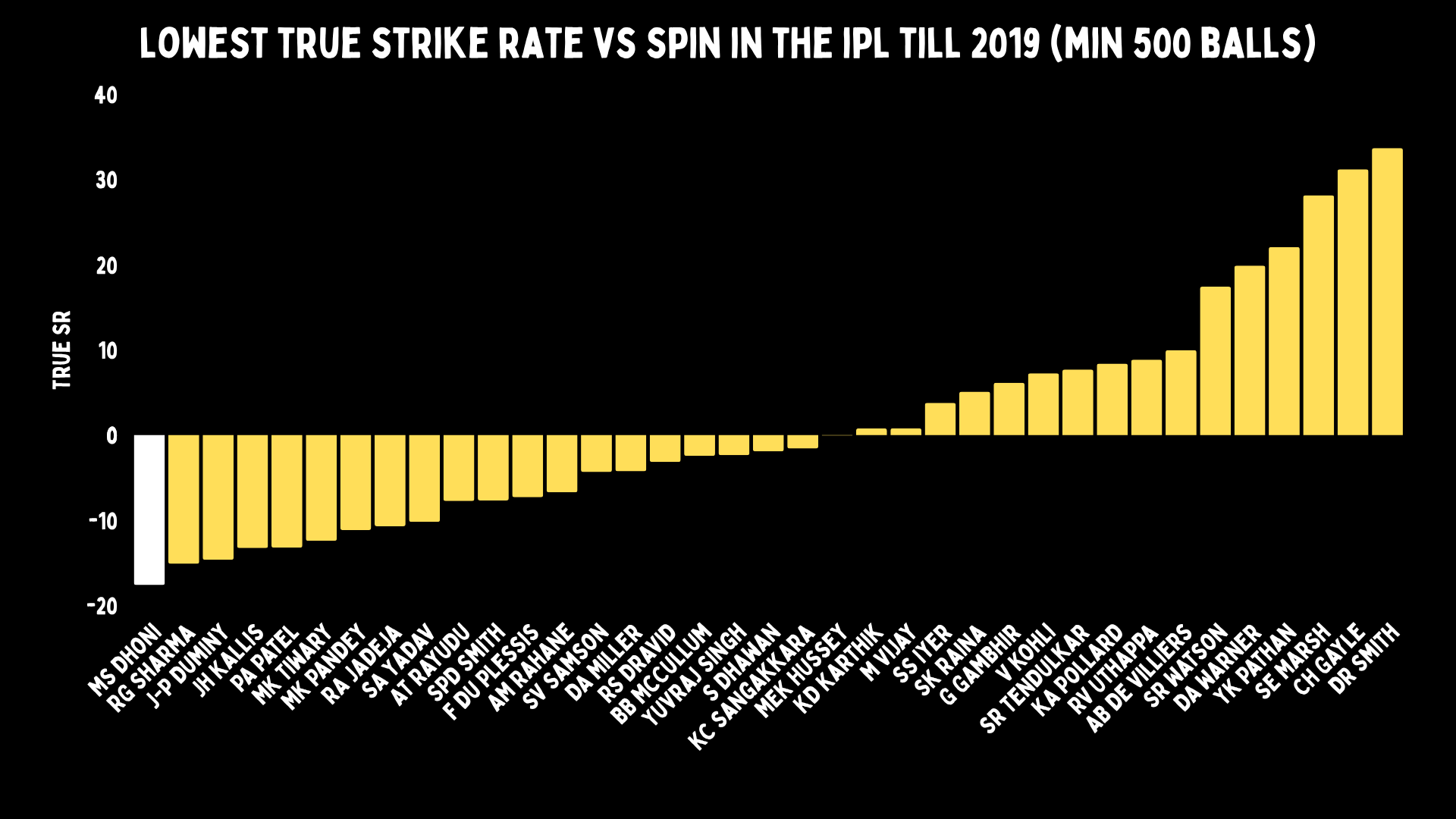
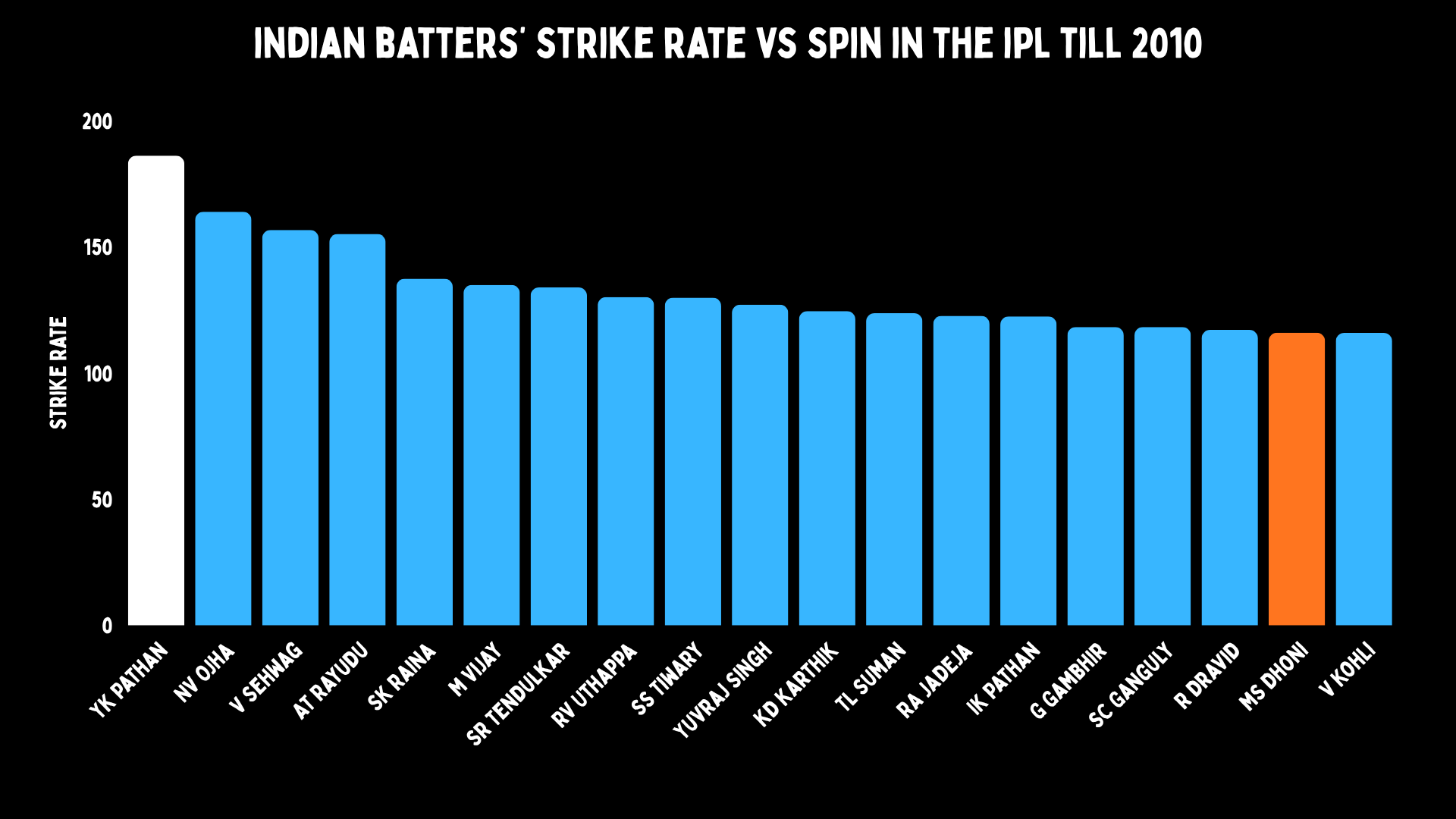
Until 2019, for anyone that has faced at least 500 balls of spin in the IPL, Dhoni has the worst true SR.
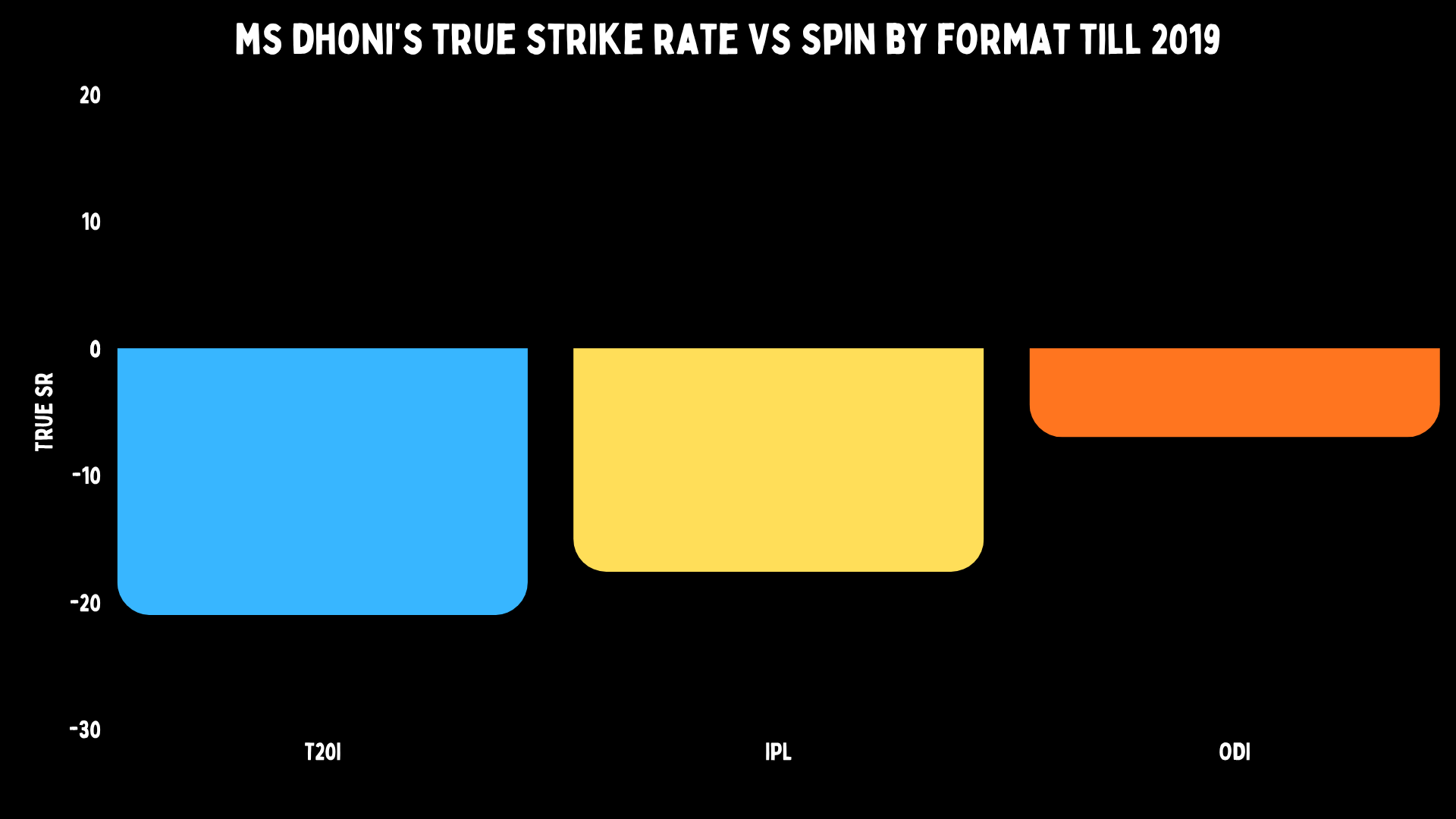
And this holds for every white-ball format he’s been a part of. His true strike rate was -21 in T20Is and -7 in ODIs.
One thing that former Indian team analyst Himanish Ganjoo told us was, “Dhoni was a good player of classic spin”, not necessarily a great player of the modern faster spinners. So think more Warne and Murali, and less Varun Chakaravarthy or Sunil Narine.
Brian Lara was thought of as a great player of spin, but like Dhoni, he liked it when the ball went up out of the hand. The longer Dhoni’s career has gone, the less those bowlers even exist.
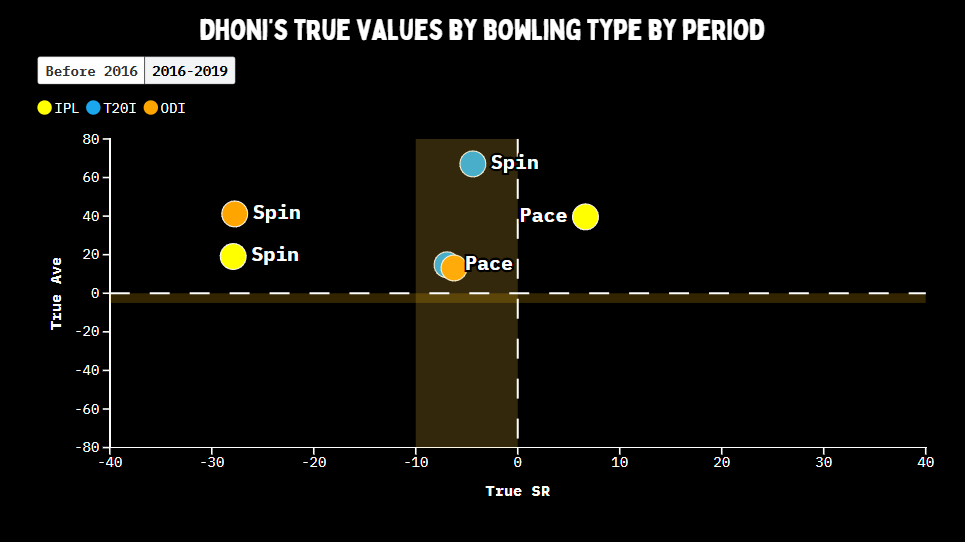
Some of his IPL issues are “old man who doesn’t have knees” Dhoni dragging it down. But the problem existed long before the knees gave out. If we see Dhoni’s true values vs spin by year in the IPL, even before 2016, there’s only two seasons where his true strike rate was positive. Now if it was only slightly negative, we’d understand. However, in three of these years it’s below -25. That is a choice he is making based on how he thinks he can make runs.
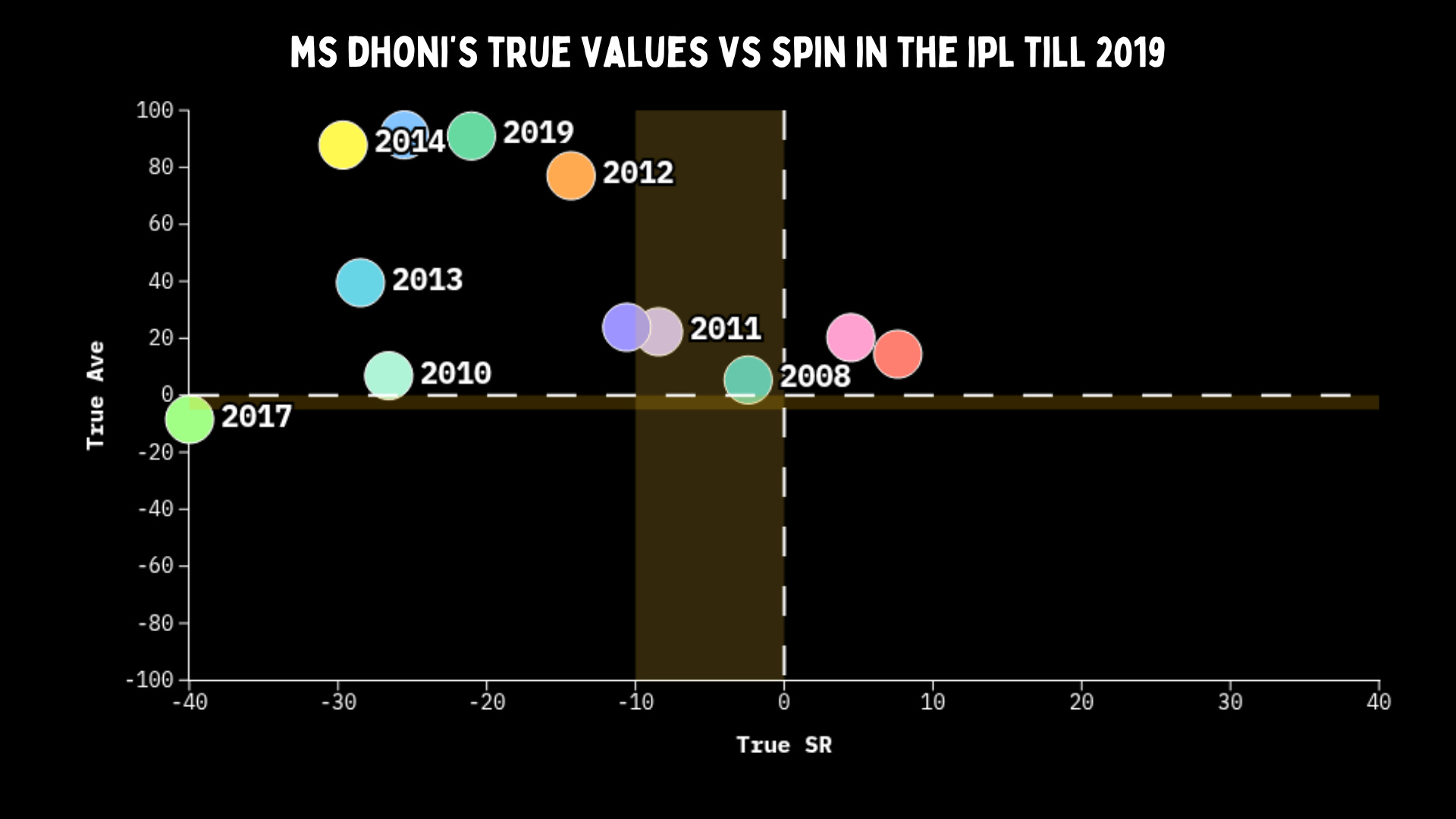
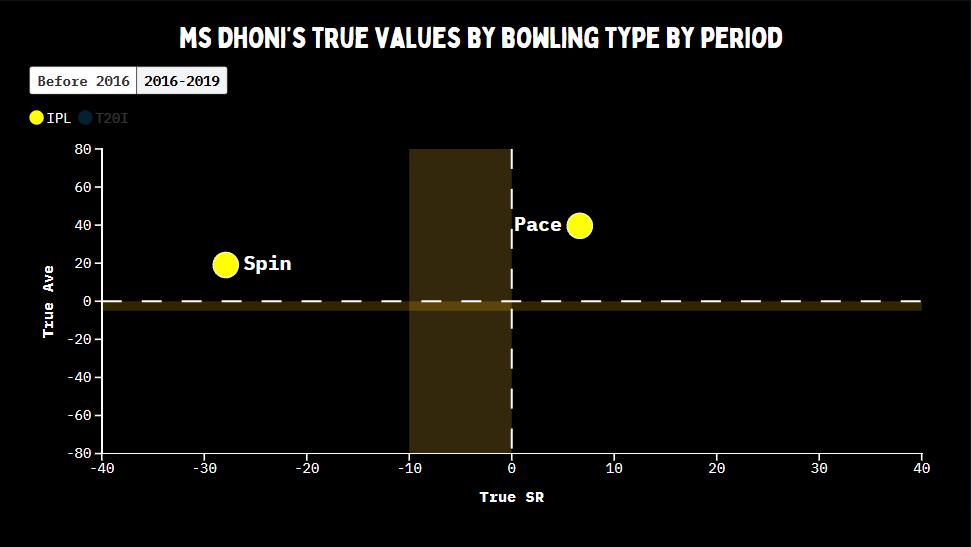
Since 2016, it’s only gotten worse; there’s been no positive true strike rate seasons and his best was in 2018, where his true strike rate was -11. He is forfeiting spin overs.
Before 2016, he was -11 against turn. Not healthy.
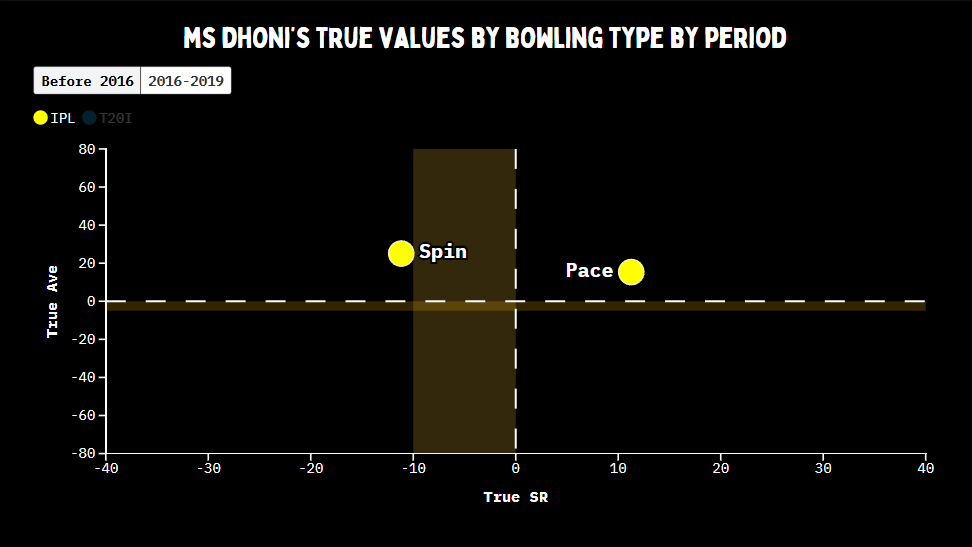
However, from 2016-2019 it’s -27. Twenty, seven.
His inability to hit spin further emphasises the need to get his entry points right. To maximise his ability, you really don’t want him to come in when there are a lot of spin overs to come. But you also want him to face a few balls. He doesn’t feel as comfortable hitting from the first delivery, because one of his main skills is reading a pitch.
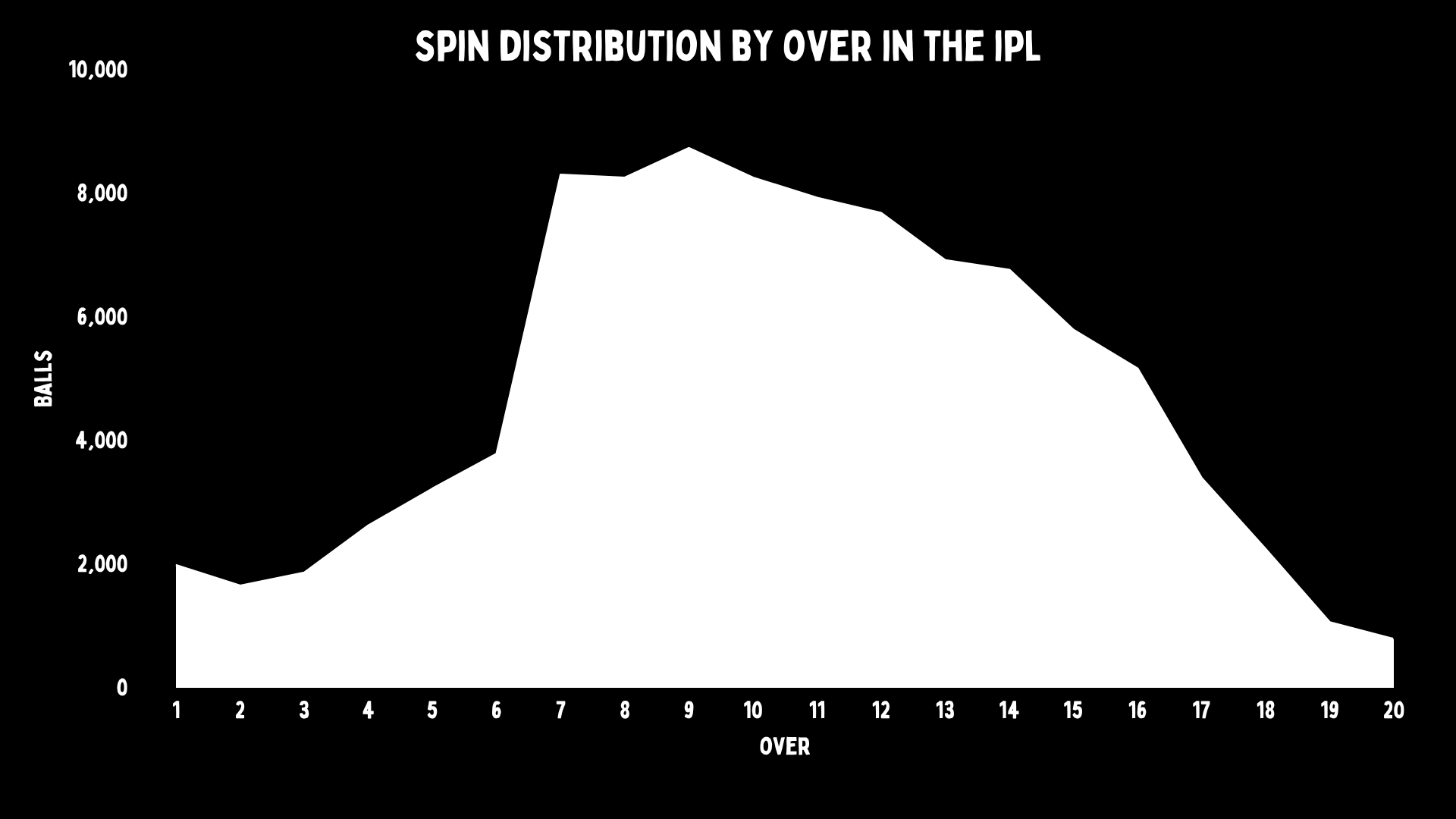
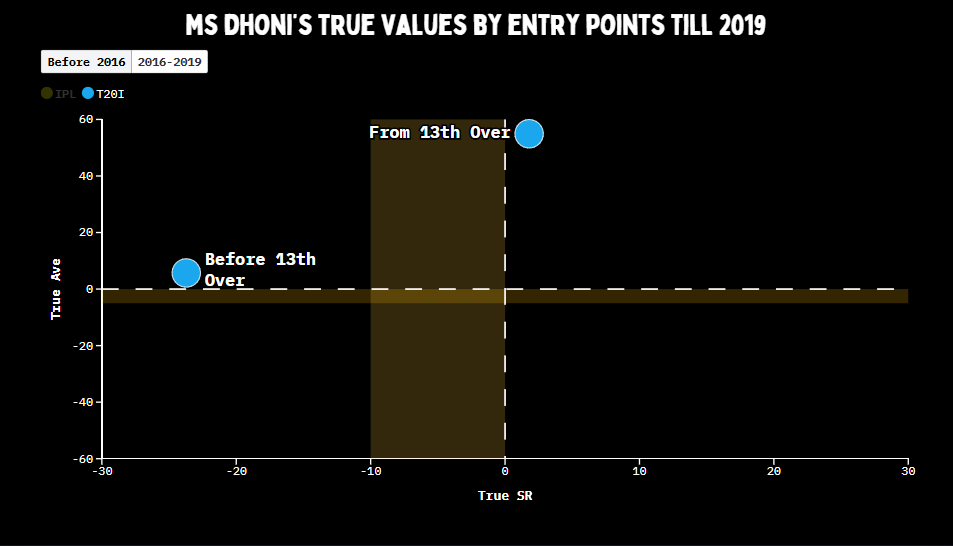
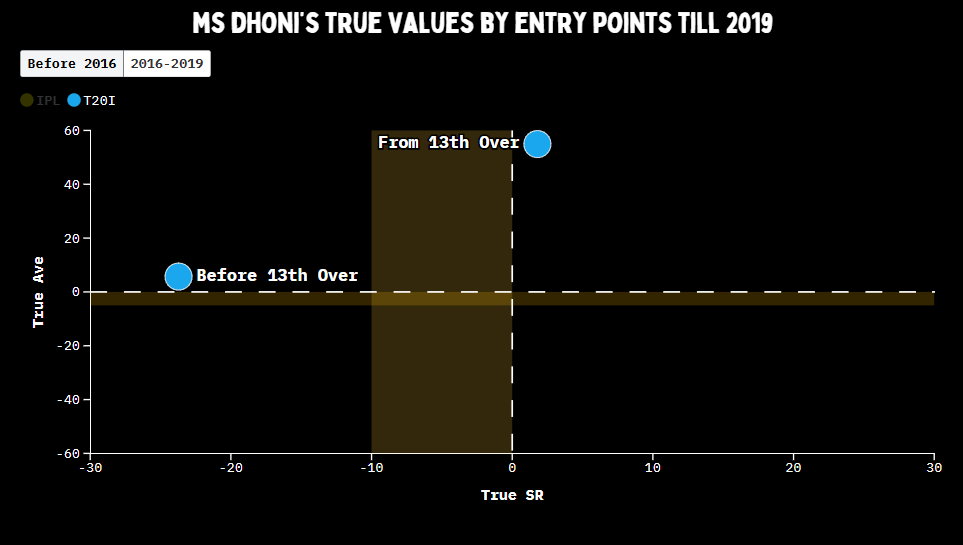
His ideal entry point would be from the 13th over, where he can take 10 to 15 balls to get set and he won’t face more than an over or two of spin. And once set, he can bash pace at the death.
The issue with this approach is, you’re putting a lot of faith in both your ability to not get stuck vs spin and pulling off a good death hitting game. Unfortunately for Dhoni in international cricket, it was the former that caused issues.
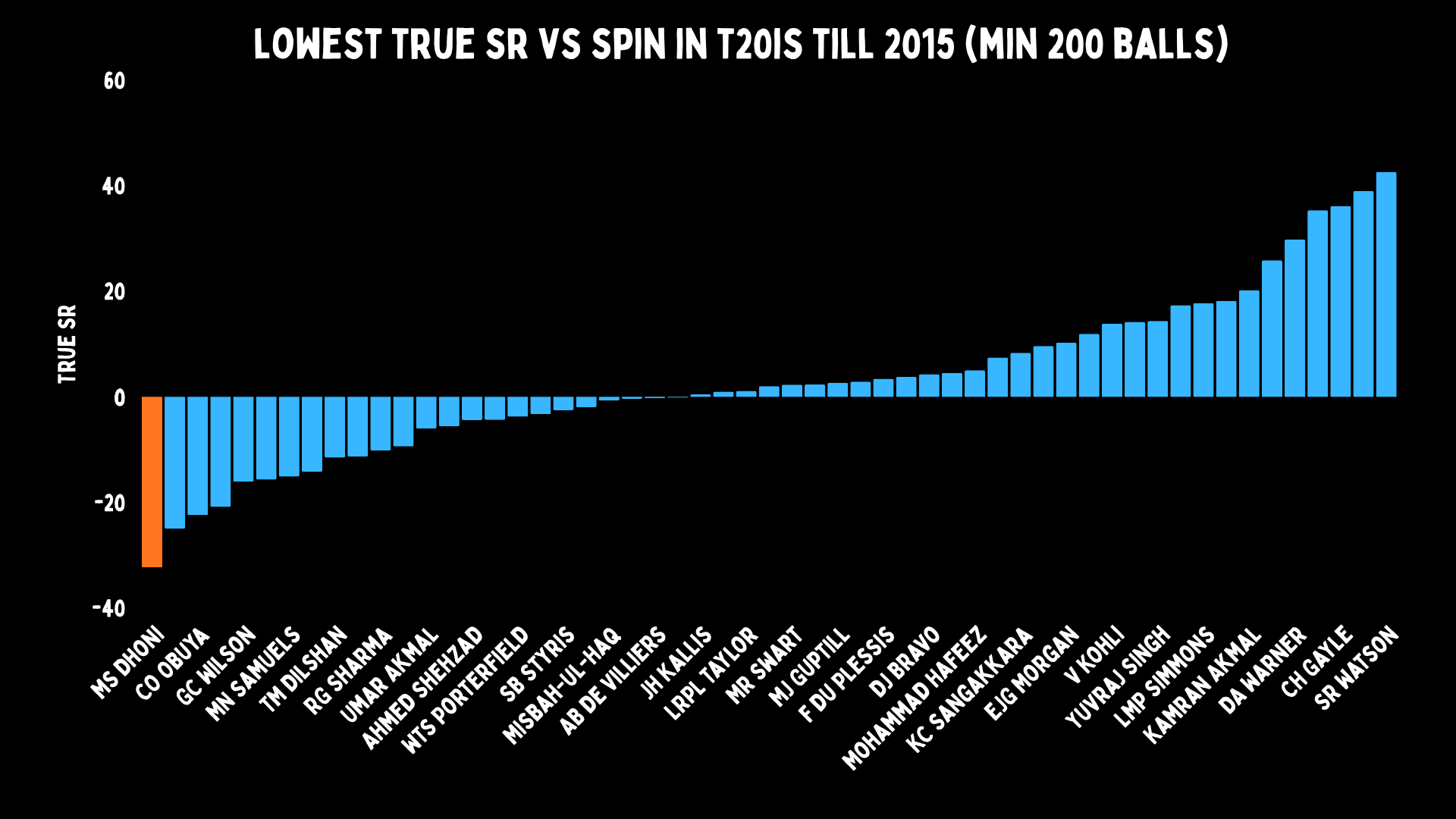
Remember, his true strike rate vs spin in the IPL before 2016 was -11. At the same time, that goes down to -32 in T20Is, making him the worst of all batters that have faced 200 balls of spin. That is Babar Azam in the Big Bash League bad. He’s got a lower true strike rate than Ravi Bopara and Collins Obuya. You don’t really expect Dhoni to be compared with a 40-year-old Kenyan legspinner turned batter.
Amongst the three white-ball formats, T20Is are by far Dhoni’s worst.
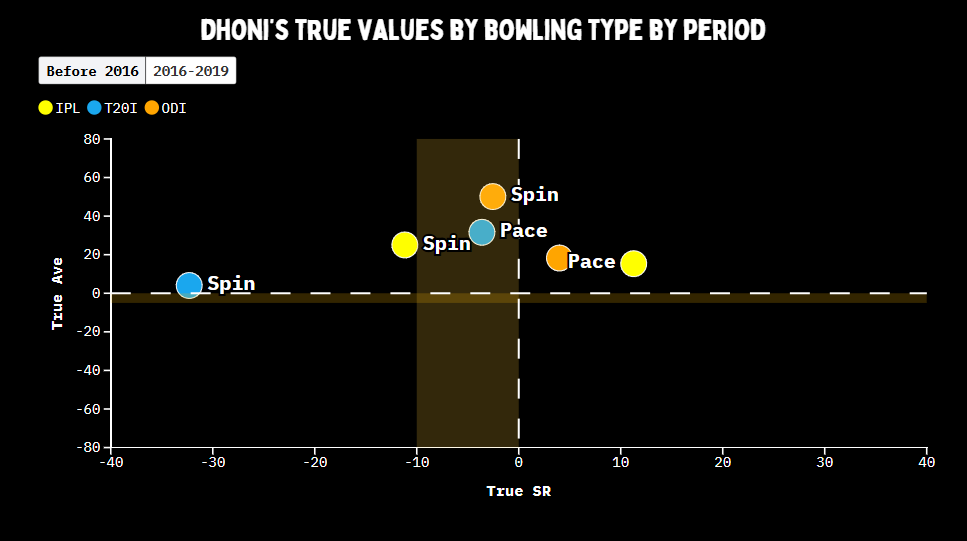
What makes this even harder to explain is what happens after 2016. His IPL and ODI numbers fall off a cliff to -28 in both. But in T20Is, the format that troubled him the most, where he couldn’t hit a spinner for a six if they bowled a bunch of full tosses with all fielders inside the circle, he gets better. His true strike rate improves to -4.
This might be explained by who he is as a cricketer. He is not normal. When he makes a decision, he is fundamentalist about it. So some of his play against spin is not just that he couldn’t score quickly, but that he decided this was his method in that format or team. Then, in a new situation, he just changes.
But early in his career, his usage is truly bizarre. In T20Is before 2016, he entered before the 13th over in 46% of his innings. And he was terrible in those situations; he had a true strike rate of -24. Even if we give him some leeway for early wickets, -24 is really bad. Match-losing on most days. Once he enters from the 13th over, he’s at a neutral true strike rate with a very good true average. This is ideally where you want him.
A case study of bad usage were the 2009 and 2010 T20 World Cups. The structure of the batting then was Gautam Gambhir, Suresh Raina, Yuvraj Singh, Rohit Sharma and Yusuf Pathan with Dhoni. They largely took part in both tournaments, and they’re all better players of white-ball turn. So what you don’t do is send Dhoni ahead of any of these guys when spin is in play. Especially Yusuf.
Across the two World Cups, Yusuf and Dhoni played ten games together. Yusuf doesn’t bat in two matches, so that’s eight innings. There’s only one time where Yusuf bats ahead of Dhoni: when he came in at the 16th over vs South Africa in 2010. It would have actually made more sense for Dhoni to come in, since that’s close to the death overs.
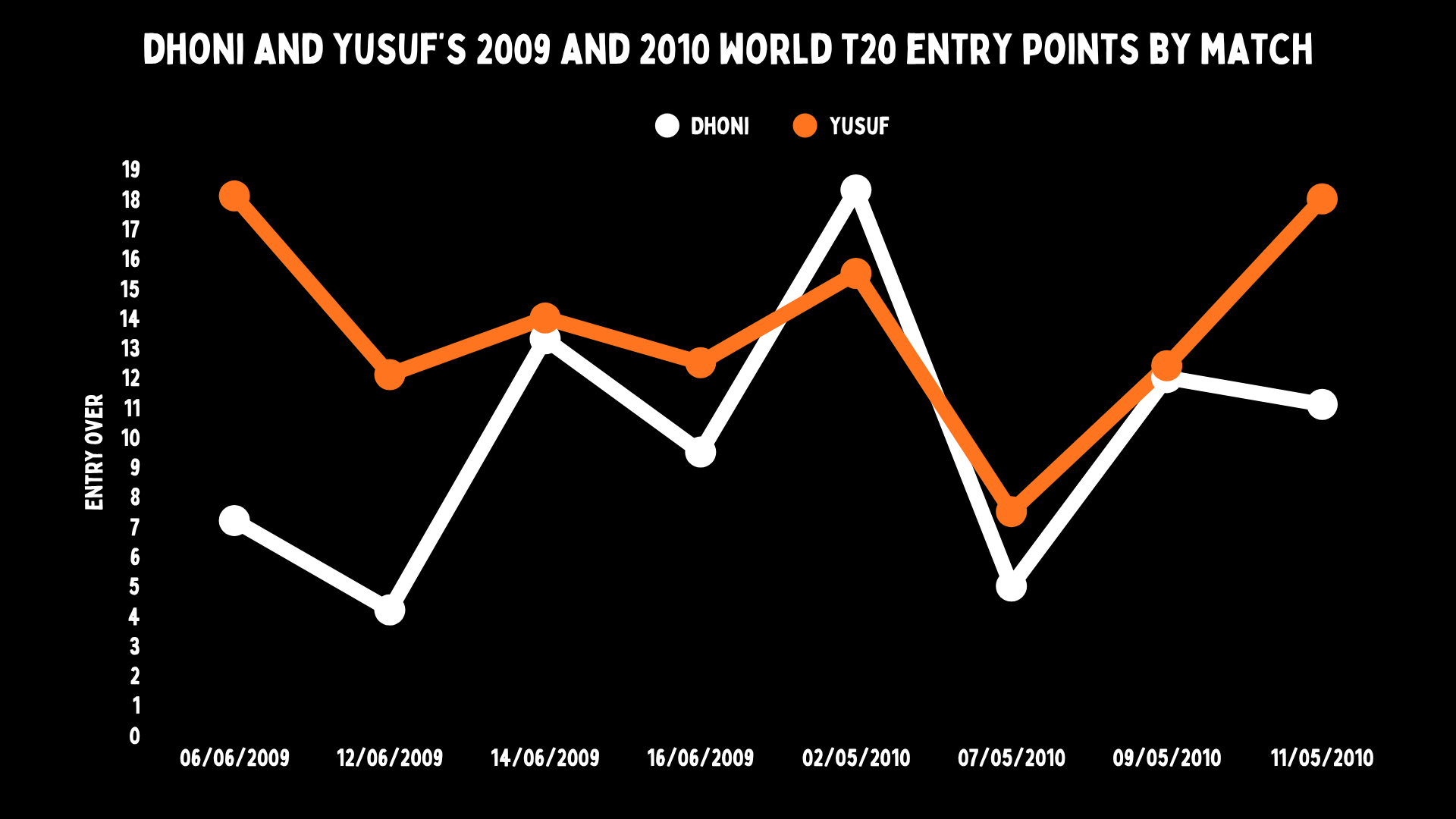
So that’s eight innings where you have the best hitter of spin bowling in Indian cricket up to that point and you actively try to not use him vs spin.
Across the two tournaments, Dhoni made 81 off 96 balls with 4 dismissals when he entered before the 13th over, compared to 90 off 50 (and got out only once) when he entered after it.
When Dhoni started, T20 cricket was in a steam-powered era. We just didn’t know that much. Even if Dhoni was a steampunk T20 player before it was cool. But India wouldn’t use Yusuf’s 176 strike rate against spin all that much. And he was dropped for three back-to back World Cups in Asia.
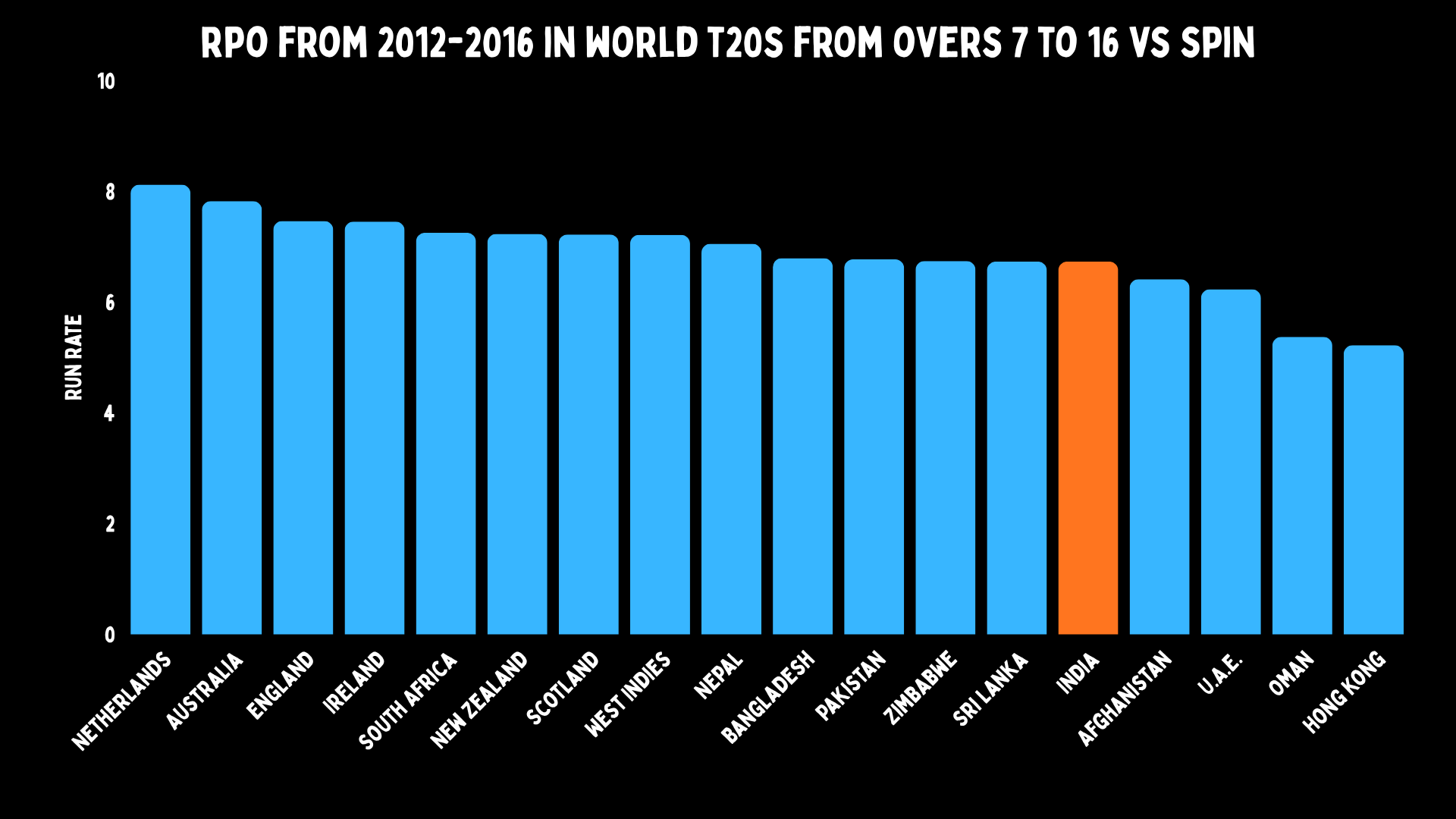
From 2012 to 2016 edition, India had the sixth-worst scoring speed versus spin in the middle overs.
It wasn’t just Yusuf, India also misused Raina down the order.
So India missed out on their spin stars, but in terms of Dhoni, they had one of the best pace hitters out of place as well. This means that India had an incredible T20 player, but didn’t quite use him well, until he was almost done.
Which is more bizarre, because he was using himself. And in many other ways, he was a genius and pioneer.
***
But we are looking back at all this like people knew what was happening. This was a period where South Africa were moving AB de Villiers all around the place, because people didn’t know that much.
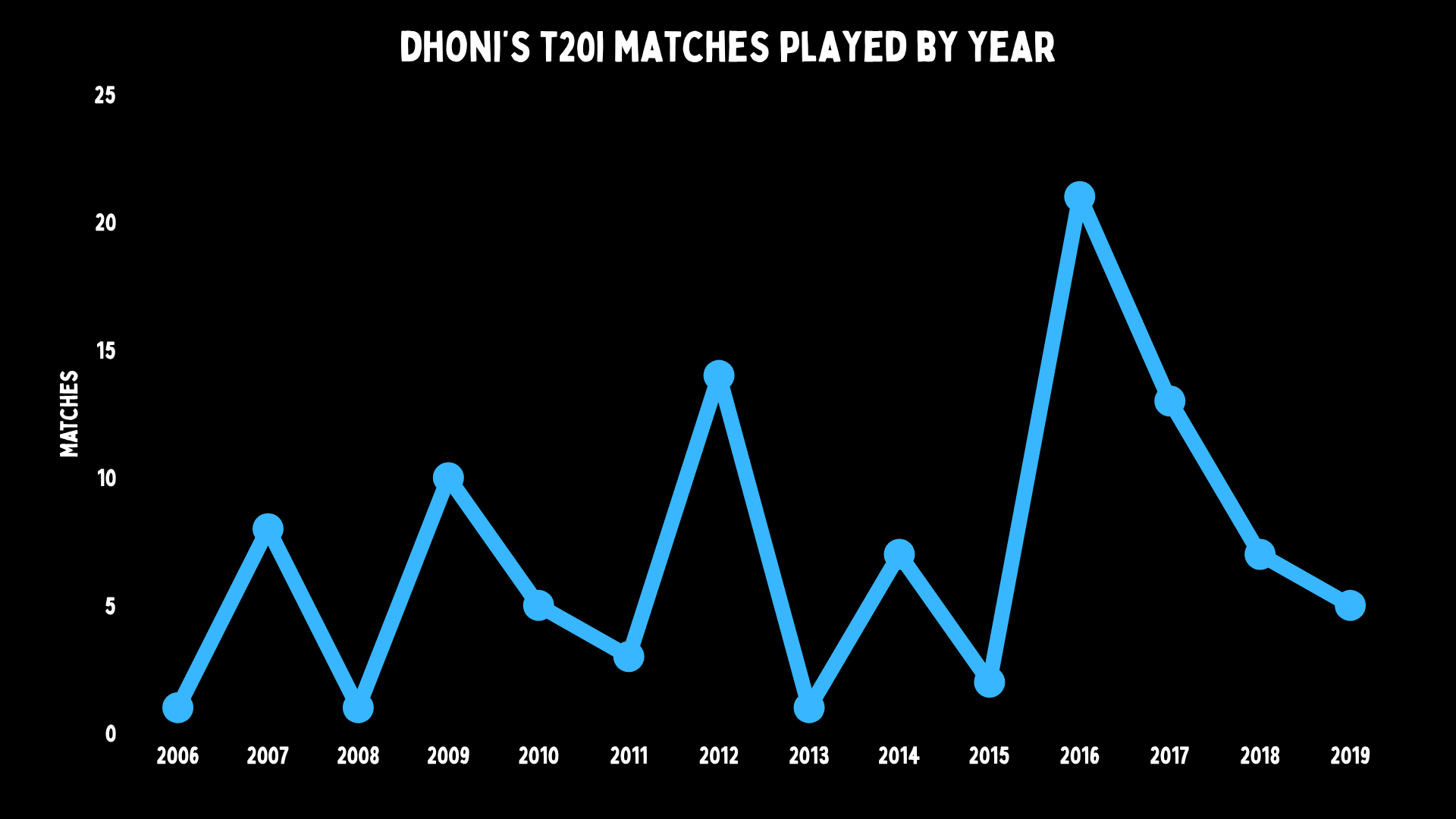
Also while players were learning more about T20 cricket, international teams were trying to assemble the Avengers, and doing it poorly. Until 2015, Dhoni played 52 T20Is for India; 28 of them were at World Cups.
From 2016-2019, 24.6% of his major games were T20Is. It might not be a complete coincidence that his improvement in this format coincides with him having more time to focus on it and the prestige of it increasing, all at the same time.
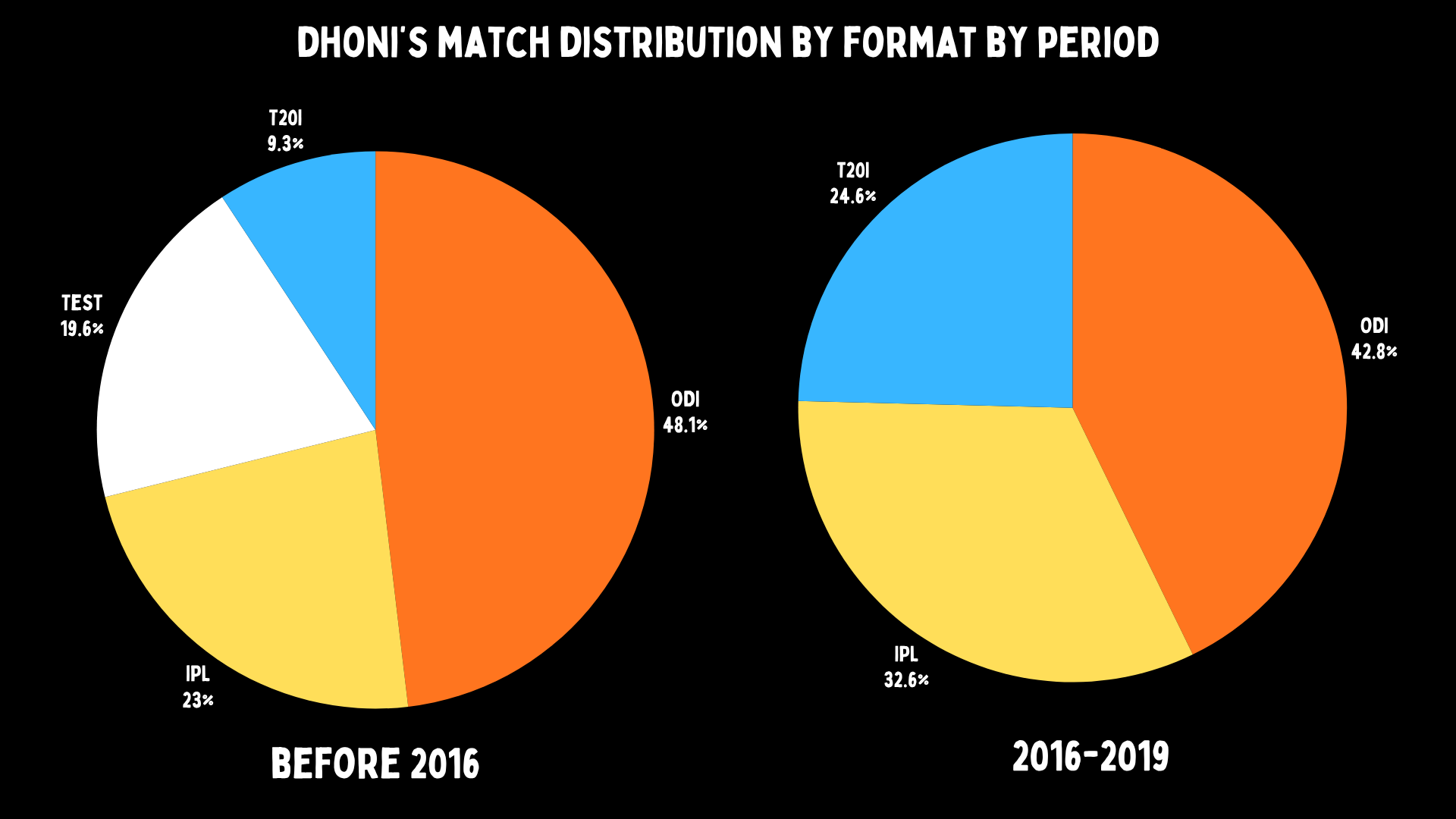
For years, Dhoni was keeping, captaining and batting across three formats and the IPL simultaneously. That’s not ideal. And retiring from Tests gave him a bump, but he was passing his best.
So Dhoni has been a great T20 player, and yet, never even got to the best he could be. That is part of the fascinating legacy. He really took over early T20 cricket by using what had worked in ODIs. And then when T20 changed, he assumed this new bizarre role.
Dhoni felt like a player from the future, but during his career, it changed so fast that he ended up chained to the past. But even in that, he is pioneering this new role.
The anchor, that finishes.