


Not a single New Zealand player made the headlines for being in a nightclub late at night when a fight broke out. No Blackcaps were involved in an internal struggle for power that could bring down an era. And no Kiwis were overlooked for leadership honours because recently a bouncer punched him outside a club.
They played their cricket the same unsexy way.
They have no huge cricket-bending theories, they are not trying to win anything morally, and they understand there are times when you just need to hang in there. In this world, it is almost a novel idea.
They played cricket, while their opposition was playing 5D chess while injecting Fentanyl into their eyeballs on the field, and slapstick capers off it. The cricket team won.
South Africa last won on England pitches in 2012, India was 2007 and Australia not since 2001. New Zealand just did it without Trent Boult, Neil Wagner, Tim Southee, Ross Taylor and BJ Watling. Kyle Jamieson and Matt Henry didn’t finish the series, nor did Glenn Phillips. And Kane Williamson played a single Test.
On top of that, they came back from behind in a three match series.
It is hard to tell from all the nonsense of England’s stunning self immolation how good a win this was. But at the end of Lord’s, no one thought Tom Latham would hold the trophy up.
On the last day of the series, England’s best chance was Joe Root staying out there. Early on, Jamie Smith pushed a ball into the offside to point. Both he and Root seemed to think there was a single there. And, maybe they were right.
But Henry Nicholls, who was a backup batter to start this tour, flew around from gully, slid into the ball, and then as he was falling back flung it at the one stump he could see. Root was well short.
And if you think it was a fluke, a few overs later he hit the stumps again from the same kind of fielding. What New Zealand did was sane, smart cricket while England burned.
***
Daryl Mitchell’s body was covered in bruises. His style of batting, coming out of his crease, walking towards cover, and playing with his body behind the ball, is perfect on some surfaces. But on the Trent Bridge wicket, he was hit everywhere. Head, arm, hip and chest.
He was never in great form in this series, even while making his hundred. But when England got his top order out, he just found a way. He realised early on that if he got outside the line, England couldn’t bowl him, and LBWs were unlikely. And so he made the decision to be hit a lot.
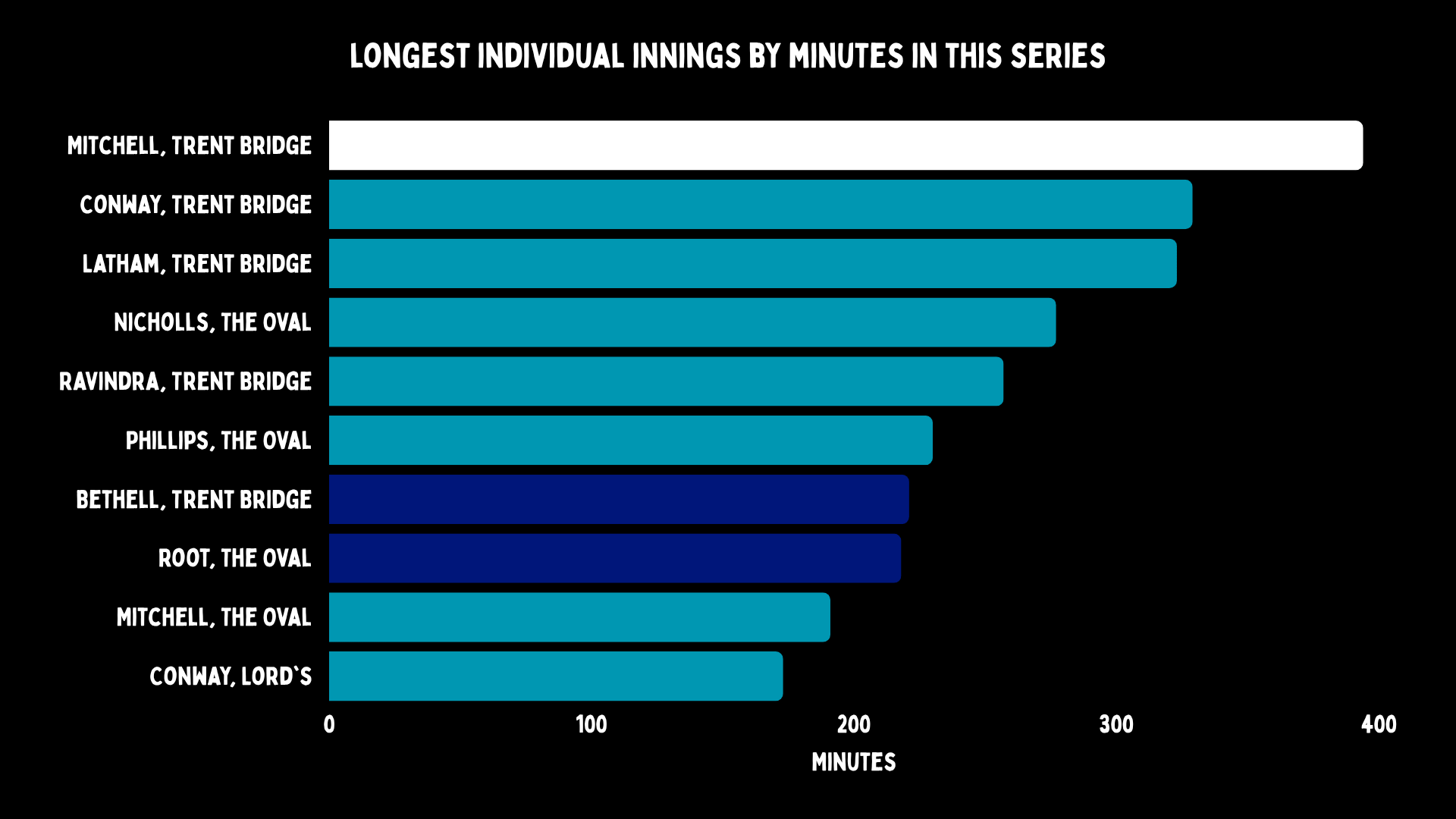
It is that simple, so he picked up a few bruises, but also 100 runs. He batted for 400 minutes on a wicket that was attacking him physically, and he barely played a shot back. Less than an over after their declaration, England were playing reverse ramps.
Of all New Zealand’s specialist batters, Rachin Ravindra is probably the most English in his style. He stands legside of the ball, he likes to hit it a lot, and is a natural scorer. Twice in this series he made big half centuries, worth far more than the numbers suggest. In his Trent Bridge knock, he was well above a run a ball, before England bowled wide.
His counterattack had worked, he could have kept slashing at the wide ones. Instead, he left them. His aggressive style had forced England into a 7/2 field, hanging the ball miles outside off stump with seven men to retrieve it. So he waited.
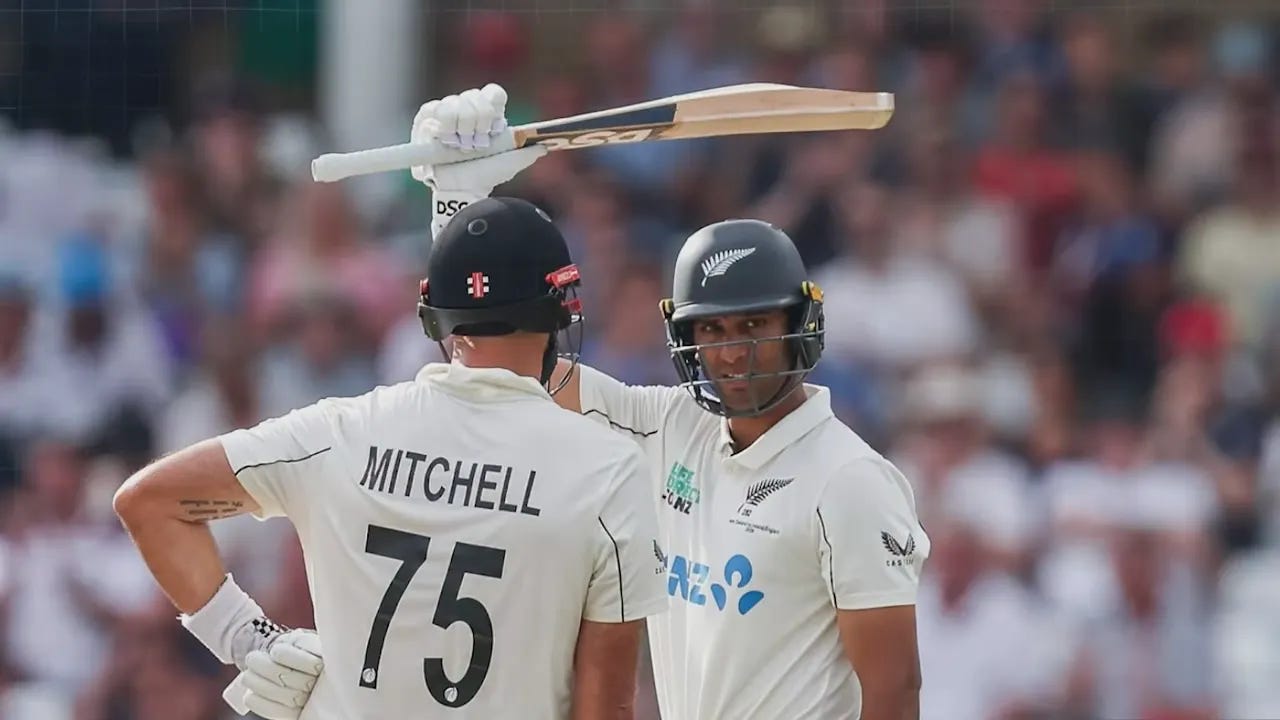
By the time he was dismissed, England were out of the game. He never chased, or tried to walk outside off stump and slog to leg. What would England batters have done?
Nathan Smith is just a good cricketer, while still almost feeling like a club player. He moves well in the field, can hold a bat, and with the ball he hustles in the low to mid 80s. A few years ago, he might have been an England type cricketer. But his skills as a bowler - the fact he can swing it both ways and bowl the wobbleball in a skiddy way - is not the kind of high impact England want.
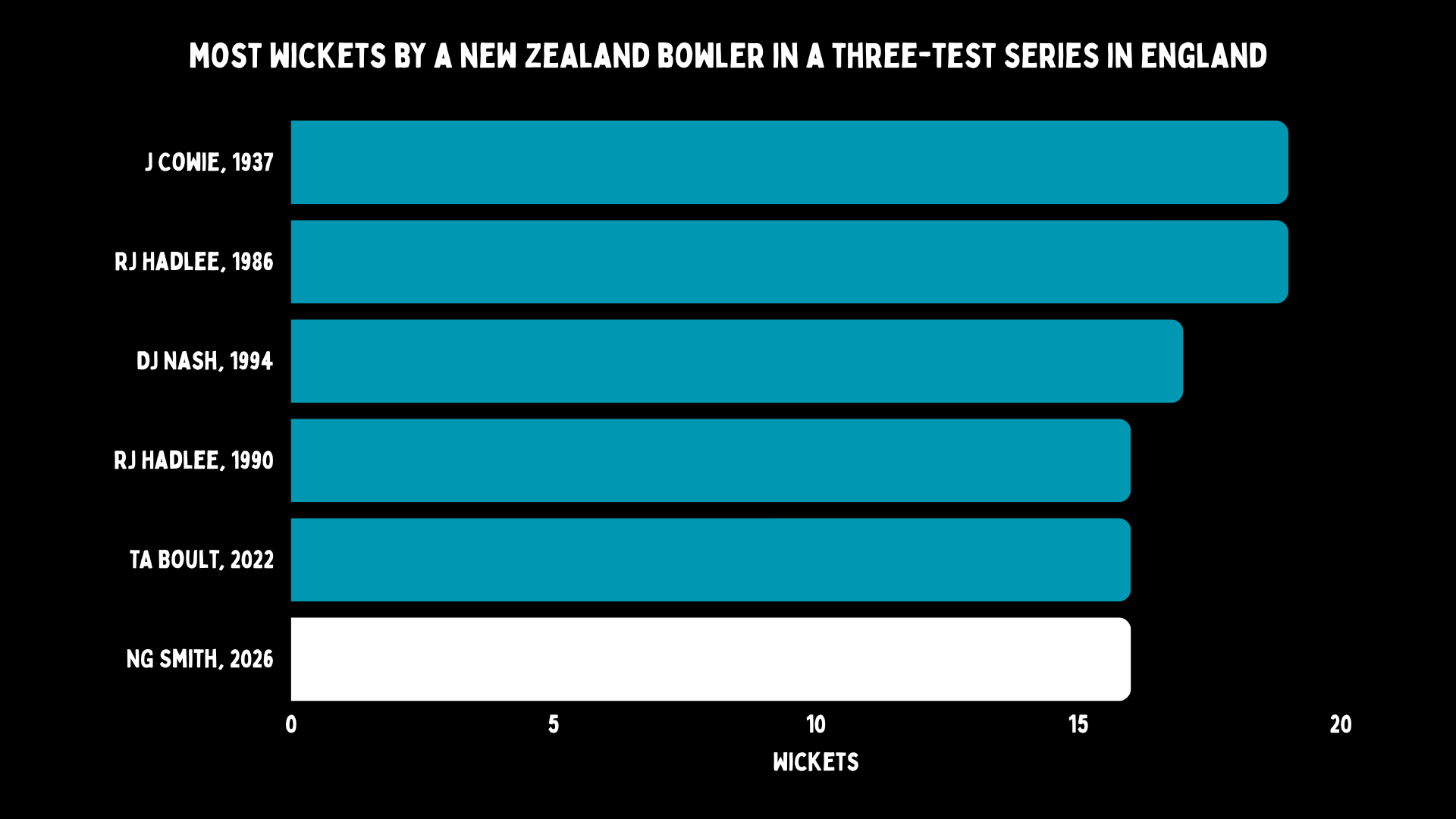
He is simply too slow, and too unsexy for England’s new setup. This series, he almost always found a way of being handy - from holding up an end all the way to reverse swing. When he had the ball, he fit in where he had to. England went for him, scoring at nearly four runs an over despite his constant nagging areas. But at the end, he had 16 wickets, the same tally as Richard Hadlee in 1990.
Glenn Phillips would be picked by England - they would bat him at number three, use him as a keeper, or make him their main spinner. Maybe all at once. At Lord’s, he was playing a similar game plan: the pitch was tough, so he decided to upset their line and length by attacking. He made runs in both innings.
But it was at the Oval he had his biggest impact. Taking a mediocre total and pushing it until they were miles ahead. A lot of that was attacking, but some of it was simply ducking. Jofra Archer was on one in the weird late afternoon light, and Phillips spent as much time on the ground as he did batting. He could have hooked his way out of trouble, but he barely did. So even the Blackcaps’ most expansive man was willing to let the bowler have his moment. Lay down and take it for his country.
And heading into the last match, Phillips was their most in-form batter. He then had a side strain, and couldn’t play at all.
If that was all that happened, it would have been fine. But in this series the Kiwis lost Jacob Duffy due to paternity leave before the series started. Kyle Jamieson missed the last match because they’re terrified of breaking him again. And Blair Tickner bowled three overs before concussion ended his involvement. New Zealand had their full strength team once, in the first match, when they got smashed.
This was a win from their depth. Zak Foulkes wasn’t picked for a single match, and yet he stood up with bat and ball when needed.
Think of Matt Henry. In the first match, he got a back spasm after one spell. If you have a player like him, England is exactly where you want him deployed. On a wicket like Lord’s, he should be unplayable. Instead when he did bowl, you could hear his body creaking.
And yet he played in the next Test, slower and more careful than usual. At that point, it was his calf that was the issue. So he was within himself, without the zip off the pitch you expect. Regardless, he completely got in the heads of England’s two best batters, Root and Brook. He took a ten-wicket haul at 90% fitness. England couldn’t get wickets out of fully fit bowlers.
Part of that was Tom Blundell standing up at the stumps. When this period of cricket is discussed, Blundell deserves more than a footnote. Wicketkeepers haven’t stood up to seamers since the early 90s, unless the bowler is very slow. We pick batter-keepers now, not keeper-batters.
Blundell is a keeper and a batter. When he saw England using the crease with their Bazball shuffle, he went up to seamers like a throwback. Alex Carey gets a lot of credit, but Blundell did it first and every bit as well. It took until this Test for Jamie Smith to try it. It is hard and dangerous, and not at all what you want a non-specialist to attempt. But it kept England’s best players in handcuffs.
Then there is leadership. There are a lot of words being spilled about Ben Stokes being the heroic leader who could do no more. Leaving it all out on the field, and almost giving himself flowers as he did it. He went as hard as he could, until there was nothing left. As always with Stokes, there are elements of truth in that. But there is a whole lot of bullshit as well.
He went to the well one last time. But he also told us all about it, a lot. He was a victim of a terrible ECB culture - but one he helped build. Is he frustrated by the manoeuvring of English cricket around him? Yes. But he’s also lost a lot of Tests recently. He can try as hard as he wants. But a sensible team of professionals just made his clown car team look like idiots. That’s happened two series in a row.
Look at how former captain and legend Kane Williamson handled his retirement. He is arguably the second greatest player ever from his country. A giant of the game. But he slipped away quietly for the good of his team after one Test. Stokes is never quiet.
Tom Latham didn’t need to bowl long spells, or play weird shots. He put fielders in the right areas, his bowlers backed up his smart plans. When things went wrong, they made small adjustments, not wild swings. He was not in great form, but when he got in, he made a big difference to the total. He was not trying to alpha-male lead from the front. To borrow a term from his old boss, he steadied the ship while Stokes set the sails on fire.
When the pitch was flat on day one at Trent Bridge, Latham did little more than wait for England’s mistakes. He did that at the Oval too. His plan was not brave, nor crazy. It was simple and attainable. He lifted the trophy.
The finale was inspired by not one, but two run outs. But perhaps the most interesting came at the Oval. Will O’Rourke was in the middle of one of his very good spells, and Emilio Gay was not enjoying it. So he pushed the ball to mid off and bolted to get off strike. It was too close to Nathan Smith, who picked it up and ran an in-form Ben Duckett out.
Except, in the balls and overs before that, other things had been going on. Smith had fielded several balls at mid off, often athletically saving runs. For Duckett, he was fielding defensively, trying to stop boundaries. But for Gay, he had been creeping in.
He knew the young player was struggling, and he wanted to back up his bowler. By the time Gay hit the ball, Smith had already assumed he might steal a run, so he was on his toes and closer than at any other point. Gay was being attacked by O’Rourke, so he never noticed New Zealand were hunting him in the field as well.
In this series, the Blackcaps got three run outs. England got none.
Brilliant Jarod. Finally some unmitigated honesty about the Stokes “bullshit”. You, Neil Manthorp and a few others deserve qudos for your reporting of these issues. It seems a large quotient of the cricket media remain in Stokes’s thrall. As a cricket fan I’ve been extremely frustrated at how he, and for a while McCullum, were protected species. It almost felt like it was wrong to criticise, and yet there have been some truly bizarre claims made by the both of them. McCullum’s interview with Ian Ward was incredible, after all this time and so many mis steps he still shows no reflection or humility.