


“There’s a line, we’ll headbutt the line but we won’t go over it.”
Nathan Lyon, Australian bowler.
Cameron Bancroft is dancing. The spinner has tossed one up, and he’s raced down to flick the ball over midwicket for a boundary. He stands in the middle of the WACA, bat and helmet raised. This was his 228 not out against South Australia, who had three international bowlers in their attack, on the 14th of November 2017. He was the team’s wicketkeeper in this match and opened the batting too. It was quite the innings.
Cameron Bancroft is not known for being a part-time keeper. Yet his first match for Australia was a T20I, where he was selected as their glovesman.
Until the Cape Town Test, he was a fairly consistent part-time keeper. Western Australia had Sam Whiteman, so they didn’t always need to use Bancroft with the gloves. But he did it enough times.
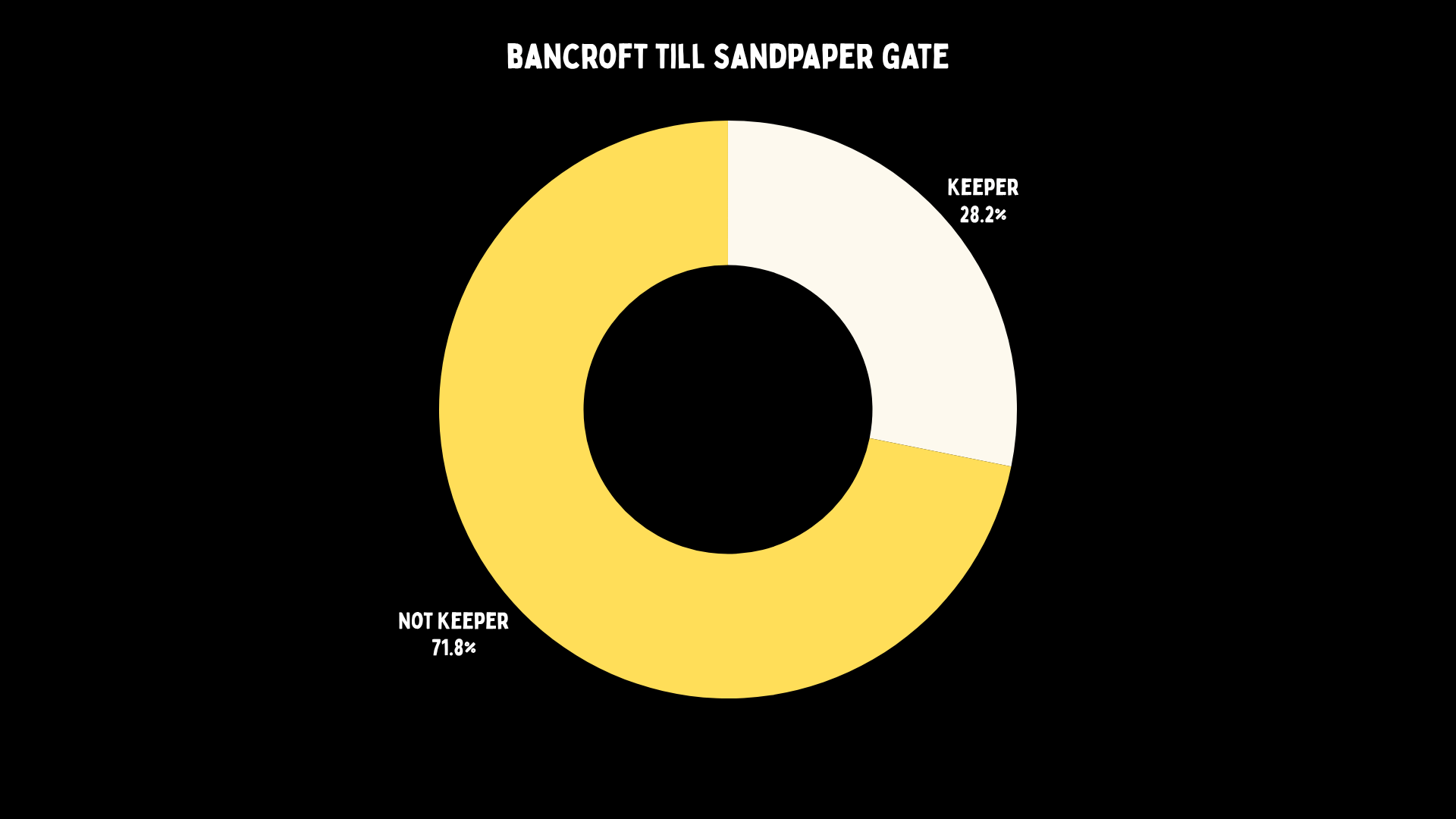
It might seem weird to focus on such a small part of his career. But wicketkeepers wear great big gloves. And for a large part of Bancroft’s career, he had them on. These gloves make it impossible for that player to be involved with “ball maintenance” and the dark arts of ball tampering. To put it simply, it is very hard to shine the cherry while wearing big rubber things on your hands.
Bancroft was not the person who did this for the Australian team; that was David Warner. And so what Australia had was a man who had just taken the gloves for his state side, recently promoted to the national team, with no history of ‘ball maintenance’. By his eighth Test, he was part of an elaborate sandpaper-led tampering conspiracy.
The timeline is this: on the 14th of November 2017, Bancroft made his double ton. On the 20th of November, Nathan Lyon said the team was going to headbutt their imaginary line. The 23rd of November was Bancroft’s Australian Test debut, where later in the game he made 82 not out chasing down a total of 170.
And 130 days after Cameron Bancroft was a wicketkeeper for Western Australia, he was caught tampering with the ball, and it ruined his life.
During that 17/18 Ashes, news broke that Jonny Bairstow had tried to measure noggins with Bancroft late at night, which led to a low-level headbutt. The reason that happened was because of a story where the West Australian players had tricked Bancroft into thinking he had a heavy head, by putting a toe on the scales when he weighed it.
In the end, Lyon’s metaphorical headbutt did more damage than an actual English player’s.
***
In the 2017/18 Ashes series, then ESPNcricinfo writer George Dobell told me that he had heard David Warner was tampering with the ball. I had heard a similar rumour. So Dobell asked critically acclaimed photographer Phil Brown to see if his telephoto lens could find it. Those two covered the entire series, but I only arrived for the last two matches.
As the contest was already over, I spent much of my time on the binoculars trying to see if I could catch Warner tampering with the ball. He had it in his hands a lot, but I never saw any tampering.
But if you go back, England were certainly hinting about something happening with the ball. This was a pretty constant rumour in cricket circles at this time.
That Ashes wasn’t the beginning, though.
That was in Hobart in 2016, where Vernon Philander and Kyle Abbott destroyed the Australians. After a first-innings collapse of 85, an emergency selection meeting was held.
After the game, two senior executives went into the players’ rooms to scream at the players. According to Steve Smith, that was CEO James Sutherland and General Manager Pat Howard. This is not normal, and many players involved were shaken up by this.
This was ground zero for sandpapergate.
Australia were sick of losing. And so they did what they often do: got angry and demanded results. The line Smith has quoted, without attributing it to Howard or Sutherland, is “We don’t pay you to play, we pay you to win”.
This meant Australia were desperate. As we have seen with them before, be it underarm or Justin Langer knocking the bails off in Sri Lanka, if they are cornered, they do stupid things.
What is different about this time is that it wasn’t a frustrated team, but instead, a pissed-off corporation. Team Australia’s brand was low, something had to change. And so there was an organisation-wide plan to fix it.
The only Cricket Australia person to take sandpaper onto the field was Bancroft, but clearly the toxic environment played a huge role in his incredible mistake.
In 2008, India played Australia at Sydney in the Test match that changed the sport forever. There was racism, sledging and cheating. It was a huge moment for the sport, and when Australia were criticised over how their team handled themselves, then-CEO James Sutherland said, “Test cricket is what is being played here. It’s not tiddlywinks.”
When Shane Warne threw the ball at Marlon Samuels during a Big Bash game, who retaliated by chucking the bat back at him, Sutherland saw it as a good thing for the league.
In 2018, Sutherland was the most important official in Australian cricket. He was the CEO, but also more powerful than any chairman. The entire organisation ran around his personality. And there was little tiddlywinks being played.
Then you have coach Darren Lehmann, once caught saying something racist to the Sri Lankan team. In 2016, The Grade Cricketer’s Sam Perry wrote about Lehmann’s coaching presentation called “The Australian Way”.
Perry writes, “A slide headlined “Batting – Key Points” saw Lehmann note the importance of being “aggressive in everything you do!”, that “our first thought is to score”, and that “team philosophy is going to be aggression and freedom going forward”. The first point of his opening slide simply said “WTBC” (translation: “Watch the ball, cunt”)”.
David Saker was the bowling coach, who was renowned for his work with England, his tactics, and his understanding of reverse swing. As a player, he was deemed too out of control to play for Victoria early in his career, after bowling intentional no-balls in club cricket.
No matter how you dissect it, this was an interesting group of men to be in charge.
But it would be wrong to just look at these guys. The environment at Cricket Australia was arrogant, hostile and petty. People were played off against each other. Many staff confided in the media that it was a horrible place to work.
From 2012 onwards, the culture was toxic. By 2018, it was nearly nuclear.
***
Mitch Starc is coming around the wicket to Faf du Plessis. This is the first Test of the 2018 series at Durban. Australia made 351 in the first innings, and South Africa are in some trouble at 92-3. But du Plessis is set, and AB de Villiers more so.
However, Starc manages to swing the ball away on this obscene angle and takes the edge. Theunis de Bruyn is in next. From the same bowler and angle, he gets a half-volley that also takes the outside edge. The 28th over is when du Plessis is out.
In the 52nd over, the innings is completed after Starc and Hazlewood get the ball to reverse massively to close out the tail.
That is 24 overs apart, with the ball still relatively new. It’s not unheard of for the ball to reverse twice. But reversing this early, and so drastically, twice, does seem odd.
Australia will win the Durban Test.
As of now, no one has claimed sandpaper was used in this match, though with this story, things seem to take a while to come out. Already, AB de Villiers has hinted at all not being right in the Durban Test too. [
***
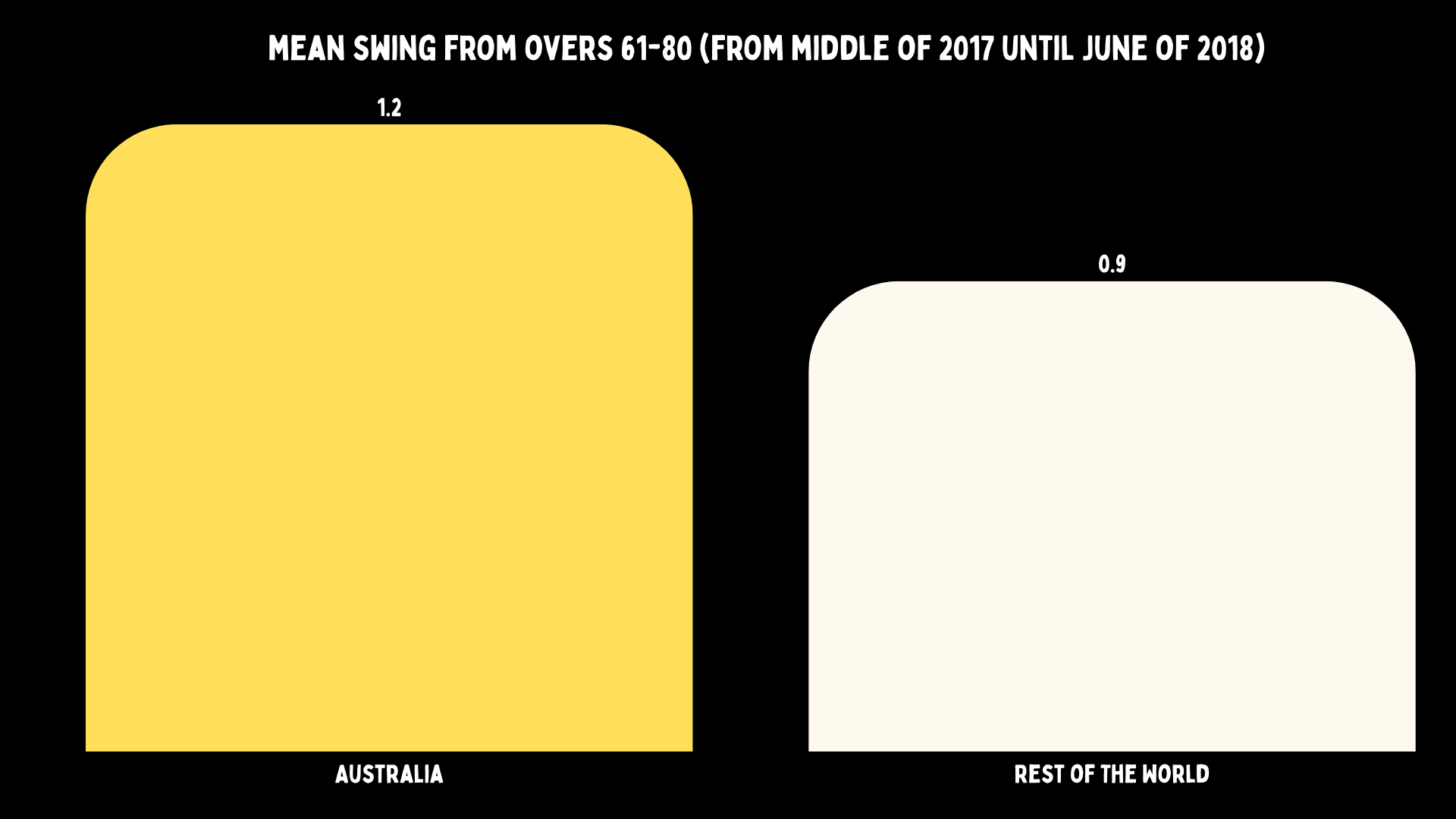
From the middle of 2017 until June of 2018, Australia swung the old ball violently.
Just looking at overs 60-80, they moved it 1.2 degrees. The rest of cricket combined was at 0.9. So either Australia got the luckiest balls around, or, you know, tampering went on about as long as we thought.
We have split these years from July to June, and just looked at Australia. 2016/17 starts before the Test in Hobart against South Africa, but includes the home series against Pakistan, and then the away series against India.
2017/18 is the peak of the suspicions and when they are caught. And 2018/19 is the year after.
Across all three years, Australia’s new-ball swing is pretty similar.
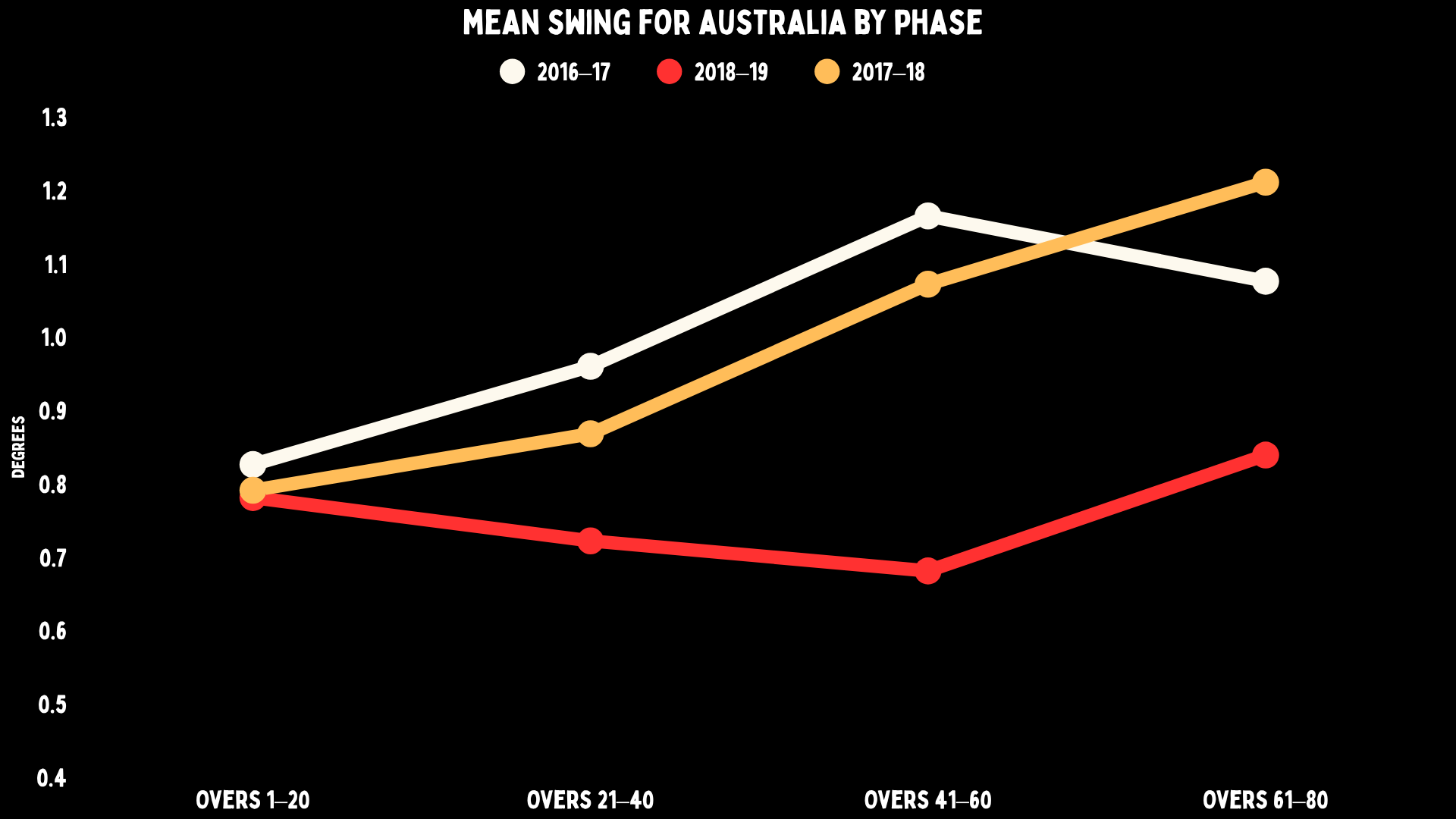
But once the ball hits the 20-over mark, a split starts to occur. All things being equal, Australia get about the same amount of swing throughout the innings in 2018/19, after the bans.
Look at the other two years, though: the swing is violent from overs 40-80.
It would be hard, near on impossible, to look at this data (which Cricket Australia had access to through Hawkeye) and believe that Cape Town was the only time Australia used sandpaper.
You would have to look away to avoid seeing a pattern here.
***
At Port Elizabeth (Gqeberha now) for the second Test, Australia batted first again, but this time they only made 243. By tea on the second day, South Africa were 153 for 2.
According to Cameron Bancroft, a meeting was held in the change room between some players and coaches. In that discussion, David Warner suggested they could use sandpaper to reverse the ball.
Warner couldn’t use it himself, as SuperSport kept looking at his finger tape for signs of him tampering with the ball. Instead, they found Warner’s family written on it.
So Bancroft was asked to do it. Steve Smith was aware and wanted to distance himself from it, but didn’t stop the plan.
Then, as is common practice, the umpires left the ball on the ground after tea, the team walked out and Bancroft picked it up. Then the side shielded him from the cameras. This is why people like me, looking for in-play tampering, couldn’t find it: they had found a loophole.
The issue from here goes back to who Bancroft is: he didn’t work on ball maintenance. So the only way he could be sure he was doing the work right was to speak to Pat Cummins, Mitchell Starc, Josh Hazlewood and Mitchell Marsh, and to get feedback from keeper Tim Paine.
In that list are the current Test and ODI captains (Marsh captained vs England), and the previous red-ball leader.
Bancroft also wrote, “The conversations about the effect the sandpaper was having on the ball were regular, very natural and organic on the field.” So that is it, case closed, they all knew.
However, there remains plausible deniability in his statement, as it never says, “I spoke to one of the bowlers about sandpaper.”
Of course, Bancroft also says that Mitch Marsh was laughing at how much the ball was swinging. You can see why: when de Bruyn was out, the ball swung like a sparrow changing direction. That is not natural.
At one point, according to Bancroft, “There was even a time I was told to stop out of fear what I was doing was becoming too obvious.”
When 12th man Chadd Sayers spoke on this Test, he admitted to going onto the field to retrieve the sandpaper. He was a bowler, but not in that game. But he was never suspended or fined for this action. Until now, his name has never really come up.
***
After the second Test, which South Africa still won, Australia’s media manager Kate Hutchison took the press out for lunch. At that time, she told them she was quitting, that she’d had enough of the job.
According to Bancroft, she knew of the sandpaper and was clear it was wrong.
At one point, Bancroft even speaks to her directly about the tampering at training, asking what will happen if he is caught. Her response was “not good” and she walked off.
Media managers are not in the team room the entire time. They have to go back and forth to the press box, where they have a desk. They are also rarely involved in strategic conversations. They might be near them, but there is no reason to ask your media manager about where to bowl or when to declare.
And yet this staff member, who was neither backroom staff nor in the locker room full time, knew about the plan to use sandpaper, enough to make it clear to Bancroft it was wrong and that there would be consequences.
It’s weird that Hutchison would know this much, yet, by their own account, none of the bowlers or coaches were aware.
“Because in spite of having scored the most hundreds of any player in the competition in the last six years, including featuring in the top-three run scorers for over half that period I have never had a look in.” This is Bancroft on the fact he has not been in the Australian team since 2019.
Since Bancroft’s last Test as an opener, Australia have used Wade, Pucovski, Head, Smith, McSweeney, Konstas, Labuschagne, Weatherald, Renshaw and Maddinson as new Test openers.
Cam, she’s just not that into you.
Bancroft has made the most Shield runs since the start of 2020. There was a chance for him to come in when Smith made the weird decision to open. The other time was when Harris was dropped, and Khawaja was used as a stopgap because they couldn’t find a middle-order spot for him.
His best case was when Weatherald came in. To be fair, Weatherald also earned a chance, and he is a more dynamic player than Bancroft, plus two years younger. Of course, Maddinson recently jumped him in selection. But at that point, Bancroft was not in sexy form, with no hundreds in that period.
Australia probably needed him most when McSweeney/Konstas came in at the end of 2024. Sadly, he was in career worst form at this point. He scored a golden duck against South Australia on the first ball of the match. The day before, Nathan McSweeney made ten on his debut for Australia. In the second innings of that Shield match, Bancroft made 105 not out. It was just too late.
Bancroft was in the middle of a real-life sporting conspiracy. And his life was ruined by it. Not being selected one time in almost seven years, while Australia played shuffle mode with the top order, is bizarre. What really happened was probably bad form at the wrong time, and Australia using almost all their middle order as openers.
***
In Cape Town, Australia started to struggle again. One thing you need for reverse swing is dryness, and the square had moisture in it, so the preparation was not working. According to Bancroft, bowling coach David Saker told him he “needed to do more with the sandpaper”.
On the field, Bancroft also says that he was having conversations with the bowlers. This tracks with what I was told years ago, that the ball wouldn’t reverse swing because of dampness, and that the bowlers demanded he make it swing.
Soon after, SuperSport began showing something in Bancroft’s hand, then his pocket, and ultimately his underwear. This is the part we all knew.
The footage shows coach Darren Lehmann on the walkie-talkie, saying “What the fuck is going on?” Well, that is what Cricket Australia told us. Bancroft claims that the coach actually said, “Get the fucken sandpaper off Bangers now.” It’s worth noting that Lehmann has always denied knowing about sandpaper.
After that day’s play, Steve Smith wanted to address it straight away at the press conference, so he could focus on his batting. That is probably the most Smith-like thought process there is. To him, this was a small thing, whereas his next knock was always the most important.
According to Bancroft, Saker warned against saying sandpaper at the press conference, so it was described as tape and material collected from the ground. This is the moment that shows how little they understood what was happening.
The Australian cricket team thought they were talking to a cricket world that understood a little bit of tampering was needed for reverse swing. Actually, they were talking to the whole planet, who just saw them as massive cheats.
The front of the newspaper is for the biggest news story; the back is where the sport goes. Australia didn’t realise at this point that they’d gone from the back page to the front.
Malcolm Turnbull was the Australian prime minister for less than three years. He led during a time when it seemed the same selectors picking Australian openers were choosing who was in charge, as so many changes were made.
By 2018, he was not popular. In April of that year, he would suffer his 30th straight Newspoll loss. That was two weeks after the Cape Town Test.
So Australia had an unpopular PM who was looking for an easy win.
Turnbull said, “We all woke up this morning shocked and bitterly disappointed by the news from South Africa. It seemed completely beyond belief that the Australian cricket team had been involved in cheating. After all, our cricketers are role models and cricket is synonymous with fair play.”
This kept it on the front page.
Turnbull is not really a cricket fan, but he has one very interesting link to the sport. When Kerry Packer split the sport into two for World Series Cricket, he went around buying players from boards. In 1978, Turnbull signed Desmond Haynes, Colin Croft and Richard Austin during a Test. That led to the West Indies board dropping players and Clive Lloyd resigning.
Sandpapergate has been one of the most controversial moments in Australian cricket, but in the number one spot is Kerry Packer’s split, which Turnbull was part of.
And for all his appealing to the public’s anger, in August of 2018, Malcolm Turnbull was ousted by his former ally Scott Morrison.
But if Packer’s event was a circus, this was a freakshow.
You wouldn’t have guessed that from the ICC suspensions. The governing body gave Steve Smith a one-game ban, and he lost 100% of his match fee. Cam Bancroft was fined 75 per cent of his match fee and handed three demerit points. Warner was not given any punishment.
Then Cricket Australia handed down their findings.
They suspended Smith for 12 months from all international and domestic cricket. Warner received the same. Bancroft was suspended for nine months from all international and domestic cricket.
The difference between the suspensions shows how the hysteria had swelled. This was a misdemeanour for the ICC, and a capital offence for Cricket Australia.
It is forever worth noting that in the Hobart match that started Australia on this path, South Africa’s captain Faf du Plessis was found guilty of ball tampering. The same man who would be in charge at Cape Town. And that was his second offence.
The first time du Plessis was found guilty of ball tampering was in 2013. He was fined 50% of his match fee.
When it happened again in Hobart, he was handed a 100 percent match fee fine for ball tampering. And it was weirdly treated as a first offence, despite, you know, it being his second.
Du Plessis never even missed a match for two ball-tampering offences. The Australians lost 9 months or a year.
***
“Once again. WE ALL KNEW.”
That is what Bancroft has said about the team and sandpaper. It clearly supported what Khawaja said in his Sabr book. “It was all of us. Not the batters, not the bowlers, not the staff.”
There is an obvious issue here, and it is one that Cummins and the bowlers will wriggle through until there is direct evidence or testimony they can’t dismiss. “When he says we all knew, if by that he means that we knew sandpaper was going out in the field, he’s 100 per cent wrong” is what Cummins said at the press conference.
This may not be true, but Bancroft and Khawaja did not interview all their teammates and backroom staff.
Remember, they were in the sporting version of a criminal conspiracy. There would have been conversations, but no one was taking roll call:
“Handscomb, Peter, do you know about sandpaper?”
These were conversations in change rooms, and out on the ground. As any coach in history will tell you, players do not always listen. Even people sitting in a huddle might be in a weird mental state.
Bancroft says that Lehmann, Saker and Hutchison were directly involved in talks about sandpaper. He does not say that about the bowlers or Paine. With them, he mentions conversations about reverse swing.
In 2021, when interviewed by Donald McRae, Bancroft was asked about whether some of the bowlers knew what he was doing. “Yeah, obviously what I did benefits bowlers and the awareness around that, probably, is self-explanatory. I guess one thing I learnt through the journey and being responsible is that’s where the buck stops (with Bancroft himself).”
That statement, where he takes responsibility and never actually fully commits to the bowlers knowing, led to the quartet releasing a joint statement saying they did not know anything about “a foreign substance being taken onto the field of play to alter the condition of the ball”.
We asked Bancroft’s agent, Ben Tippett, if the bowlers or Cricket Australia had put any pressure on Bancroft to retract the statement, and were told they had not. However, Tippett added something else: “They haven’t had a lot of dialogue over the years with Cameron.”
According to Khawaja’s book Sabr, in 2021 he rang then coach Justin Langer: “Alf, Alf, come on let’s take it together. Let’s cop it as a team.” Khawaja gave up after the bowlers’ statement: “I wasn’t going to go to war with those guys back then.”
So when people say, “Why did it take eight years?” - this is why.
The statement from Bancroft is not complete; there are lots of unanswered questions. Like the long meeting about the team taking responsibility, which 12th man Chadd Sayers and Khawaja mention. Warner tweeted back in 2018,: “I know there are unanswered questions and lots of them... In time I will do my best to answer them all.” Eight years on, and we still haven’t got tell-all books or Test match-length press conferences from all the players involved.
Tippett confirmed Bancroft wrote this statement on his own. We know that Khawaja did something similar. Because of this, they lack some journalistic rigour. The wording is loose at times, which is why Khawaja struggled when questioned by a non-cricket journalist. And there are other places where they did not think to answer questions.
There are also cricket things worth mentioning here. Did the bowling unit know sandpaper was used? We have not seen that evidence or testimony. Does every professional bowler know that consistent reverse swing requires tampering? Yes.
According to Wasim Akram, a ball looks very different when it has been tampered with using foreign items. But regardless of that, they already knew that to get it to reverse, it needed illegal means.
In Pat Cummins’ epic 68-minute, 34-second press conference, he said that he’d seen illegal ball tampering on the field just once. It is possible he never saw it, because that is the point; it needs to be hidden. But teams know it happens. To get the ball to reverse three Tests in a row, like Australia did in South Africa, there is no option to rely on legal methods. Sandpaper, fingernails, zips, or boundary concrete. Something had to be used.
It is almost impossible for a bowler of his intelligence not to know illegal methods were used to tamper with the balls he used. Maybe he didn’t see or participate in them and no one has suggested he was in on every detail of the plot. In my career, I have spoken to more than 50 bowlers about reverse swing, all have told me illegal methods are used. All of them.
None of that means he knew of sandpaper, but clearly a lot of players did based on recent evidence.
But these are cricketers speaking about something eight years after it happened. Sayers has admitted his memory is not exact, and no one’s could be. That is not how memory even works.
However, the reason we don’t know is because Cricket Australia did not want us to.
They had three sporting criminals for the public to abuse; they overpunished them, and then many other people were eventually managed out, or just left on their own. Not everyone was interviewed, and they only looked into one match: Cape Town.
They did that because it was easier, cleaner and would move it on. Eight years later, it looks even stupider now than it did then.
Even before Khawaja’s book, the idea this was just a one off was preposterous. Like catching a cat burglar, and assuming this is the only crime they’ve ever committed, so it would be pointless checking their fingerprints.
No, it was clearly a part of the clean-up to narrow their sights so nothing could actually be seen. So they didn’t do a thorough independent review of what happened. Instead, their lawyer Iain Roy did a rushed version. Working with him was Pat Howard, the same man who stormed into the Hobart change room not two years earlier. And Roy worked directly for James Sutherland, the other man who did.
The suspensions of Warner, Smith and Bancroft came from the near embodiment of a Kangaroo court. They limited the scope and investigated the issue only to find that they were not guilty at all, instead, it was just three guys in the book depository alone. While so many cricket players, coaches, backroom staff and officials stood silently on the grassy knoll.
In December 2023, before Warner’s farewell Test series, Mitchell Johnson wrote a column attacking him, partly over Sandpapergate. Khawaja defended Warner. He called him “a hero” who had “paid their dues”.
You can debate whether he is right there. Everyone is picking a side.
But how many people actually believe this was ONLY perpetuated by three men in one Test? We were sold bullshit and told it was beef from the start.
Everyone is now fixated on the players and who knew what. In 2018, Bancroft was not much older than when his teammates tricked him on the weight of his own head. Cummins was a 24-year-old, newly back in the team trying to stay fit. Smith was/is a batting-obsessed meganerd who never had great people skills. Khawaja was a fringe player trying to fit in.
Even David Warner has a complicated history. He was told by his bosses to settle down and be the nice guy, so he tried, and people nicknamed him the Reverend as they mocked him. He was then told the team was losing because they were too nice, so Warner had to become the attack dog.
The coaches, the managers, the officials and the executive are still barely mentioned. And it was months later when their part was even looked into.
When Ethics Centre Director Dr Simon Longstaff reviewed Australian cricket culture, he could have summed it up by showing the pile of shit emoji.
“The most common description of CA is as ‘arrogant’ and ‘controlling’,” the report said. “The core complaint is that the organisation does not respect anyone other than its own.”
But most crucially, it said administrators should bear as much blame as Steve Smith, David Warner and Cameron Bancroft. That was more than six months later, and it had almost no impact outside of Pat Howard losing his job. But by then, James Sutherland had already left Cricket Australia.
They were the two men who stormed into the Hobart change room, where Warner’s manager claims the players were given permission to tamper with the ball. Both left cricket quietly without the rage of Sandpapergate.
***
We are here because of Usman Khawaja’s book, David Warner’s social and media comments, Pat Cummins’s press conference, Chadd Sayers’s radio interview, and Cameron Bancroft’s article. Every Australian player (or former) using a different part of the media to state their case.
It is just one way the cricket community has never looked more fractured.
Through a quirk, Australian cricket is different to most cultures. English cricket was built around a class system, meaning that everyone played for themselves or their next contract.
In the 1800s, Australian Rules Football was invented to train cricketers in the winter. That is a sport where team first is the only option. On top of that, Australia didn’t have the same class issues as England did. So cricket became a sport where it was more about the team than the individuals.
That is the ideal.
It has been one reason Australia has gone on to be the most successful team ever.
The baggy green and the team come first. That sounds great, but it also means that sometimes players have to be sacrificed at the altar of the team. Even when Khawaja wanted to go public, Smith talked him out of it because Smith “wanted to take the blame”. Jumping onto the baggy green to protect it from the mortar shells.
All in the name of wins. But the Australian team lost. First on the field. Then off it. They are still losing now. For a culture obsessed with winning, in the end, they made it impossible to find any victory in this.
Australia has always been obsessed with playing up to the line. The issue has always been that it’s imaginary. So the Australian team wanted to headbutt their own made-up line. And in the end, they knocked themselves out.
Cameron Bancroft has been taking blows for years. This time, he headbutted a few back.