



Buy your copy of 'The Art of Batting' here:
30 is a weird age for a batter. In your prime, and yet with fewer years ahead than behind. You could keep your place on top, or be done by 33. Almost all players are closer to the end than the beginning at this age. Most likely at their batting pinnacle, and yet we hear anything starting with thirty and think subconsciously they’re about to decline. Modern players start to use hair dye, dress younger, or leak their new fitness regimes around this time. Letting everyone know they’re still on top.
It’s not that there aren’t some great years ahead of someone this age. They’re settled professionals while young enough athletically to enjoy the fruits of experience.
But they’re old enough for people to look towards the next big thing.
Some players just feel older. Sanju Samson is only 30, but he’s also 13 seasons into an IPL career, and it been more than a decade since his debut for India. Samson is a lot of things, but a shiny new toy is not one of them.
He would have assumed his recent body of work sealed one of the two opening batters’ spots in India’s T20I side. But then in comes Shubman Gill, as vice-captain, and suddenly Samson has a maths problem: how does India use Samson, Gill and Abhishek Sharma up top if there are only two spots? As vice-captain, Gill will surely start, and Abhishek’s left-handedness and ability to bowl a few overs gives him an edge. The other keeper in India’s squad for the Asia Cup is Jitesh Sharma, who slots into the lower middle-order much more comfortably than Samson.
Perhaps that’s why, in the Kerala Premier League 2025, Samson tried batting lower down for Kochi Blue Tigers - No.6 once for a scratchy 13 off 22, and sat out another -before returning to the top to smash 121 off 51, 89 off 46, 62 off 37 and 83 off 41. Was he proving he could adapt to the middle order, or simply reminding everyone where he’s at his best?
That is the life of a modern Indian player. The talent comes at you so fast, that everyone is already looking beyond you. If you slip, or pause, then you can be done.
But Samson isn’t just on the outs with India. The last season of the IPL, it seemed as if Rajasthan Royals were consciously uncoupling from him. They already had Yashasvi Jaiswal at the top of the order, and Vaibhav Suryavanshi stepping up spectacularly when Samson had to sit out with injury. Riyan Parag was leading the team when Samson was unavailable, and Lhuan-dre Pretorius was also selected in the squad. Suddenly, the oldest batter in his team was less important. Just like India, Rajasthan had younger players and a maths problem. It was clear there was a possibility that Samson was on his way out.
Now it appears he’s a trade asset, rather than the franchise player he was before. All while he was still India’s opener. It’s as if everyone suddenly decided he was out of fashion, even while they were still using him.
Sanju Samson is 30, but it already feels like he’s on the verge of being obsolete.
In 2013, Rahul Dravid handpicked Samson for the Royals. Meaning, he had the seal of approval from one of the best players ever, and even a future coach. His talent was immense, and big things were expected.
Yet, in the last 12 years, Samson has played only 16 ODIs and 42 T20Is for India. Until the end of 2023, he had played only 14 20 over matches. It’s only after the 2024 World Cup that he has featured more regularly in Indian teams. Samson has been stuck in the friend zone most of his international career.
One of the worst things you can be as a modern India player is someone who can’t match the hype. His promise was always likely to be more than his reality.
What makes Samson compelling despite these scattered performances is how he bats in T20s. He was among the first prominent Indian batters, especially at the top of the order, to play a high-intent game. He was ready to sacrifice run tallies and averages at the altar of strike-rates.
If you think about it, Samson was batting for speed when India still loved anchors. And yet, as they’ve come around to his way, they’re almost already onto the next guys he helped inspire. So he’s ahead of the game, and yet still somehow old news.
After his first year in 2013, he’s had a negative true strike rate only twice in 12 years, while his true average has been negative five times. ‘How quick’ matters more than ‘how many’ to him.
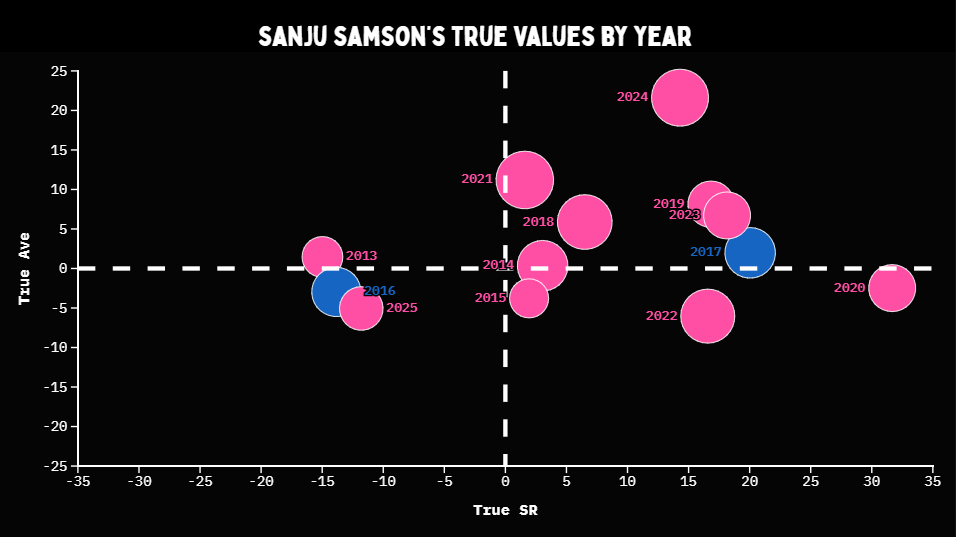
It’s a remarkable quality in a country where the ‘high-risk, high-reward’ method is still not easily digestible. It’s lauded when there are big scores, but the pressure mounts exponentially when it produces a low run, and there is clamour for ‘consistency’. Basically, the Indian cricket ecosystem - fans, media, commentators - regularly want a lot of runs, scored very quickly.
If you fail, your method is wrong. If you succeed, you’re a legend. It’s almost that binary.
