


Stephen Fleming paused the great killing machine of Australia with point fielders.
Damien Martyn was one of the best strikers of the ball in the world. That is the wrong word; he caressed deliveries in a minimalist fashion to places he wished them to go. There was no huge foot movement or jerkiness, just short perfect touches and half-brush strokes that painted perhaps one of the most beautiful pictures in batting.
Fleming was not like this. He always moved like his bat was too heavy for him. It was a long flow that almost hinted it would be too late, but it caught up to the ball. His feet were like Martyn’s in that they didn’t move much. But they felt stuck on the surface, as if on his part of the pitch were an invisible tar pit. It was a different kind of elegance; Fleming flowed runs. He was all bat path, almost looking like he was using a gymnastics ribbon. At times his blade seemed to transform into rubber.
Damien Martyn was supposed to be the Australian captain for a long time and never did the job. Stephen Fleming was the New Zealand captain who briefly interrupted Australia’s dominance.
There is no magic to it; he just works the machine any way he can.
-
England could not have been luckier to land Stephen Fleming as their coach. They did it in the same arse backwards way they’ve run their cricket for a while.
If they were going to move on their coach, the Ashes was the right time. They did not do that. If they were thinking of making off-field changes, then keeping their captain happy and loved was the right idea. They did not do that. If they were going to make a huge change of captain and coach, they needed to be sure this is the Director of Cricket who will be around for ages. They did not do that. And if they had another person who they were desperate to bring in, they should have been sure before sacking their current coach. They did not do that.
Let’s run it back a little.
The director of cricket picks the coach and has a major say in who the captain is. After the Ashes, Rob Key really struggled to explain anything in a rational or coherent way. Whether Key is good at his job or not isn’t the issue here. Because at that point he was clearly the wrong person to lead Brendon McCullum. Maybe he always was. But something was missing; England needed a vice principal at a school with talented little shits everywhere. And instead he was none of that.
If Key was removed then, that allows a nice long look at his replacement. But from a sports perspective, it also permits something really important: for the new leader to take over and have a say in the main decision they will make. If you’re picking a director of cricket you want their vision and plan; can you have that when the coach isn’t their pick? Yes, but it makes it way harder and brings about complications you don’t need.
So moving on from Key, bringing in a new director of cricket and their choice as coach would have allowed England to spend more time on their fractured relationship with Ben Stokes. Instead, they’ve ended up with a new coach and captain. Chosen by a director of cricket whose job was actually the most tenuous of the three.
But they ended up with Stephen Fleming, so clearly they know what they’re doing.
Except, again, no. Andy Flower knocked them back; they then went through a bunch of good and terrible options, but they were lucky that the Chennai Super Kings decided to change tack and Fleming was around.
It may not end up successful for Fleming’s reign. England still have a caretaker captain and someone not long for this job as director of cricket. Fleming will struggle to find them another all-rounder, any spinner, and the idea of a secure top three seems like a fairytale. He might also not gel with a team that believes their job is to supply vibes. Or he could be a poor coach in red ball cricket.
However, England got a very experienced, successful and smart cricket coach. And like most things in English cricket, it was almost entirely by accident.
But after a crash, you need a mechanic.
-
Weirdly, I have worked for Stephen Fleming. There used to be a cricket team called the Melbourne Stars, and he was the coach there. For one season, I was their remote analyst. I couldn’t have been further away, as I was in the West Indies commentating a Test series while working for them.
So it was not a normal job where we sit around and talk nonsense about cricket after the day’s play. However, I did get a good idea of how he worked, and what his vision was.
The year before, we spent more time together when I was covering the Stars, but also around the team hotel a lot.
On top of all this, I have also spent a lot of time watching CSK; in many ways, they were one of my earlier obsessions as they were really good when I was learning about cricket data and T20 analysis.
So I don’t have a PhD in Stephen Fleming as a coach, but I feel like I understand him pretty well.
The main thing I have noticed is his love of all-rounders. Chennai have had some of the longest batting line-ups ever, and at other stages they had six bowling options. When we were at the Stars, we had to replace a specialist bowler, and we did that by bringing in Liam Plunkett. Part of the reason was the extra batting he could provide.
It was also there that I came up with the Evan Gulbis effect, when the Stars dropped him for a final and batted slowly because of the shorter line-up. Gulbis’ career was largely shaped by Fleming’s love of all-rounders. But in that side he also had Marcus Stoinis, Glenn Maxwell, Dwayne Bravo and occasionally Plunkett.
England aren’t quite in the Stokes/Moeen/Woakes territory anymore. So that will be harder for Fleming, but there is Sam Curran, Rehan Ahmed and even Craig Overton if they feel the need.
However, will Fleming’s white ball coaching be how he thinks about Tests?
The short answer is we don’t know.
Fleming won five titles with CSK, they dominated the IPL with different teams, not just one golden generation. Dhoni gets a lot of rightful praise, but Fleming was the other main constant.
One thing the men share is role definition. Part of that might overlap with Dhoni’s thoughts. But even if you go back to his New Zealand teams, players always seemed to be in the side for a reason. I wouldn’t say he backs fit over talent, but he lets players know they have a job, and keeps cricket simple for them.
One thing you can see with his teams is that they are largely built on traditional methods; he likes slow starters in T20 and usually has a lot more finger spin than mystery or wrist. Then there is the home grounds; Chennai rode a lot of their success on picking the right team for their surfaces. At the MCG, the Stars played the longer boundaries well.
Also worth noting, all teams he’s led played a different style of cricket. Some coaches just rehash one idea; New Zealand, Chennai and the Stars were all very different.
Fleming is smart and thorough; he finds a method that fits each team, and then makes small changes around the edges. Tactically, he is clever, but he is also not afraid of conventional wisdom too. He will use what works when he needs to.
He is many things, and none of them is Brendon McCullum. Baz is a magician, Flem is a machinist.
-
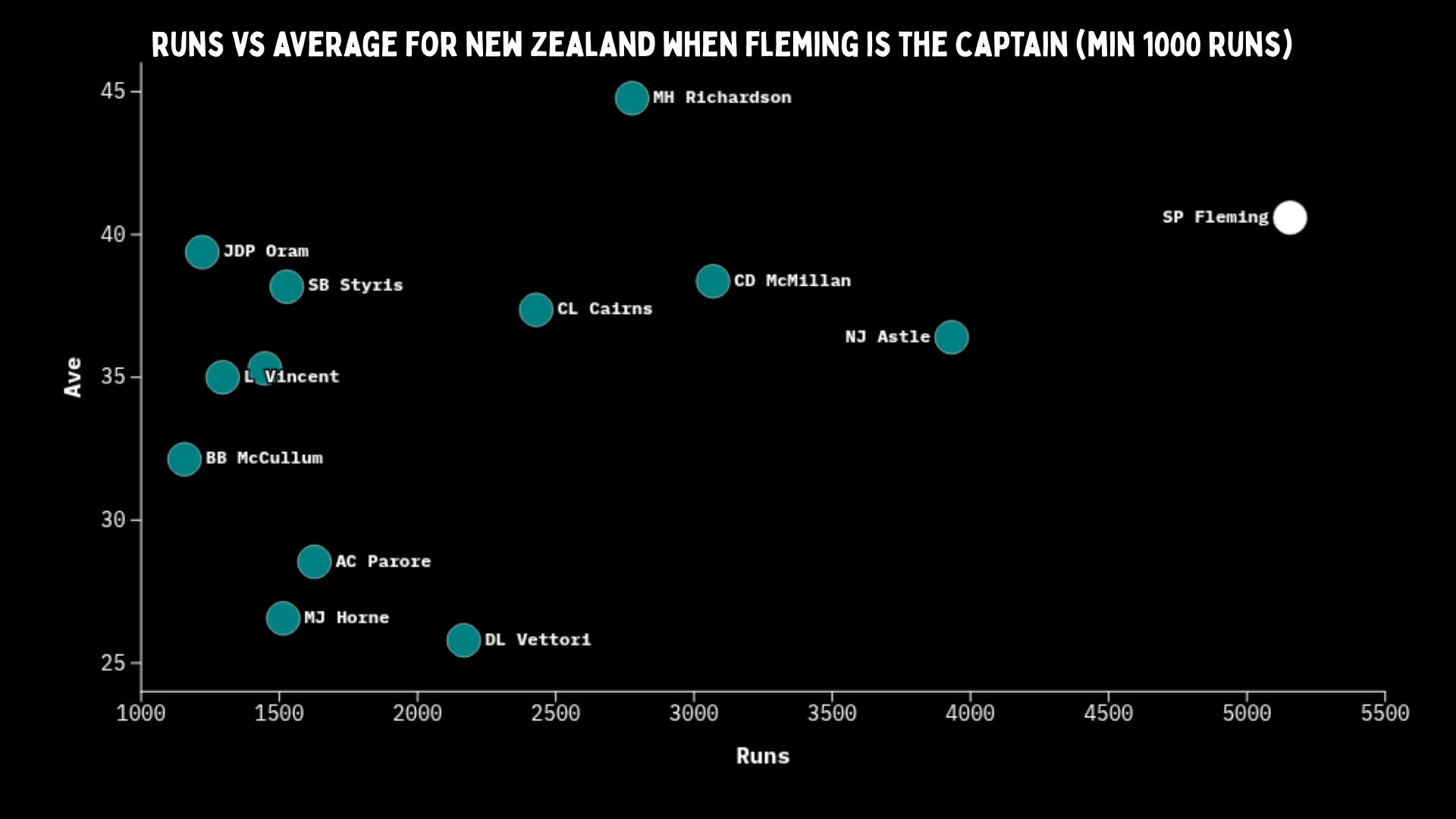
Stephen Fleming could bat; he averaged 40, largely as an opener, which, by New Zealand pitch standards, is pretty good. However, during his time as captain, that was the second-best mark. Only his occasional opening partner Mark Richardson was higher, and that was a spectacularly short and weird career.
But Fleming’s was bizarre too.

Fleming averaged 34 at home, 46 away. In terms of Tests’ heaviest scorers, only one player has a better away ratio than this. So Fleming truly never worked out the long white cloud at home, but on the road he was incredible, averaging over 45 in South Africa and 100 when touring Murali in Sri Lanka as a left-hander.
The weirdness continues: in 111 Tests, he has nine hundreds.
-
Fleming was still feet, some pokes outside off-stump, and then a long flowing drive followed by a dismissal between 30 and 70.
He was dismissed seven times with the score on 30 and 31. With another 15 innings in the 60s. It was like Fleming built himself a glass floor and ceiling.

Fleming had the starts of a world-class batter, but then the conversion of a number seven.
It is partly why he ends up averaging 40, when clearly there were more runs in him. But most players with that kind of record are stuck with a lower average because they never score big tons. Fleming’s nine hundreds include five of more than 150, and three of those are doubles.

So Fleming never passes 60, and if he does, chances are he might make a double hundred.
He was the best Kiwi batter in his era, and yet also the most frustrating.
It is why many people see him as a slip fielder (he was one of the best of all time) and as a leader.
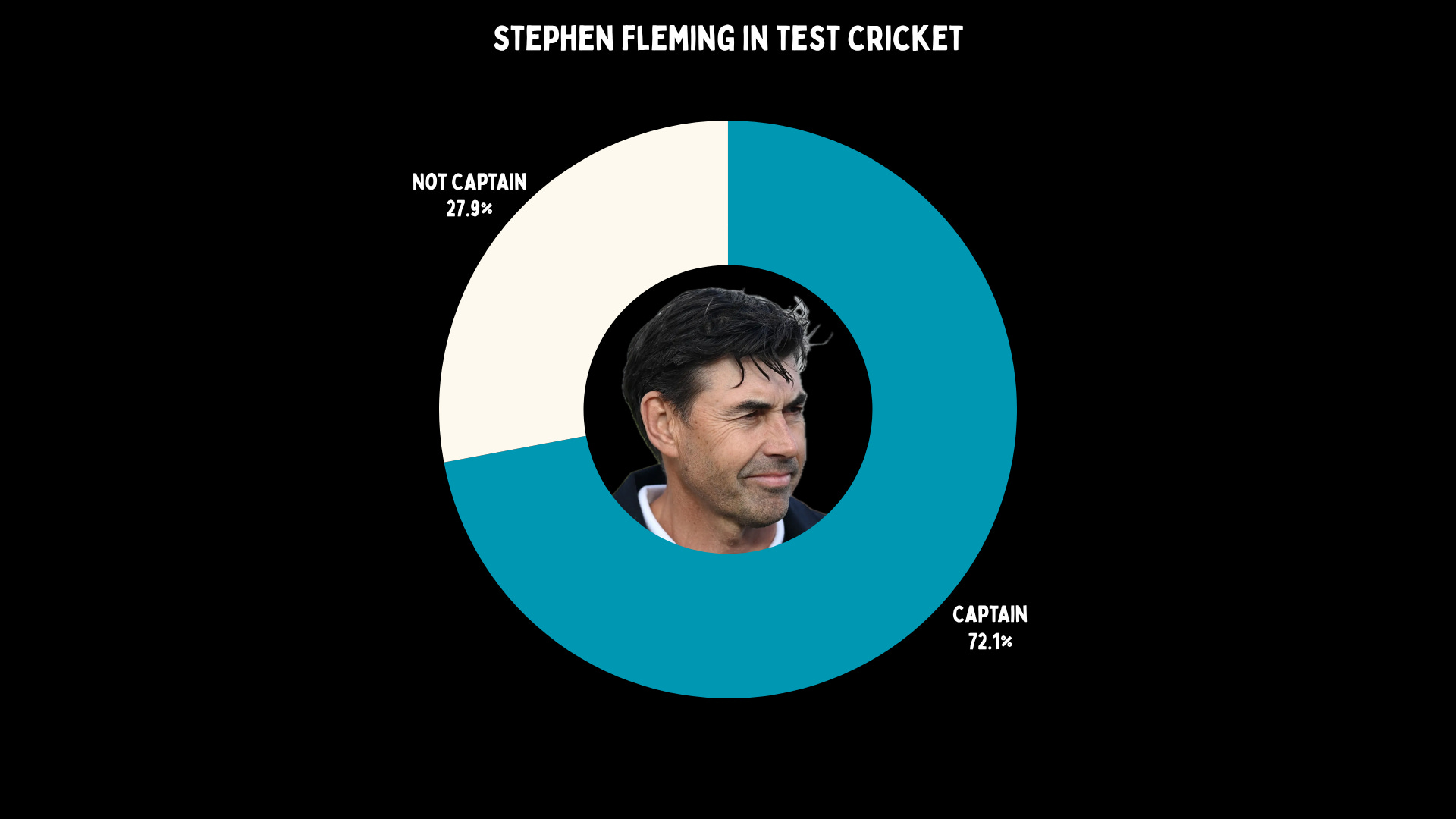
To most fans, they only know Fleming as a captain in Tests. In more than 70% of his matches, he was in charge. That is a huge number. It’s very rare for a player to lead more than not, and in his case, it’s not even close.
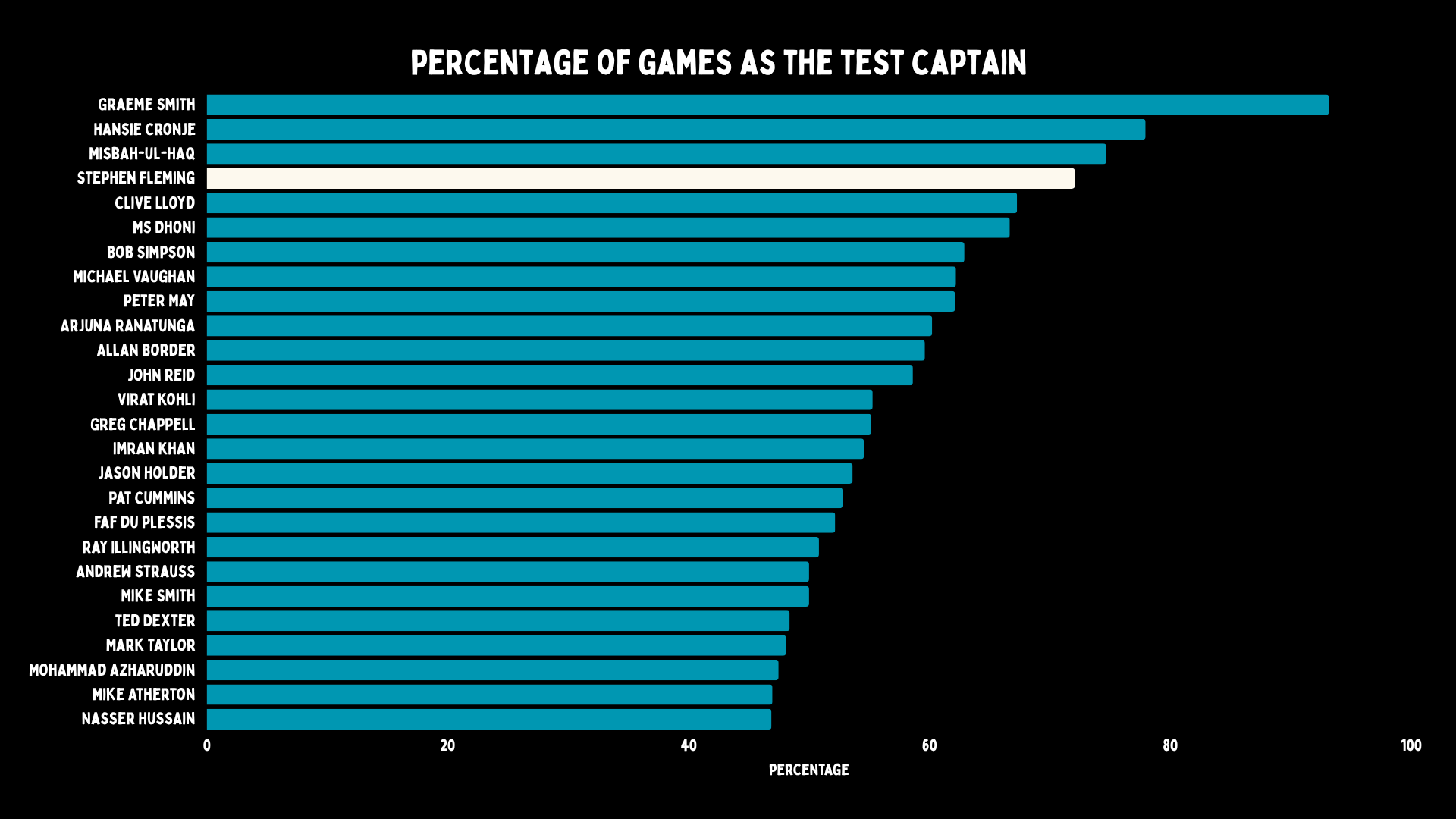
It puts him on a short list of guys who really do the job a lot. The fourth highest percentage ever. One of them was Graeme Smith, and they are linked by a story from an ODI in Auckland, where Fleming hurled abuse at the massive South African skipper.
It was against type for Fleming, but it also made sense. He felt that young Smith could be very emotional, so he used the tool to win the match. That is what his captaincy was.
And in many ways, his reputation and career are defined by how he led. He took over the role early because of a leadership vacuum; their previous captain was Lee Germon. A keeper who had never played a Test when he received the job. The very definition of a stopgap, and Fleming has said before, he got the job because there were no other options. He was 23, and two years earlier he’d been caught smoking weed.
And his team was not great; coming off their high in the 80s had led to a real struggle in the 90s. But a young herb-smoking Fleming did very well at rebuilding them, without much batting, or really bowling.
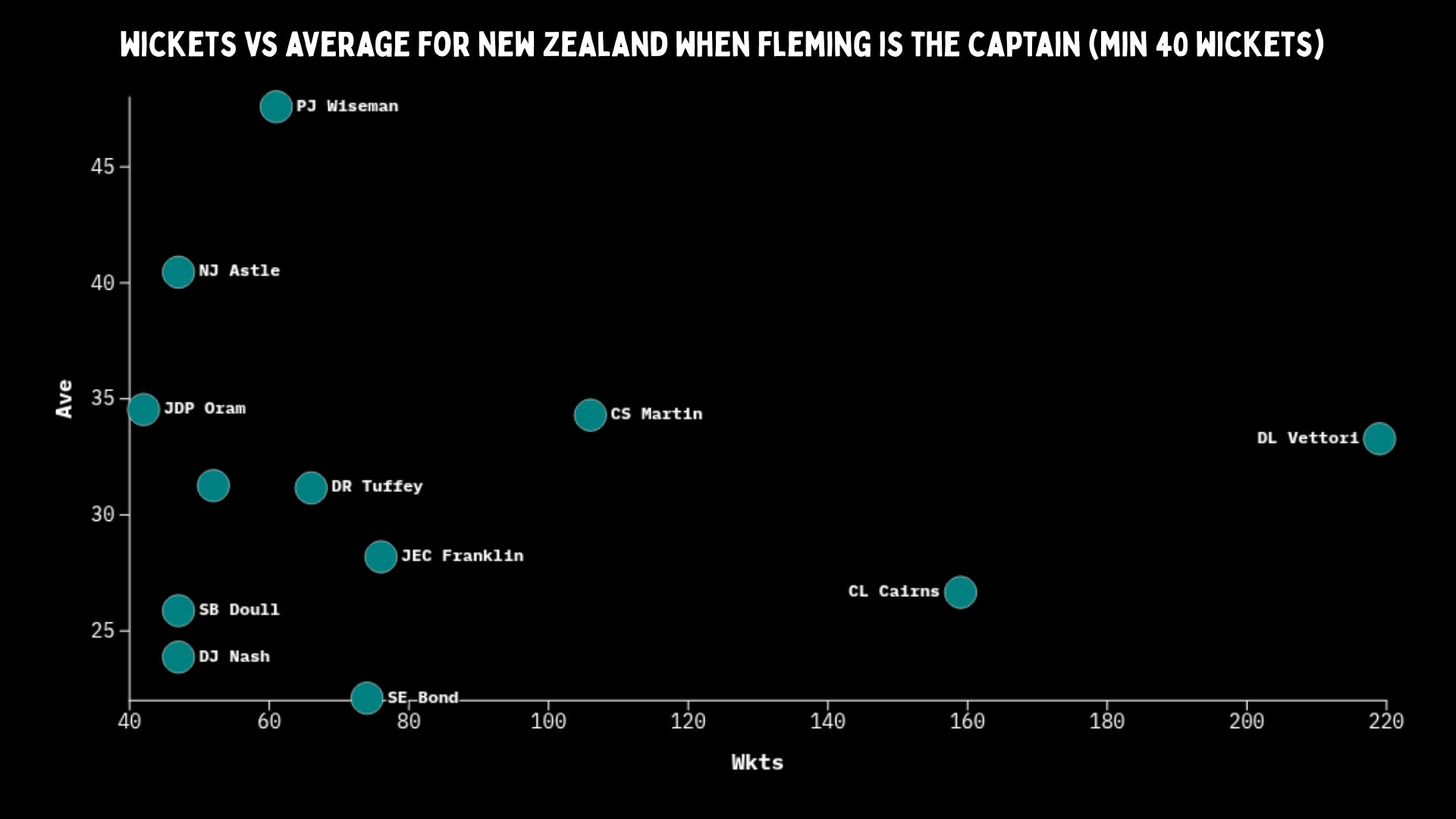
While most teams in the world had a great new ball partnership, or an awesome spinner, New Zealand had bits and pieces. They were not bad; when fit, he had Chris Cairns, a great all-rounder, but he was not always available. He had the ends of Simon Doull and Dion Nash’s careers, and got the best out of James Franklin’s left-arm seam. The bowler he had the most was Dan Vettori, someone picked years before he was ready, and who did a very good job as a spinner in a country that didn’t need that skill much.
But the bowler that Fleming only used 16 times was Shane Bond. New Zealand only ever had one bowler like this. Richard Hadlee was better, but they’ve had other versions like him, the same with Boult and Southee. Bond was quicker than all of them, but also skilled. He could get lateral movement, his bounce was off-putting, and no one liked facing him. In those few matches, he took 66 wickets at 22.
Fleming was smart with all his bowlers because he had no choice; everyone had to chip in. But he used Bond like the perfect weapon. Catching fielders, short spells, targeted match-ups. The Blackcaps skipper was finally using all of his bag.
It was fun watching Fleming set a trap for someone against medium-fast seam. But that was chess. When he had Bond, it was poetic violence.
With Shane in full flow, Fleming was turned into a Bond Villain with access to Thanos’ army.
Fleming fully came alive when he had quick; and he made it feel like there were two of him in the attack such was the genius of how he used him. But sadly, it never lasted.
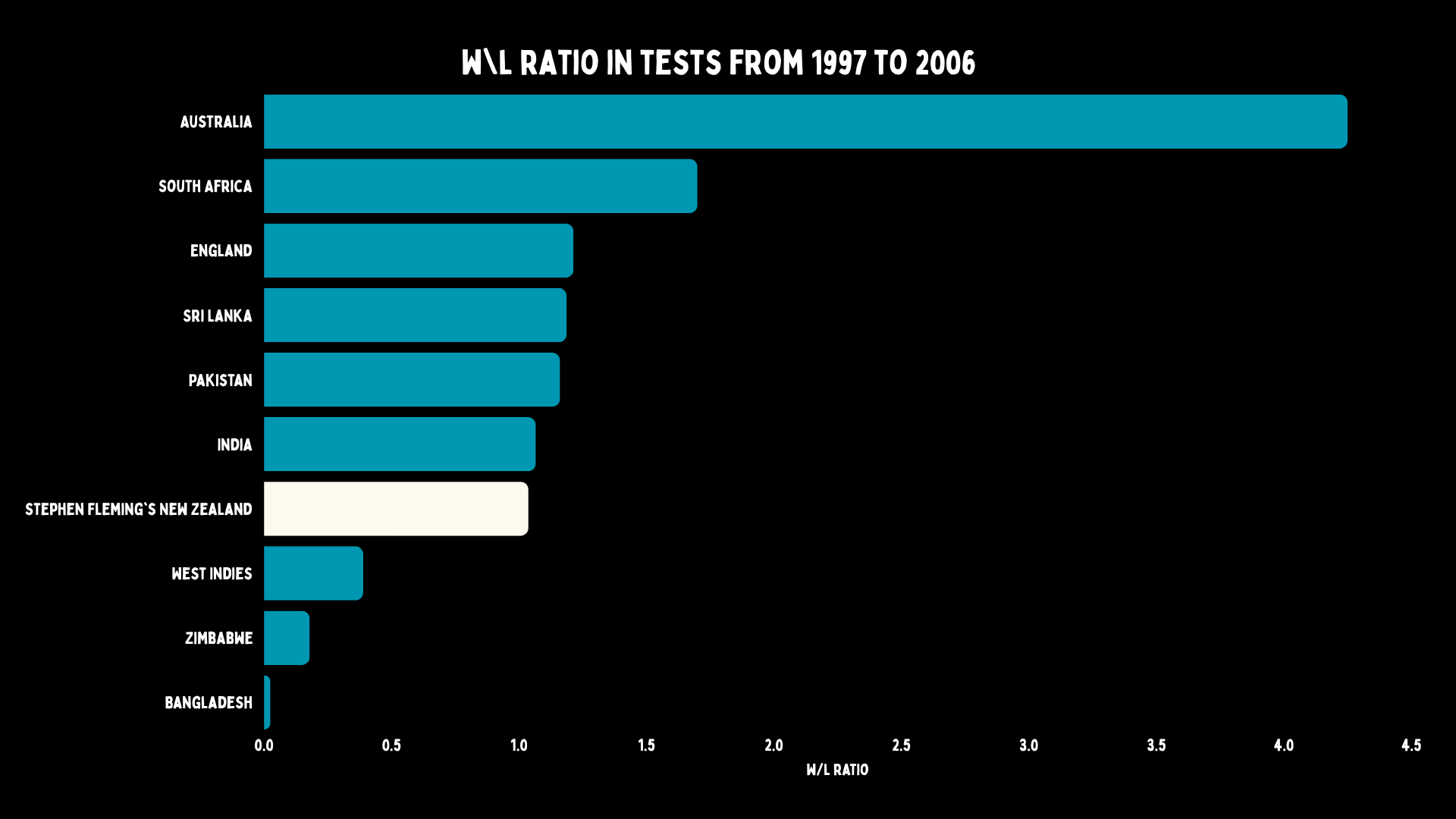
It meant that Fleming usually had to squeeze every inch of talent out of his team, which never had great bowlers or batters.
Somehow he ended up dragging New Zealand to a 50/50 win-loss record. Now it was still a long way from the good teams, but it was hard to watch his side in this era and not think he made it better. That is the job of a skipper. You don’t always get the best players; it is how you use the talent you have.
He was not given a big, powerful V8, but he tricked out his hatchback anyway he could.
-
In 2001/02 Australia were the best team. They had just set a world record of 16 straight Test wins. And turning up to play was New Zealand. The same team who almost two years earlier hosted Australia and lost 3-0.
At the Gabba for the first Test, the Kiwis were behind when Australia made a big first innings total, but the hosts were pretty confident. They set the Blackcaps 284 to win, but probably thought a bowling attack of Glenn McGrath, Jason Gillespie, Brett Lee and Shane Warne was enough. Instead, New Zealand spanked the ball around, and in the end, just ran out of time.
It would have been a stolen Test, but in that era, chasing nearly 300 at five runs an over was an incredible effort.
The second Test was washed out, which saved the Kiwis as they were a long way behind.
For the third at the WACA, the Blackcaps smashed the Aussies’ all-star line-up. Fleming made one of his nine hundreds as they passed 500. Australia stuttered, but in the end, Shane Warne’s career-high of 99 saved them some face. New Zealand set 440 for Australia, but the Aussies lost early wickets, and found themselves 220/5 with heaps of time left. Then Steve Waugh and Adam Gilchrist fought to save the Test with three wickets in hand.
In 1949, New Zealand cricket changed its future by drawing three matches against England; half a century later they did the same thing against the world-conquering Australia.
But it was how. Vettori and Cairns took 23 wickets combined; their next best was batter Craig McMillan with four. But that was ok; McGrath and Warne were completely nullified.
They’d had off-series before, but it was worse because several Australian batters also couldn’t get going. Fleming did two things in that series that worked. He used his medium-fast bowlers to bounce ageing twins Steve and Mark Waugh. Neither had a big series.
That is not what people remember; it was the fielding plan for Damien Martyn.
By modern times, this will not sound like a dynamic act, but Fleming packed the point gully area. That is where Martyn was at his best, and so Fleming regularly had multiple catchers, or many in the ring, just where the Australian wanted to hit the ball. If this was modern England, they’d have had five guys there.
This simple tweak really messed up Martyn; he didn’t know how to deal with it. He was in the form of his life, but never passed 60 in the series, averaging 23. In his following five innings, he made three hundreds.
Stephen Fleming bounced with slow bowlers and set funky fields before cricket thought of either. But mostly, he did whatever was needed to make his team better. As a player, and now a coach.
England don’t have any answers for their vacant all-rounder, a viable spin prospect or a functioning top three. Fleming may not be able to fix those issues.
But England wanted magic before; that didn’t work, so now they’re trying a mechanic.
If i had a choice of a few players having an relative injury free career. It would be Simon Jones and Shane Bond.
Brilliant article and analysis.