


If you watched the football World Cup at all, chances are, you saw the living statue at one stage or another. That was Lumumba Vea, a man from the Democratic Republic of the Congo. He goes to football games, and then stands there as still as he can, imitating the famous statue of Congo’s first ever leader.
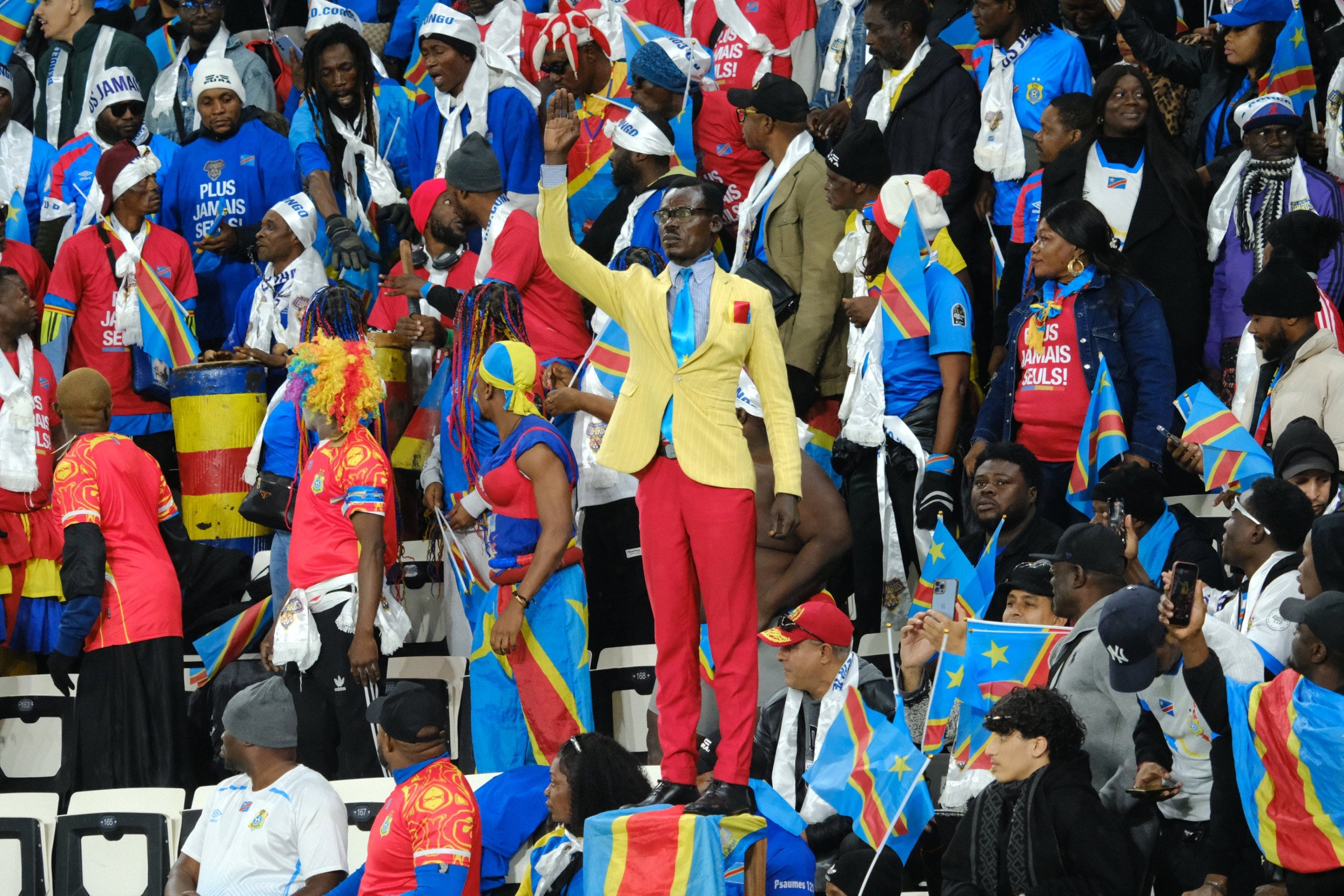
It’s a striking visual, no matter how you look at it. And through this World Cup, by just standing still, by getting denied entry in places, and by people talking about the politics of what he was doing, it meant the football World Cup was continuously in the conversation. Because one man stood still at a football game.
The team that he was supporting is currently ranked 41st in the world according to the FIFA rankings. This wasn’t a team that people had a lot of hopes or expectations for. They were not favourites. They were not expected to win. The best possible scenario was them doing okay in the group games. And yet so many people followed Congo because they were at a World Cup and they had this striking image on the field of what Lumumba Vea did.
Whether you like football or not, it would be hard to argue that the last World Cup we saw was actually a global event.
Now ask yourself: in cricket, do we really have those?
***
The football World Cup has 48 teams. That is a lot more than cricket has ever had, or perhaps will ever have.
There are over 200 registered teams with FIFA -- basically every UN nation in the world and a couple of others that probably aren’t even on that list. And yet, when they hold their World Cup, almost a quarter of all of those teams get a chance at playing in the biggest event in the world. You have a legitimate chance, no matter where you are from, of actually making it to the world’s biggest tournament.
I know what you’re thinking, ‘Football’s huge, right? We shouldn’t be comparing cricket to football, even if they’re the No.1 and No.2 sports in the world. There’s such a distance between them.’
So let’s try another sport.
Rugby’s next World Cup is going to have 24 teams. Their previous edition had 20. Rugby is not the second biggest sport in the world. Neither is it anywhere near the size of cricket overall, and yet they are still looking for inclusion, growth, and expansion.
It doesn’t stop there. Basketball has its own World Cup, and it has 32 teams.
The sport that you could actually compare cricket most to is ice hockey. But that is a winter sport where the vast majority of the world doesn’t even have the ice required to form some kind of team. You need a lot of facilities, multiple players, leagues, and everything that goes with it.
When you have a look at the Winter Olympics, check the sorts of countries that send people to compete in ice hockey: they’re either rich or they’re cold, and sometimes both.
And yet ice hockey is still managing 16 teams. With all due respect to the great puck, it is nowhere near the size of cricket around the world.
And that is because cricket is the second-most viewed sport. Ice hockey is not the third-most viewed either. You’d probably argue that basketball is up there, but ice hockey and rugby are a long way behind cricket. And yet, when it comes to World Cups and who they invite, they both invite more teams than cricket does.
Do these sports not like money?
Why not just get your most famous teams to play each other over and over again in an endless loop? They don’t seem to follow that model. But in cricket, we do, and we have for quite some time.
Of course, in cricket, things have to be more confusing than that. We actually have two World Cups, one of which has more than the 16 teams in ice hockey, and the other one has fewer.
In the middle of a football World Cup with 48 teams that was doing really, really well, the ICC released their information on the next cricket editions. Let’s say they’ve used some ‘creative accounting’ to make some things happen.
In T20 cricket we have 20 teams, which seems apt. In the ODI World Cup, we have 14 sides.
Previously we had four groups of five, and now we’re going to have five groups of four in the T20 edition. There are a few minor changes all the way through, but all things considered, the T20 tournament makes a lot more sense. It’s up where rugby used to be when it comes to the number of teams. It’s well above where ice hockey was.
While they haven’t taken the opportunity to bring any more sides in, they’re at least making it look like a global event by having 20 teams. Twenty seems like a decent number in modern sport.
Whereas the ODI World Cup is going to have 14 teams... except that’s a lie. Because the 50-over edition will not actually have 14 teams. It will have 12.
The reason I say this is that, yes, 14 teams will technically be invited to the World Cup. However, three teams are going to play a preliminary tournament before the World Cup. Those three teams will whittle down to one team.
So what we’re really having is a fun little qualifier just before the tournament. But those teams won’t feel like they’re at the World Cup. One of them will actually make it, and the other two will disappear before the tournament starts.
So we do not have 14 teams in the World Cup. We have 12.
To quote the Big Orange Giant: “The 14 number is completely and utterly fake.”

But there is another number that’s important here, the number three.
That is the number of times it is possible that India can play Pakistan in one World Cup, which at a certain point no longer feels like a World Cup. Twice, you’re like, “Okay, we could see how that can happen.” But if it’s three times, it feels like you are gerrymandering the entire World Cup just to get more money from one game.
There is a part of me that doesn’t mind that, as long as some of that money goes directly to the players involved. But we all know that’s not how this works.
Indian cricketers are incredibly underpaid for how famous and rich they should be, and Pakistani players are also underpaid. They are the other half of the India–Pakistan game, which is a billion-dollar game. It’s so important that we have essentially created a World Cup to make sure they can play each other three times.
I should point out that as far as I can understand for the T20 edition, there is no way that India could play Pakistan three times in that tournament.
But for the ODI edition, three games could happen.
I’m assuming that India and Pakistan will be in the same group based on the fact that they always are, and also because we rig all of these tournaments. There are no fair ballots, rankings, or seedings. We just try to make sure, as much as possible, that India play Pakistan at least once.
So if they both play in that group, they then go to another section called the Super Sevens. But in true cricket fashion, what we’re really doing with this seven-team group is essentially bringing back the original Test sides and saying, “These are the only ones you need to worry about.”
It’s going back to the old private members’ club.
Which is part of the reason why all these other sports have so many teams in the World Cup and we don’t. We set cricket up as a private members’ club, and then we decided never to let anyone into it.
So then we manufacture our World Cups. If India and Pakistan are in the same group originally, they’ll play once. Then they’ll play each other in the round of seven if they both get there.
And then there is the possibility of them meeting again in the final.
Now, it’s Pakistan, so it’s less of a chance -- but you get my general point.
***
Here’s another number for you: 111.
That is how many ICC member nations currently have cricket teams.
Yet somehow we’ve ended up with a World Cup where only 12 teams are really going to be invited to the event, and it’s possible for one team to play another three times.
How? Why? Only in cricket could we think this is okay, or normal in any way.
We have the second biggest sport in the world, and it’s still set up as a private members’ club that’s all about making as much money as possible from the same two teams playing each other as many times as possible, in part because they won’t play each other any other time.
I mean, yes, a lot of other sports are dysfunctional. Ours is uber dysfunctional.
So you end up with 12 out of 111 teams being invited to your biggest event. Sure, we’ll invite two more for the pre-party appetisers, but they’re not allowed to stay when things get fun.
And for the other tournament that we’re less interested in at the moment, we’ll invite a couple more. But largely, that is just to stop the moaning about the fact that only 12 teams are coming to the ODI World Cup.
Since this has all been about numbers, let’s finish with these ones: 2–1.
That was the score of a football game at this World Cup. At the seven-minute mark of that game, Congo scored a goal.
And it wasn’t just any goal. It was against England, the team that invented the sport. On top of that, it was in a knockout game. This was a legitimate chance for Congo to progress later in the tournament.
There have been a lot of great games played at this football World Cup, but this was certainly one of the most exciting. If for no other reason, Congo were in front of England for most of the match.
From the seventh until the 75th minute, Congo were 1–0 up against England, when Harry Kane equalised. Then, in the 86th minute, he scored again, and Congo were going home while England went through to the next round.
It was a predictable result, but nothing about the game felt that way. It was exciting and exhilarating, and I say this as a non-football fan.
So the 41st-ranked side in world football gave us this beautiful moment of a man pretending to be a statue that we were all absolutely fascinated and obsessed by. They gave us the possibility of an English loss early in the tournament, and I’m only talking about two of the highlights.
Would you like to know who the 41st-best ODI men’s cricket team in the world is? So would I. But the ICC haven’t actually sanctioned that many teams for ODIs, so we don’t know.
I can tell you that the 41st-best men’s T20 team in the world is Japan.
Luckily, there’s nothing crazy or wild going on in Japanese sport at the moment. A country that currently has the most marketable baseball player on the planet.
But when it comes to cricket, we’re not looking for that. If somehow Japan became absolutely obsessed with cricket, do you know what it would mean? More money for the sport.
We are told that these decisions are always made because of business. But they always leave out one phrase: short-term. In the long term, the other sports are pulling away. We have more fans, we have more interest -- and we have fewer teams.
At a certain point, something has to change within our sport, and we have to understand that the world means the world.
Cricket has been a private members club for a very long time. It’s just that the address has changed.
I don’t believe cricket should be an exclusive club but I do believe the viewing public are entitled to watch a quality product. Football has been a global sport for a very long time and I’d argue the standard of the game is broadly higher. Cricket is emerging from the shadows big time but has a fraction of football’s legacy and some of the associate nations are very poor. The issue is exacerbated in the women’s game where the legacy is even smaller. There’s always the argument to “grow the game” and perhaps the advent of Indian money means expansion is smarter and safer now than ever before, but sport is also replete with examples of expansion overreach. You mention rugby, the associate nations are also very poor there, and previous world cups have seen ridiculous thrashings that do nothing for anyone. Also in rugby the once vaunted “super” franchise competition expanded from 10 to 18 teams and in doing so diluted its product so badly that the competition disbanded. Even now with cricket my experience with the cricinfo website is that there’s so much meaningless cricket posted on there that I sometimes have to trawl to find Ashes results and it’s diluted my passion as well. There is a conflation of all matches into one pot and an unspoken inference that they all hold equal value. This has crept into statistics and rankings. Case in point Rashid Khan (fine bowler though he is) is currently the no. 1 ranked ODI bowler in the world yet almost half of his ~200 wickets have been against Zimbabwe and Ireland. It’s a quality vs quantity argument. And experience shows that chasing bigger markets mindlessly destroys the essence that attracted people in the first place. Plus Too much of anything reduces value. So my boring conclusion is that it’s about balance.