



Zizi Mkhize has been in for three hours, over two days. He walks in late on the first, conquers opposition bowlers in fading light, and reaches a century the next morning.
This is expected from Mkhize. He’s one of the most highly rated young black batters in Johannesburg. In 2025, he was named Player of the Tournament at the CSA U16 National Week. Three months later, he did it again at the Schools SA20 finals week, taking Jeppe High, his school, to the title.
Mkhize grew up surrounded by cricket lovers. His father played, and later coached one of the handful of cricket clubs found in black townships. He watched and played against many grown-ups. But it wasn’t until he was 11 that he met an internationally successful black batter.
The century he scored over two days was at South Africa’s premier school festival. A multi-day event designed to provide young cricketers with a reference point for Tests. A black, 17-year-old left-hander with promise was on show, because of what had gone before him. He was walking a path already charted. That day, he took his steps at the ground named after the player he met when he was an 11-year-old.
They call it Temba Bavuma Oval.
As Desmond Tutu once said, “Hope is being able to see that there is light despite all of the darkness.”
And in more ways than one, Temba is hope.
***
0.264 of a second is not long to do anything.
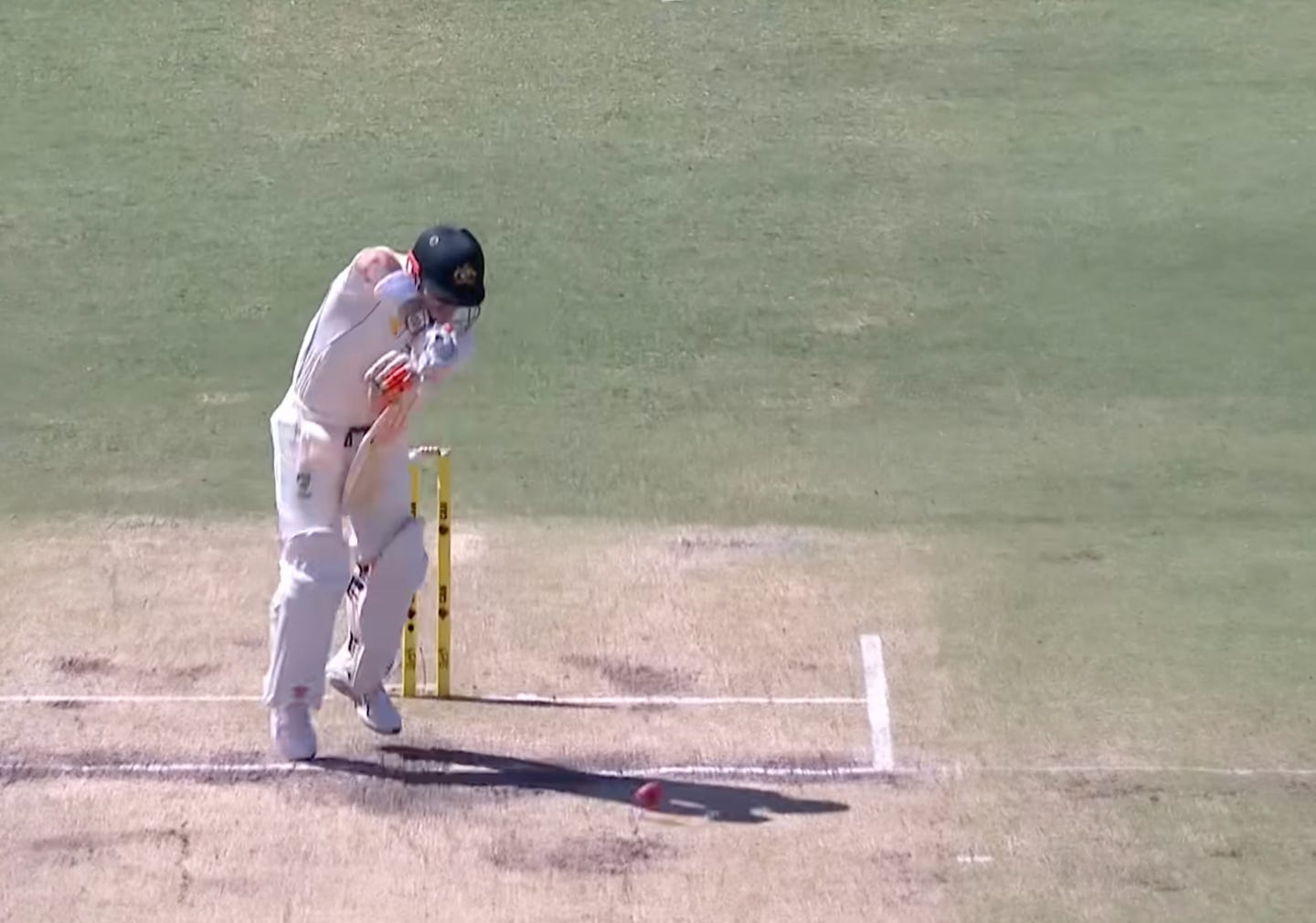
David Warner pushes the ball out on the offside and takes off. There is a gap in the covers, kind of. The Australian opener was known as a big hitter when he was young, but it soon became clear he was one of the best runners in the world. In terms of speed and also judging the run. But he would push hard.
This is one of those.
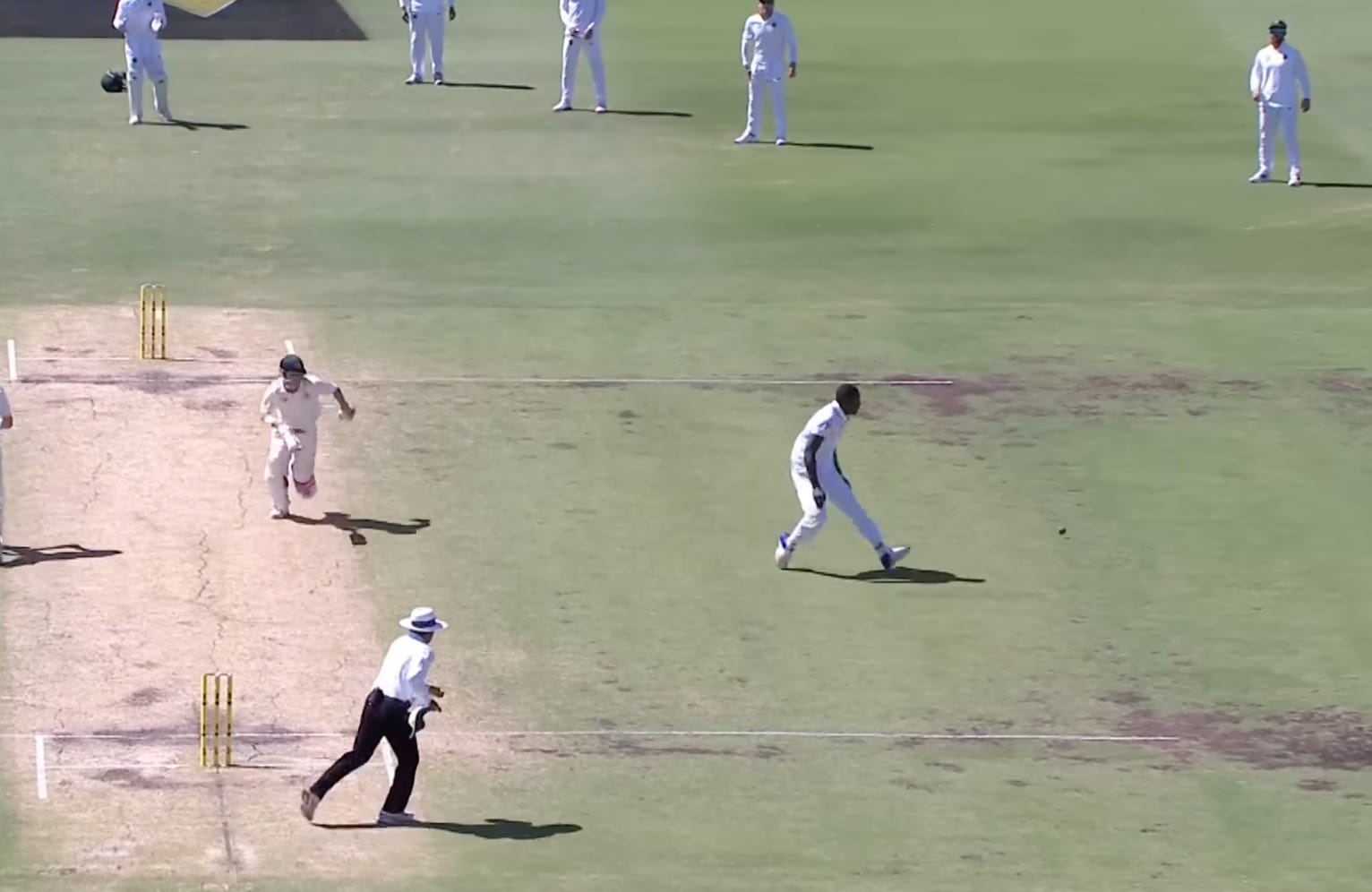
But it is in a gap; the only fielder close is at point, and the ball is to his left hand, so the chances of being caught short are slim.
It is a run, until it isn’t.
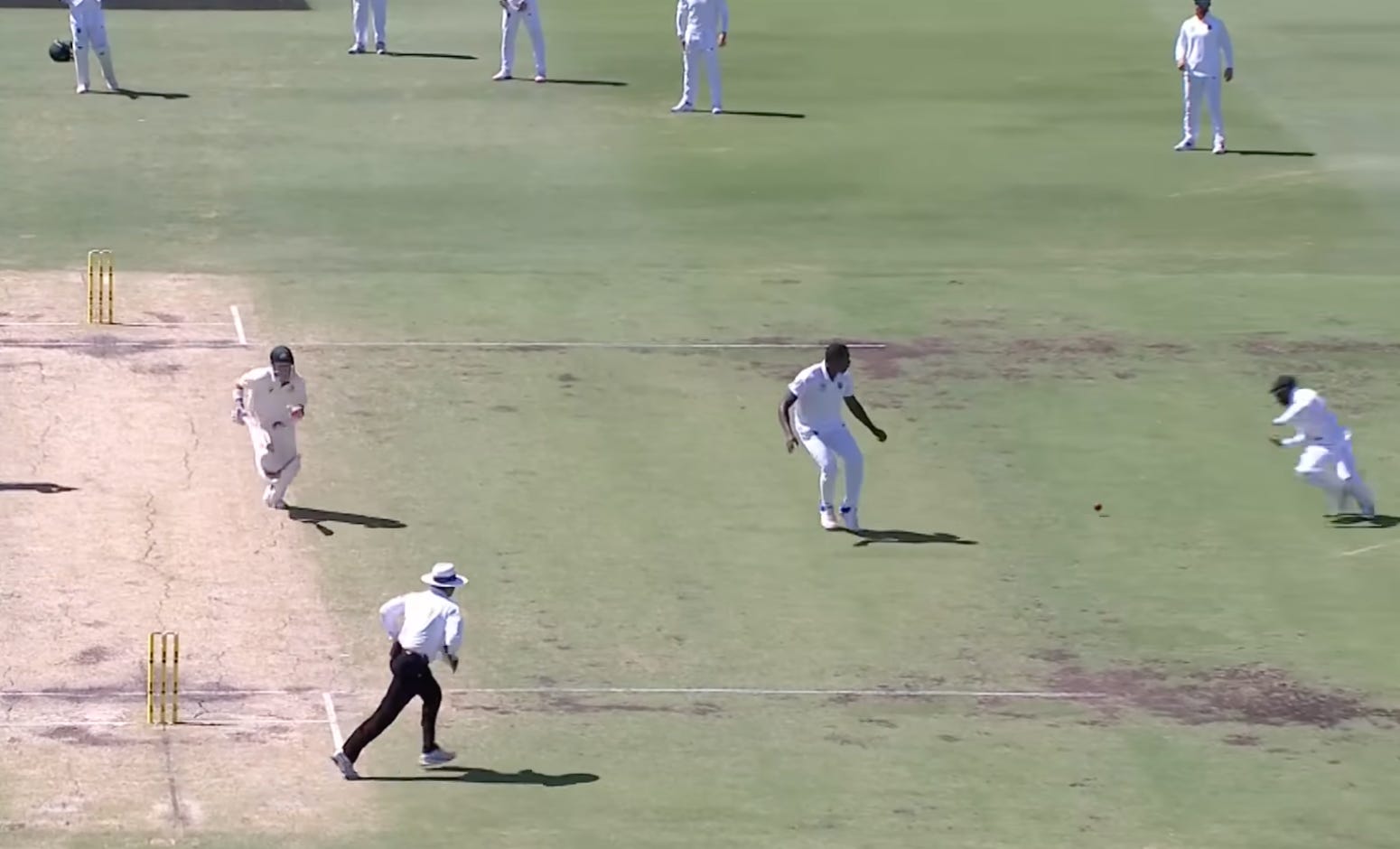
Temba Bavuma takes nine steps, but he still has an issue: to pick up the ball and throw with his strong hand, he needs to be on the other side of it. So he angles his run to meet the ball on his dominant side.
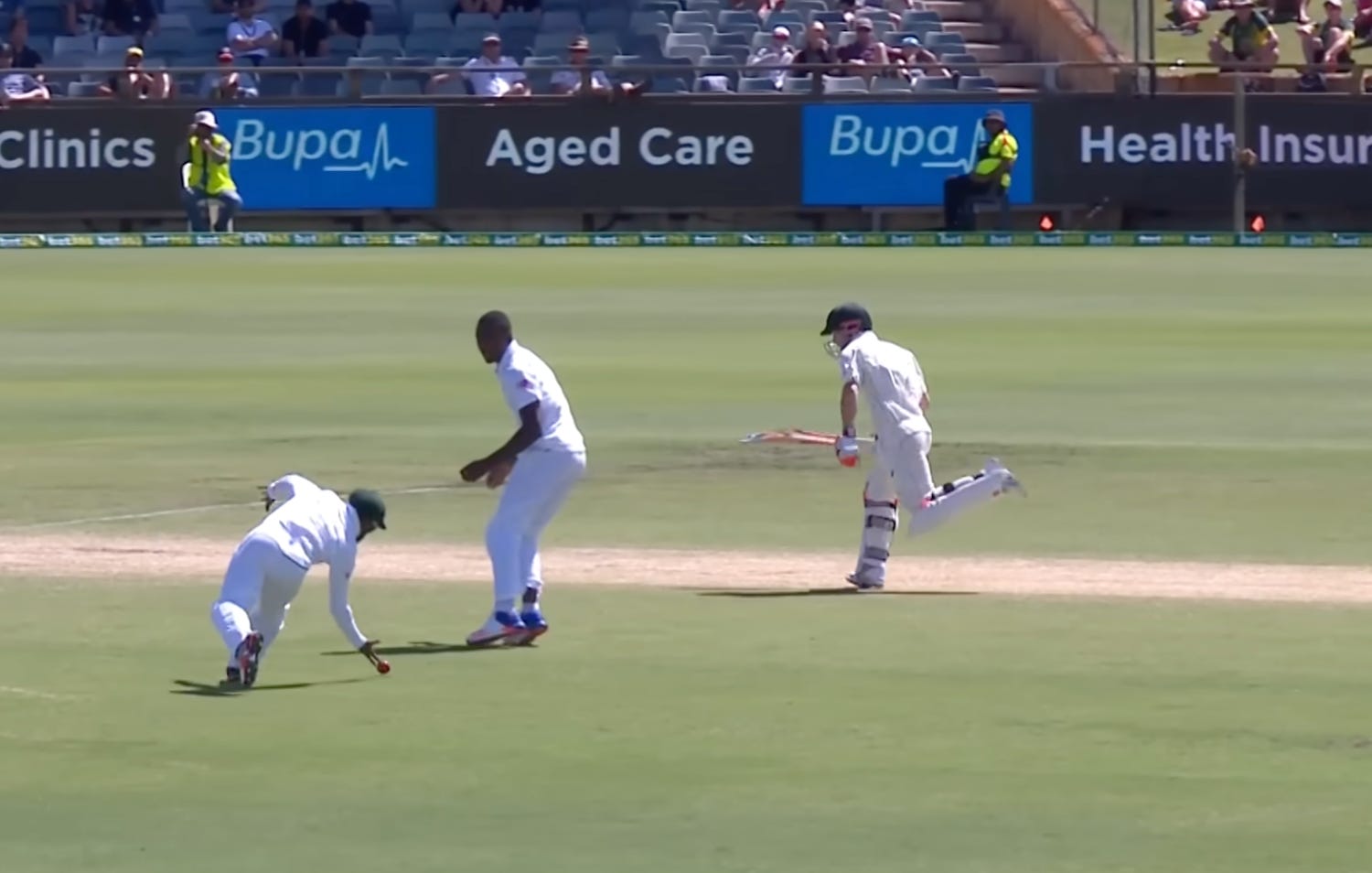
The skill it takes to measure this angle is breathtaking, but even after that, he has to throw the ball. The issue is that he’s still a long way from the stumps, so a normal underarm throw won’t do. Before or in an instant, he works out that this will still need overarm power, but from an underarm position. So far he has shown genius and speed, but he adds one of the most extraordinary jumps ever.
From one leg seemingly falling over, he launches his body up, allowing just enough room for a full throw from under his body.
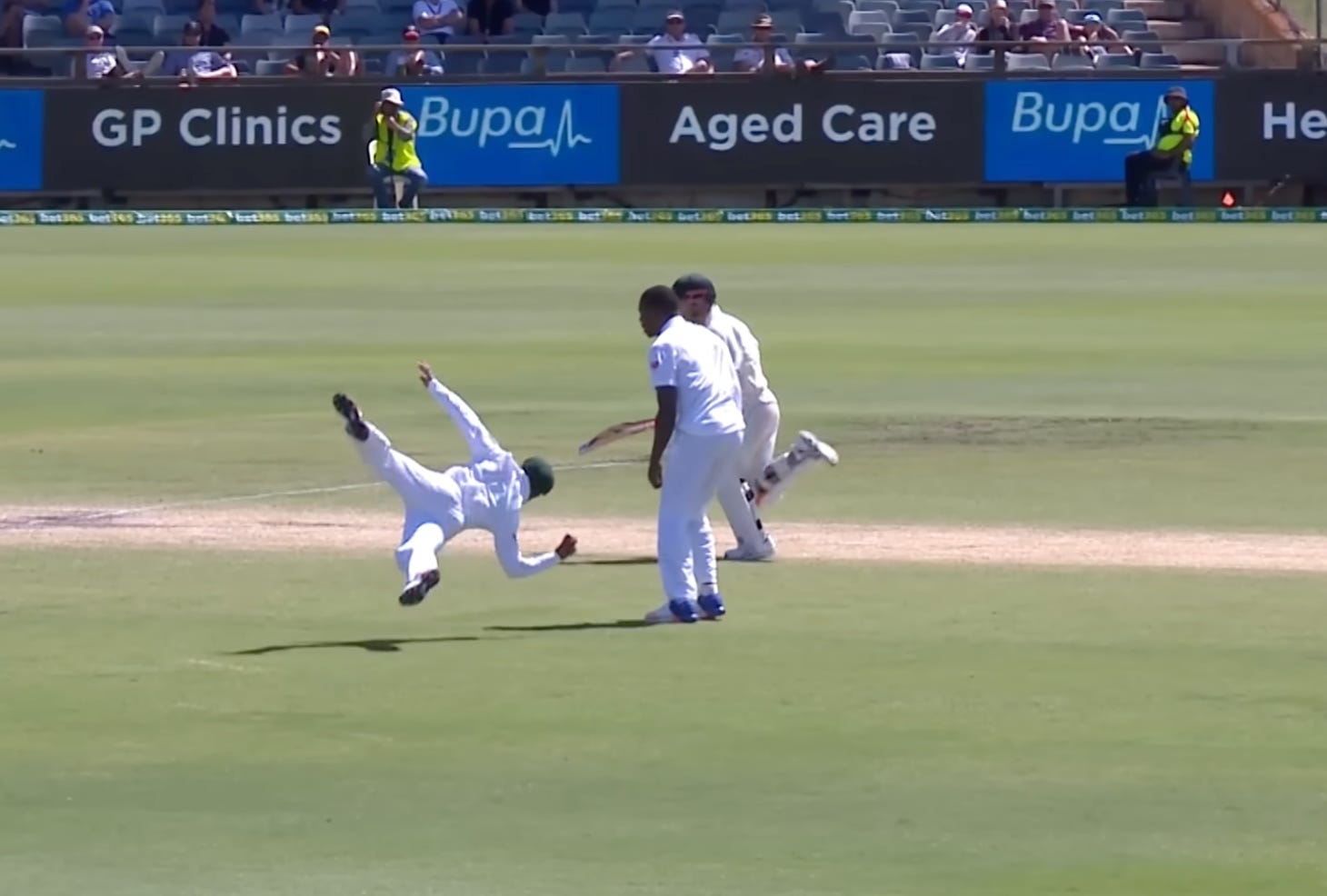
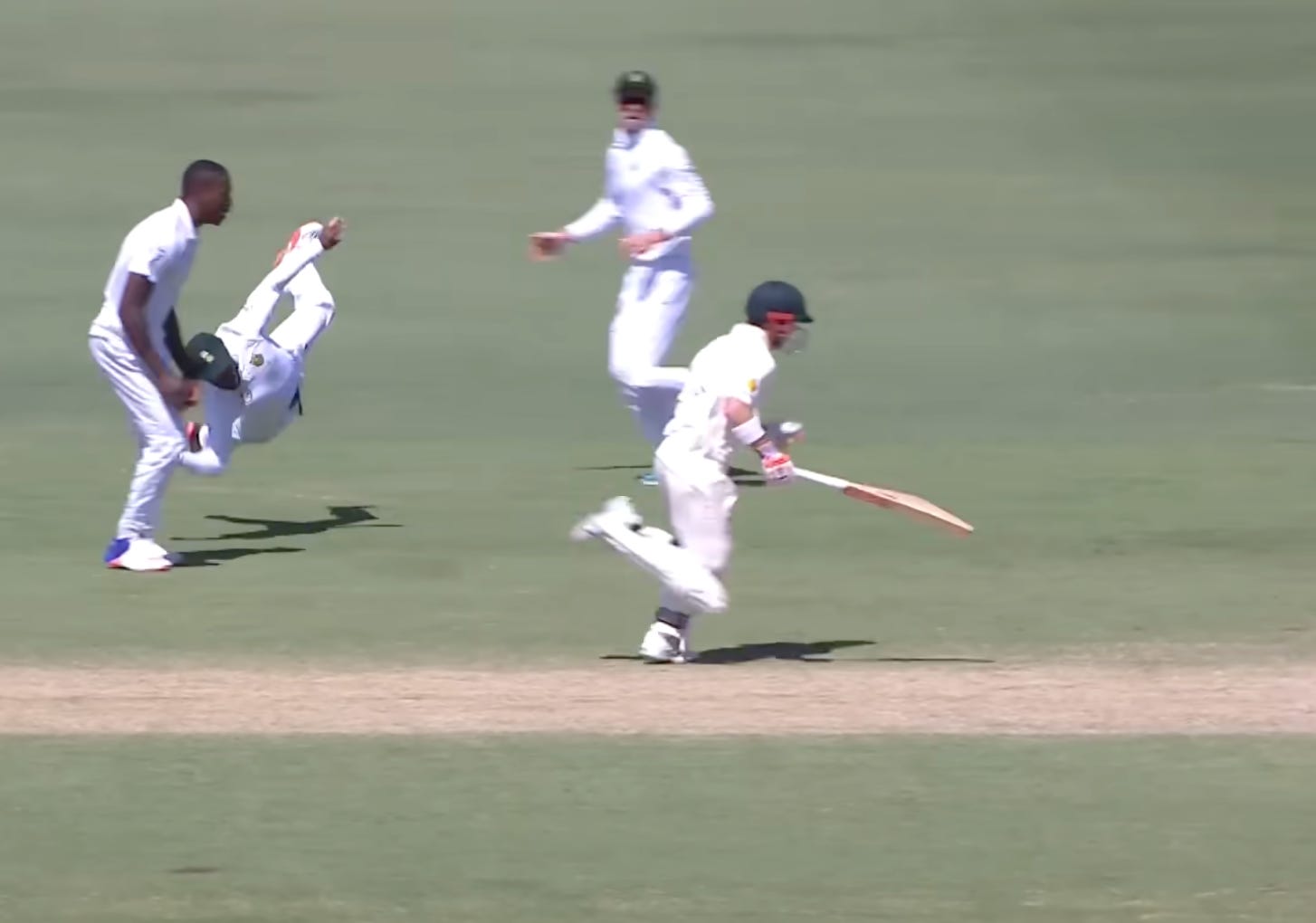
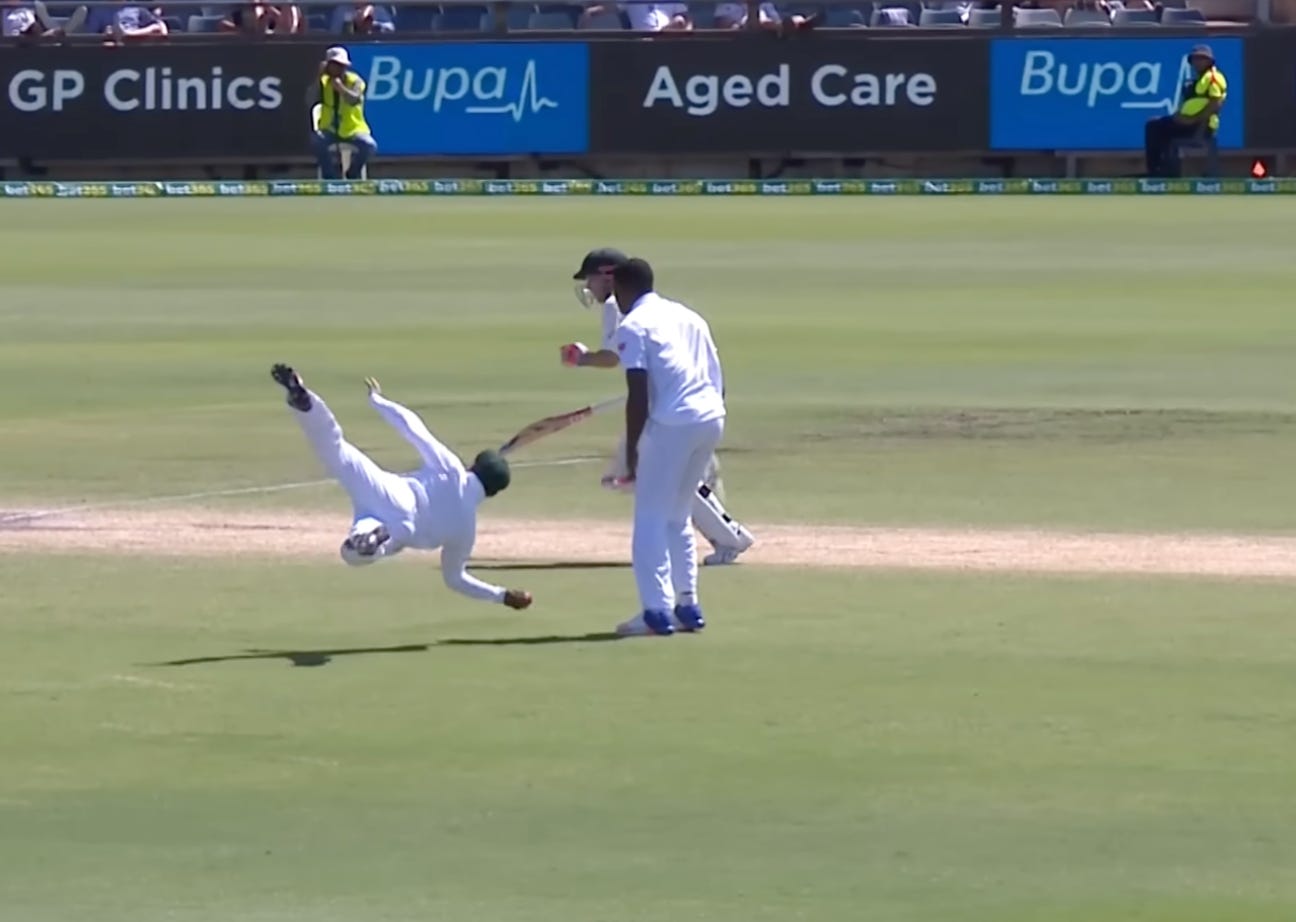
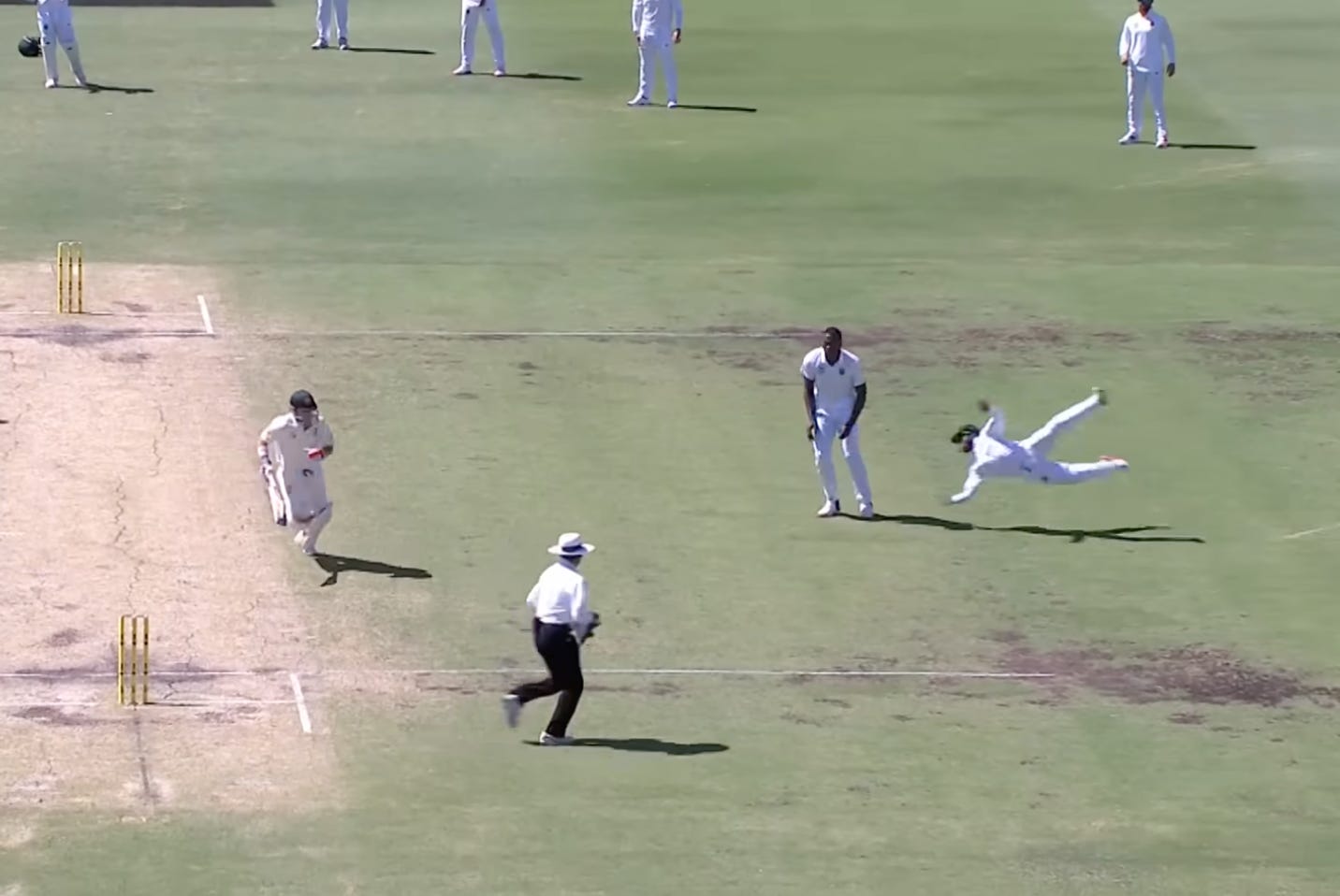
He is flying while throwing. All while wearing shin pads from short-leg fielding.
The broadcasters time how long the ball is in his hand: 0.264 seconds, about the same as a blink.
David Warner never thought a run out was possible, and all but one time in a million, he was right.
There is no doubt that Temba Bavuma is one of the greatest athletes to ever play cricket. But this hasn’t always been a plus in South Africa. For generations, younger black African cricketers who were incredible athletes were pushed towards fast bowling. That’s where the success has been. This is a trope across all sports: follow the pattern.
So young black cricketers who bat well end up working on their pace bowling for hours on end. When you check the ledger, there are so many black fast bowlers and almost none who bat. That is a pattern that needs to break.
Perhaps with Bavuma, it did, because you couldn’t push him to bowl fast; he is simply too short. At his height, he was born to bat.
****
Every time Bavuma walked the streets of the township, he read the disc that proclaimed ‘Thami Tsolekile, Cricketer, Lives Here’ on the wall surrounding the former wicketkeeper’s home. Bavuma probably never got to watch the three Tests that Tsolekile featured in, but he saw Tsolekile’s signed Test shirt in the clubhouse from the time he was nine years old.
Those symbols can be enough. Bavuma and his mates played cricket at every street and every corner. A few metres from his house, there is a strip of tarmac they called Karachi because of the unpredictable bounce it generated. It was cracked and unevenly patched in many places. Here, the future South African captain sharpened his skills against the turning ball.

If they had Karachi for spin, they had the MCG for quicks. They named this strip after the Australian field because it was ideal for high-end pace. Street cricket had no age restrictions. It wasn’t uncommon to see older and stronger teenagers steaming in to bowl to pre-adolescents. Bavuma’s technique was regularly tested by 15-year-olds on these strips when he was only nine. From a young age, the ball was around his ears at pace.
His maternal uncle, Tengo Sokanyile, drilled the fundamentals into him. Sokanyile is cricket-mad and he introduced Bavuma to the sport when he was only a few months old. Soon, Sokanyile was throwing underarm and guiding Bavuma’s technique.
It helped that Rubusana Avenue, the street Bavuma grew up on, was just around the corner from Langa Cricket Club, Sokanyile’s second home. He chaired the club.
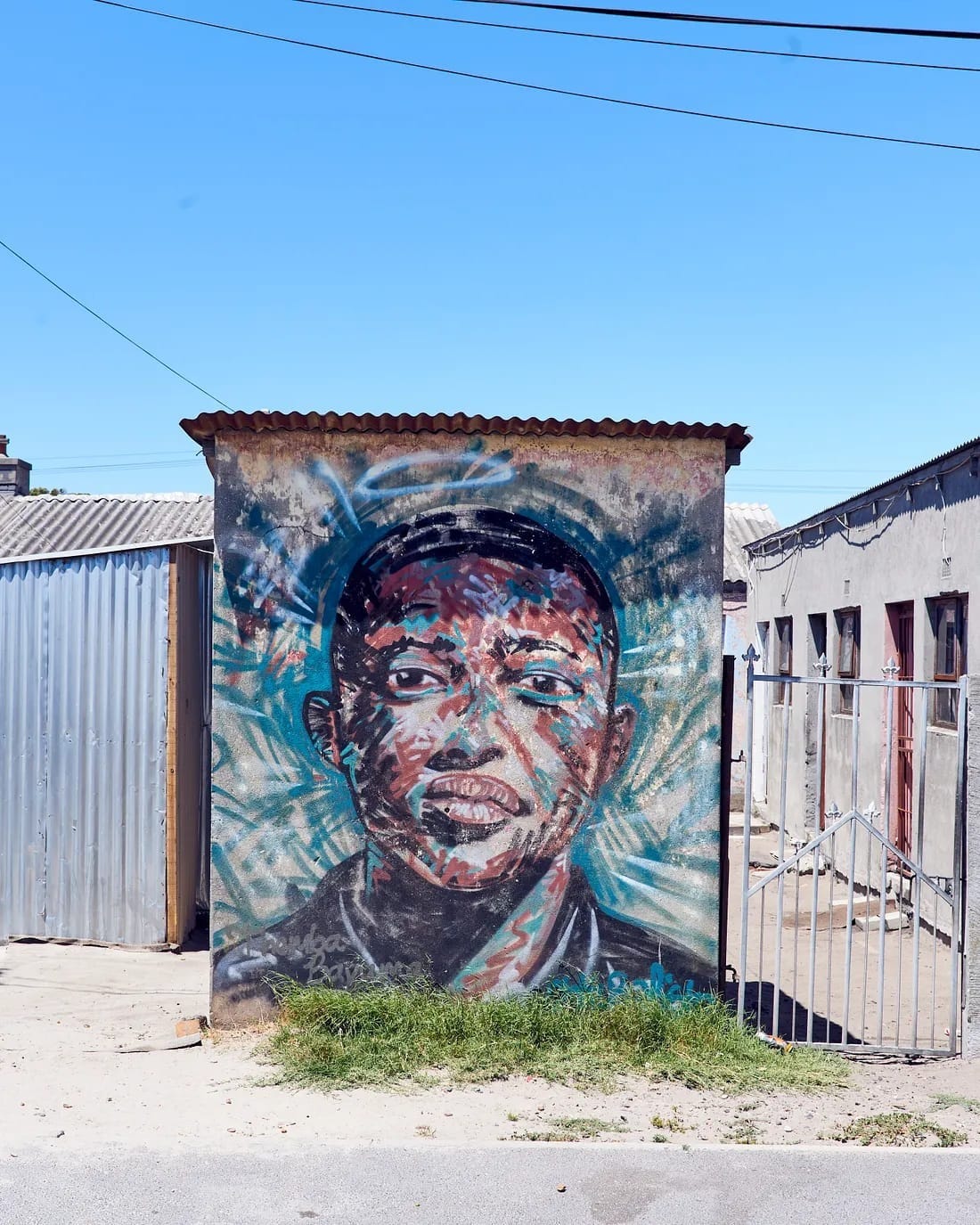
In 2015, a few months after his Proteas debut, a graffiti artist painted a giant mural of Bavuma overlooking the streets that helped mould him. He was a street cricketer, who became a Test player. He was the boy who walked these streets, and now the man who ruled them.
****
“When you do well, transformation is not spoken about but when you do badly, transformation is thrown at the top of the agenda. I have a serious problem with that.”
Temba Bavuma’s career has never been just about cricket. People who say you need to take the politics out of sport never truly understand that for some athletes, their identity is political. Bavuma can never only bat; he is more than runs. That is not his choice; it is his reality. His form is politics.
When he was first selected, there were always subplots and subtext. He needed to make twice as many runs to win some people over, and half as many for others. He was more of a totem than a batter.
After calling his mother when he was first chosen for South Africa, he shared the news with Geoffrey Toyana a few minutes later.
Toyana was a second-generation black cricketer. His father, Gus, played when there was nothing beyond club cricket for players of colour.
Toyana turned professional at a time when teams didn’t hesitate to pick a black batter. But then used them at No.9 or No.10, even when they didn’t bowl. They were professional fielders.
The message was clear: they were in there to tick quota boxes. They were in the game, but were not part of the game.
It didn’t matter that Toyana was the first black batter to be in the top 20 run-scorers in a single season. He was still regarded as a ‘quota’ player. Toyana, the first black franchise coach in South Africa, didn’t say much when Bavuma shared the news with him. He couldn’t, because he simply hugged him and wept.
“I am black, that’s my skin. But I play cricket because I love it.”
****
Bavuma was bullied at school, the year after he graduated.
Every cricket culture finds its players in a slightly different way. Australia’s method is through clubs, but in South Africa, where you go to school matters. Over the last three decades, the vast majority of cricketers have come from private schools that churn out players at an obscene level.
This causes problems for most of the poorer kids, but in black African societies it can end careers before they start. It means South Africa is always picking from a smaller catchment, or hoping the best young poor players get a scholarship.
For batting, it matters even more. Facilities are so important. Bowlers can come from the beach or a cow paddock. Batters need high-quality pitches and nets; most of the best players in the world have access to great schools or incredible clubs.
Bavuma was good enough to get two schools. First SACS (South African College), a posh educational institute, ironed out the kinks in his game. Then St David’s Marist Inanda put the finishing touches on it.
Bavuma started school a year earlier than most South African children, so he matriculated at 16. Instead of taking a gap year or furthering his studies, he chose a post-matric year at St David’s. This gave him unfettered access to the school’s facilities and coaches for another 12 months, and also a viable shot at playing SA U19.
The system built to exclude him became the one he used to become a professional while still at school.
But this is where the bullying starts. St David’s had fine coaches and facilities, but that didn’t make it a cricket school. Major international players came from Affies, Grey College, and KES. St David’s wasn’t really a high-performing sports school, so the extra post-matriculation year what was common at the other places, wasn’t there.
So instead of embracing their star athlete, a rumour started that he’d flunked his exams, and that was why he was staying. Many questioned why a scholarship was being wasted on a failure. Soon his peers, the youngsters, and even teachers bullied him.
Bavuma was an outsider many times over, an athlete at a non-sport first school. A township boy amongst fee-paying students. Black, when many were white.
But he was also from Langa.
Like many townships, the location is prone to moments of madness. Residents administer mob justice to criminals, and most of them do not survive. Bavuma hadn’t turned 10 when he first witnessed one of those acts.
Bullying is bad; Bavuma had seen worse.
***
Bavuma had to score. Because he was on trial for every single run. He needed each one to justify his selection. When he failed, a section of the populace made it an indictment of an entire race. But also, when he didn’t make runs, another section pined for them. There was no such thing as a low-pressure knock.
In Tests, for the third innings, when you have a lead, these are the easiest runs to knock up. Bavuma can’t even play those, because every stroke was part of a conversation he never entered - but also never left.
Bavuma made his debut in December 2014. His second century was March 2023. He had batting talent, but looked like he’d been chosen too soon.
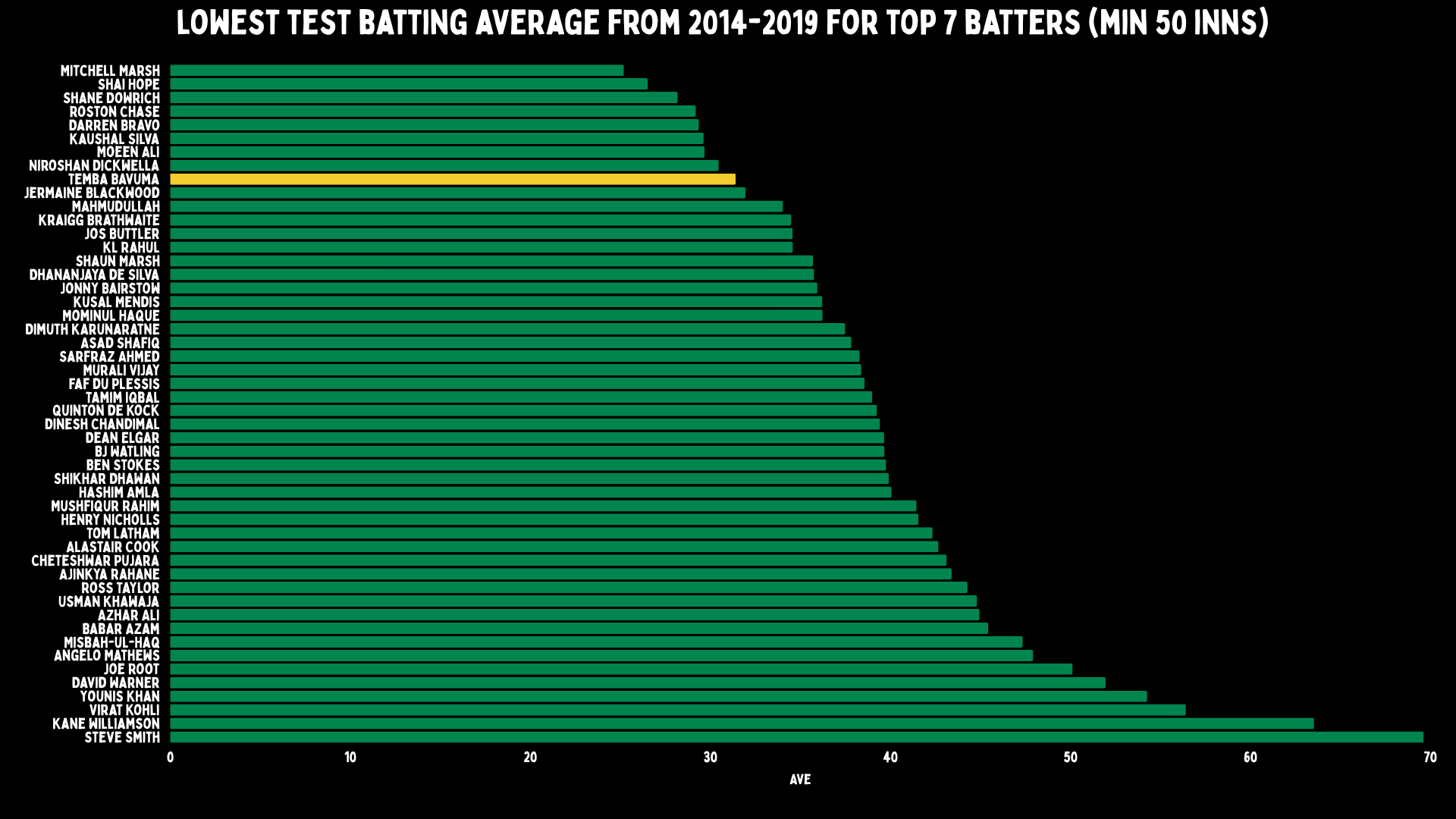
A magnificent 95* against Australia in March 2018 seemed to encapsulate his career: promising, but frustrating. For his critics, of course, it was a sign of black mediocrity, and they had the stats to prove it. The lack of hundreds wasn’t the only issue, his average was one of the lowest compared to other batters in his position.
At this point, he simply didn’t look like a Test player. And soon, he wasn’t one.
***
South African cricketers were suspicious of Temba Bavuma. Coming from outside the main schools, they often hadn’t seen much of him. Many of them had lived through the quota system, watching young black African batters in teams not make runs. Others were still in a racist mindset.
But as bad as his treatment in the game could be, those pushing him did damage too. In 2014, he made his Test debut in a year he averaged 32 in first-class cricket, largely because of a 400-run partnership he shared with Rilee Rossouw against an Australian A attack with Michael Neser and Chadd Sayers.
That is not ideal, but you can see why they chose him for Tests. The weird thing is, they stopped there.
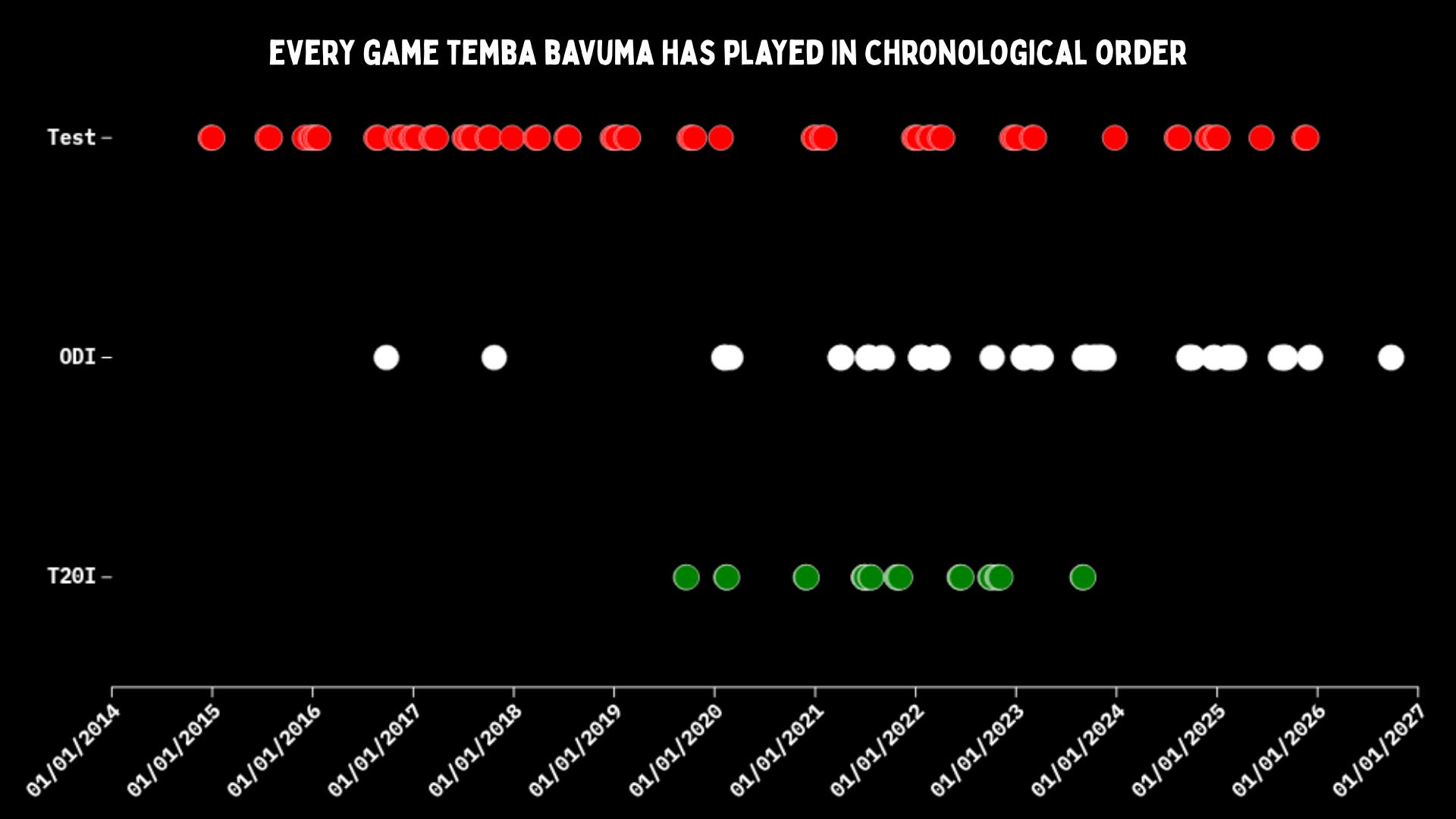
It took two years for him to get a chance in an ODI. His third was more than five years after his Test debut; it was against the World Cup-winning English team, and he made 98 to chase down their target easily.
For a player with his skill against spin and his ability to rotate strike, it seems almost criminal that the format he was best suited to was the one where they didn’t push him.
Then at the same time, as if annoyed by their previous error, they decided to play him in T20s.
Bavuma is so not suited to that format, that in the first SA20 he went undrafted. The market knew what South African cricket refused to believe. They made him captain of a format he shouldn’t play.
It got so bad for the national side that it looked like he might have to drop himself midway through a World Cup.
Cricket South Africa pushed Temba Bavuma as far as they could in Tests, and then fully committed to him in T20s. But they were apprehensive in the one place that mattered most.
It shows the weird environment he was in: people either didn’t believe in him at all, or way too much.
****
“You are absolutely shit.” - Ben Stokes, Newlands, 2016.
No, that is not exactly what he said.
Temba Bavuma has just edged the ball back past his stumps, and Stokes runs down to scream something at him. Bavuma hears it, but he’s in a bubble. This is a rare error for him as his team struggles; he can’t help but find the middle of that bat. Tripping into effortless cover drives, short-king pull shots, and a guide through backward point that is almost art.
The bubble pops after his 50; England tighten up. They start to take him seriously, and the runs slow down as the moment gets to him. He has never been this close before. He is very tense as he attempts another cover drive, but it’s a failure; it takes the edge and flies down between slip and third towards the rope. Moeen Ali is slow to pick it up, so it gets past him to the boundary.
An edge, a mistake, but a glorious one.
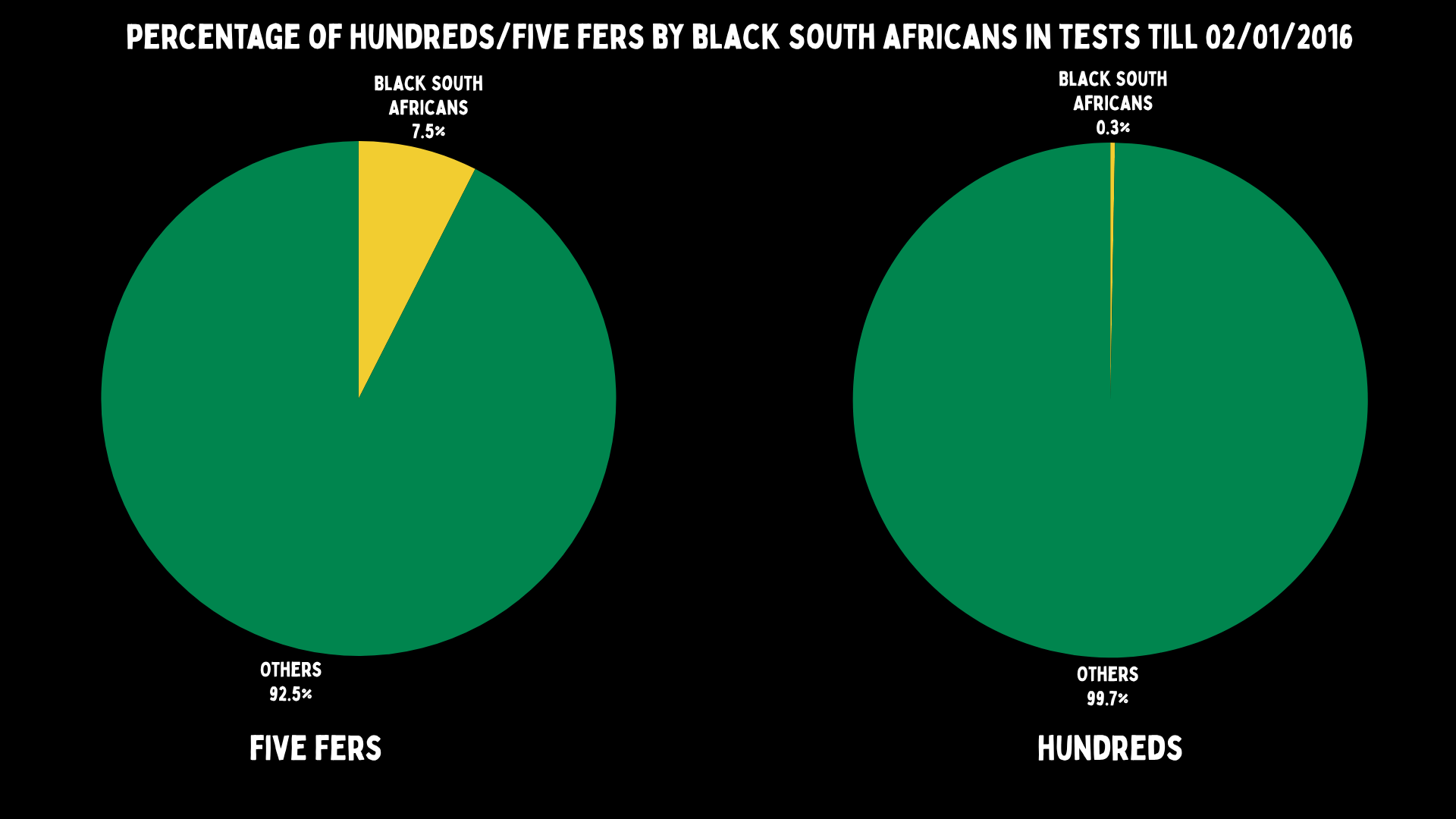
When Bavuma scores his maiden Test century, it isn’t just a hundred. He was the first black player to reach the milestone for the Proteas.
There had been 19 five-wicket hauls by black bowlers. And it had been 17 years since Makhaya Ntini’s debut.
There have been more than two million runs scored in Test cricket, but Bavuma’s runs stand out. That lucky boundary taking him from 96 to 100, isn’t just four runs. It was a blow struck for the millions of South Africans who were ignored, forgotten, and banned.
It was his runs, and all of theirs too.
Bavuma doesn’t celebrate like a man who knows his history, but like a cricketer who needed this. He runs around the pitch, jumps and thrusts his bat forward as he screams.
Stokes did not say, “You are absolutely shit.” According to Bavuma, he said, “You are so shit, I don’t know what you are doing here.”
Bavuma’s reply a few hours later could have been: “making a hundred”.
***
Temba Bavuma should have been dropped by South Africa. By 2020, his career hadn’t worked.
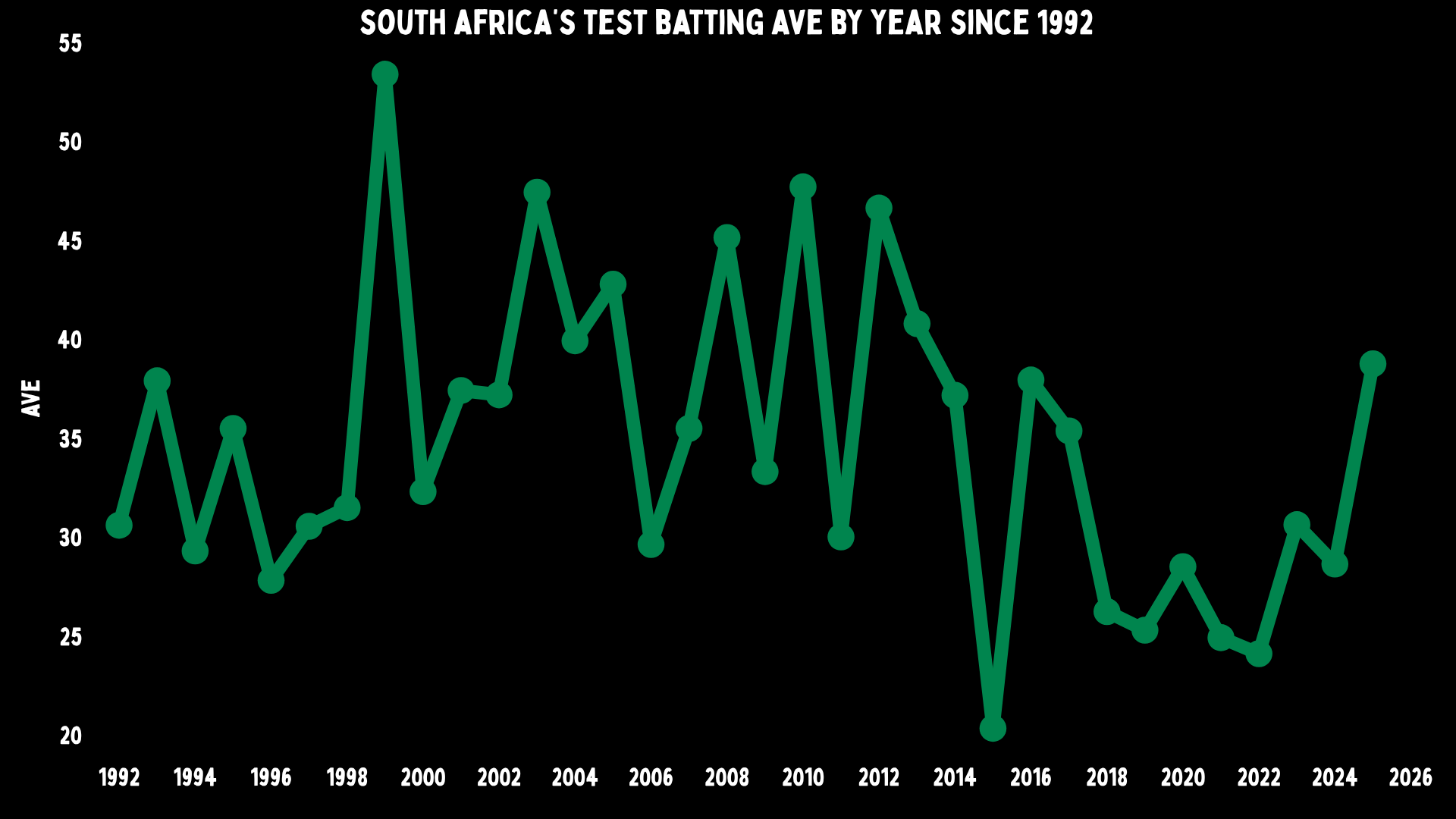
For most of his early years, he shared the ground with some of the greatest players to ever bat. Then they retired, just as the pace-playing pandemic started. South Africa suddenly found themselves in their most barren era. This meant that while his form wasn’t good enough, it was an odd time to drop him.
But something had to change, so Bavuma found himself out of the team.
However, South Africa still struggled. The young players didn’t work, the older vets weren’t up to it and the Kolpak pros couldn’t get the job done either.
When he was in primary school, Bavuma’s class was asked to write down what they hoped to achieve in adulthood. He listed three things: being an accountant, meeting the president, and playing cricket for South Africa. He attained his Bachelor of Commerce degree in 2014.
There is something very Bavuma in this mix. He had the highest dreams, and a functioning backup. Hope and pragmatism. Not many people walk this line.
Being dropped is hard for any player, but he instantly went to work. He was told he needed the weight of runs to reclaim his spot, and he took it personally, hammering a career-best 180 in domestic cricket in his next outing. He returned to the South African side in less than a month.
That is not a long time, but in this quick turnaround, he underwent an incredible metamorphosis.
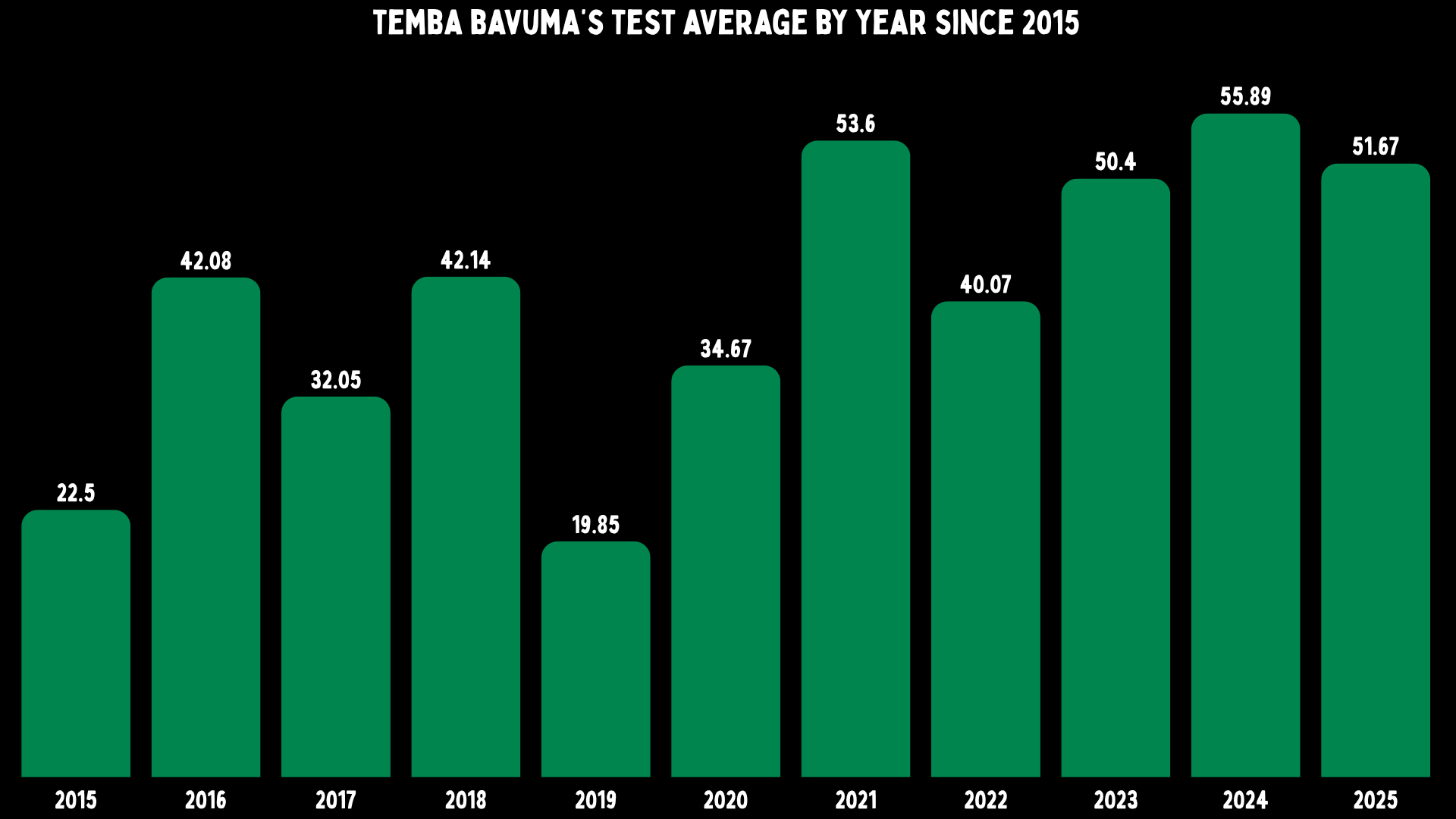
It was the beginning of the second phase of his Test career. Bavuma hit a half-century in his second outing on his comeback. He followed that with his best year (till then) in 2021.
Bavuma the batter has always had distinctive attributes. He’s been the smallest guy on most teams. His lack of height meant he couldn’t generate the power needed to hit the ball far. He compensated with his speed between the wickets. He steals singles and finds twos.
He’s also distinctive visually, which means he has often been part of viral memes.
The 2023 World Cup captains press conference trended for Bavuma because it looks like he falls asleep on his chair. Here he is surrounded by Pat Cummins, Rohit Sharma and Kane Williamson, all expected to be greats from their teen years, yet it is the South African skipper, the outsider, who is so comfortable he almost dozes off. This is a man who knows who he is, and isn’t fazed even though he always stands out.
He was made for modern virality, whether it was his awkward high fives with Kagiso Rabada or the many times he had to stand next to Marco Jansen, who made him look like a small boy.
However, in the second stage of his career, Bavuma transitioned from being a short man to a leader with great stature.
South Africa were making no runs and always mid-collapse. He was required to hold things together. He did so slowly, in his own method.
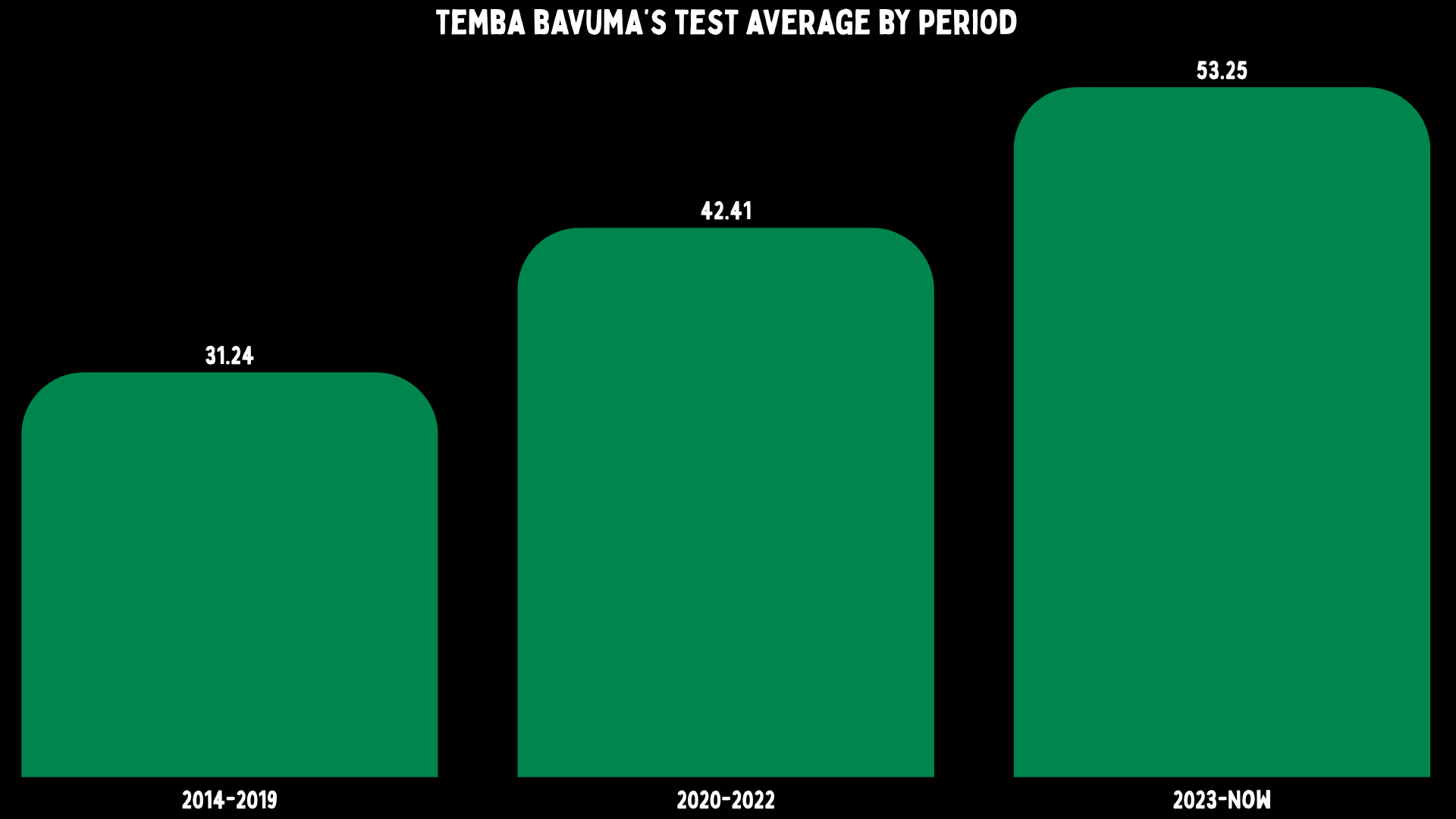
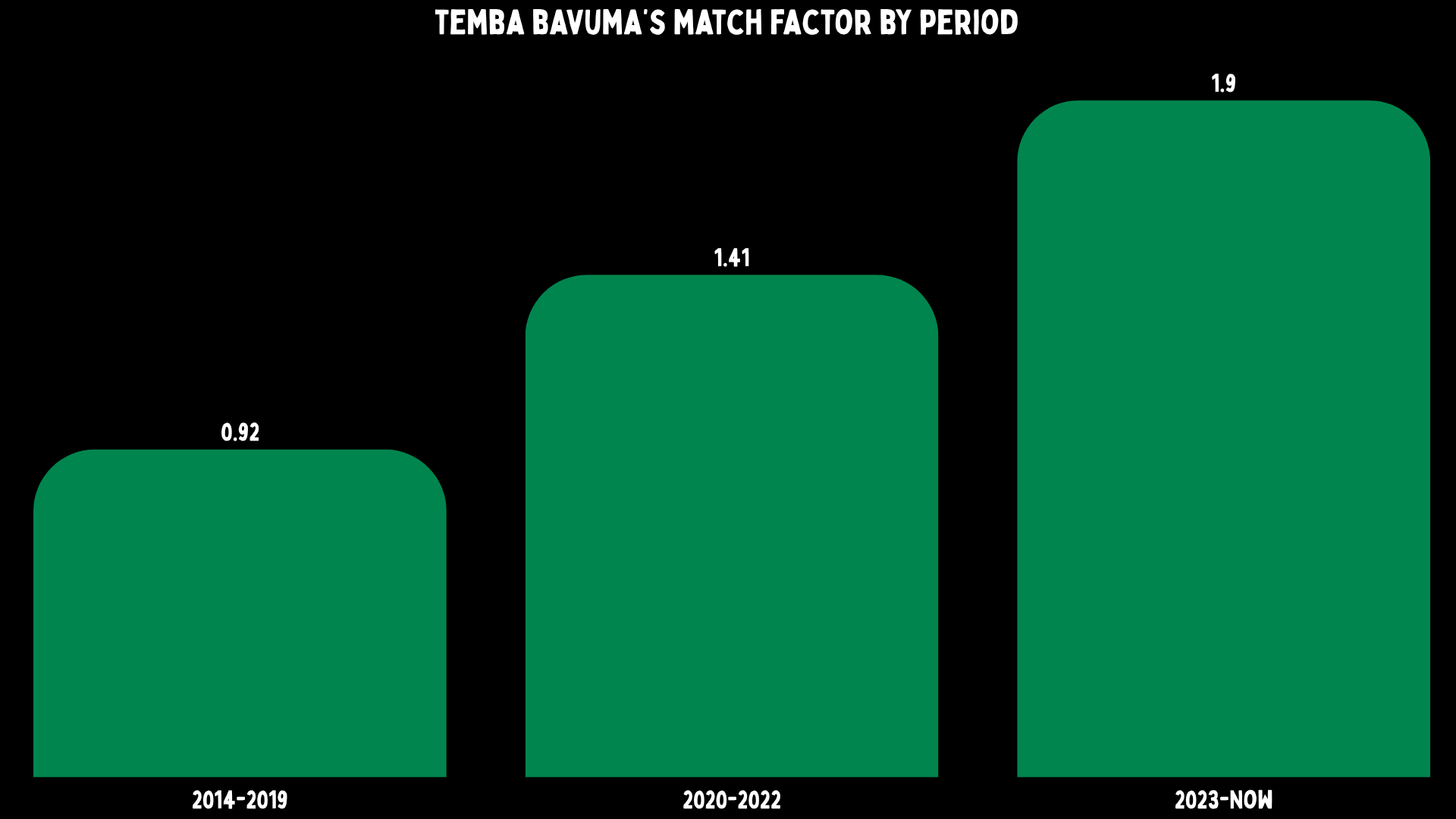
It was in this period that he developed a reputation for gritty knocks. He made runs that were worth more than their numerical value. Bavuma’s seven half-centuries in 26 innings from 2020 to 2022 were gold-dust. His average of 42.4 was 12 points higher than the combined average (30.1) of the rest of his teammates in the same period.
We have something called the Good Areas Most Improved Test Player. Every two years we pick nominees and then a winner. Bavuma was nominated for two straight editions. Think about that: he improved enough to get nominated one time, and then improved way more on his last development.
That is something special. He found a new best, and instantly beat it.
At Lord’s, in 2003, Ntini sank to his knees and kissed the pitch. He had just dismissed Steve Harmison to become the first South African bowler to capture 10 wickets in a Test at the home of cricket. It wasn’t just a groundbreaking moment for South Africa; it was a seminal occasion for black cricketers.
At Lord’s two decades later, the same crowd would applaud another man who couldn’t even run after scoring 66.
That half-century was one of six across 23 innings, from 2023 till now. He also reached triple figures three times in this period. He is still a 50s man, and maybe he always will be. Only now, it’s his average too.
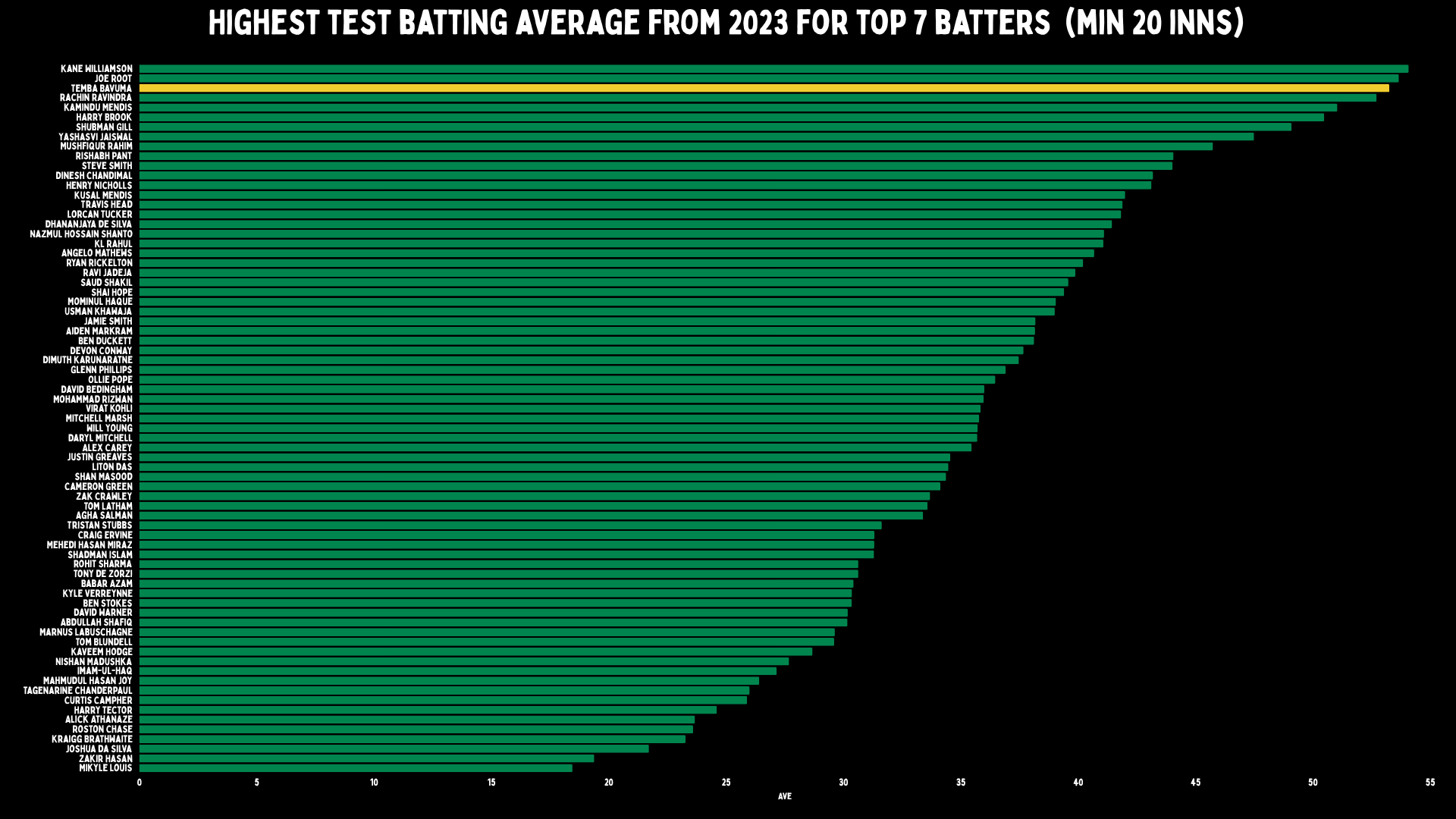
In an era where almost no batter in the world has made runs, the one that many South Africans didn’t believe in, and Ben Stokes thought was shit, has stood the tallest. There have been 43 players in the last five years who have scored 1500 runs; five of them have a higher average than him. Bavuma’s has been 49 in that time, 19 higher than Stokes.
It has been a very long walk, but finally, he is one of the best bats in the world.
***
Temba Bavuma is walking around Lord’s; his teammates are a long way behind. There is no doubt who the leader is.
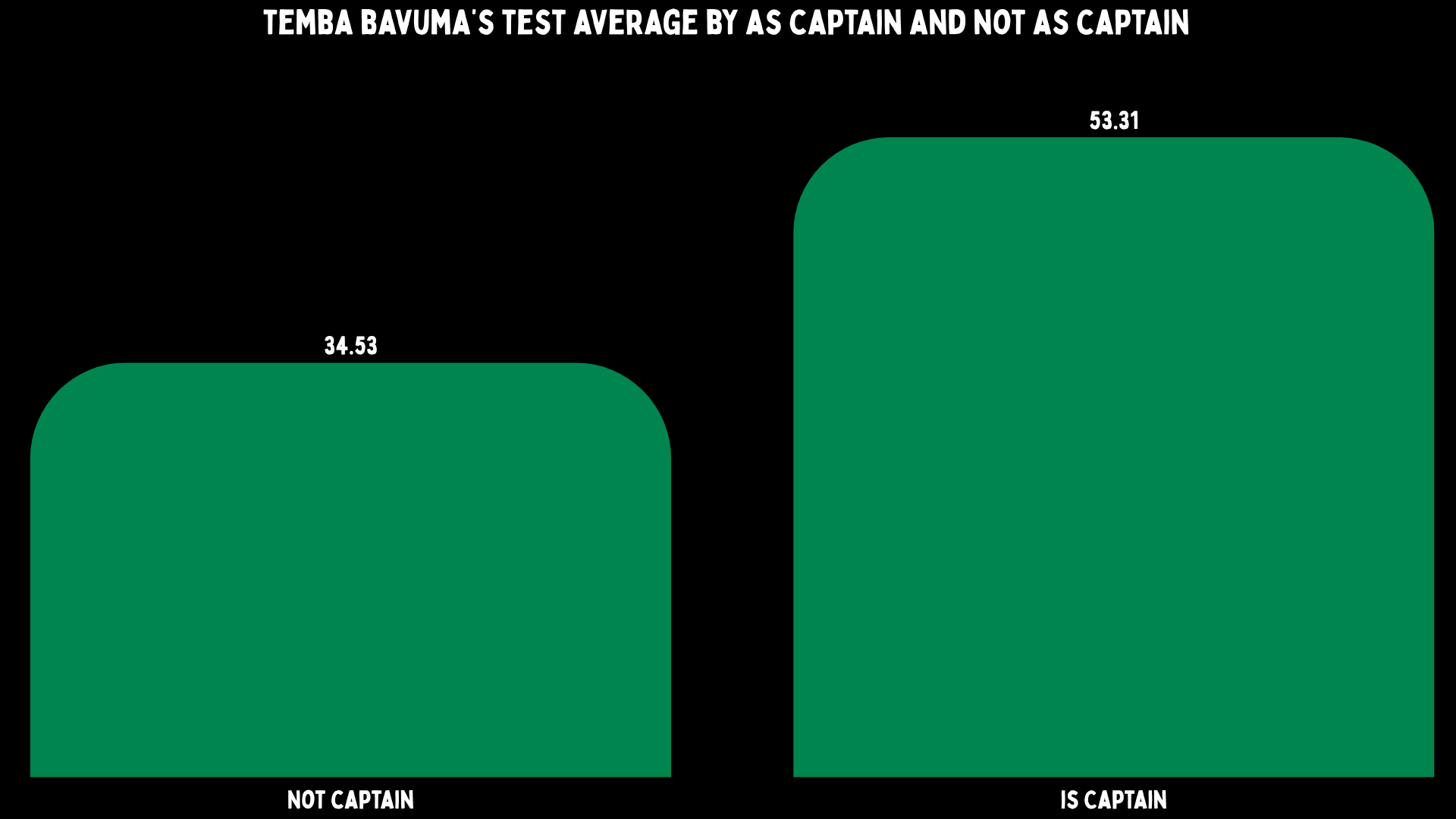
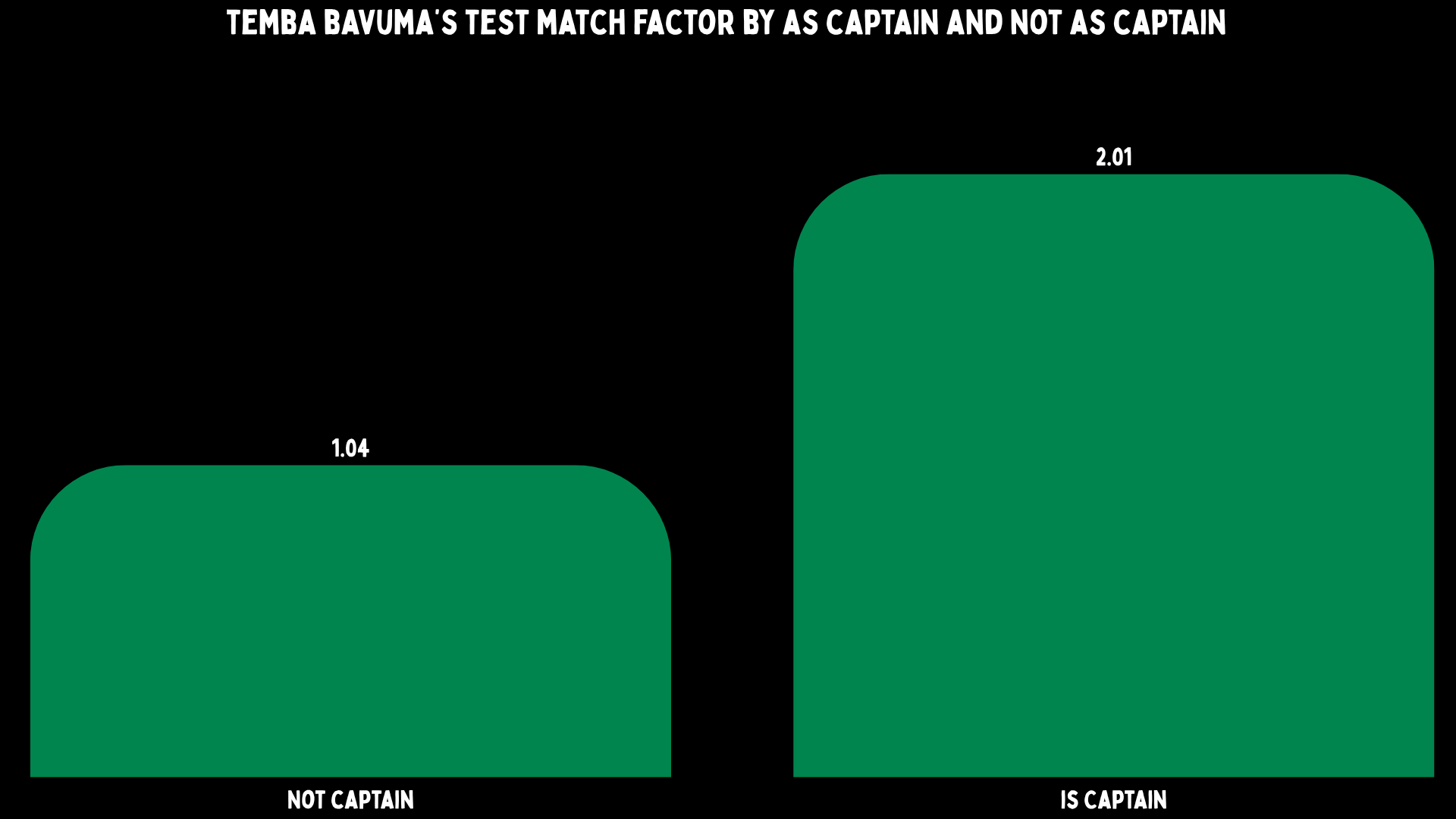
South Africa have had 18 Test captains since readmission. Only eight have led the side in 10 or more Tests. Three of them – Shaun Pollock, Hashim Amla, and Bavuma – averaged more with the bat as captains than they did as regular players. Pollock and Amla had win percentages of 53.8 (26 Tests) and 50 (14 Tests). Bavuma has led in only 12 Tests so far, but his win percentage is 91.7.
South Africa’s most important captain since readmission is Graeme Smith. He led in 109 of the 117 Tests he played. He was on the field when Ntini took his ten-fer. Smith conquered the world by managing a team of talented individuals. He is a giant in real terms, and for South Africa.
Bavuma can never have a career like this. But he won with a side where the whole was far greater than the sum of its parts.
As incredible as Bavuma’s impact has been on the cricket team, it has been even greater for his country.
“When I walk on the field, it’s not just me walking on the field. I understand the significance. It’s about being a role model and an inspiration to kids, especially black African kids,” Bavuma had said after his maiden Test century. Smith was a great captain, but this is a different leadership.
New Balance made an ad for him recently, where he said, “I’ve been called a lot of names in my life. Some names hurt.”
His first name resonates most. He was born in 1990, when South Africa was working its way out of apartheid. His grandmother hoped for a better future.
“The name I’ve been called the most is Temba. My grandmother named me Temba because it means hope.”
Decades later, he launched the Temba Bavuma Foundation. It provides bursaries to talented young players and feeds society’s downtrodden, among other things. Mostly, it gives what his grandmother wanted, hope.
Bavuma is not a great player in a conventional sense. He lacks power in T20, needs a special kind of team to be good in ODIs, and has made the best of what he has to be above average in Tests.
His greatness is that he can walk around Lord’s as the leader of a nation that never even hoped for something like this.
Earlier, he had come in at 70 for 2 and tried to make a statement. He played a shot a ball, and ran really hard.
However, his scoring rate, and more importantly, speed and athleticism were halted by a hamstring strain. Soon he was limping, and looking like a child wearing pads for the first time. He became crease-bound, doing little more than a light jog, like Arjuna Ranatunga in the middle overs of ODIs.
Bavuma was playing on skill. For years, he was told he didn’t have any. Now, it is all he has, and it’s giving his nation the chance of their first major win.
But while his grandmother named him Hope, his teammates went with Malume, which means uncle. For many in the modern world, Unc is an insult, but for Bavuma, it is the ultimate compliment.
At Lord’s, the crowd sees the older, wiser, ground-bound Bavuma, and this is his uncle knock. It is full of wisdom and cunning, while lacking in athleticism and speed. This innings completely stops Australia. On his way to a huge score in this chase, he’s surprised by a Pat Cummins ball and leaves at 217 for 3.
Bavuma has changed so much as a batter, but still gets out before the big scores. However, it is okay today, as he doesn’t have to do it alone. Aiden Markram makes the hundred before the middle order steps up. South Africa have chased against Australia at Lord’s to win the WTC. His team has won its first major ICC trophy. He holds cricket’s mace as he steps onto the Lord’s outfield with his team behind him.
As always, Temba Bavuma walks, so others can follow.
He's the GOAT