


Jacques Kallis is one of the greatest cricketers to have ever lived, but he was not a cricketer ahead of his time.
A case could be made for Kallis being amongst the ten best Test batters in history, who was a formidable fifth bowling option too. As far as all-rounders go, only Garry Sobers and Imran Khan have claims of outshining him. His bowling numbers might flatter on paper, given how he played his home cricket in South Africa - but that very fact makes his batting averages look other-worldly.
The South African all-round behemoth was adjudged the best male cricketer of the 21st century by ESPNcricinfo. While that could be debatable, what is not up for debate is Kallis being a bonafide legend of the game, and a sureshot entrant to the all-timers list.
What he’s not, though, is a time-traveller. Definitely not. He didn’t play the game as if he had arrived from the future. If anything, he was aligned with the times that he played in, and some might even refute that statement if they have T20 batting on their minds.
We often speak of, or read about, batters who were ahead of their time.
Victor Trumper activated the on-side with his cross-batted shots, Viv Richards was a ball striking anomaly, AB de Villiers introduced 360-degree play, and Adam Gilchrist changed the role of a wicketkeeper-batter forever.
Then you have the blitzy trio of Sanath Jayasuriya, Shahid Afridi, and Andrew Symonds, who could give you crucial overs with the ball as well. Had they been born a decade later, they would have enjoyed the most lucrative T20 contracts that billionaire franchise owners could offer.
More recently, we have seen someone like Abhishek Sharma going hell for leather in T20 cricket with unimaginable consistency. As of today, there exists a 15-year-old boy from Bihar who is making Abhishek look like antiquity faster than you can fully pronounce Sooryavanshi.
All of these names played cricket ingested with intent pills, and were, or are, ahead of their time. But none of them earned their time-traveller tag because of their bowling skills. Batriarchy is still the one principle that rules us all.
But bowlers form one half of cricket. And a fair few of them have displayed wizardry straight out of a time machine, over the last nearly 150 years of Test cricket.
Traditionally, fans have bestowed batters with godhood. Sachin Tendulkar might come to mind, but before him there was WG Grace. To defeat this alleged god, cricket needed a demon. Enter, Frederick Robert Spofforth.
A towering figure, with hair parted through the middle, sporting a bushy and pointed moustache, Spofforth certainly had the look of a demon. With a cricket ball in his hand, he completed his transformation to Lucifer incarnate.
Living up to his moniker, Spofforth’s main weapon was swing bowling, which is obviously the devil’s work. He was the first to hoop the ball in the air, and in the famous Oval Test in 1882, he had England’s bearded deity down on his haunches.
Out of 20 English wickets, Spofforth accounted for 14, helping Australia defend 85 runs in the fourth innings against a team considered far superior to them. Spofforth’s ability to swing the red cherry gave birth to both international cricket and the Ashes. To further elevate his credentials, he is also the first hattrick-hero in Tests. Not only was Spofforth a relic from the future, he was perhaps the first time-traveller cricket had ever seen.
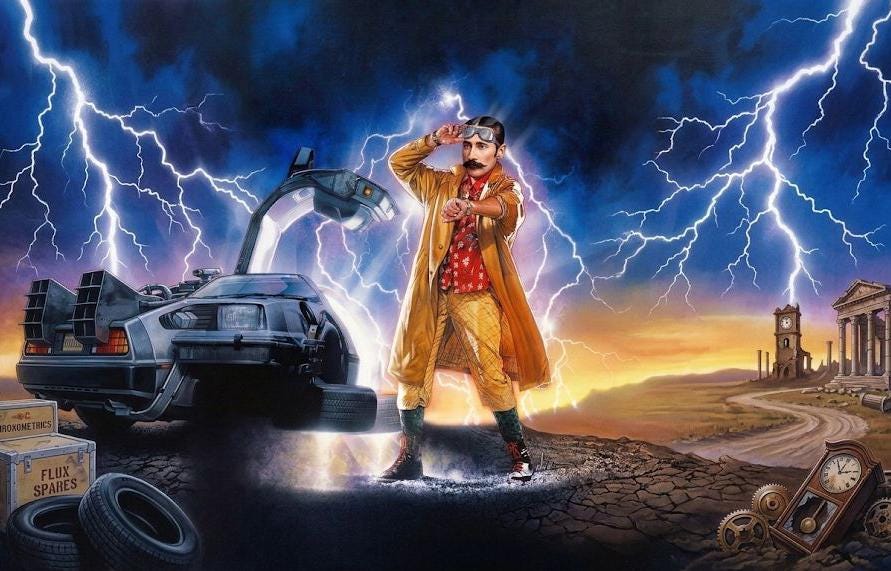
About a decade after Spofforth hung up his boots, a young wrist spinner from Oxford University kicked off his first-class career. If you Google the name Bernard Bosanquet, the first result is the Wikipedia page of an English philosopher. The father of the googly is not even the most famous Bernard Bosanquet.
Inventing the wrong’un was not something he was lauded for, however. In fact, English cricket was so vehemently opposed to the googly, known as the Bosie back then, that there were efforts to deem the delivery type illegal.
England’s loss turned out to be South Africa’s gain, as Bosanquet taught his craft to Middlesex teammate Reggie Schwarz, who further imparted this knowledge to his South African compatriots. Next thing you know, a four-pronged attack of legspinners, armed with the wrong’un, floored England in back-to-back home Test series. The past might well be one of the best teachers, but in this case, the Englishmen failed to comprehend a lesson from the future.
Wrist spin mystery is not restricted to googlies. In 1925 Australian legspinner Clarrie Grimmett made his international debut, and amassed 200 Test wickets in 36 games. At the time, no other bowler had gotten to this landmark in fewer games. He achieved this feat by outfoxing batters with his invention called the flipper, a delivery which was spammed by many future wristies including the late great Shane Warne. Grimmett’s record stood for a whopping 82 years, up until 2018 when another leggie from Pakistan, Yasir Shah, usurped him.
Speaking of spinners ahead of their time, many would remember Ajantha Mendis wreaking havoc with his carrom ball, up until he was found out. He had a short period under the sun, but since then, we have seen the carrom ball become mainstream.
Most people, however, might not know that it was not Mendis who came up with this finger-flicking innovation. That honour belongs to Australian tweaker Jack Iverson, who featured in just five Tests and 34 first-class games in the early 1950s. It took over half a century for cricket to catch up with Iverson’s genius - fortifying his position as a bowler well ahead of his time.
The last spinner worth mentioning here is one of Pakistan’s finest offbreak bowlers, Saqlain Mushtaq, who stumbled upon a pot of gold by fiddling with a table tennis ball. The Urdu word “doosra” literally translates to “the other one” in English, and even though this variation is defunct in modern-day cricket due to restrictions around how many degrees a bowling arm is allowed to bend, it remains the most lethal weapon finger spinners have ever had.
From the mid-1990s to early 2010s we saw several doosra bowlers dominate, most notably Sri Lankan legend Muttiah Muralitharan, who boasts the record of most wickets in both ODIs and Tests. None of this chaos would have been possible without Saqlain’s accidental trip, traversing through the fragments of time. Maybe it will come back someday, like the carrom ball. Science is the man after all.
Spofforth was the pioneer of swing, but conventional swing bowling has never been remotely as sexy as reverse swing. Pakistan’s deadly duo of Wasim Akram and Waqar Younis might be hailed as the greatest exponents of reverse swing, which is probably a fair statement, but they were not trail-blazers.
The art of scuffing up the ball on one side and shining it on the other was passed down to the two Ws by Imran Khan, who in his youth had learned it from Sarfraz Nawaz. A stocky bowler with long hair and a burly moustache, Sarfraz did not invent reverse swing, which had emerged in Pakistan earlier, courtesy of placid tracks which offered negligible purchase to bowlers, under the blazing sun.
Sarfraz did, however, play the biggest role in spreading this innovation, and even though his bowling numbers do not scream world-class, he deserves credit for his foresight. You surely warrant some acknowledgement for planting the seeds of one of cricket’s most exhilarating sights. It’s funny how it only took the sport about three decades to come to terms with a skill which was long thought of as cheating.
Come to think of it, the thrill that comes with witnessing reverse swing on display would not nearly be as intoxicating without the yorker. The death rattle created by a ball shattering the stumps is the best sound in all of cricket, and the visuals are always amplified when the base of the stumps is violated.
Cricket without the yorker is like basketball without the slam dunk. This hair-raising delivery has existed since the 1800s, but it was not until the late 1950s that it was made popular, by a fearsome tearaway quick from Barbados. Wes Hall should go down as one of the most important cricketers in the history of the sport, for without his contribution, it could have been devoid of toe-crushing carnage.
Adrenaline is the jugular of sport, and fast bowling is the ultimate adrenaline inducer in cricket. Express pace merchants have always been red-hot commodities in the game, but it was only after the career of Jeff Thomson that teams felt their necessity.
Bowling evolved from being under-arm to round-arm to over-arm, so slingy actions were not unusual back in the day. When the no-ball law switched from relying on the back foot to the front foot in 1963, we saw slingy bowling actions return.
If you think Lasith Malinga’s action was awkward, go search for Thomson’s name on YouTube. His numbers may not do justice to his talent, but he is the first of his kind to mix serious heat with a slingy action, rendering him ahead of his time on multiple fronts. Speed guns be damned.
While pace is necessary to get the juices flowing, batters these days in white-ball cricket are most often deceived by variations in pace. In this day and age there exist several different types of slower balls. Cutters, back of the hand slower ones, split finger deliveries, moon balls, and the ones that dip violently due to the Magnus effect.
Change of pace has become an essential component of the modern white-ball bowler’s artillery, and as the game continues to move forward, bowlers who are unable to vary their bowling speed are considered one dimensional. Who started it though?
The answer to that is complex, because in the earlier days of cricket it was harder to distinguish between fast bowlers and spinners. Cricketers like Sydney Barnes made a career out of bamboozling batters in this manner. But with time, the distinction between quicks and tweakers became more and more apparent.
That said, an Englishman by the name of Bill Lockwood is credited as the inventor of the slower ball, somewhere towards the end of the 19th century. It is remarkable how a delivery which is predominantly a limited-overs skill, had existed seventy years before the dawn of ODI cricket.
The slower one faded away from the scene after Lockwood, until another tall West Indian bowler from Barbados made it hip again. Franklyn Stephenson developed his version of the moon ball in the 1980s, deceiving batters by bowling what he called an off-spinning delivery with a fast bowler’s action. He was the first of many to deploy a subtle movement of fingers disguised in a fashion that batters were unable to pick. Sam Curran is basically Stephenson teleported from the past.
These days, you see some T20 seamer come up with a new adaptation of the slower ball every other minute, which makes it the most frequently occurring innovation in recent times. The last proper inflection point though, from a fast bowling perspective, was the advent of the wobble seam delivery.
The pace playing pandemic started around 2018 as fast bowlers across the world caught on to the art that England’s James Anderson had made mainstream. As a result, batters - even the best ones - saw their averages plummet, which gave rise to a bowler-dominant period in the longest format. Anderson deserves all the acclaim for spreading this delivery like wildfire, but he too picked it up from someone else.
Pakistan seamer Mohammad Asif was a bowler from a utopian future, where the ball danced at his whims. Vernon Philander claims that he never knew which direction the ball would nip towards when he bowled wobble seam, but if you have ever witnessed Asif play his tunes on a cricket pitch, he seemed in complete control. His off-field shenanigans deprived both the world and himself, of what could have been a magnificent career. Perhaps drugs and spot-fixing were legal in the utopian future he came from.
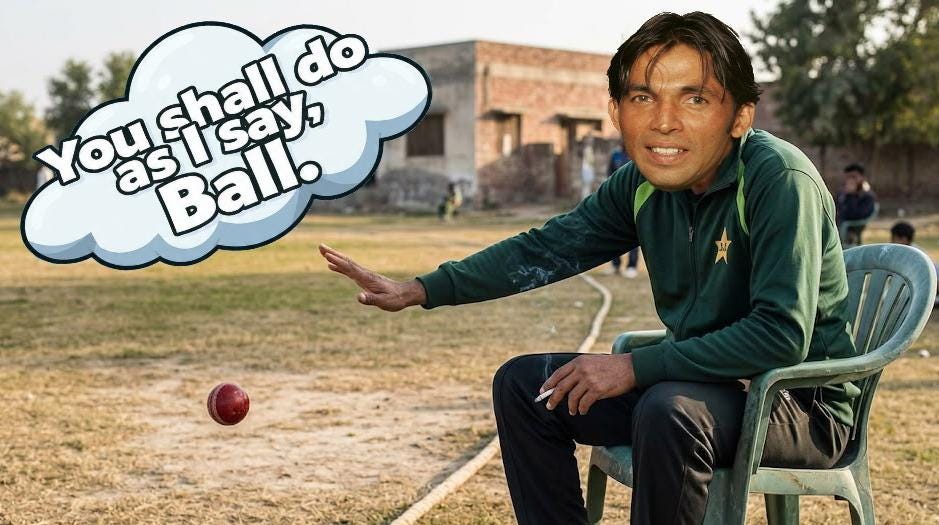
It is worth mentioning that Australian seamer Stuart Clark was devastating batters with the wobble seam delivery during Asif’s era as well. Some years before that, West Indian quick Courtney Walsh also bowled it, albeit unintentionally.
All these bowlers from the future gave cricket one, or a maximum of two, different skillsets - courtesy of a peculiar trick up their sleeve. The only fast bowler to have mastered everything that the craft has to offer, and be thought of as complete in every sense, is a living legend who was born in Ahmedabad some thirty-odd years ago.
Jasprit Bumrah belongs to the space age of cyborg bowlers. There is not a single type of delivery that he has not perfected. His yorker is one of the finest the game has ever seen, and his length is supreme for whatever plan he aims to execute. His slower ones cut in sharply like faster off-spinners, paying homage to those Barnes-esque hybrid bowlers of yesteryear.
He gets the ball to swing in the air and seam off the deck with the consistency of Scooby Doo gobbling down a free meal. His freak action allows him to deliver the ball later than other bowlers, helping him gain an extra yard of pace, which is a trait that would have certified him as a time traveller on its own.
As things stand, he is the only bowler in the history of Test cricket to take 200-plus wickets at a sub-20 bowling average. Without his services, India could not have lifted the last two T20 World Cups. Part alien, part robot, full-time freak of nature.
The format, phase of the game, opposition team, playing conditions, none of these things matter to him. Bumrah is inevitable, and has single-handedly done his bit to smash the Batriarchy. Maybe a couple of generations later, we will realise just what breed of time-traveller he was.