


Garfield Sobers had an extra finger on each hand. Like a perfect jigsaw puzzle with a spare piece. His friends would tell him he was cheating when he played cricket because of them. One of the fingers came off when he was still young. But he had eleven when people noticed him in Barbados.
There is a feeling in some parts of the world that having extra fingers is good luck. Today, it’s something we see with artificial intelligence image generators. That fits Sobers, because if you got AI to try and make a perfect cricketer, it would be him.
Bob ‘Knocker’ White was his teammate at Nottingham. White played as a batter for a decade at Middlesex, then moved to Nottingham and remade himself into an allrounder. He finished his playing career and went into umpiring. He basically stood on professional grounds for 50 years. And he only ever saw one Sobers.
Knocker was in awe at the non-striker’s end, barely believing his luck in seeing Sobers from this close. Then he would go down and ask for tips, advice, or just an explanation of how Sobers played the last ball. The West Indian was happy to answer Knocker’s questions. But it was pointless. What Sobers could do was not transferable. Knocker was a solid professional cricketer, he could ask the right things, saw subtle changes of grip, or position on the crease. But he couldn’t be Sobers, because no one could.
He wasn’t built like normal people. That eleventh digit that people said he was cheating with, Sobers cut that off himself with catgut. He was cricketing perfection and an amateur surgeon. Not just all the pieces that you would want in a cricketer, but he had extra. Sobers could do everything.
***
Sobers was first chosen as a left-arm finger spinner. This was a little like the Steve Smith decision, as the West Indies knew he could bat. But at that stage, his bowling was more useful to them, and they thought it’d develop quicker.
Over his first few Tests, it looked like his bowling would be better. He took 4/75 the first time he bowled and added 40 across both innings in his debut Test. After 16 Tests, he hadn’t bettered those figures, and his bowling average was over 40. His batting had shown glimpses with six 50s; it was enough to keep him in the team, but not much more.
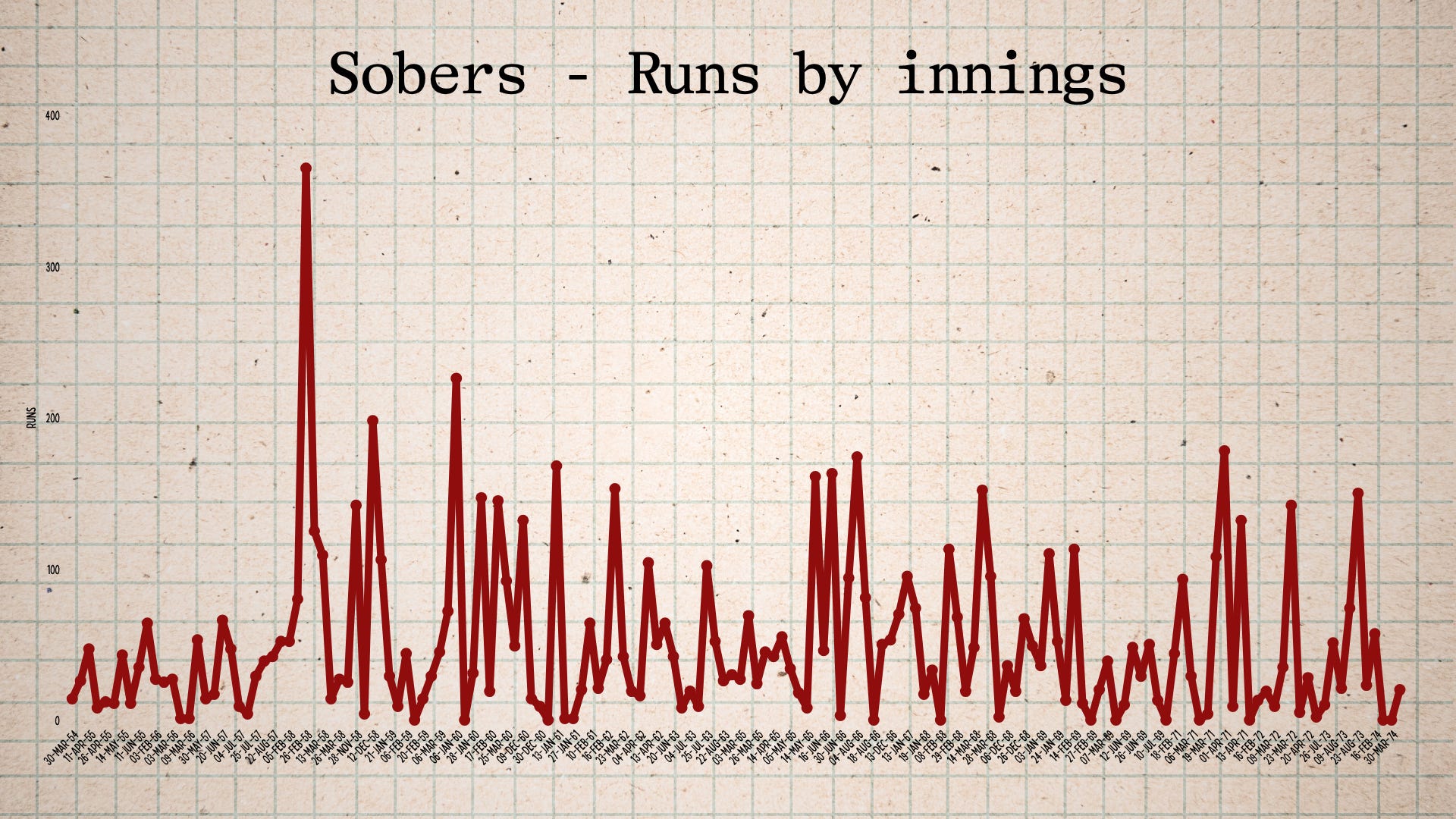
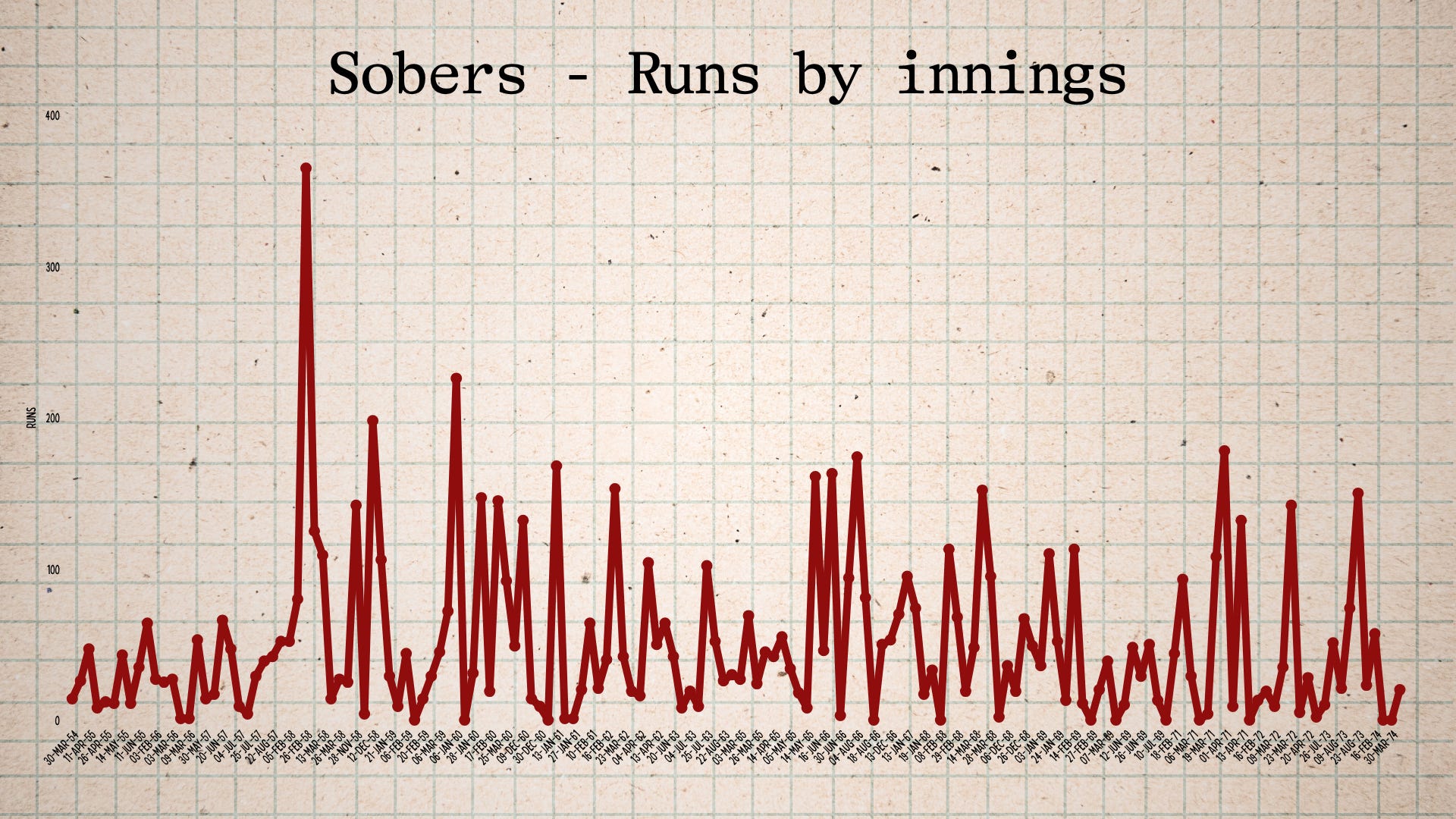
None of this was helped by the West Indies having no idea what to do with him. In his short career, he’d batted at 9, 6, 8, 7, 5, 3 and 4. Plus, he’d opened. His batting average was 34 at the age of 21.
His next innings was 365 not out. The confusing allrounder with no batting position broke the world record when only 21, with his first hundred.
Wisden described it this way: “The 21-year-old West Indies left-hander, making his first Test century in the third Test at Kingston, hit 365 not out in ten hours eight minutes, three hours twelve minutes less than Hutton took in his innings against Australia at The Oval nearly twenty years previously. Although Pakistan were handicapped by injuries to bowlers, Sobers nevertheless played a brilliant innings.”
What a way to explain the biggest score in Test history.
But this knock changed everything. He went from a bits-and-pieces player to a star.
The next year he averaged 30. He made 365 when he was still clearly in development. But the issue for the West Indies at the time was where to bat him.
These days he would be a No.4, but at that stage the West Indies had Everton Weekes and Clyde Walcott - both naturals there. Five also made sense, but they had Frank Worrell too. So do you bat Sobers at three? No, that is Rohan Kanhai. All four of those batters are great. Not for just that era, but all time.
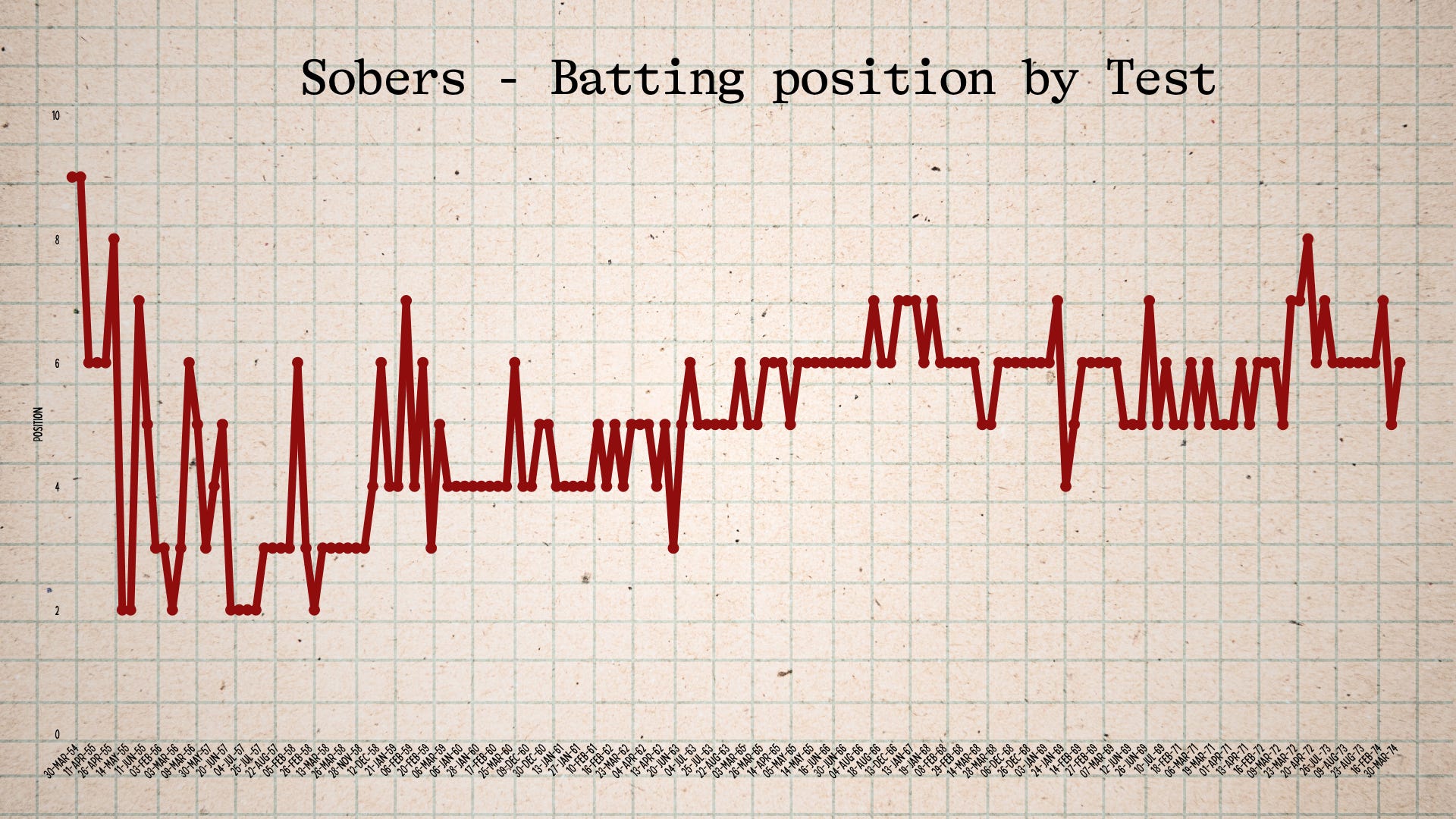
Sobers was still a project. He wasn’t as refined as them. And fitting him in was just hard. Now, what about his bowling? If you want him to bat up the order, you cannot use his second skill as much.
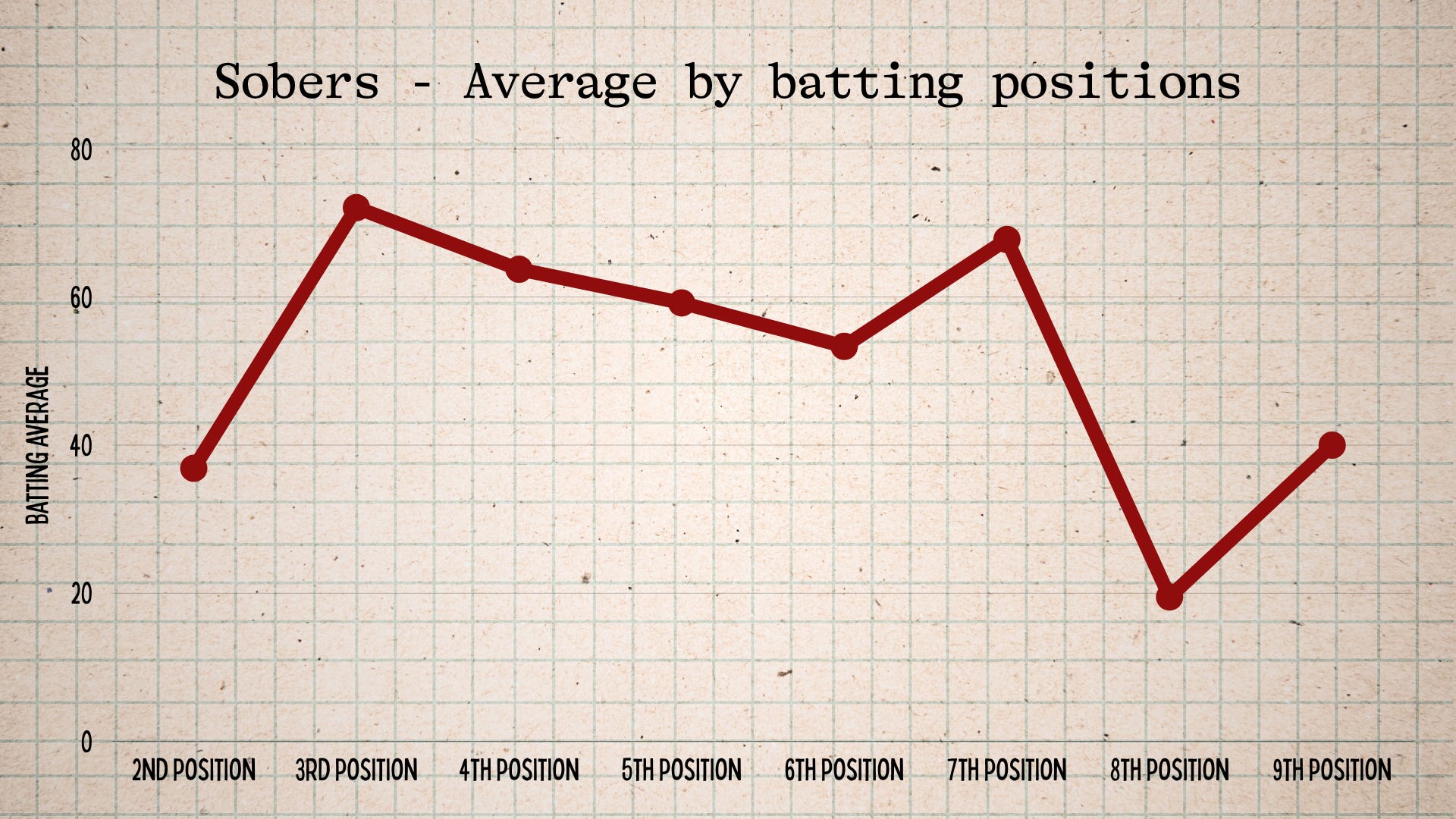
Sobers probably should have batted at three. And unlike other players who chose to bat lower, Sobers was batting down the order to deliver Jimmy Anderson-level overs. Are the number three stats a blip? A little, because of the 365 not out. But he also averages more than 60 at four. His mark drops down a little when batting at five and six.
We don’t have his full stats of spin and pace, but we certainly have enough to know he played pace and spin as well as each other. So he wasn’t afraid of the new ball. His speed of scoring at three or four, matched with his talent for making runs, could have made him even better than he was.
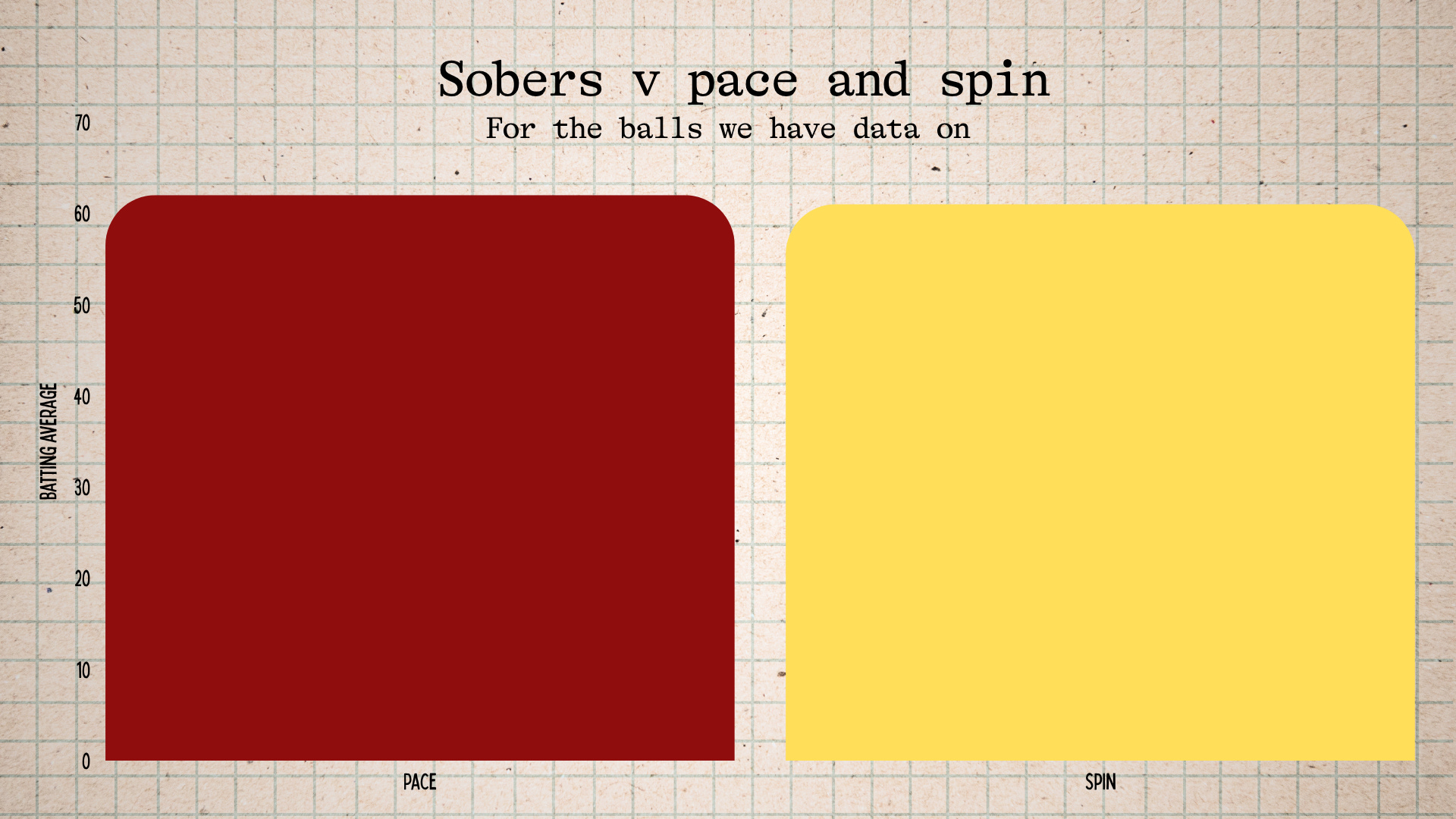
What’s incredible is that Sobers still averages the fourth-best of anyone with 5000 runs. Even though he played when he was too young, and really a bowler, batting in so many positions, rarely in the ones he was probably most suited to and bowling like a frontline specialist.
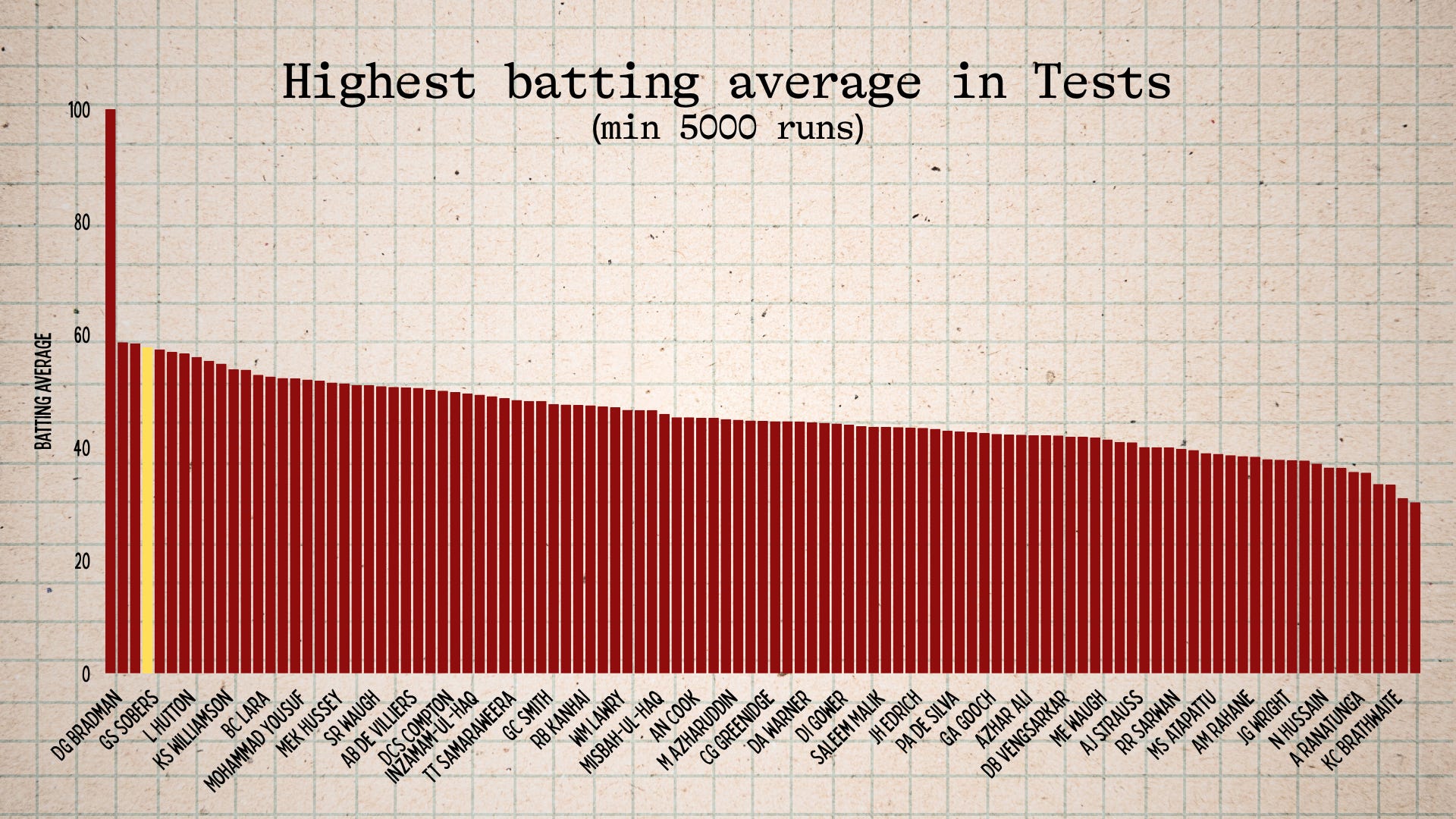
Sobers was one of the greatest batters of all time, and he could have been better.
***
Sobers was raised by his mum in a shack in Bridgetown’s Bay Land. It was formerly an area in Barbados where slaves lived and was now for the plantation workers. The local cricket club was for whites only. He was born into a world that was not for him. And he then proceeded to own it anyway.
He made his debut six years before the West Indies ever had a permanent black captain.
So when he rose, they all did. He was the collective hope and dreams of an entire region. He was a player whose greatness shone despite the world he was forced to overcome. Proof that Caribbean excellence could overcome everything.
Sobers was a cricketer, but really more of a folk hero and political icon.
But Sobers didn’t like that. He saw cricket as entertainment, and he had a professional mindset. He was going to play cricket for money, do it well, and get paid for it. So when one of those calls came from Rhodesia to play in a double-wicket competition, he went there. Saying afterwards that he knew little about the politics of what he’d done.
In fact, instead of distancing himself from the controversy, later in his career, he said that he would have happily played in South Africa had it not been for all the “publicity and criticism”.
Playing in Southern Africa was not the only issue. Sobers didn’t always want to represent the West Indies. He was the best player in the game, and was the most highly paid. But that money didn’t come from his Test team; it was from everything else.
This led to a situation where Sobers was going to turn his back on the West Indies for a club payday in English league cricket. It took Don Bradman and Richie Benaud intervening to swing him back around. “My kind of cricket is world cricket,” he says in his book. “And the jet plane makes all-year-round cricket possible for the individual world player.” Sobers was freelance eons before anyone even thought of that phrase for cricket.
So while CLR James called him, “a West Indian cricketer, not merely a cricketer from the West Indies”. It was true. He played cricket in a nearly pure West Indian style, but for him it was about making money to survive. James called him “the living embodiment of centuries of tortured history”. Sobers said, “Cricketers are entertainers”. Both were accurate.
Sobers lived by his creed, he wanted the fans to remember him. He wasn’t there to make numbers, but memories. And as he travelled the world, he went just as hard with late nights as he had when in the middle of the ground. He lived every moment, on and off the cricket field.
Sobers was West Indian cricket at its best, most dominant, stylish, and free, but he was also the worst. He put himself through an extraordinary workload. He would have been near the top of the lists for most runs and most wickets in first-class cricket had he not been playing league cricket so often. But Sobers was always batting or bowling somewhere. For money.
Politics were for other people, Sobers entertained.
***
For The Art of Batting, we had to find ways of comparing greats throughout different eras. It’s not an easy thing to compare Jack Hobbs, Virat Kohli and Garfield Sobers. Their careers are defined by the eras they play in and the pitches they end up on.
So we came up with a batting ratio method. We took all the players with 3000 runs at an average of more than 44 as a base level to give us around 80 of the best batters who ever lived statistically. And then we compared them to each other, or their era, or the pitches they batted on.
It means every player has a particular pattern. This is Sobers.
Compared to the rest of the group, he scored a lot of runs, especially for an all-rounder who was often down the order. His average ratio is obviously really high, which is not surprising. That comes down a little when you look at Sobers away. That is because he only averages 50 on the road, while almost 70 at home.
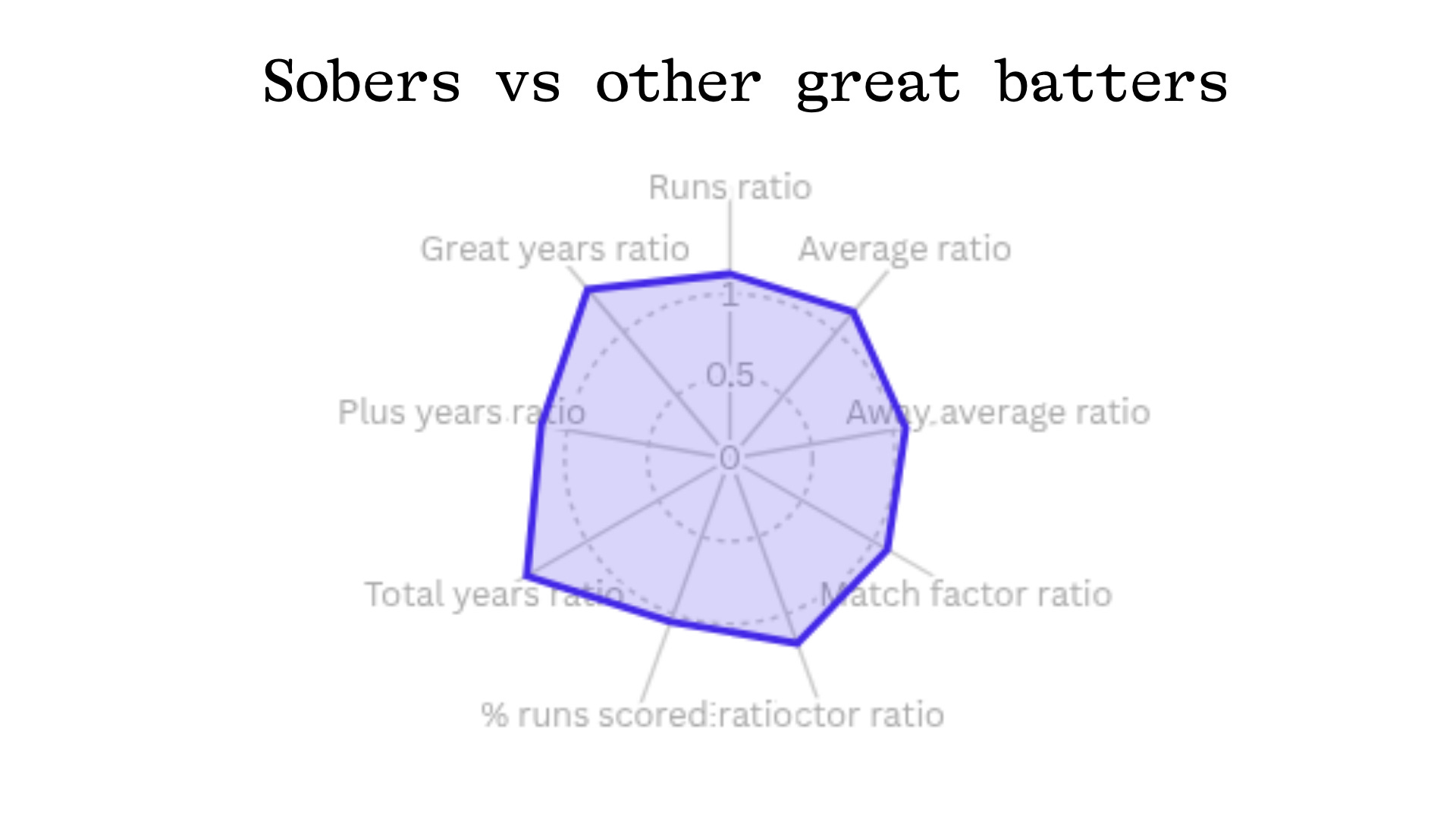
When you break that down, he still pops massively, because against England and Australia - the best bowling lineups of that era - he was awesome. In 31 matches, he averaged more than 50 combined. His mark in Australia is lower, but it doesn’t include his double hundred against them in a Rest of the World XI. He also went at basically 100 in eight Indian Tests. The great Indian quartet had not been fully formed, but Sobers went up against BS Chandrasekhar, Vinoo Mankad, Bishan Bedi and Srinivas Venkataraghavan. So it wasn’t as if he wasn’t tested.
His away record looks worse because the two places he struggled with were also probably the weakest bowling lineups, Pakistan and New Zealand. Fazal Mahmood did get him three times LBW. But really, it’s hard to take this too seriously, as he smashed the far better attacks. So I would argue his away record is actually better than it looks.
Then we get match factor. That is looking at the runs you made compared to the rest of the top six players in your matches. It allows us to understand the pitches a player has to deal with. We know that Sobers had good pitches because everyone in his side made runs. So his match factor is low. We see that for Ricky Ponting and Sachin Tendulkar, you get penalised for the fact that your teammates are good. But it does also show Sobers batted on pretty good surfaces.
However, his era was tough. So he certainly comes out of that pretty well. It is one reason he stood out: it was often a tricky period for batting, and he made it look very easy.
In percentage of runs scored, you can see despite his massive average he didn’t make a huge part of the West Indies totals. Again, that is because he had incredible teammates. Brian Lara and Shivnarine Chanderpaul scored really highly on this metric.
What Sobers gets a boost for, is his total years, because he really has a long career. Twenty years is huge. And then we looked at something else, a measure to separate players who made the bulk of their runs in one period, usually their prime. Any year with an average above 40 was considered a plus, and he was actually not spectacular on that metric. But any year above 50 was considered great. Look at the boost he gets there. Sobers averaged 40 plus ten times, and eight of them were over 50. And not just a little more, he never had a year of averaging in his 50s, he had 144, 78.5, 70, 99, 169 (from only one Test), 67, 75, and 76.5.
There is no period where he averages more than 50 in four consecutive years. He will average 70 in a year, and then 30s or 40s on either side. Part of this is because he played infrequently, never getting to ten Tests in a year, and only two times having eight-plus matches. So if he was like a modern player with 10-14 games, his form would look more constant. Instead, it looks like Sobers either turned up in the greatest form of anyone not Bradman, or he was not that bothered about runs.
Based on these metrics alone, we had Sobers ranked in the 20s on the original list. However, this ranking system was not built to give a final answer, but more to give us some structure to work from. We propped up openers’ records, as that is the hardest job, and downplayed people who batted in the five and six slots. In Sobers’ case, he wasn’t hiding down the order, he was placed there so they could ask him to bowl an unreasonable amount of overs.
Also we had to remember that he started in Tests at 17, as a bowler. In his early years, he’s not playing or performing like a top-order player, let alone a great one. We brought over his strike rate as well. Of the balls available to us, we know it’s around 52, which will sound low to you, but he played in the deadball era where everyone was slow. So his mark is fast for his era, because the global average was 39. He was around 36% quicker than usual. Truthfully, he could whack, but really kept the sixth gear for when he needed it, like being the first batter to hit six sixes in an over in first-class cricket. The power and speed scared people. That alone is enough to move him higher up the all time greats.
So, where did we put him in our list of the greatest Test batters of all time? Without giving you a number (buy our damn book!) we can tell you that he’s a lot higher than the 20s. His versatility, power, speed, record against the best attacks, and ability against pace and spin is like nothing we’ve seen before. Sobers should have been one of the greatest number three or fours of all time, but the West Indies had too many other pieces to fit in, and instead he had to wait around at six for someone to let him bat.
Basically, he was too talented to bat higher. That is not normal.
***
The first Tied Test had Garfield Sobers in it. He should have won the West Indies the match. He came in at No.4, and he was also the fourth wicket. The score was 239 for 4, he made 132 of them. Sadly, no one else made it past 66, and Australia had a first-innings lead of 52. Sobers took two wickets in that innings. He then failed in his next knock, and so Frank Worrell carried them, and they set Australia 233.
At 92 for 6, on the back of a Wes Hall bowling masterclass, the game appeared over. But Australia fought back, Hall kept bowling. At the other end, his partner was Sobers.
Alan Davidson had provided the muscle for the chase, Richie Benaud the fast running. For the last over, Davidson wanted strike, as he thought one big hit and this was done. Benaud just wanted them in singles. Davidson dropped one out to midwicket from Sobers’ bowling and took off. Davidson was slow, Joe Solomon picked up the ball and completed the run out. Benaud faced the last ball of Sobers’ over, but couldn’t get the strike back. Australia needed six runs off the last eight-ball over with three wickets in hand. They had Benaud at the crease, Hall was bowling, and it was 5:56 pm.
Benaud stole a leg bye to get strike back. Hall bounced him, and Benaud gloved behind.
Then it’s a scramble, Australia lose another wicket, and with three required off three and two wickets in hand, Australian left-arm seamer Ian Meckiff pulls a short delivery from Hall, and they think it’s going to the fence, before Conrad Hunte saves it. There are probably only two runs there, but the Australian keeper Wally Grout, decides to steal a third to try and win the match, and is run out.
The scores are level. There are two balls remaining. One wicket left.
Number eleven Lindsay Kline defends it on the legside. He’s not sure what to do, Meckiff just runs. Joe Solomon picks up the ball just in front of square leg, he has one stump to hit. He grew up throwing stones at mango stalks. He completes his second run out.
This is the photo by Ron Lovitt of what happened next. Test cricket’s first tie.
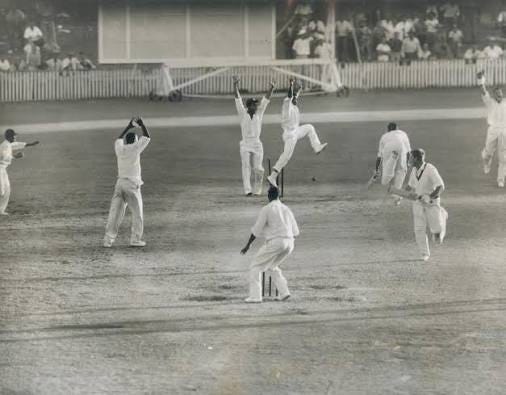
Frank Worrell is at the non-strikers’ end. The batter’s stumps are spread. Rohan Kanhai is flying in front of them. Wes Hall looks tired mid-pitch. Gerry Alexander smiles with one hand in the air. Lindsay Kline is looking back over his shoulder. And Sobers is behind the stumps, mid-appeal.
He came in to bat on the morning of day one of that Test, he was still bowling at dusk on day five. This was not a normal match, but for him it was. With bat, with ball, he was always in the game.
Garfield Sobers was not a great bowler. His record doesn’t suggest that, and neither do the reports of that time. But he made himself into a very useful option.
But let’s start at the beginning, Sobers was picked as a slow left-arm orthodox bowler. The Cricketer wrote of Sobers first Test, “He is a slim young man who runs lightly up to the wicket and the arm almost touches the ear as it comes over. On what might serve as a model action for a slow left-hand bowler, he builds changes of flight and spin in the classical manner.”
England legend Ted Dexter said, “I first played him at Cambridge where he bowled left-arm orthodox spin, turning from leg. He bowled rather too fast to turn the ball much, but was very accurate and had a very well disguised quicker ball.” So he was a quick spinner who slid it through.
But when he bowled on West Indian tracks he would move from around the wicket to over, and bowl wristspin. This is from John Arlott, “Through the sixties he developed left-arm wrist-spin, turning the ball sharply and concealing his googly well.” This was his weaker skill, and he picked it up watching Denis Compton and others bowl it.
But his captain Worrell had seen him bowl medium pace and told him to take that up in the mid-60s. So he already delivered two different types of spin, and they still asked for more. How good was his seam?
Sunil Gavaskar said, “a lethal quick bowler, who could swing the ball either way.” It is worth remembering: it’s very rare for a southpaw swinger to move it in both directions. Alec Bedser rated him in his top ten medium-pace bowlers. Tom Graveney had him second - to Bedser - among post-war fast-medium bowlers. Barry Richards said, “The fastest bowling I ever faced was from Michael Holding in the 1970s, but on his day, Garry Sobers, often under-rated as a fast man because of his other talents, could be deadly. Garry had a terrifying bouncer and his left-arm bowling, combined with great variation, often made him unplayable.”
If some of those names are too old for you, that is a great Indian batter, a great English bowler, a top English batter, and a South African batter many think was the best never to play ten Tests. What I find remarkable is they all rate him, yet describe him differently.
Then you have CLR James, who talked about his ability of striking with the very new ball. Making him sound like Mitch Starc, a new-ball specialist.
Ok, so let’s run this back a little: Sobers could swing the new ball - both ways, he could bowl pretty fast when he wanted too, delivered cutters later on, had a lovely fast slidey finger-spin action, and then bowled wristspin well enough while hiding a very decent wrong’un. And he could change between any of these styles within a ball without ever looking out of place bowling in a Test.
Let us compare that to Jacques Kallis, who is also unquestionably one of the greatest cricketers ever. He can bowl with the new ball, defensively later on, and when he was inspired could deliver a few bouncers. He gives you a couple of options. Sobers can take you with swing, or if needed, a cutter, he could also bowl a fast spell of bouncers, he could bowl faster finger-spin, defensively or attacking, and if the pitch needed wristspin, he could change to that. Or just do it when you want something very different. Allrounders give you options, Sobers gave you the entire phonebook, and all with the left arm.
And yet for all this, he also really only becomes a specialist bowler after 1961 - seven years after his debut. His entire bowling was in development for ages. And so he was probably used as a left-arm finger spinner when the conditions suited. Then suddenly he’s a frontline bowler. He has five years where he averages more than 50 six-ball overs a Test, and four further years when it’s more than 43 overs a Test. That kind of load is usually what we see of spinners like Anil Kumble, Muttiah Muralidaran and Clarrie Grimmett.
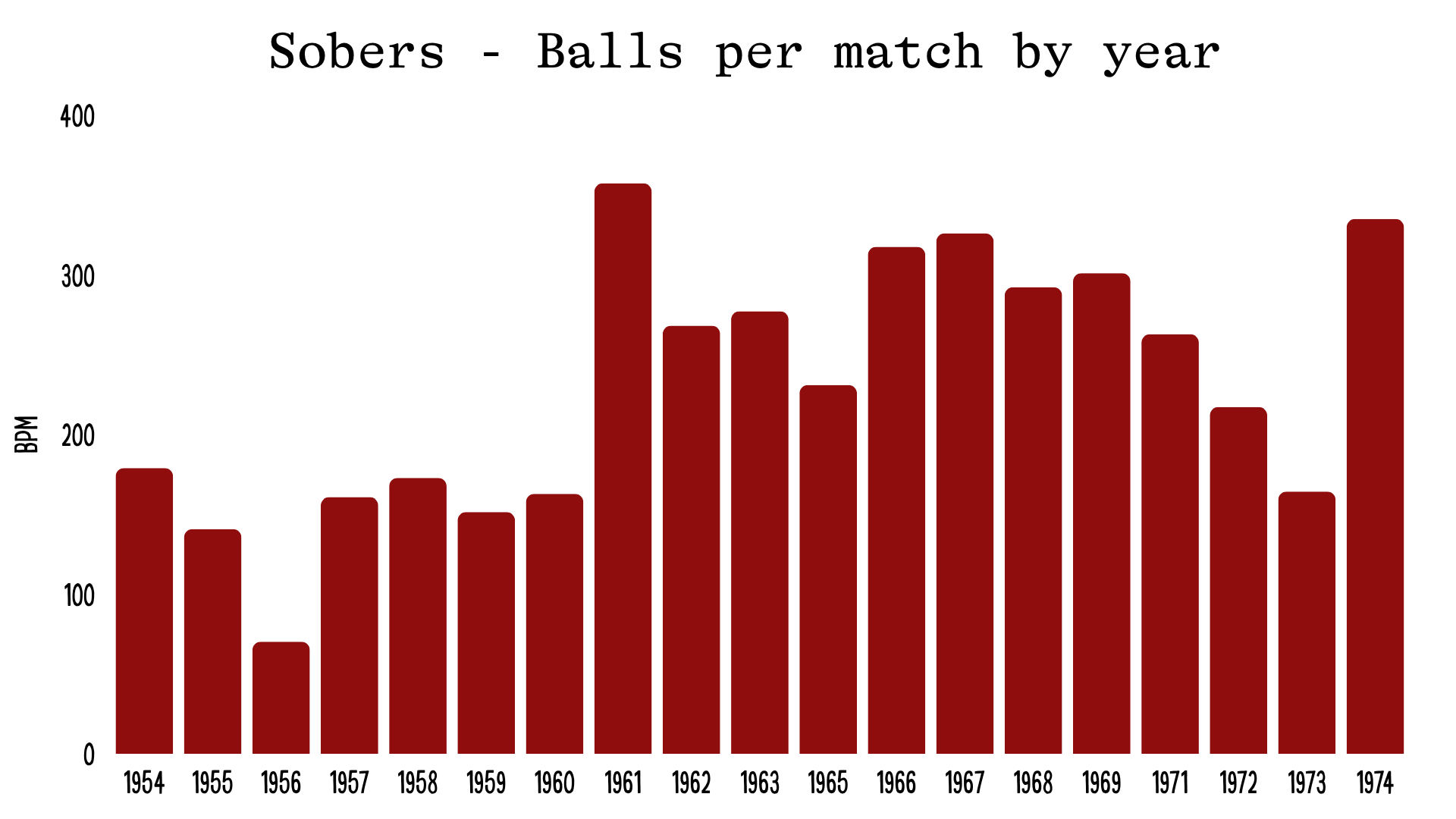
Sobers did it bowling pace and spin, while also averaging nearly 60 with the bat.
Even if you include the early years he didn’t bowl much, he still delivered 38 overs per match. If you compare him to all the players with 3000 runs and 200 wickets, he bowled the sixth most overs per game. There is only one seamer ahead of him, Richard Hadlee. And the great Kiwi was a frontline bowler his entire career. Sobers wasn’t.
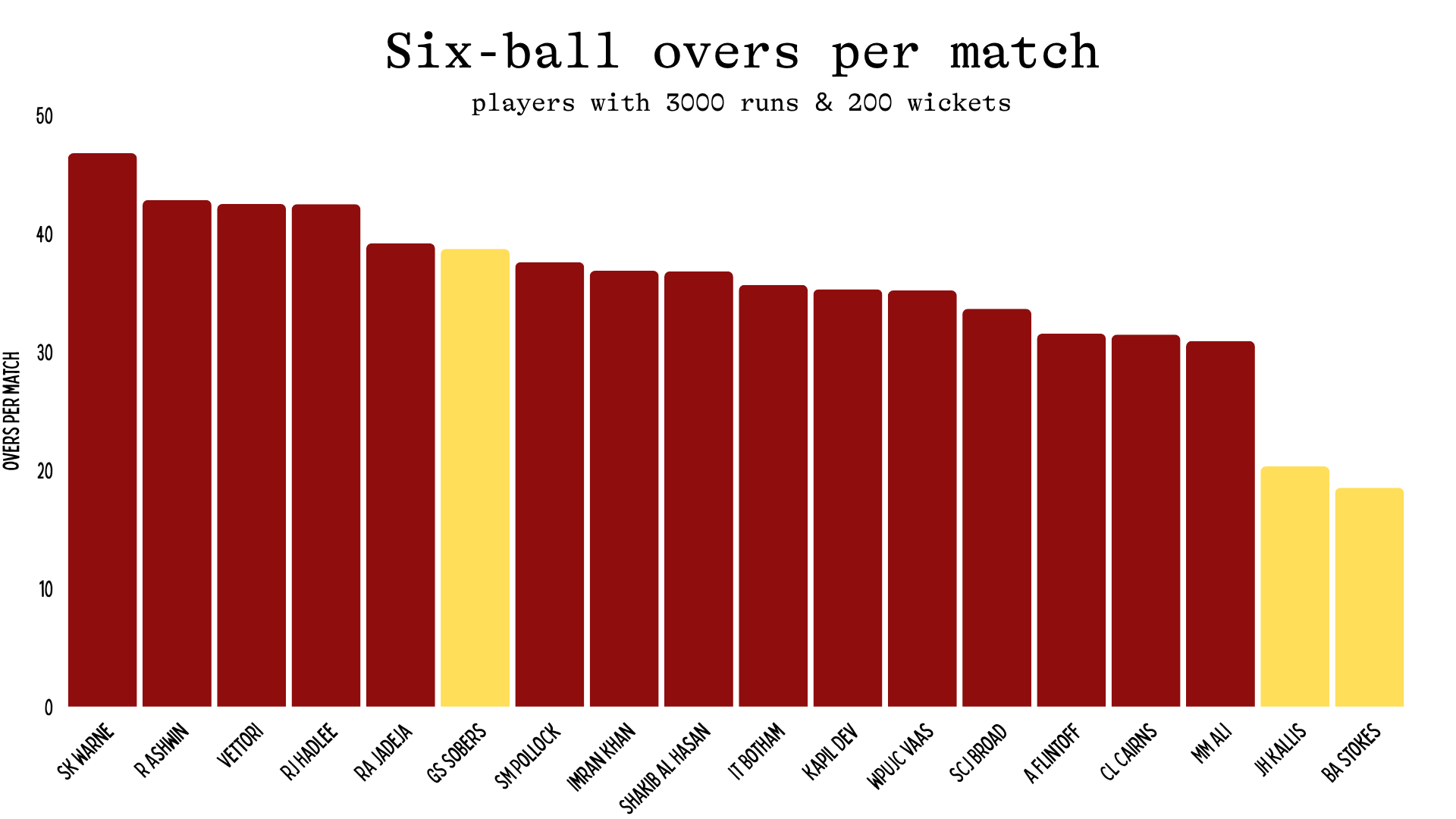
He also bowled more overs per game than Shaun Pollock, Stuart Broad, Imran Khan and Shakib al Hasan. But the fun one is this: Sobers bowled the same amount of overs each match as Jacques Kallis and Ben Stokes combined.
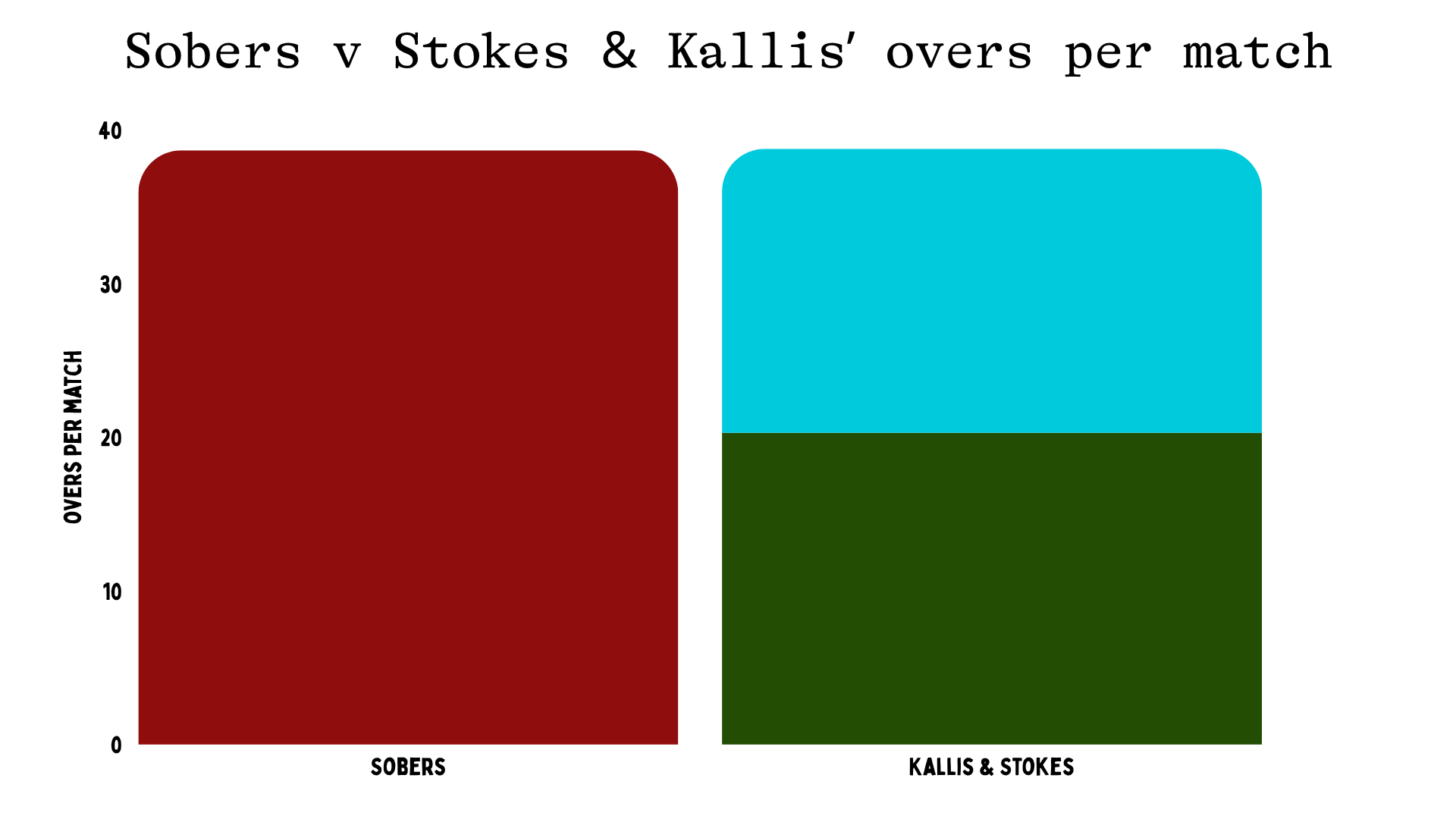
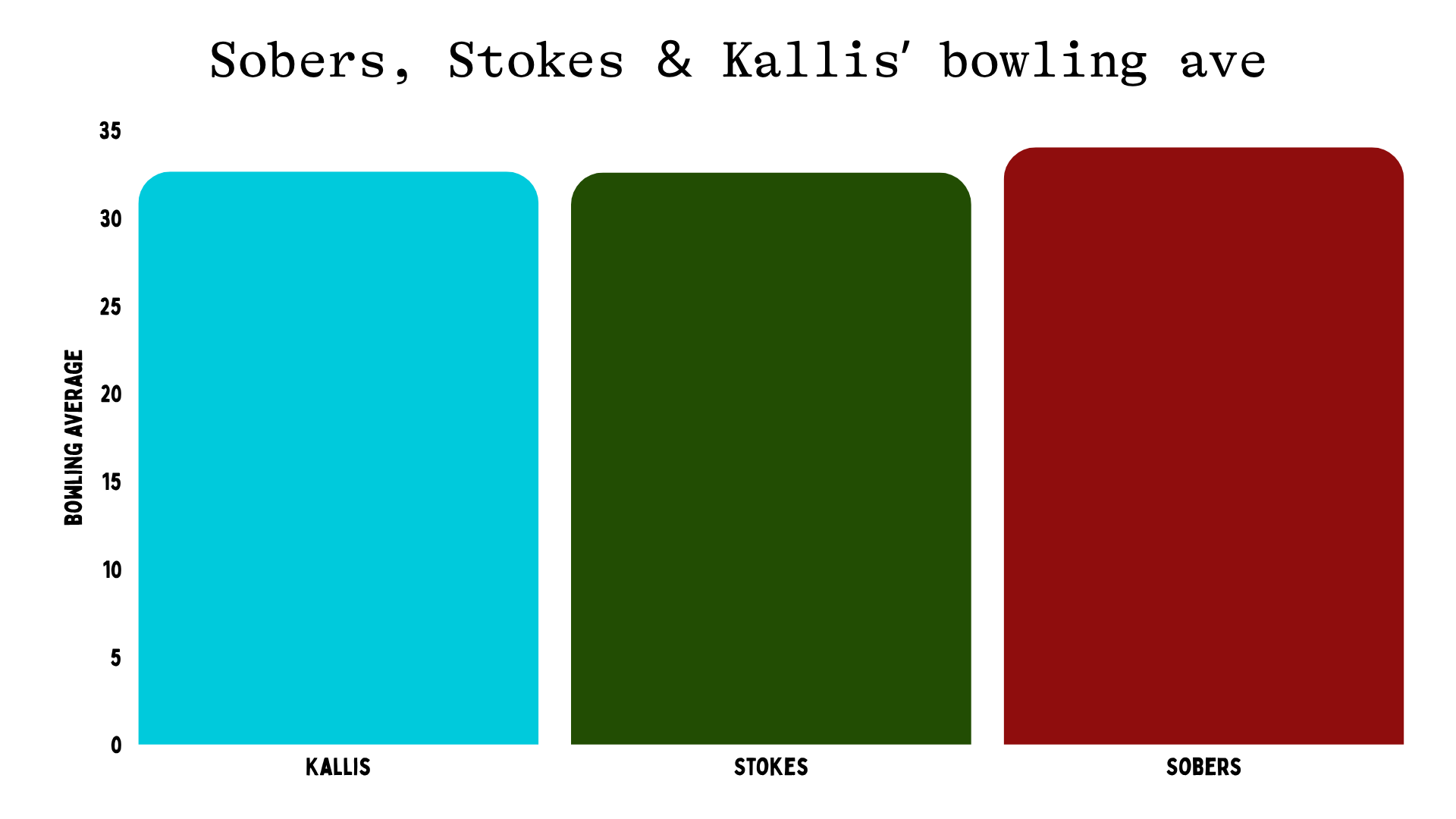
Both of them average less than Sobers, but not much. But they bowled essentially half his overs. Wouldn’t you prefer your fifth bowler to go at two runs more per wicket, but give you so many more options, and also double the overs? Yes, almost every time. And neither Stokes nor Kallis ever played as the fourth bowling option much. Sobers did it all the time. He was a frontline batter and bowler for much of his career. And the West Indies bowled him into the dirt while he was still learning some of his many crafts.
And remember this, Sobers very rarely bowled seam before 1966. From that point on, more than a decade into his career, he was asked to take the new ball more than 50% of the time. He went from not bowling seam to opening the bowling.
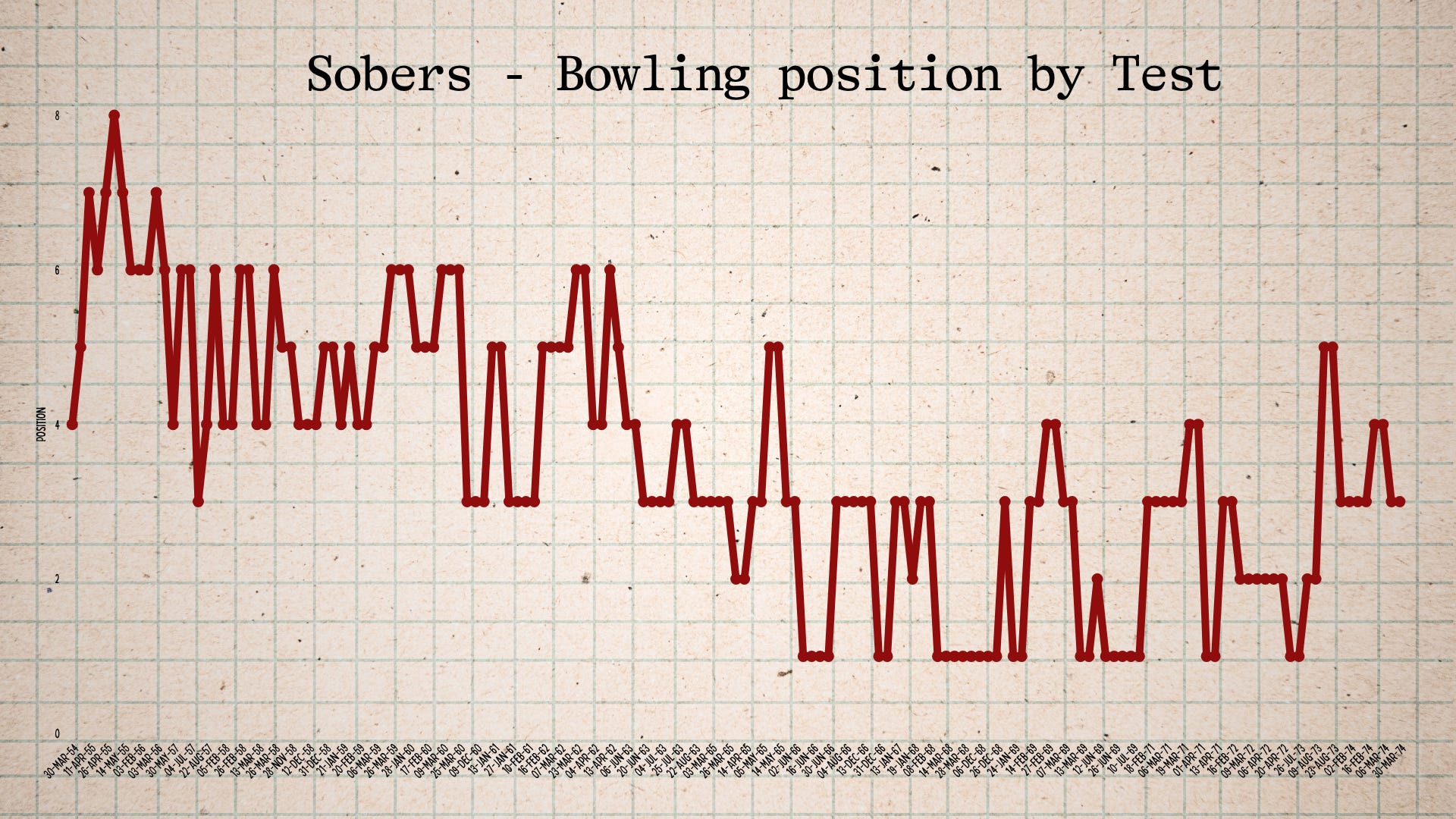
I said fourth-choice bowler before. He was second and third at times.
We really don’t know what he averaged for each bowling type. My guess is probably high 20s for seam, mid 30s for finger spin and over 40 when he did his wrist. We are basing that on the limited scorebooks we have, that tell us when he took his wickets. You can see how good he was up the top and struggled in the middle.
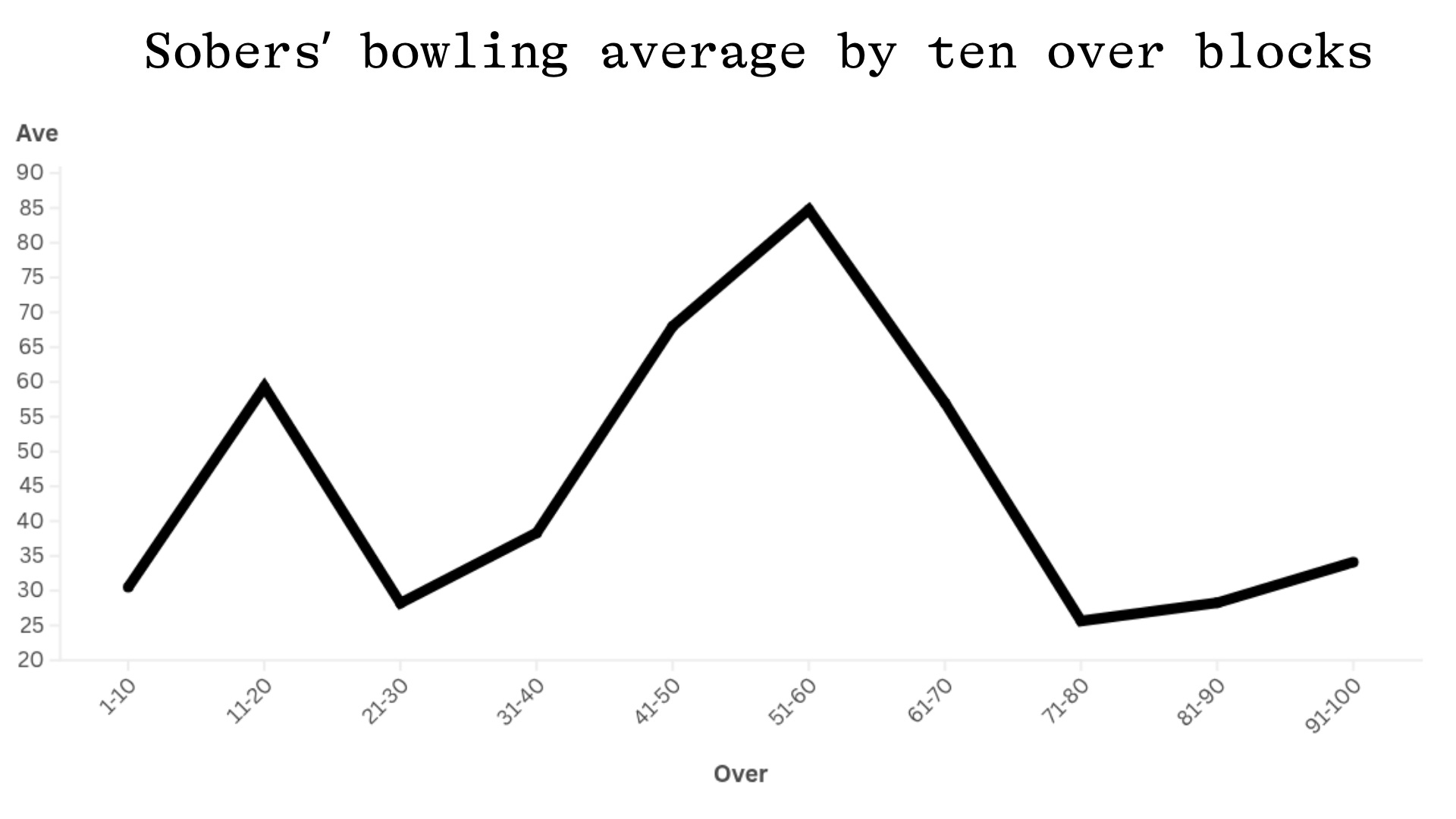
But it is just a guess. So if he hadn’t bowled spin, you can only assume his bowling record would be better. By helping the team out, his numbers were worse.
This is him against the all-rounders with 5000 runs and 200 wickets by match factor. So while Botham, Kallis and Stokes have better bowling averages, much of that is from helpful surfaces. Only Kapil Dev has a better record when looking at the pitches they bowled on. And, while the Indian was a handy batter, Sobers almost doubles his record with that.
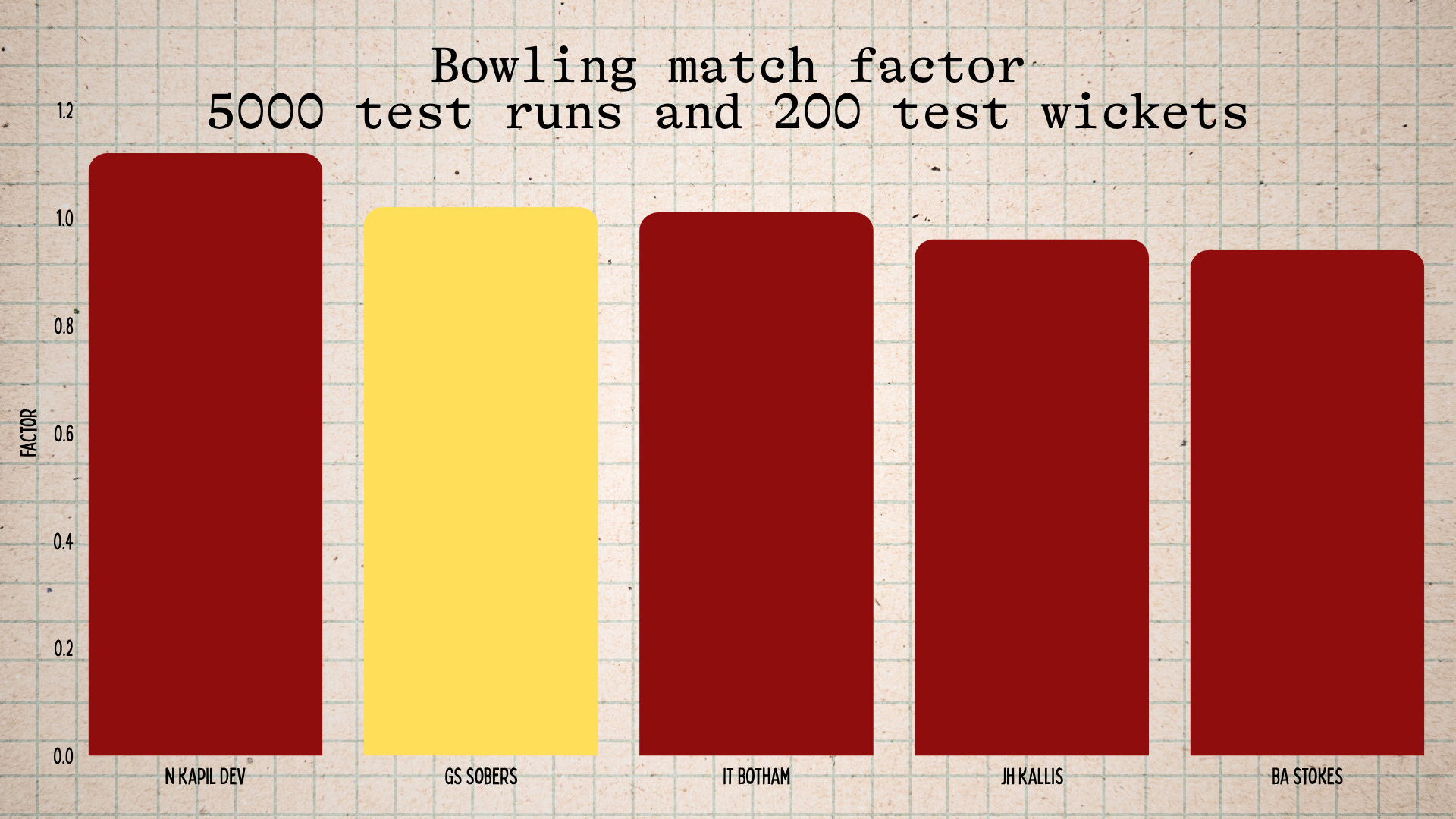
There is no doubt he was short of being a great bowler. But the flexibility and workload he offered might qualify him as the best fifth bowler of all time. With him in the side, you could bat until number eight and still have four top-quality bowlers with six different types of bowling. Or have five bowlers, with your number six averaging almost 60.
Sober’s raw numbers suggest he’s basically slightly better than a replacement-level bowler. On every other metric, you are looking at someone who is not one nice piece, but several really useful ones.
***
John Kay wrote a book called ‘Cricket in the Leagues’ where he talks about the great stories from the heartlands of the English game. In the old days, great overseas players wouldn’t come over for county contacts, but they played for private teams or league teams.
Sobers played for Norton in the North Staffordshire and South Cheshire League in 1964. They won the league title that first year; he averaged almost 50 with the bat and eight with the ball. He didn’t make as many runs the next year, but again, his bowling average was eight. They won the title again. Norton lost in 1966 because Sobers was touring England with the West Indies. They won again in 1967 of course. He averaged more than 40 with the bat, and nine with the ball. This is similar to Michael Jordan playing in a recreational basketball competition.
But we mention it to tell this story. There was a game at one point where Sobers was bowling, and someone hit the ball back over his head. The mid-on and mid-off were chasing when they heard, “Leave it to me”. Sobers ran past both of them and took the catch. According to those there, he took it just in front of the sightscreen. We could happily discount a story like this from League cricket if it didn’t match up with everything else he has done in the field.
John Arlott once talked about his fielding by basically saying he was a great slipper, incredible at short leg, fast in the outfield with a huge arm, and awesome at cover or point.
The West Indies would use him wherever they needed their best fielder. So he would be at slip for ages, then for Lance Gibbs offspin, he’d come into short leg to catch flies. If the opposition got on top, you could move him into the ring as well.
He was not the best at any of these positions. But he was great at every one of them. This was an era in which there were not many great fielders at all, and Sobers was three of them in one man.
***
The phrase ‘allrounder’ has been bastardised so much. In early cricket it meant someone who could play as a batter or bowler. Then we changed it a little to be someone who could either bat or bowl as first choice, and added a second option. Finally, we added players who probably couldn’t really bat or bowl well enough to make a team, but their combined efforts were handy.
So today we have players who are true allrounders, specialists who can be part-time with their second option, and bits-and-pieces players. Sobers started as Sanjay Manjrekar’s favourite phrase and became a specialist batter who helped out with the ball. And then graduated to a true allrounder later in his career.
That is pretty common amongst his kind. Imran’s batting and bowling took almost a decade to fully form. Ravindra Jadeja’s batting was pretty shaky for a long time. Kallis didn’t make any runs to start his career. The Ian Botham career arc of coming into Tests fully developed in two skills is rare. Players usually take time to upskill their games. They are so talented but don’t have the time to perfect anything.
Sobers wasn’t a great spinner when he made his debut; he didn’t make any runs or even bowl seam-up. But Sobers went well beyond anything Botham did, and not by a little. We don’t really have a word that encapsulates him as a player.
AA Thomson wrote this years ago in his book ‘Cricketers of My Time’.
“When Garfield Sobers was making mincemeat of the England eleven at Headingley last year, an elderly neighbour, fuming and fretting with exasperation, addressed me bitterly:
‘This isn’t fair. They’re playing fourteen men.’
A case could be made for this contention. Just then, Sobers was the best batsman in the world, the best two fielders (on that afternoon), the best three bowlers. It seemed impossible to get him out or to steer a catch anywhere near the wicket out of his reach, and, as for his bowling, what can you do with a man who can produce every speed from fast to dead slow and is as versatile as liquorice of all sorts.
I sympathise with my neighbour but have to disagree with him. Sobers is one man, not three or four, though a remarkable one.”
It wasn’t just that Sobers was a great allrounder. Jacques Kallis, Aubrey Faulkner, Keith Miller, Ian Botham, Kapil Dev, Ravi Jadeja and Imran Khan are great allrounders. None of them is anywhere near as all-round as Sobers.
He was the best fielder of that bunch. Maybe Botham or Kallis are better slippers, and Jadeja better in the outfield. But Sobers was a great catcher and outfielder at once.
Miller and Imran were better seamers, but neither was able to back that up with any kind of spin. Faulkner and Jadeja couldn’t bowl pace, or change what kind of tweakers they were. Botham and Kapil were really good batters, but for lower down the order.
I have no doubt that, looking at his record, Sobers could have batted all six positions at a well-above-average record. He was as good against pace as he was spin. He could bowl whatever the pitch needed. And he moved so well, it felt like you had two fielders in one.
Sobers was the all-roundest. No player ever had this many parts at the highest level. He was everything.
***
In my family, Sobers is not a cricketer, he’s an heirloom. Everyone had a story about him. But my father had the best: he saw Sobers’ 252.
It was 1972, and my old man was a 25-year-old high school dropout and cricket lover. So to make ends meet, he would often work multiple jobs. One was as a barman at the MCG, on the mezzanine level between the Olympic and Members’ stands.
As backup gigs go, it was pretty good. But when you ask my old man about this job, he only ever talks about one experience. Australia were supposed to be playing South Africa, but it was the 1970s, and so they were replaced by the World XI. Dad was pouring beers at what was really a beer match. The MCG didn’t get big crowds for this game, never going beyond 38,000.
The batting line up was incredible, opening was the father of HD Ackerman, Hylton. But everyone else was a worldie. Sunil Gavaskar, Zaheer Abbas, Graeme Pollock, and then Sobers. But in the first innings they were rolled for 184 as Dennis Lillee took four of the names I mentioned, and later Farokh Engineer as well.
Australia were 101 up after the first innings, and when Pollock was third out for 28, Zaheer was joined by Sobers with a lead of only 44.
It was 13 years since Sobers had made his 365, 18 since his debut. This was not peak Sobers, or anything close. He averaged 20 in his last 12 months in Tests two years later.
When he came in to bat, my dad claims the bar emptied. It didn’t fill up again once that day. So my dad walked out to the balcony, and just watched the cricket. In his words, “If my boss had come in I would’ve been in strife, but I would’ve said sack me, I’m watching the cricket.”
My dad fought for every dollar he ever brought in. He regularly worked far longer and harder than he needed to. And yet on that day, it didn’t matter. He might have been an atheist, but he found his god, Garfield Sobers. The West Indian added 139, Australia had sweepers out early in his innings to slow him down. He didn’t notice them.
And my dad saw all of this, “I got paid to watch one of the best innings of all time.”
Don Bradman later declared it probably the best batting ever seen in Australia. By a man two years away from retirement, with his team about to have a heavy loss.
In that match, Sobers made 254, and the Rest of the World side won by 96 runs. But you may be confused, as before I said my dad saw Sobers’ 252. That is because he had forgotten the score. While Sobers made all the runs, it wasn’t how many that mattered, just the how.
***
Bob ‘Knocker’ White gave up asking questions eventually. Sobers couldn’t explain his genius, and Knocker was just honoured to see it.
But Knocker told me a story about a Jamaican bowling allrounder called Carlton Forbes, who was roughly the same age as Sobers, and played for Nottingham before him. Forbes took 707 first-class wickets at 25.4; he could play.
This day Sobers was facing him. “He hit Forbes in six different directions, all six balls,” says Knocker. “He went round the clock as it were and I stood there thinking, he’s taking the mickey here. He hit the first one over or past mid-off, the next one past cover, the next one he hit square on the offside for four, the next one he flicked over that square leg. The next one was over midwicket, and the last one, hit over mid-on, and I thought this is a genius. He did it just to take the mickey out of poor Carlton.”
The following year, Garfield Sobers was signed as Nottinghamshire’s overseas player. He was representing the West Indies against someone he came up with, and in the middle of a tour match, he auditioned for a county gig by embarrassing a top-quality player.
Garfield Sobers cut off his own finger, batted everywhere from one to nine, bowled three different kinds of deliveries, fielded everywhere he was needed, invented freelance cricket, partied all night, beat poverty, overcame systemic racism, made his money, tied a Test, and lived to 89.
Garfield Sobers could do everything. Garfield Sobers did do everything.
And how.
Lovely ending to a great article!