



Thanks to Himanish Ganjoo’s T20 batting web app for a bit of help behind the scenes.
Welcome to the first edition of the Good Areas’ Most Improved IPL Player Award. For those who don’t know, we have already done three editions of this award for Test cricket. But there is a key difference: we’ve used three-year cycles for comparison. So it’s the quality of a player from 2023-25 versus 2020-22.
We also know that the impact sub rule has supercharged run rates. So we can’t judge these players on their raw stats, as that would favour the batriarchy and be unfair on bowlers. That is where true values and the impact metrics come into the picture to help us contextualise the numbers better.
Even though Jasprit Bumrah actually improved miles, it really doesn’t make sense for a superstar like him to be in contention for this award.
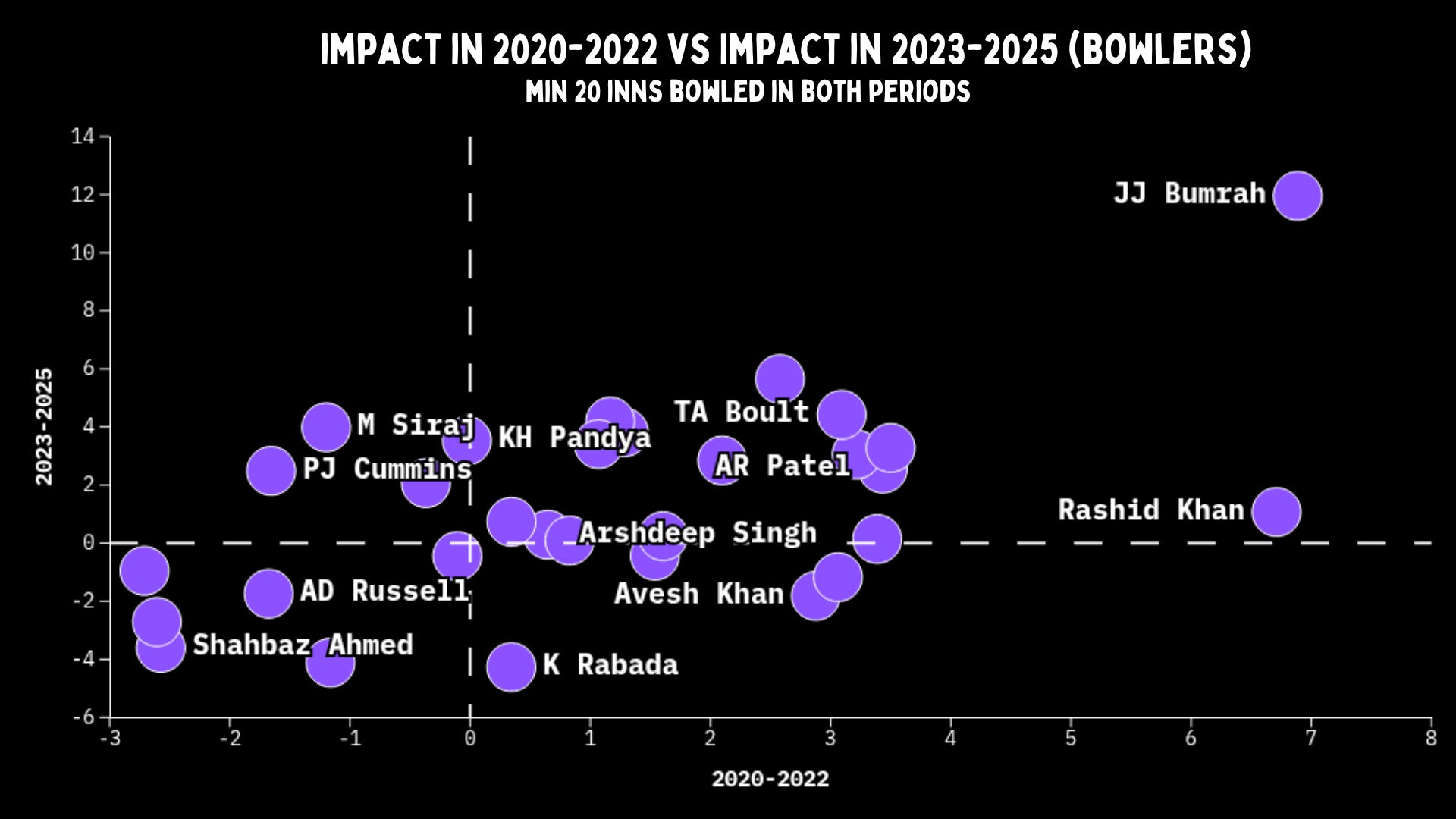
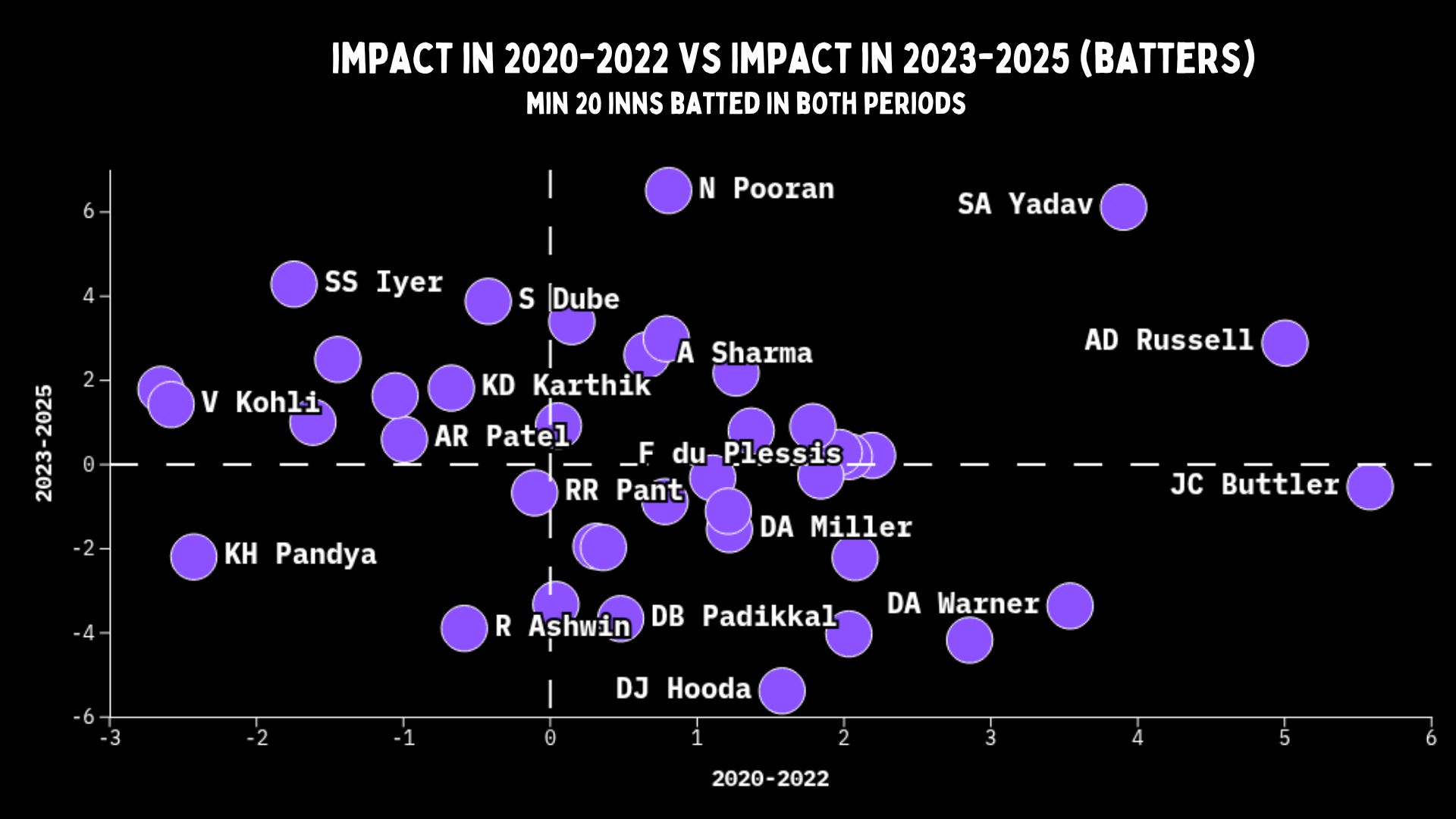
And while Virat Kohli might have upped his intent, he is the same man who once nearly made 1000 runs in a single season. So we arbitrarily ruled those two out even before getting into the weeds of this topic.
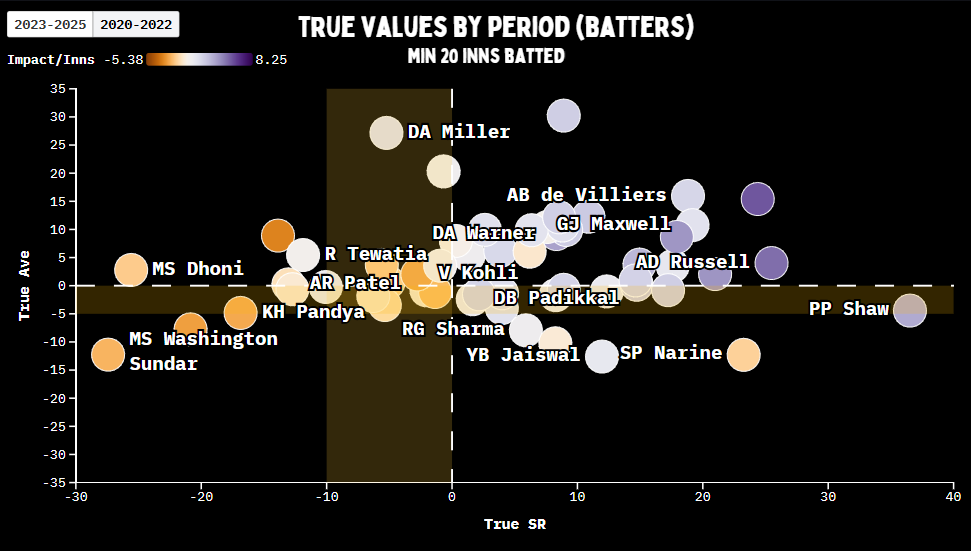
A quick reminder that rookies can’t be nominated for this award. So unfortunately MS Dhoni isn’t eligible, since we believe he’s too young in his career. Also, if you have improved only in 2025 like Devdutt Padikkal, that wouldn’t cut it because we are looking at three-year cycles.

Here is a token shoutout to players like Heinrich Klaasen and Phil Salt. They weren’t even in the playing XIs from 2020 to 2022. From that, they went on to boss the league.
Another interesting player was Ruturaj Gaikwad. While his numbers certainly got better in the recent cycle, it was only in his second season (and first full one) that he made the most runs at a healthy strike rate in a title-winning run for CSK.
A few more players that just missed out were Nicholas Pooran, Suryakumar Yadav and Marcus Stoinis. Pooran and SKY have a very similar case; they both went from very good to potentially all-time great three-year runs. Stoinis also started scoring quicker at a better true average, but his rise wasn’t as huge. You can only have so many names in the list.
Yashasvi Jaiswal was a name that actually came up a lot of times when we asked for the nominees on Twitter.


And it’s a great shout, as both his raw and true values improve.
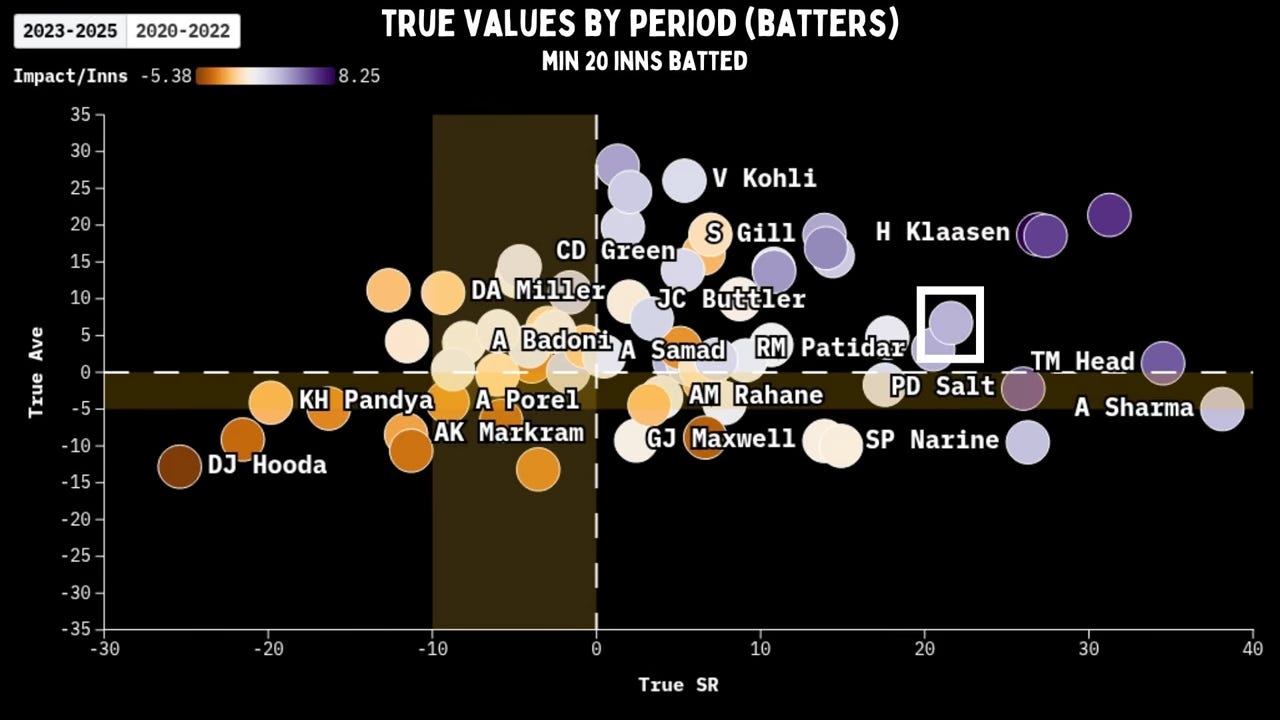
But he starts very young. And unlike his RR teammate Riyan Parag, who also began very early and struggled a lot, Jaiswal’s floor was a lot higher. While he didn’t accumulate a lot of runs in 2021, he still had a true strike rate of 27.
We still ended up with ten names, before getting it down to three vying for the title and one winner to rule them all.
Welcome to the second-least prestigious award in the IPL (after the Fairplay award), the Good Areas’ Most Improved Player.
***
Shreyas Iyer
Captain Shreyas Iyer was close to winning an IPL title with KKR and PBKS in back to back years. But his batting came a long way too. After missing out in the 2023 season, he had a good year as a role player in a strong Kolkata batting lineup, followed by his best batting season ever for Punjab.
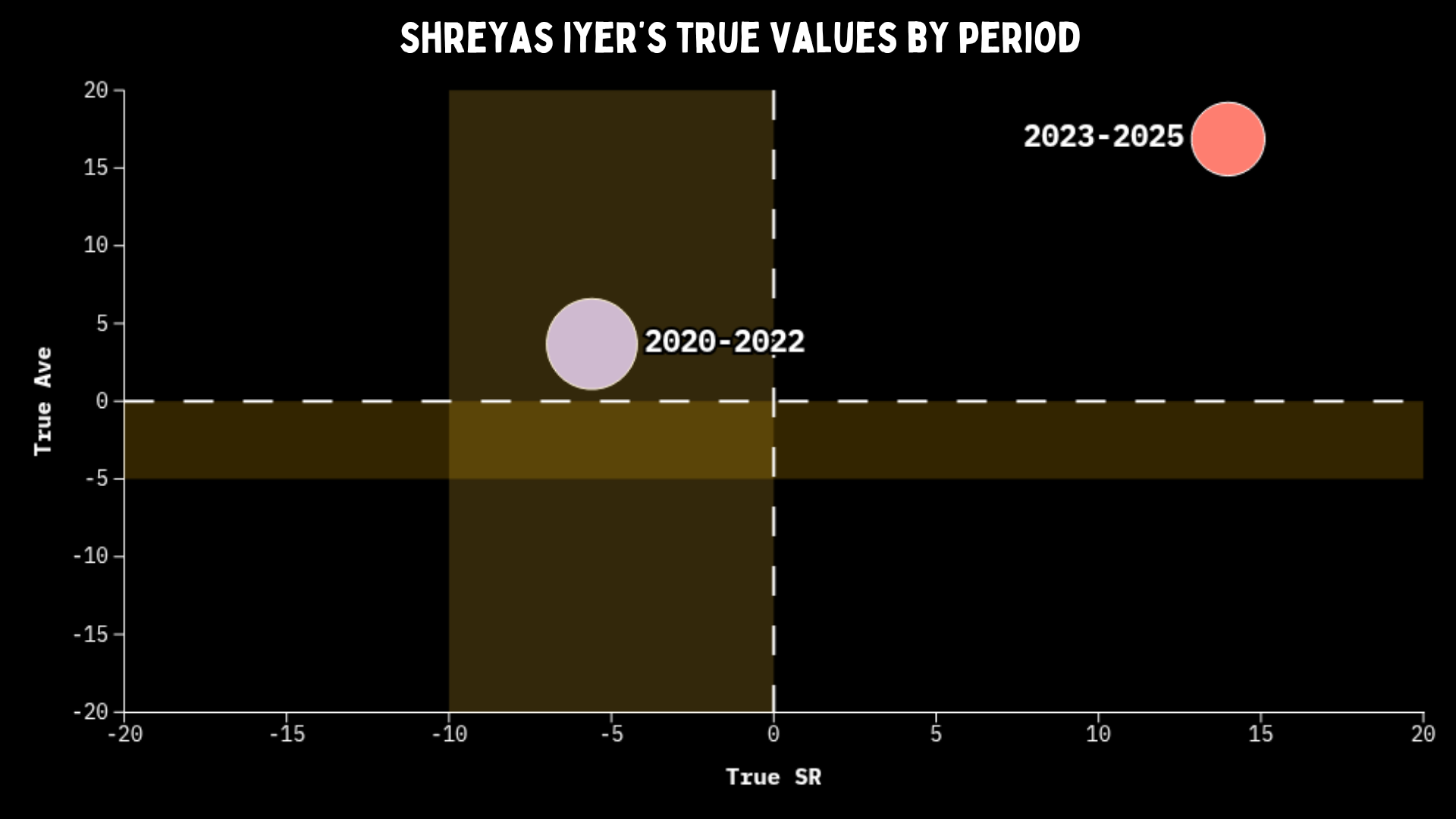
On raw numbers, he has an exponential rise. He was at plus four true average and minus six true strike rate from 2020-22, and now that is 17 and 14, respectively. He scores quicker and is harder to dismiss now. And while he does have more not outs in this period, he also scores more runs per innings.
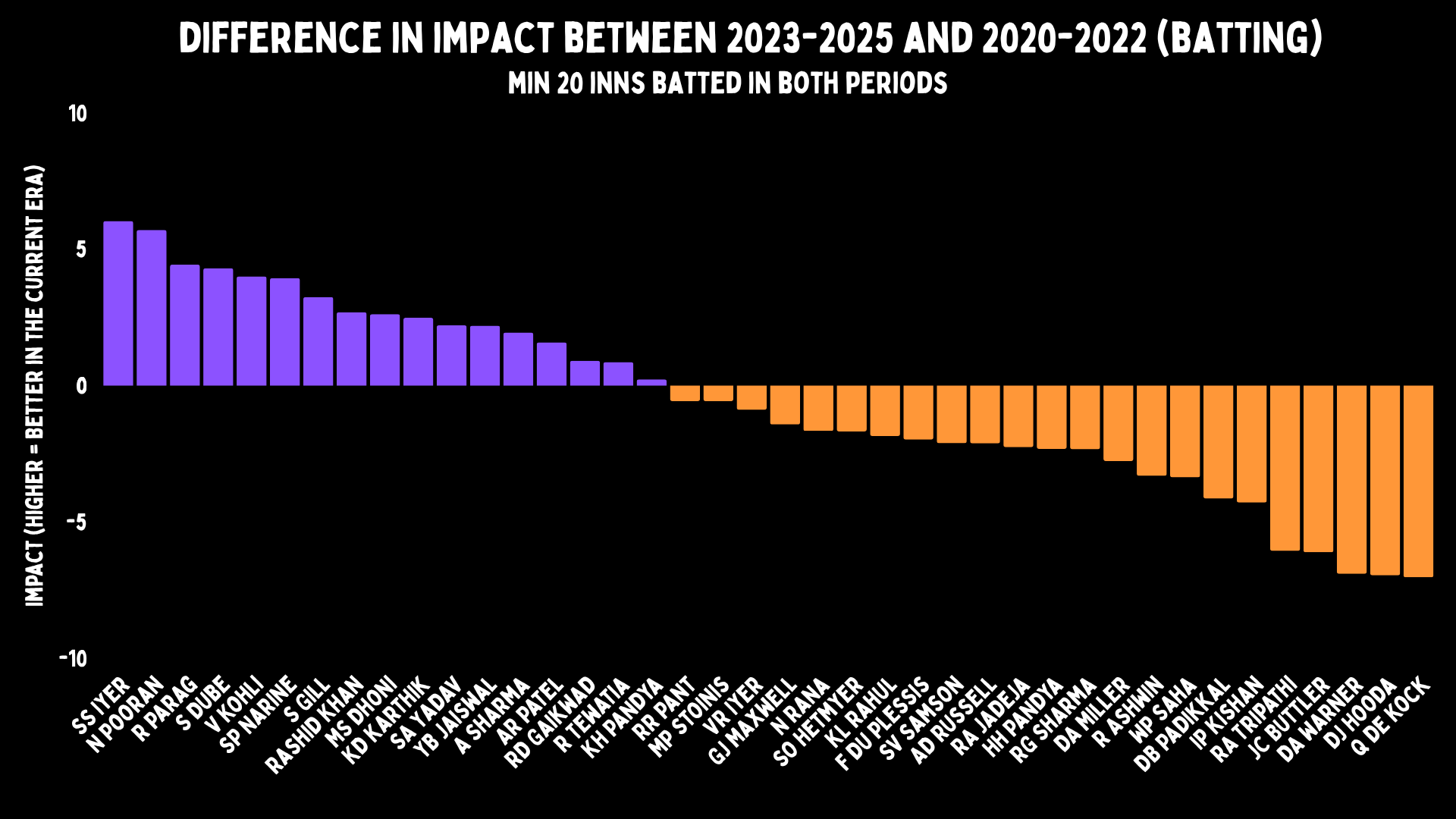
The ‘impact per innings’ metric thinks no batter has improved as much as he has.
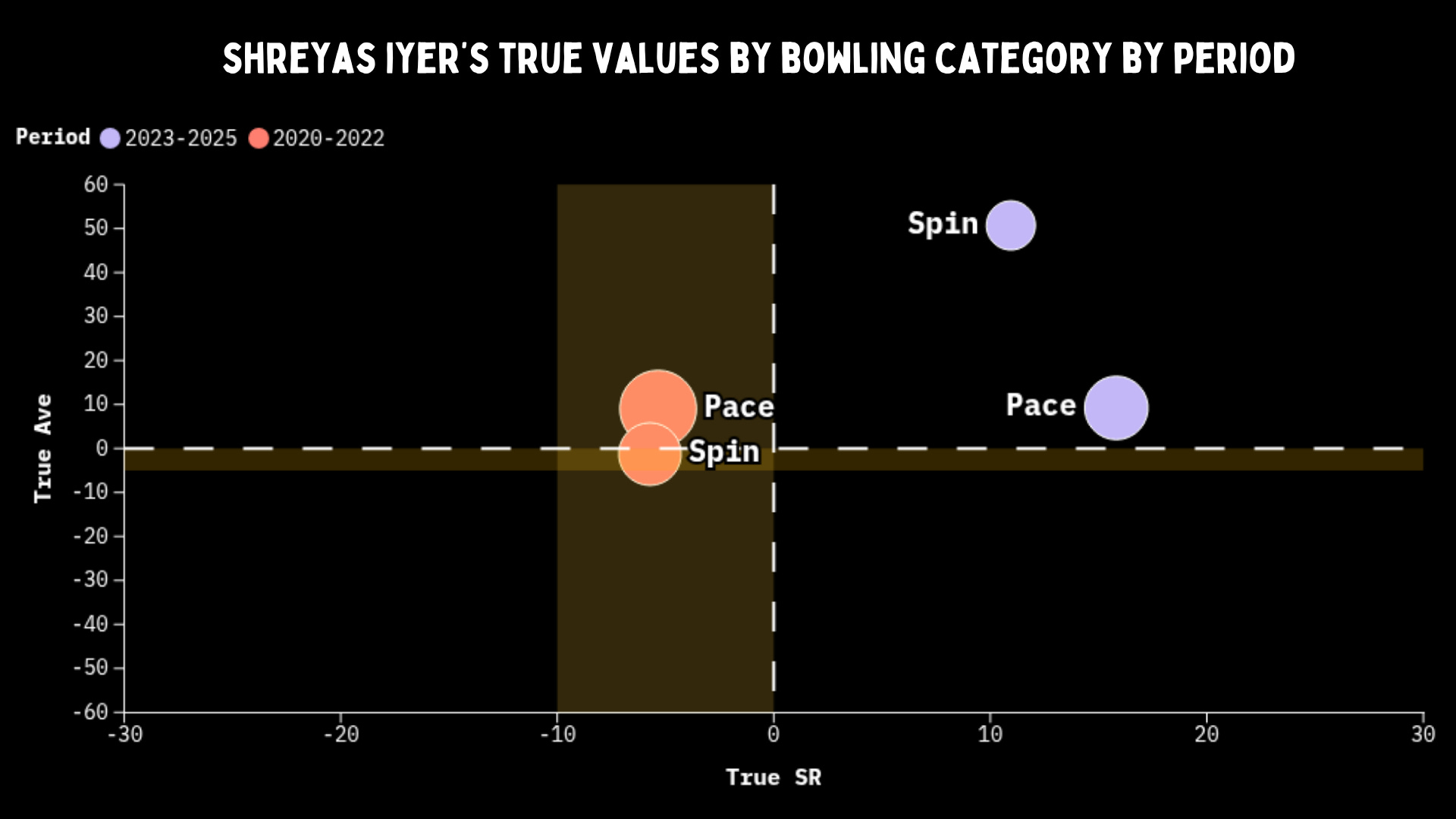
It actually starts from hitting spin. For years, he had a true strike rate of less than ten against the tweakers. In the last two seasons, he is above that. And he has combined that with an ability not to get dismissed. He is still not quite in the spin basher class of Nicholas Pooran, Heinrich Klaasen and Rajat Patidar. But this is the fastest he’s been in a while.
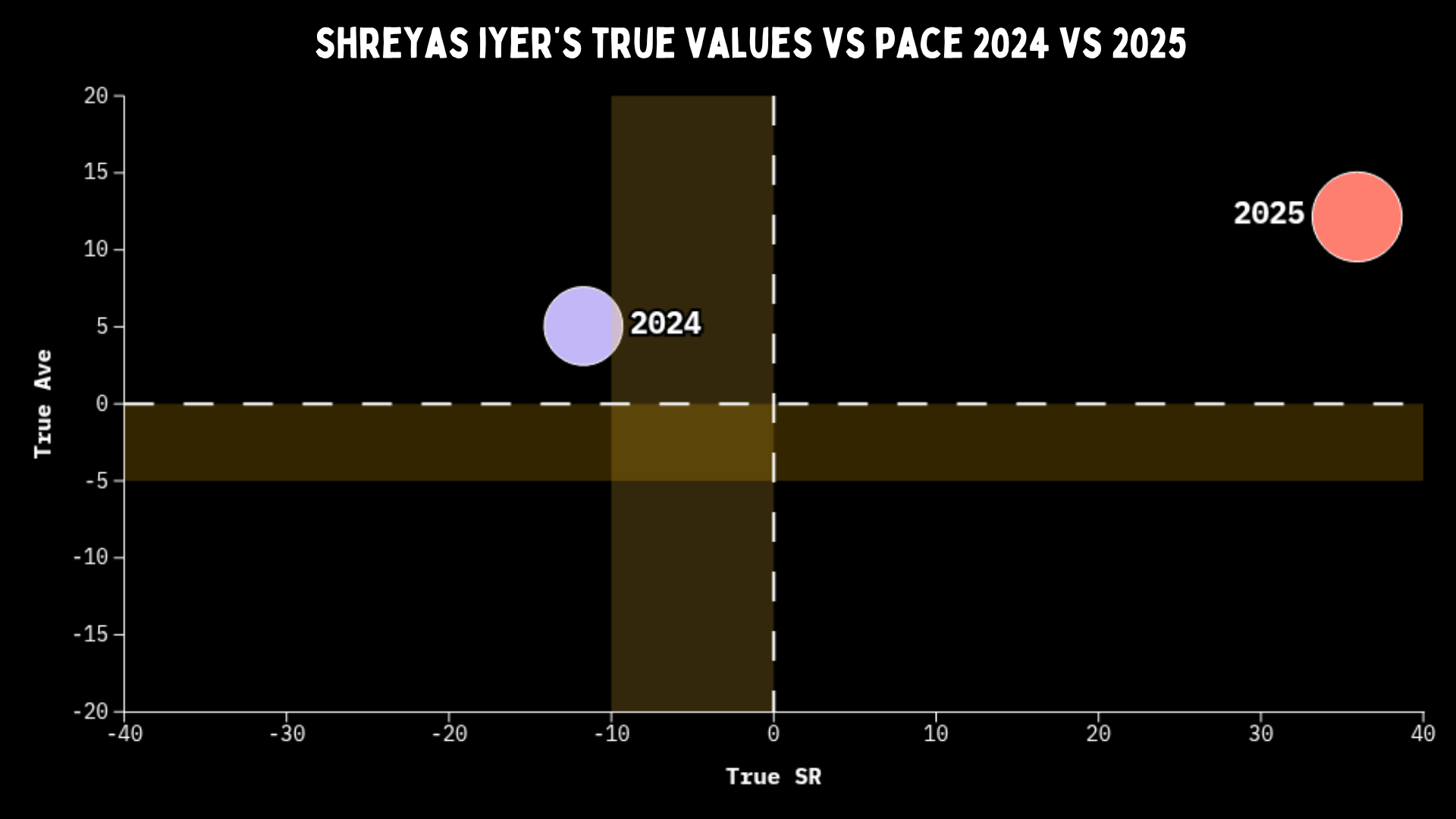
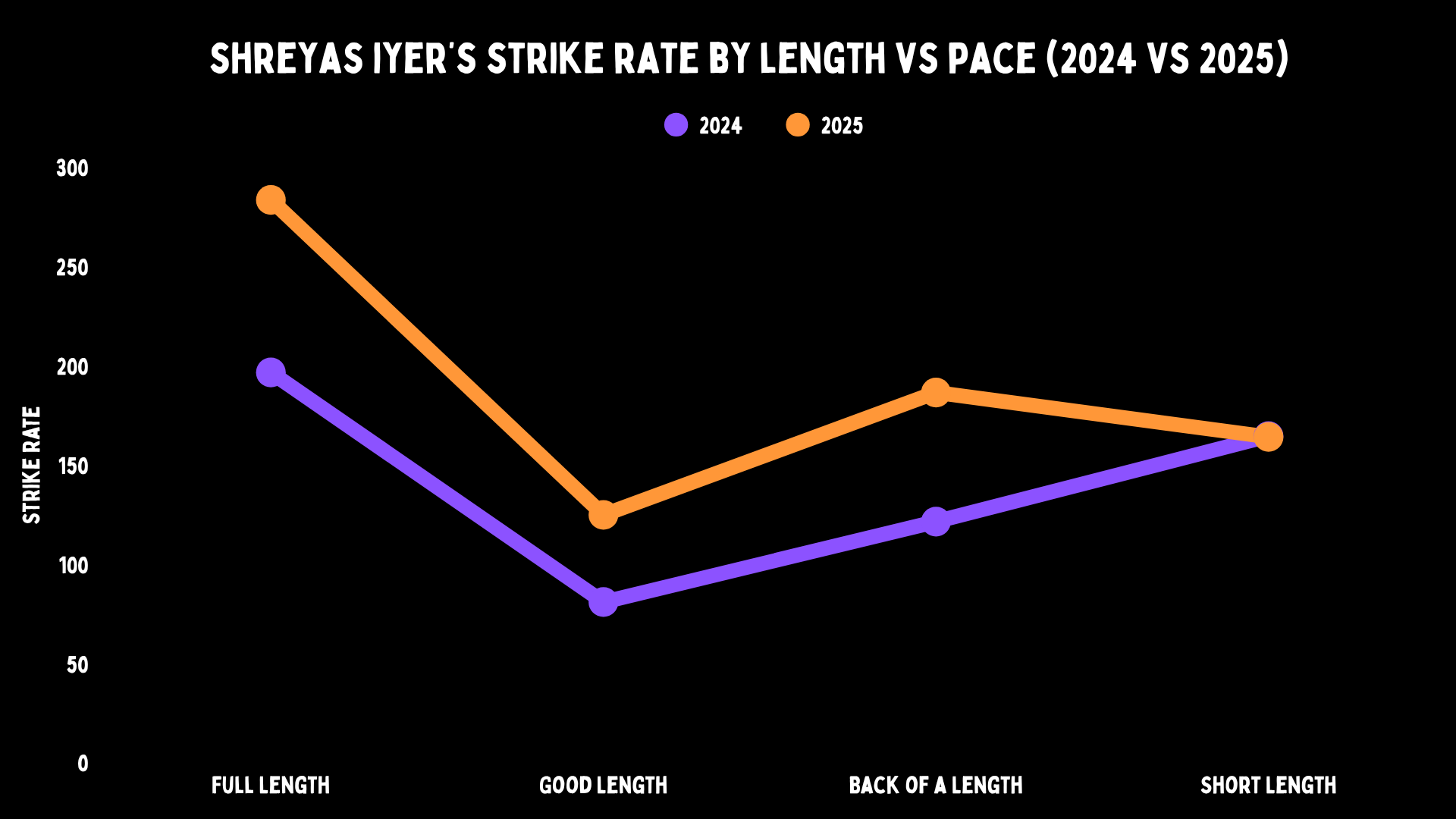
How about this though, he actually bashes pace in IPL 2025. He has a true strike rate of 36 at a solid true average. That is huge even compared to 2024.
He is far more ruthless versus the full and back of a length deliveries. He even becomes a superior player of the pull. He’s also able to handle the good lengths a lot better.
He has just become a more complete player overall, and his prime unlocked a whole new style as well. And the cult of Shreyas is getting bigger each day.
Shubman Gill
While Gill’s T20I performances were just not enough to make the cut for India’s T20 World Cup team, he has been one of the finest IPL batters in the last three seasons. The talent was there to see since his very first year in 2018, and the following year he won the Emerging Player award. The next two seasons for KKR were quite middling, and so he wasn’t even retained. Gujarat Titans got him, where he had an okay year in a title-winning campaign in 2022.
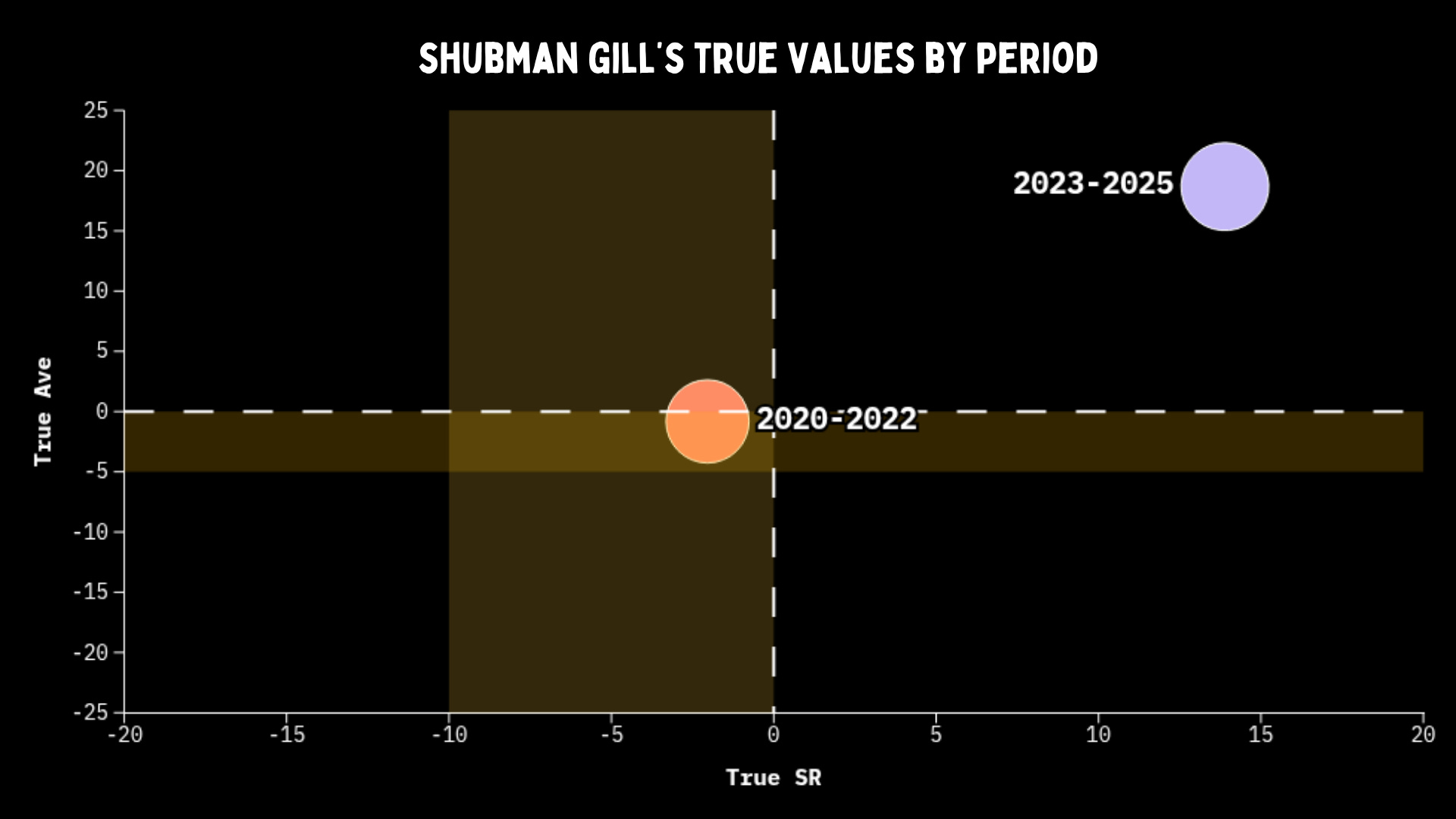
Gill’s true values go from -1 and -2 on average and strike rate to 19 and 14. Like Shreyas, he improves on both fronts.
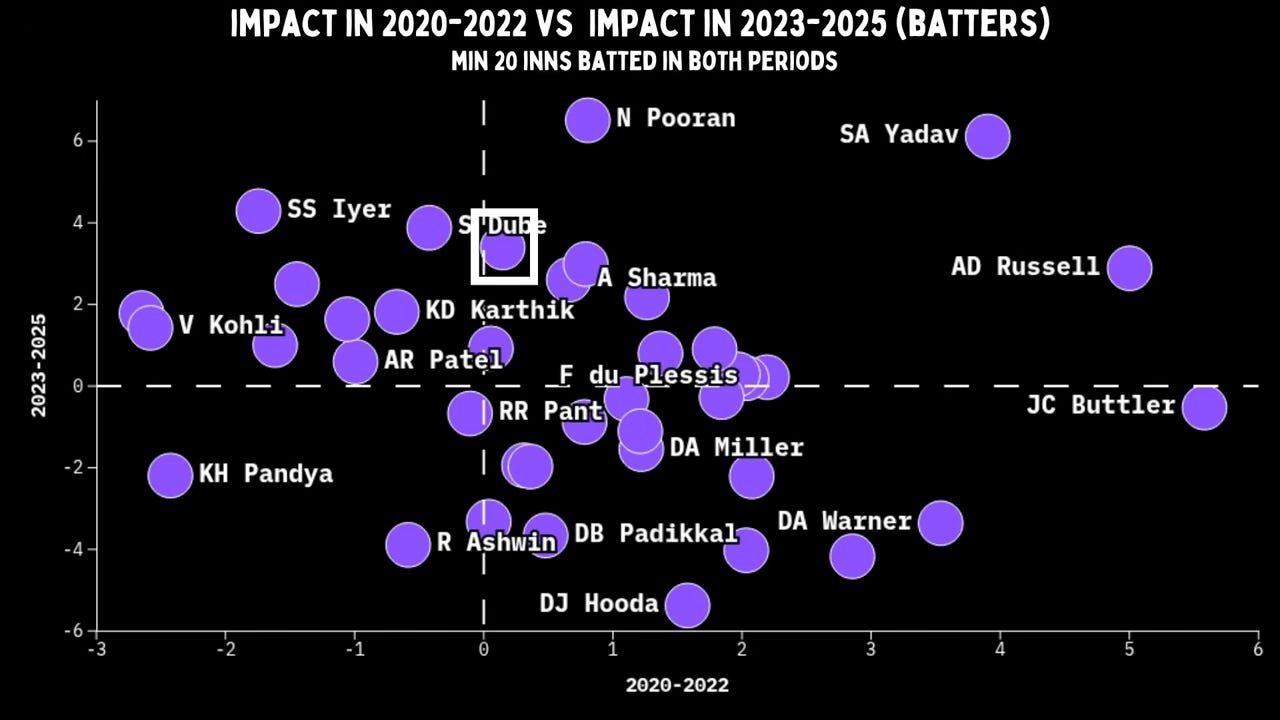
His impact per innings also rises from 0.15 to 3.4.
A major reason for this was his 2023, where he ended up making the second-most runs of all time in a season, only behind Kohli’s 973. And he did that at a true strike rate of 20, so it was high impact accumulation in a season where they were a ball away from going back to back. In 2025, he made all the runs along with Sai Sudharsan and Jos Buttler.
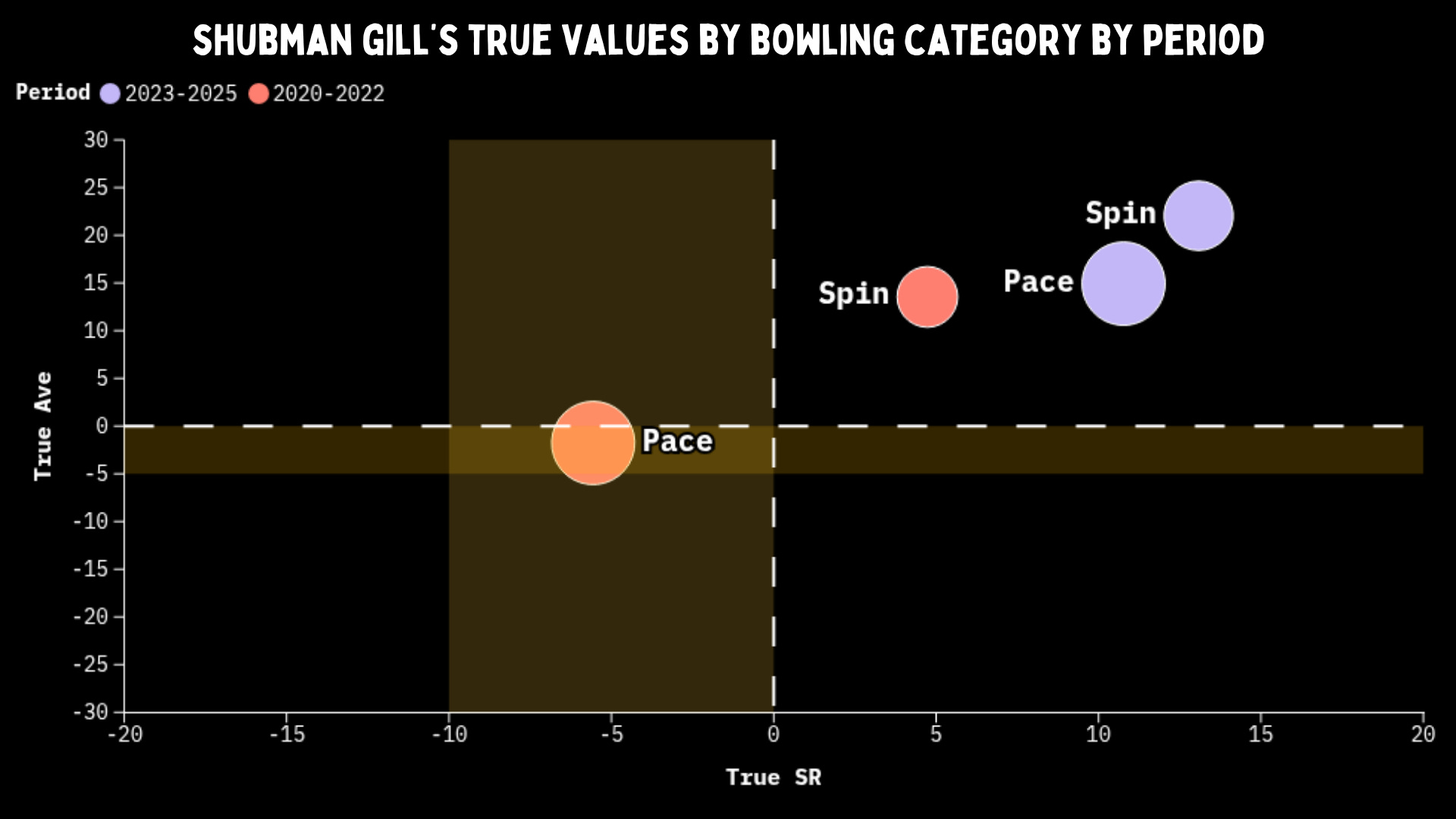
He is a better player of spin than seam, but he has improved against both. It’s a bigger deal versus the quicks, because he was actually under par on both average and strike rate in the last cycle.
He is able to score faster from his flicks and cover drives, and is also more dangerous in the V. That means he covers a lot of different parts of the ground.
He gets better at facing good and back of a length seam, but also smashes the fuller deliveries more. However, he does get out more frequently versus full and short balls now.
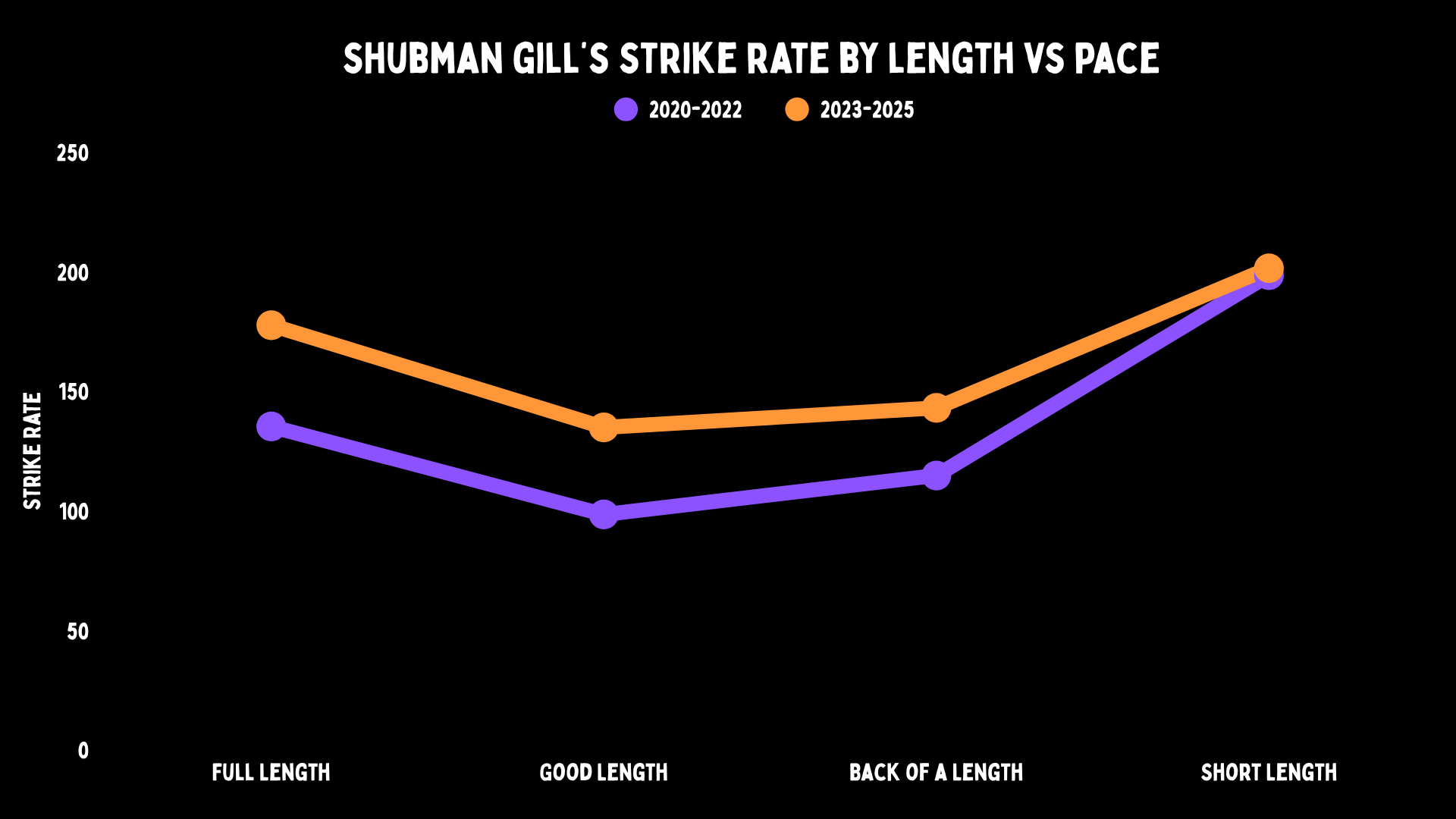
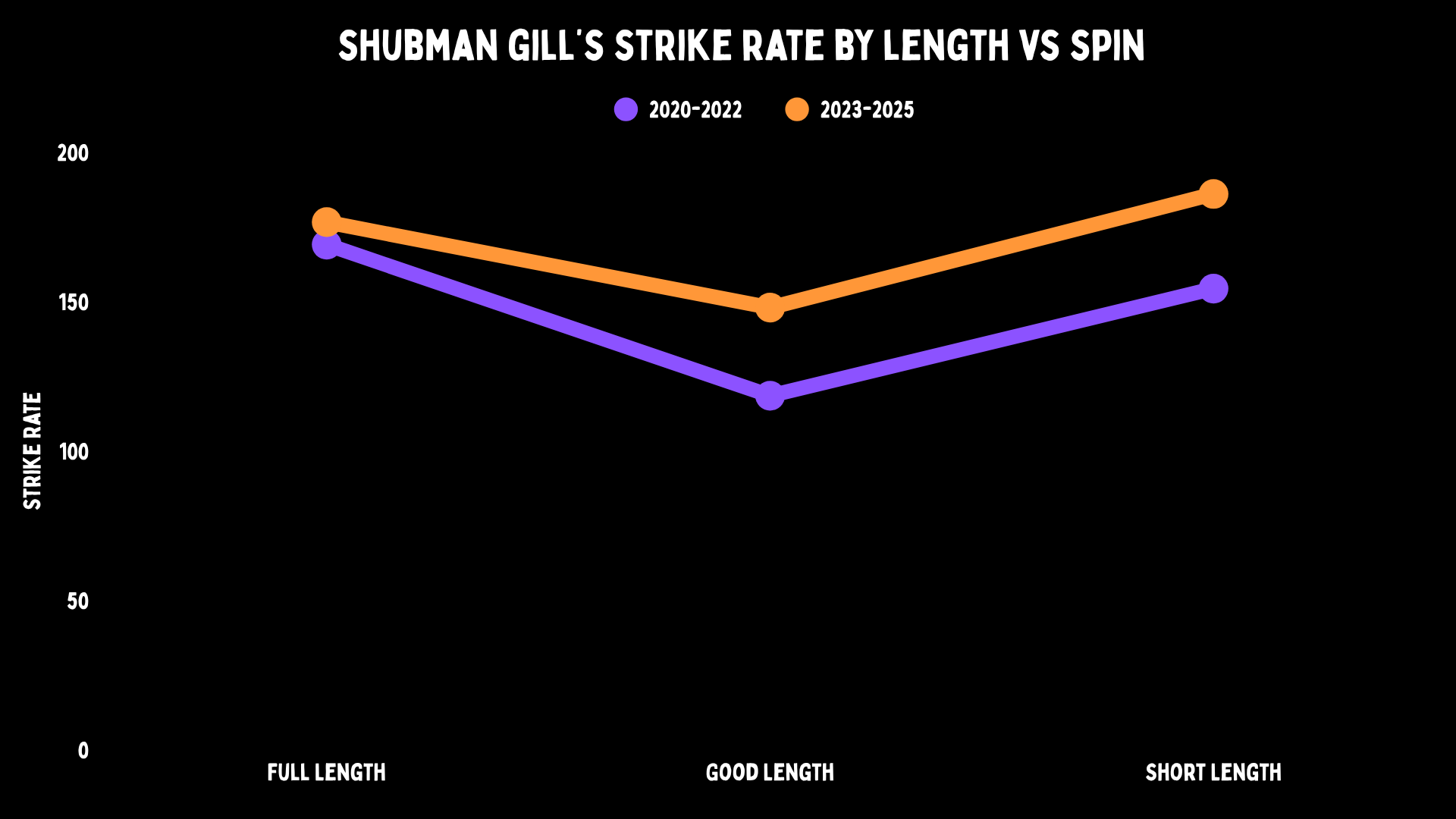
Versus spin, he improves against all lengths.
Obviously, some of Gill’s improvement has to come down to him maturing with age. But he’s still not in the peak batting ages, so can he get even better?
Shivam Dube
Shivam Dube has such gravitas that teams change their bowling plans when he’s on the crease. In IPL 2024, he faced only 56 balls of spin compared to 188 versus pace. There was a good reason for it - in the season before, he tonked the slower bowlers at a strike rate of 173. And yet, the most incredible stat on him is that for CSK, he actually has a better true strike rate against pace than spin.
In the last three IPL seasons, Dube has had an impact of 3.88 per innings, compared to -0.42 in the three years prior.
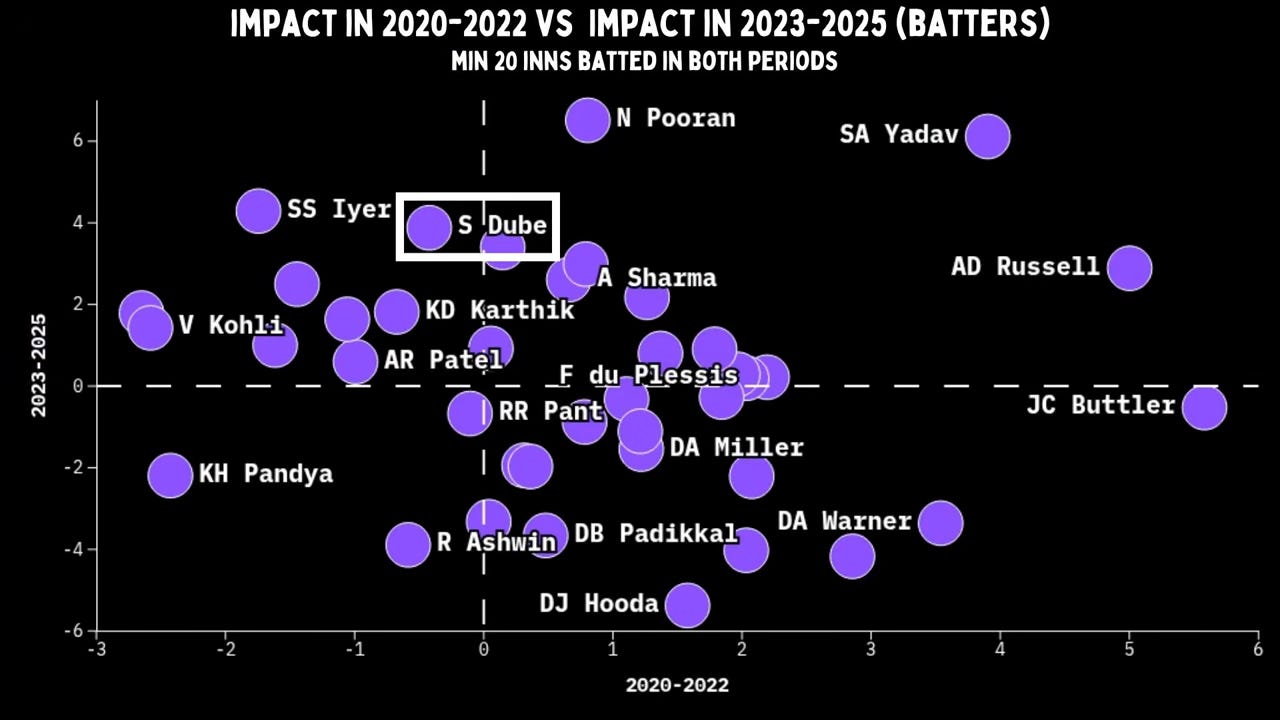
On true average and strike rate, he’s 14 and 11 respectively - a jump from -2 and -6.
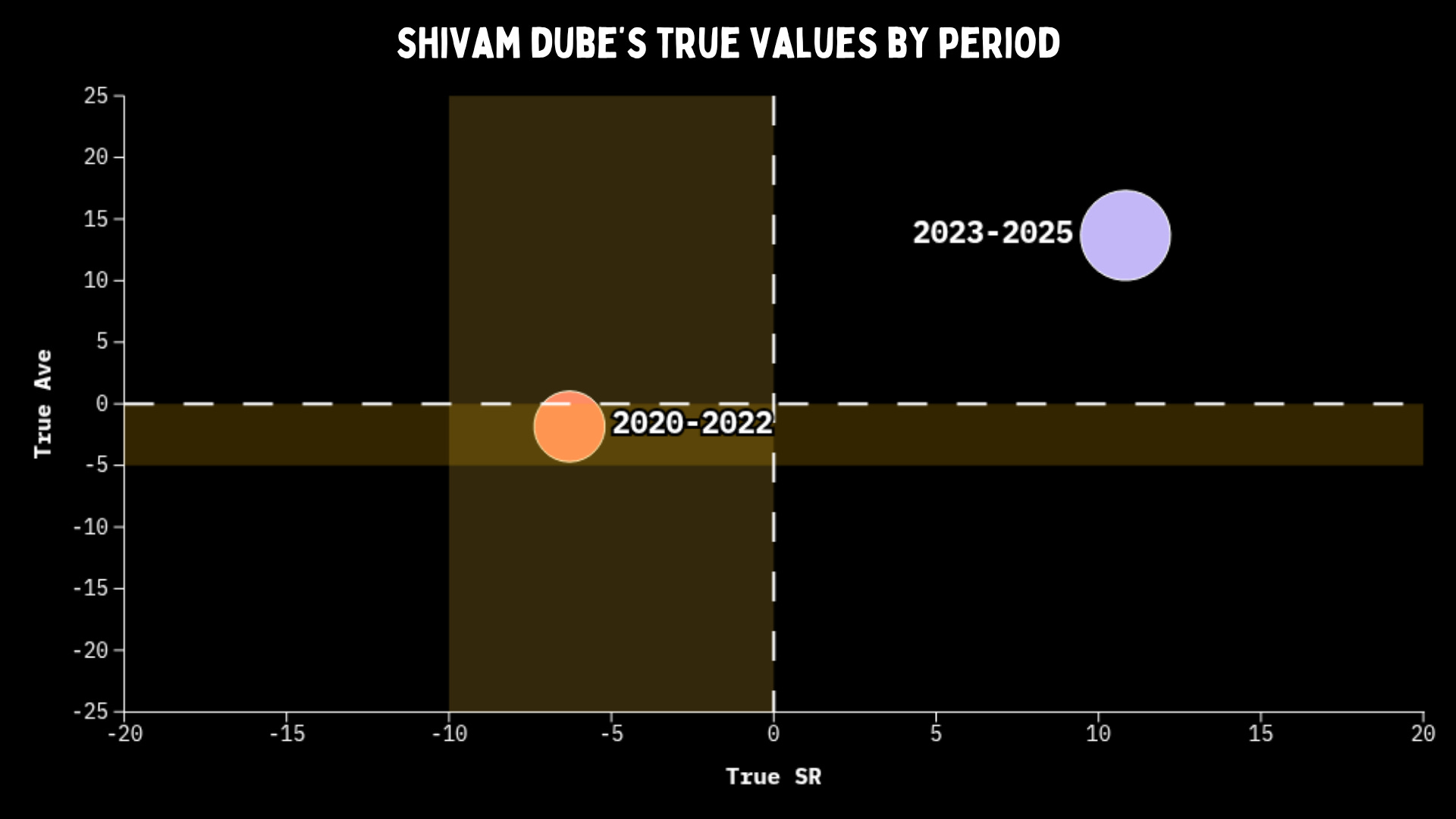
Interestingly, the three year timelines don’t exactly match for Dube. His absolute best is from 2022 to 2024. But you can’t win the award by gerrymandering years. So from 2023-25 versus 2020-22, he actually had a higher true average versus spin back then, but it came at a below par speed. Now, he’s traded some of that average for faster runs. Against pace, he’s better at both not getting dismissed as well as hitting it.
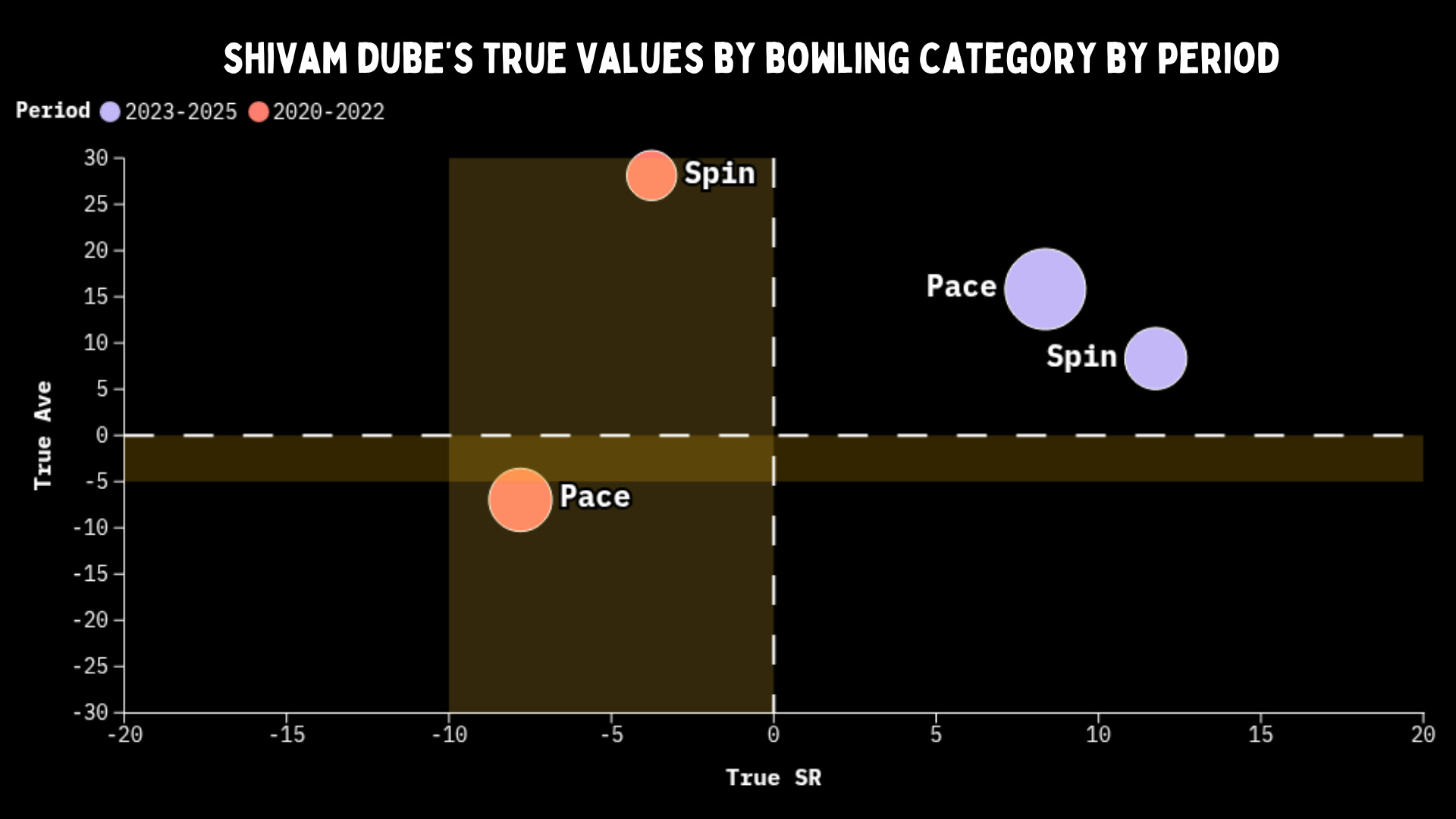
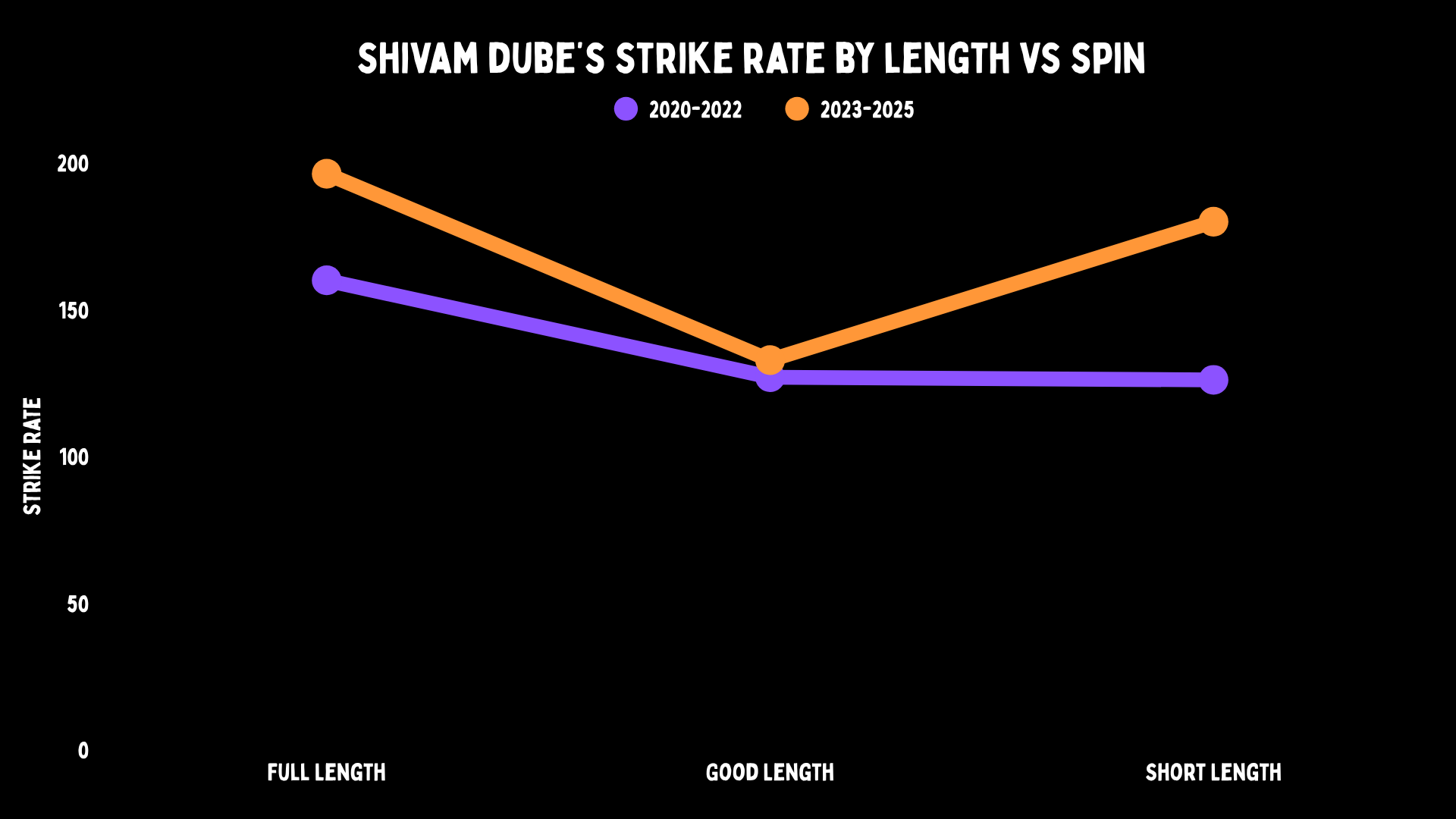
Interestingly, he struggles to smash good length spin in both the periods. He is just even more ruthless against full and shorter lengths, and he defends the ball less than he used to.
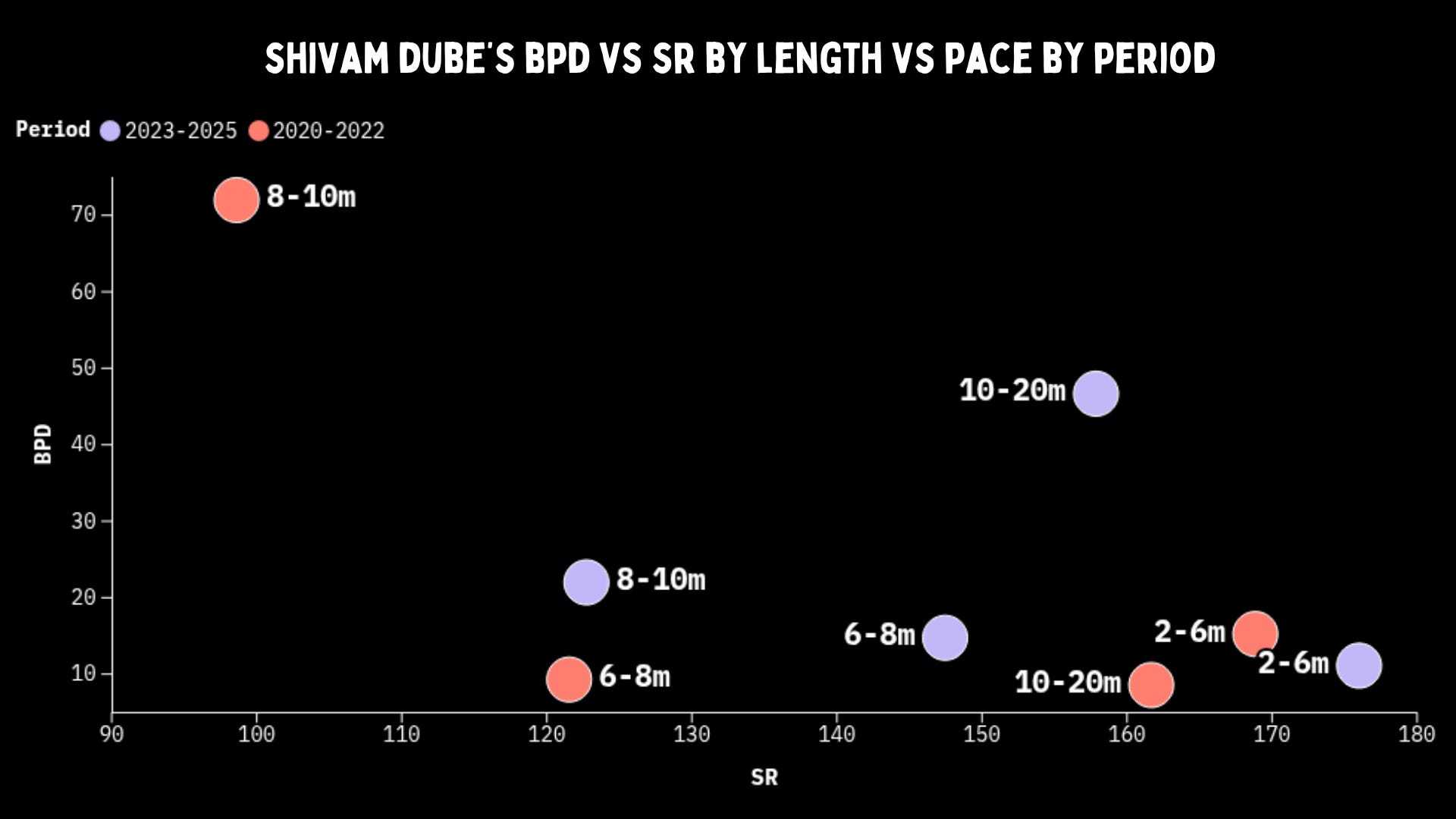
Versus the quicks too, he doesn’t like facing the good length but has certainly improved at it. Also, he can tackle back of a length or shorter deliveries a lot better now.
Shivam Dube went from being a middling squad player to one of the most valuable role players in the competition. That makes him an easy shout for this award.
Abhishek Sharma
‘Air Abhishek’ showed glimpses of his potential way back in 2018 on his IPL debut. Batting at No.6, the 17-year-old made 46 off 19 balls versus RCB. This was before appearing in the SMAT.
He’s part of a trade that sends him from Delhi to SRH, and for the next few years, he’s predominantly a lower-order batter for them. But at the same time, he’s an opener for Punjab domestically.
He gets his first go as an opener at the end of IPL 2021. In his second outing in that role, he scored a 16-ball 33 versus the Mumbai Indians. SRH didn’t retain him ahead of the mega auction, but he was bought back for INR 6.5 crores.
In 2022, he actually has a decent year; more than 400 runs at an above par average and a true strike rate of almost 19. This was before the impact sub era, so on raw numbers his strike rate of 133 doesn’t look amazing.
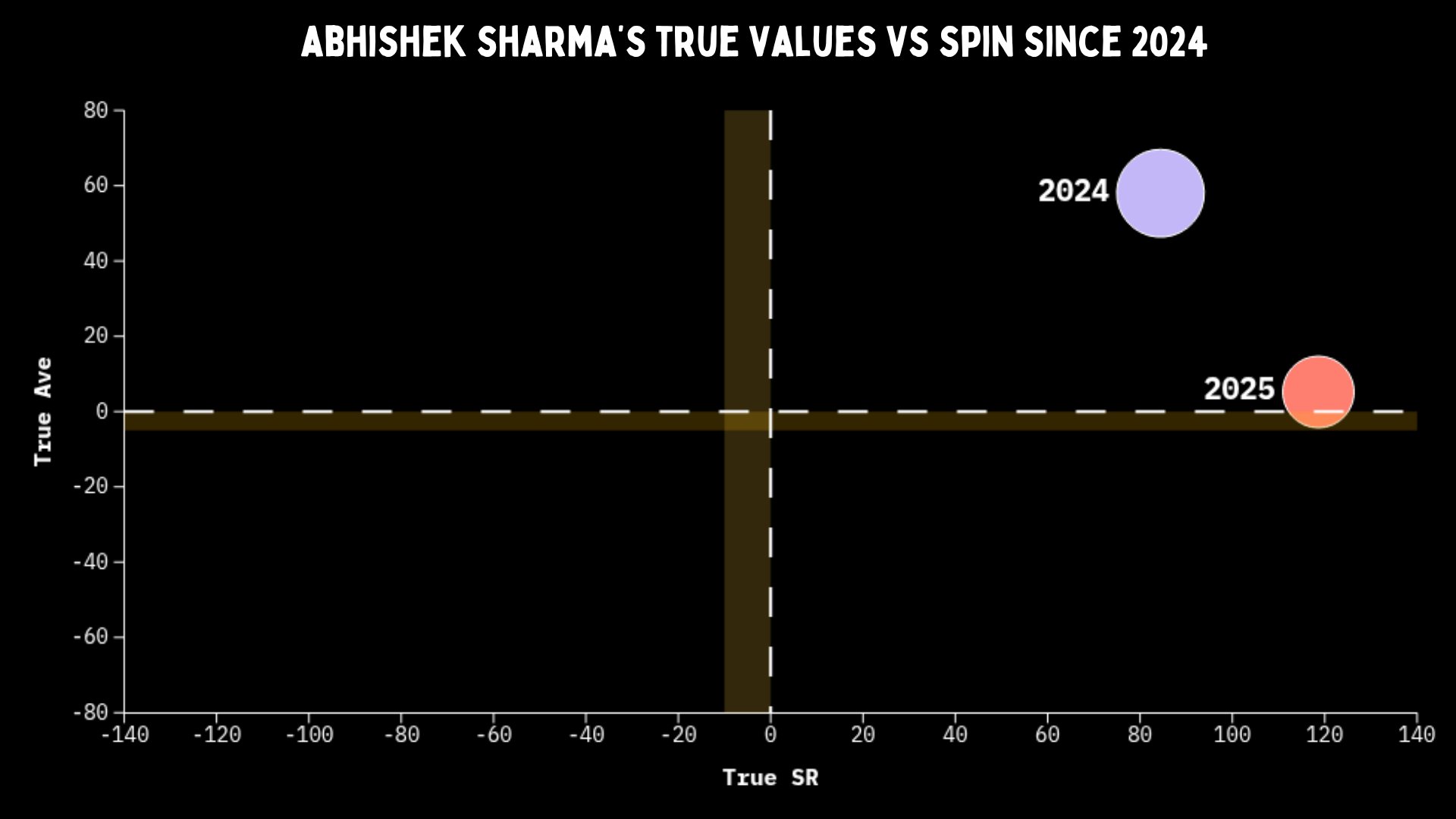
His evolution actually begins from 2024; his true strike rates are 51 and 41 in the two seasons.
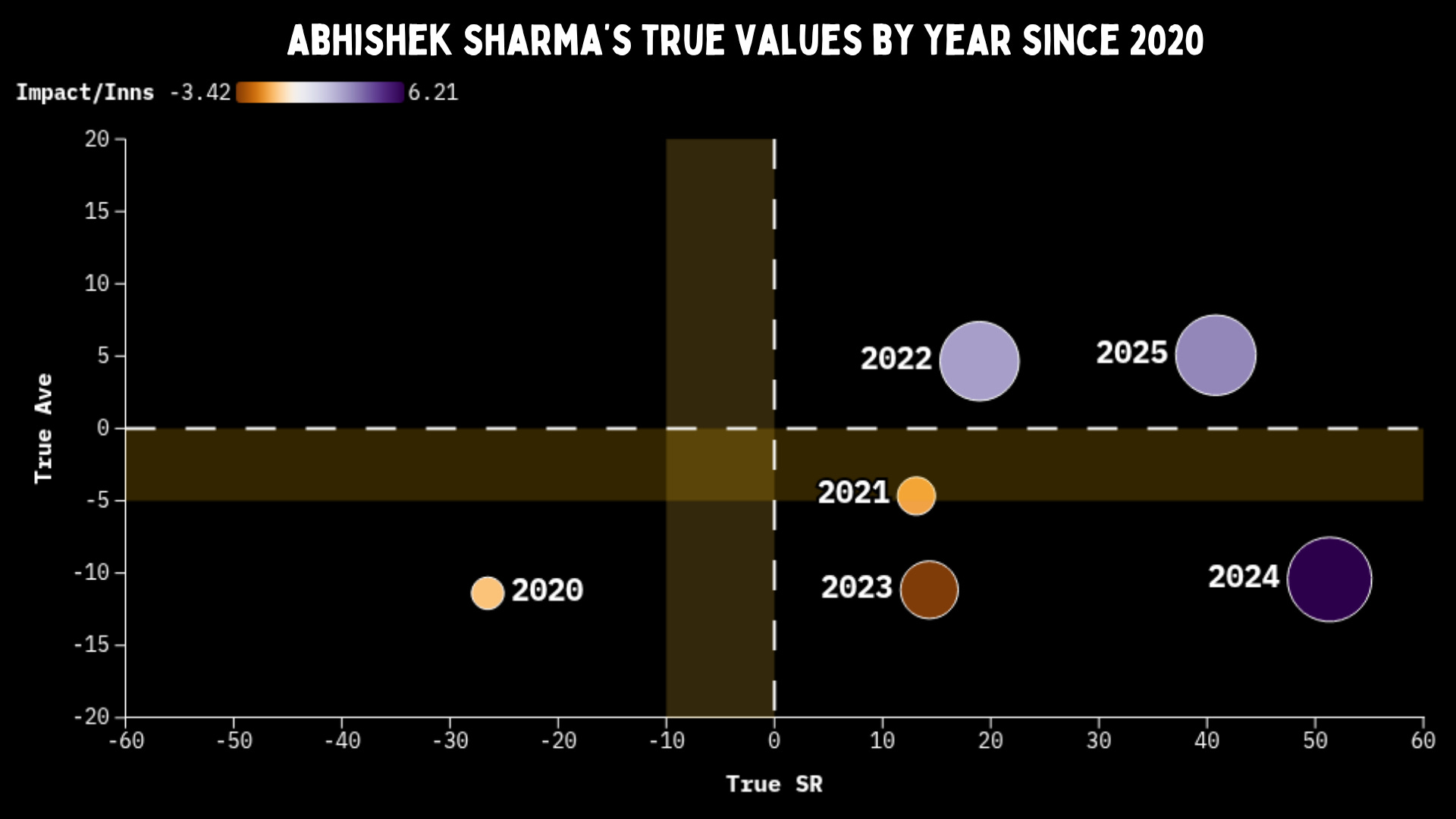
Against spin, it’s 84 and 119. There are actual players who strike at 119 or less versus spin, and that’s his true strike rate.
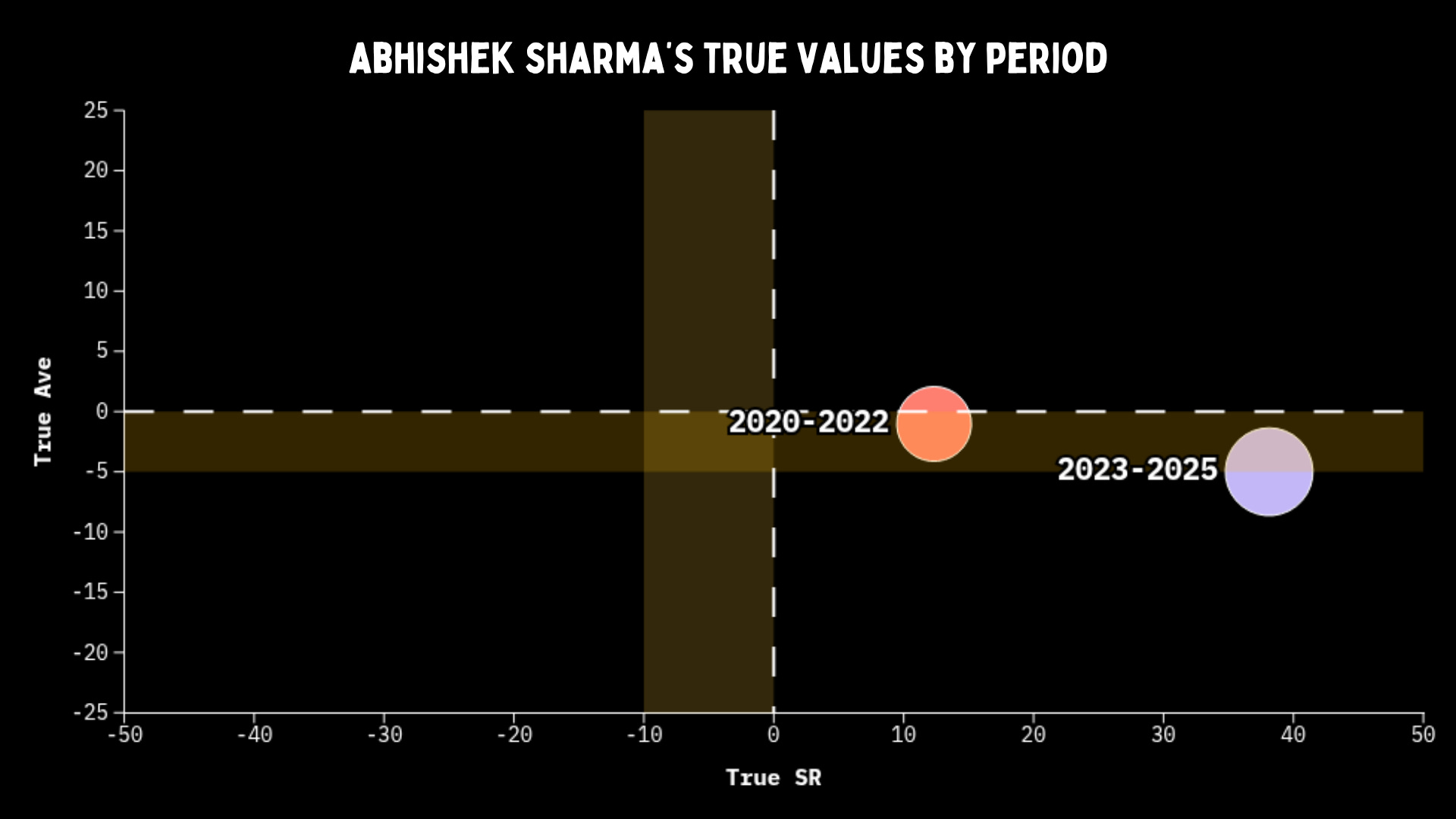
But let’s compare his output in our two timelines. From 2020 to 2022, he had a true average of -1 and a true strike rate of 12. Since then, his true average actually drops to -5. That makes sense, because for someone batting quite a bit in the lower-middle order, you don’t expect huge averages, while openers are obviously expected to score more runs per dismissal. But the true strike rate goes up to 38.
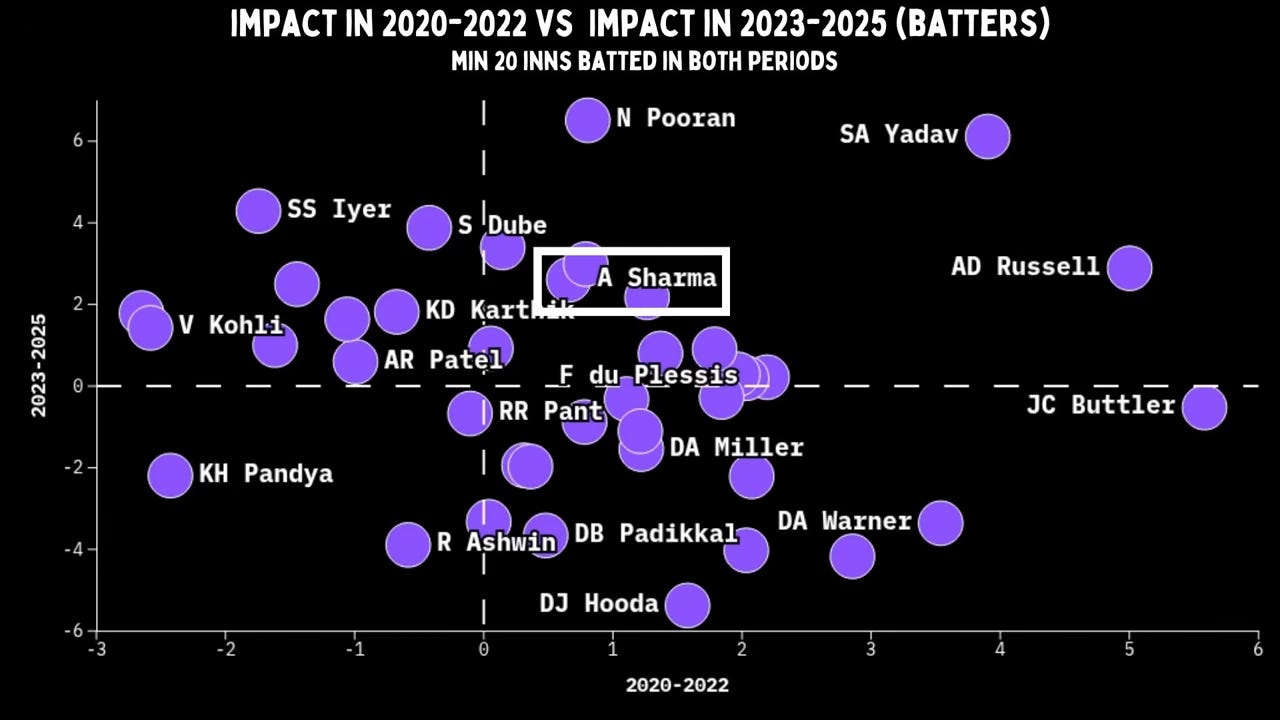
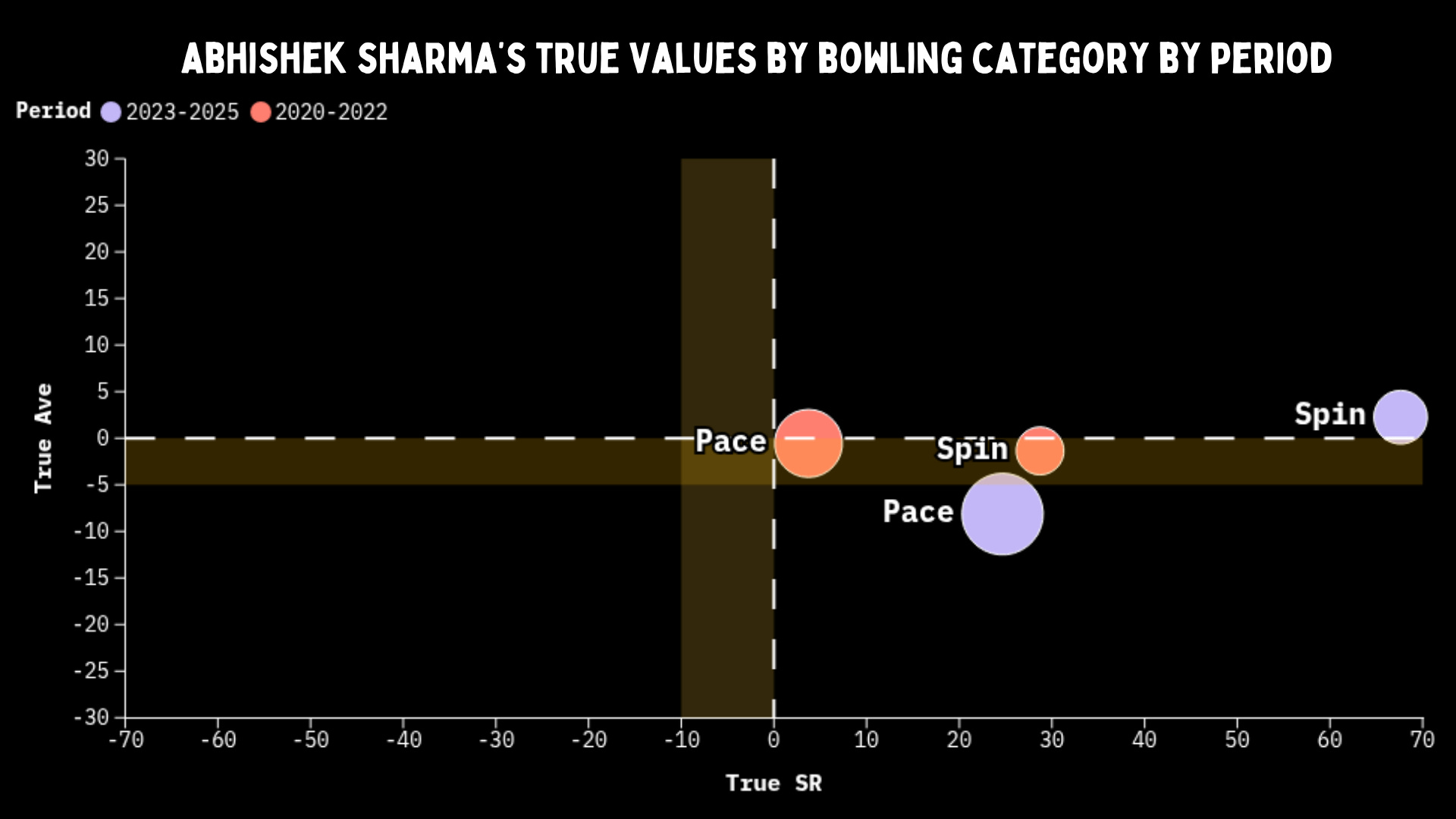
His impact per innings soars from 0.7 to 2.6, and he gets significantly quicker against both pace and spin.
But he was a spin-hitter even before, just not as insane at it. We have come to a point where he can run away with the game regardless of the kind of bowler.
The 2024 season made the ‘Travishek’ moniker famous, and got us all asking about 300s all the time. That gets him a go in the Indian team, for whom he goes on a ridiculous run till the World Cup. At the big event, he has a quiet time until the final, where he just smokes an 18-ball half-century against New Zealand.
Abhishek Sharma goes from being a talented bloke to a transformative T20 batter. The sky is quite literally the limit on Air Abhishek’s potential.
Riyan Parag
Till 2023, Parag got out for single digits in exactly half of all his IPL innings. Which feels like a cricket version of binary. But it wasn’t like he scored at a ridiculous clip to make up for the inconsistency; he struck at under 125. And yet, he had always shown glimpses of his talent. In 2019, he became the then youngest batter to score an IPL fifty. For Assam, he debuted at only 15. Plus, he was also an U-19 World Cup winner in 2018.
After his debut season, he never averaged 20 or struck at 140 for the next four years. Cut to 2024, and the only two men with more runs that year were Virat Kohli and Ruturaj Gaikwad, as RR made the playoffs.
In 2025, he had the seventh best true strike rate of the 33 batters with 300 or more runs.
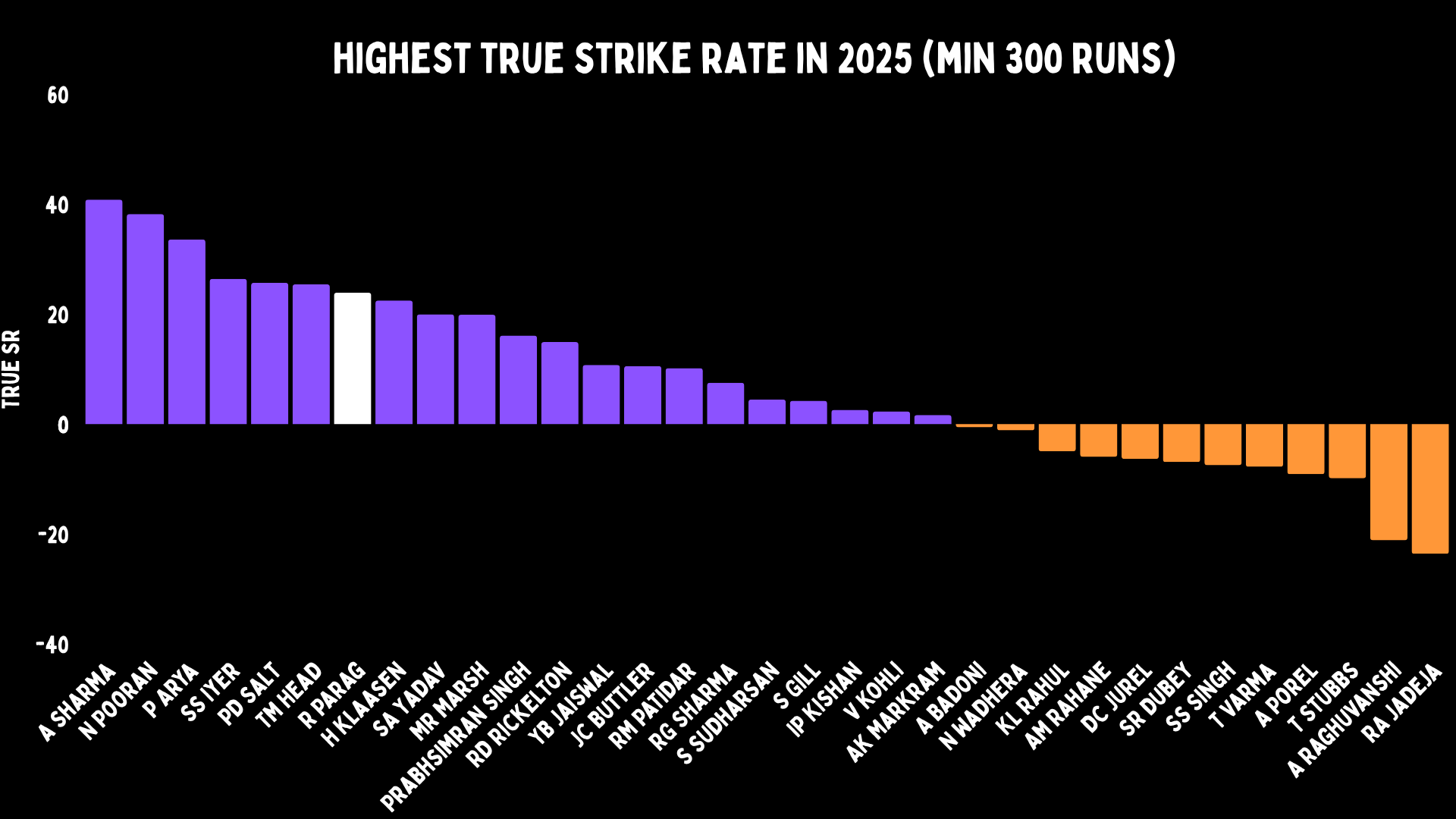
So he’s given a solid anchor season and an attacking year, showcasing his range. It helped that he got a consistent run at No.4.
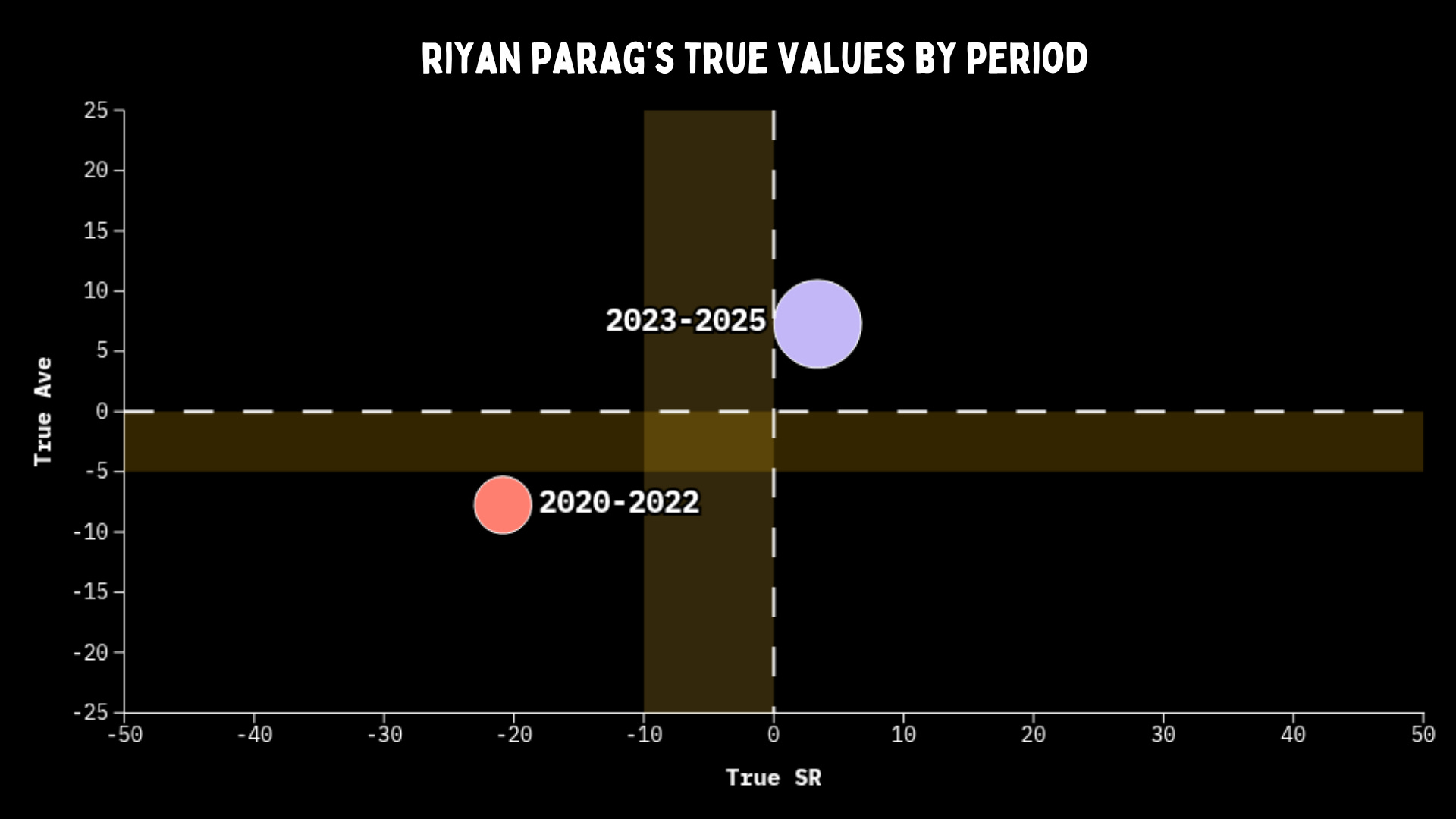
Of all the batters we nominated, he had one of the biggest deltas between the two cycles. He was -8 on true average and -21 on true strike rate, and despite a bad 2023, is 7 and 3 on the respective metrics since then.
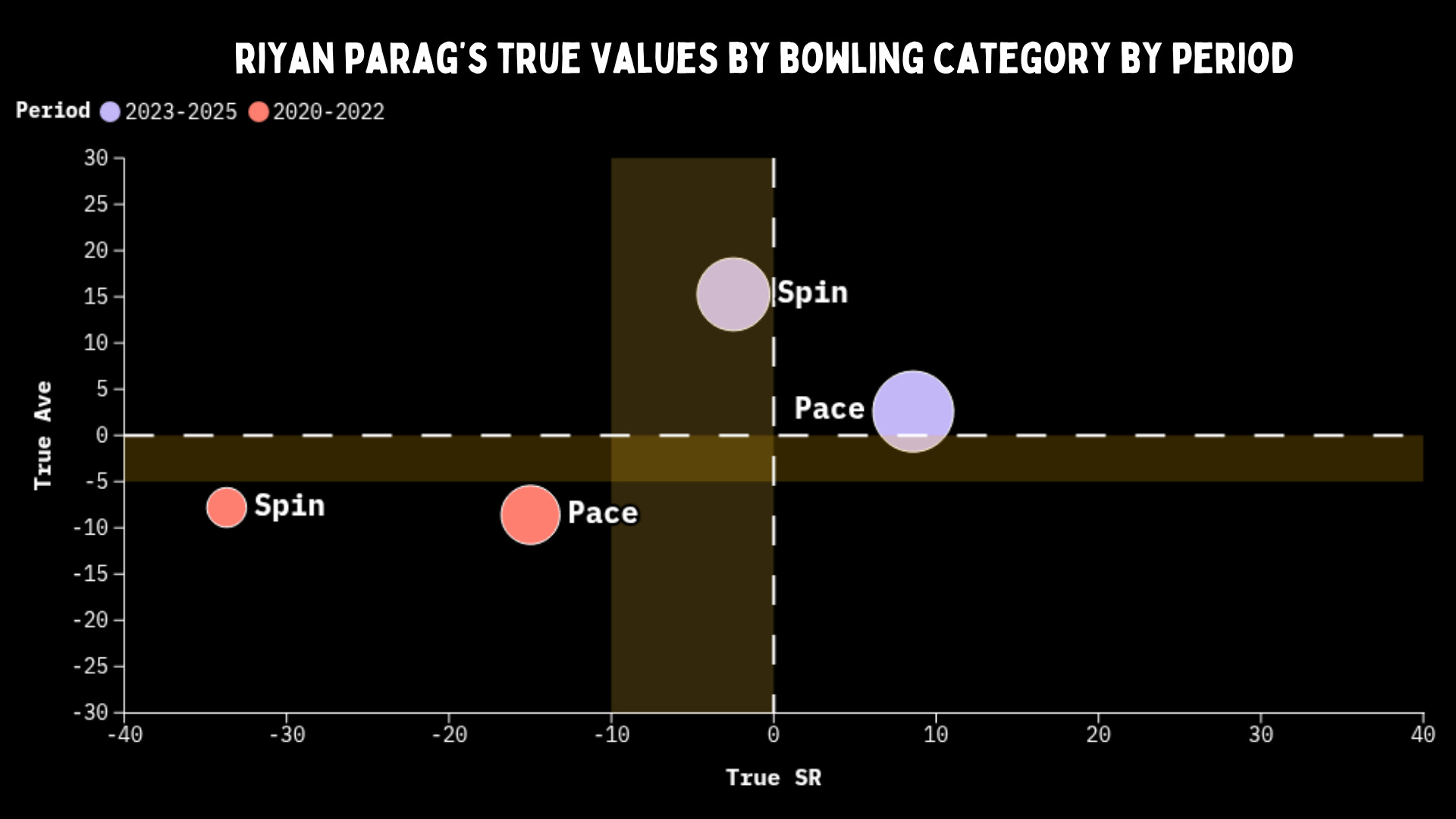
He prefers facing pace to spin generally when it comes to strike rate.
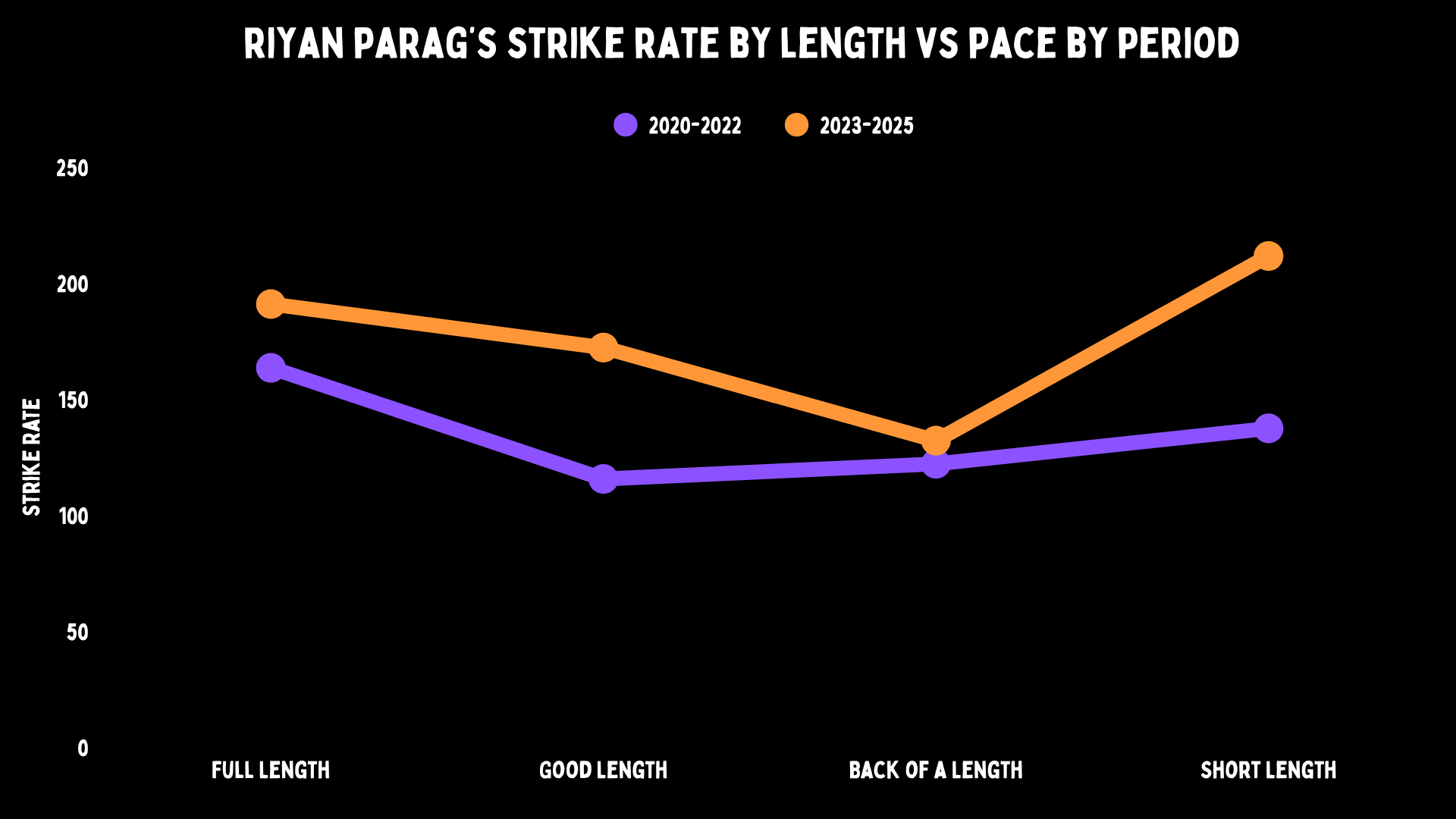
But it’s not like he didn’t work on his pace game; it is now really hard to bowl good or short length seam to him.
And it’s not just the batting. He became the fourth-youngest player to ever captain an IPL team last year. It was on the back of him leading Assam to the SMAT semi-final in 2023/24. After Sanju Samson was traded to CSK, Parag took over reigns for the Royals. After winning the first game of 2026, he also gave a very mature statement about the fickle narratives around captaincy. He just comes across as a professional now.


We spoke to our very own Saurabh Somani about his case for this award, and he said, “I think Riyan makes the list easily. Age and maturity is part of improvement. Batting position, you also roughly get the better ones as you yourself get better.” The uptick in his numbers is too stark, and he certainly beats the natural evolution with age argument.
Axar Patel
As an all-round asset, it’s really hard to look past Axar Patel for this conversation. If we just go by the true values, he has actually improved as a batter and a bowler.
It kind of felt like Axar has always been this good, because he’s been around that long.
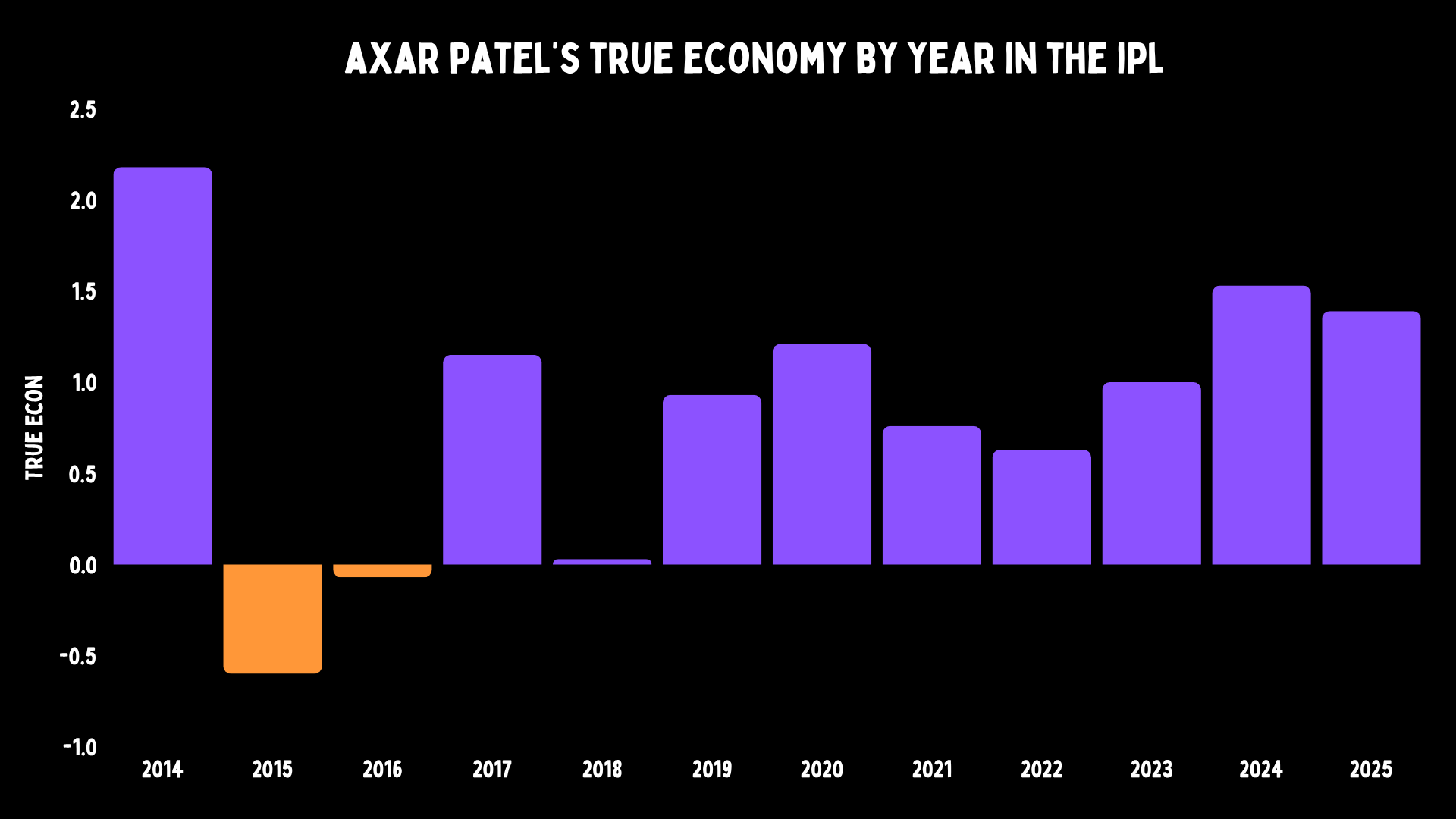
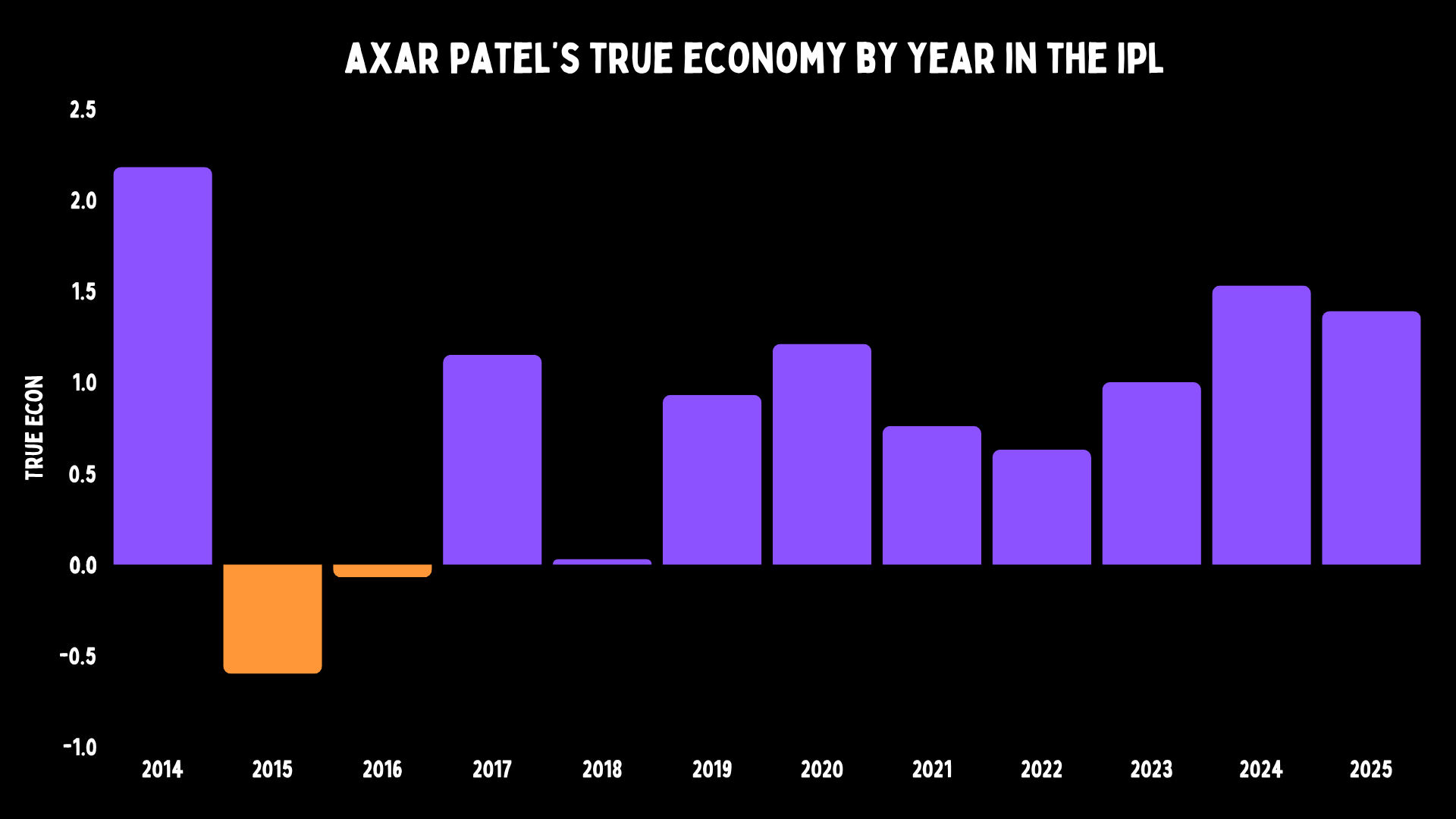
With the ball, he has had a true economy of one or more for three consecutive years - which is mind-boggling in the impact sub era.
In terms of wickets, he’s about the same as the previous three years.
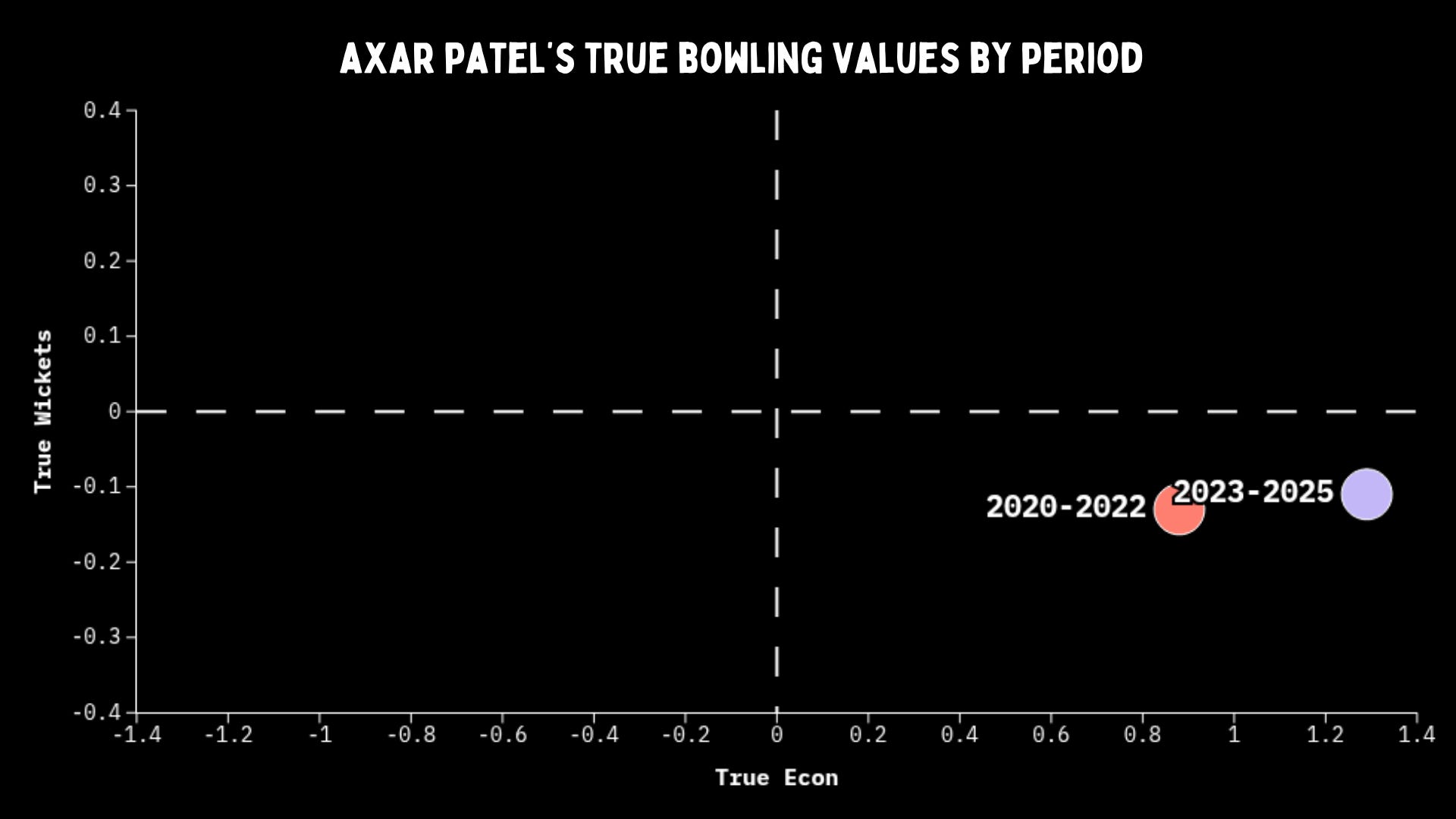
Yes, he has had better bowling years, like his debut season in 2014, but it’s his most economical three-year streak. And that’s after he bowled a higher percentage to LHBs.
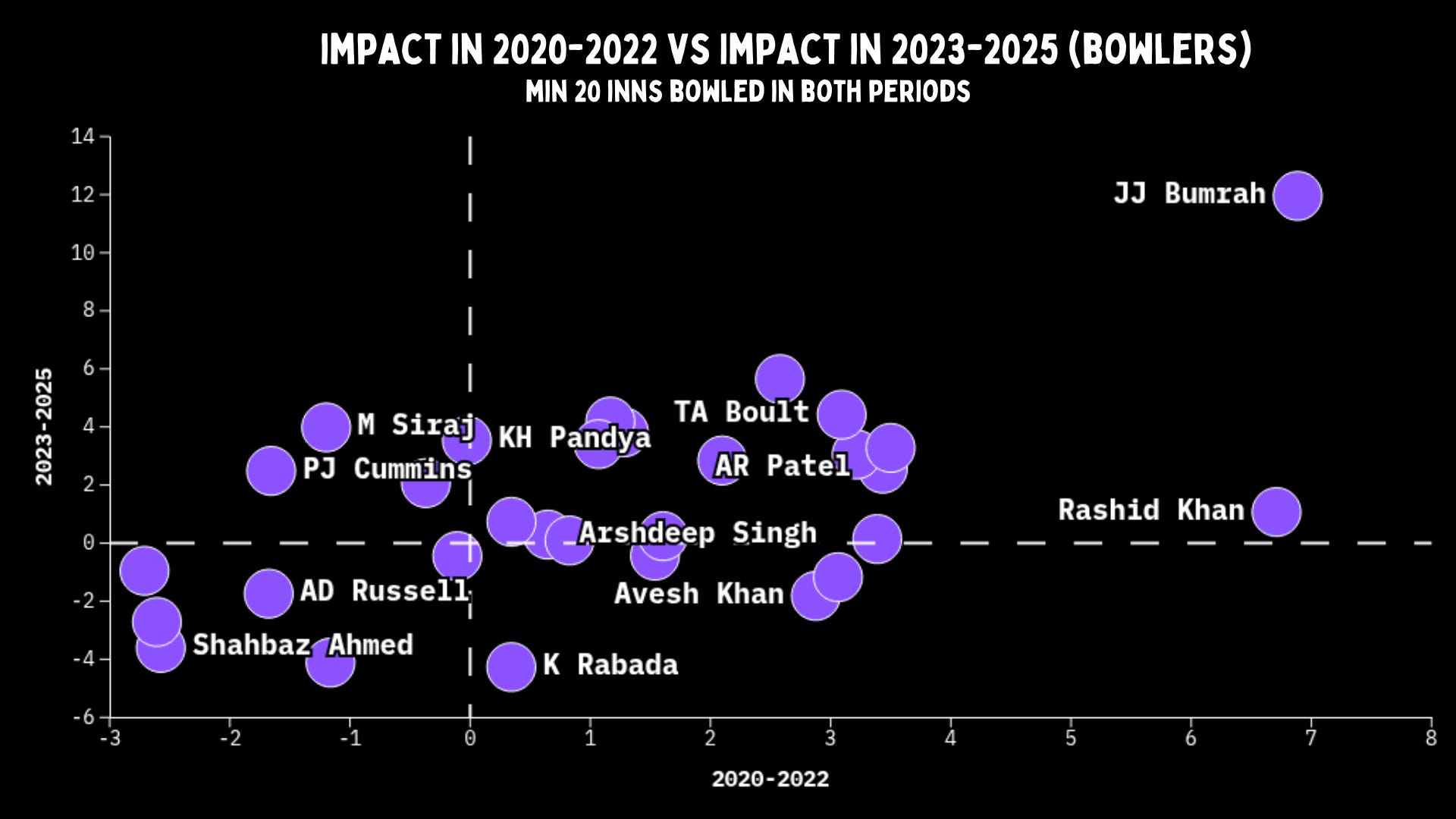
Interestingly though, impact per innings prefers 2020-22.
His batting actually starts coming along in 2022, and that also tracks with his ODI performances that year. But like for Dube, if we just stick to the set parameters, his true average is about neutral, but his true strike rate improves from -13 to -9.
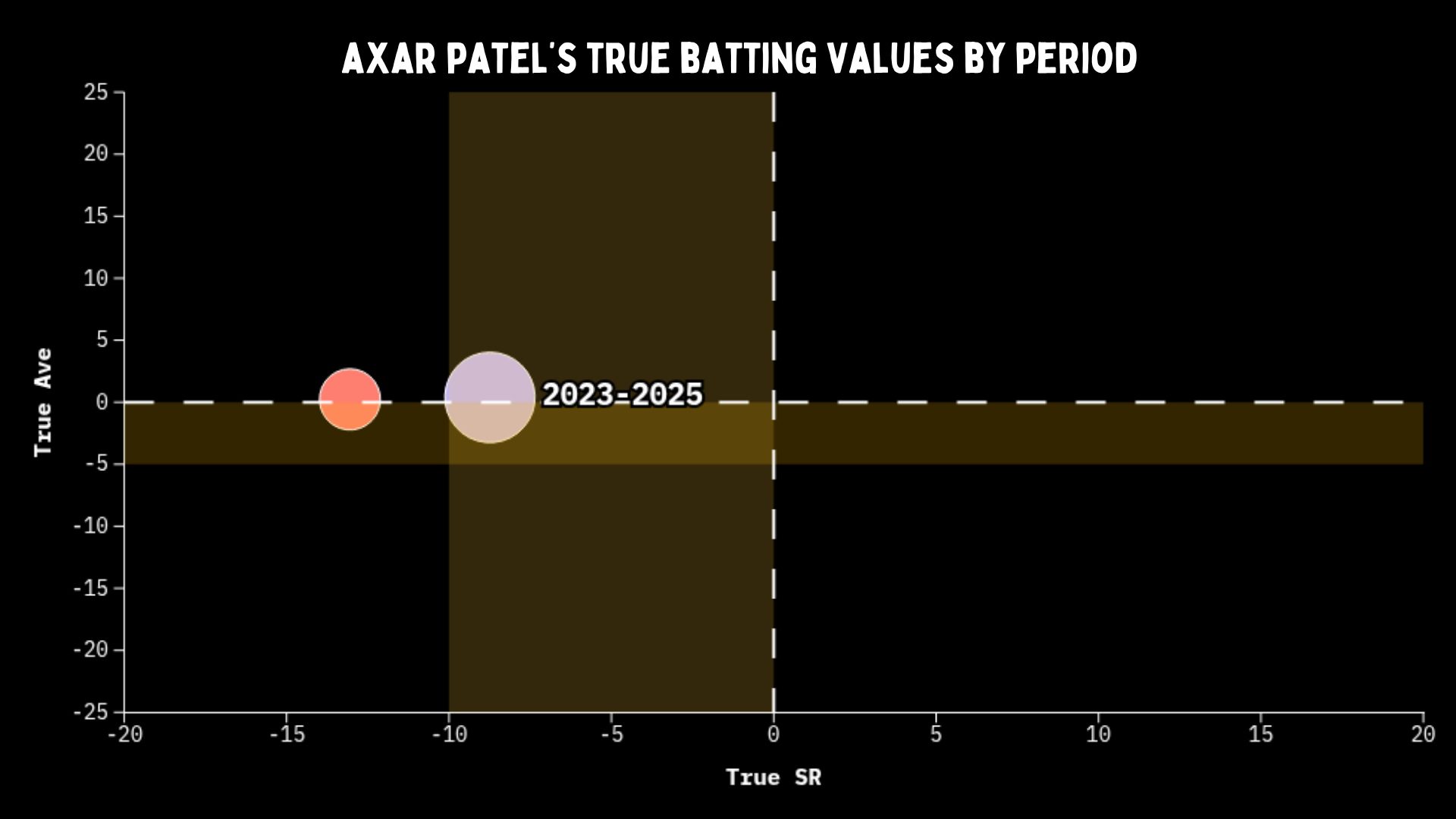
On impact per innings, he goes from almost -1 to +0.6, and faces five balls per knock more.
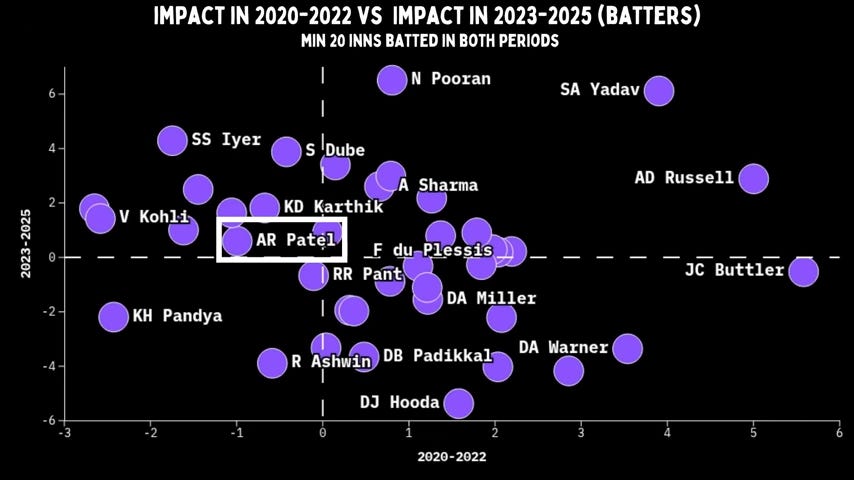
But remember, he’s still not a frontline batter, rather someone who you can use as a firefighter in certain situations. And a big part of that is tackling spin.
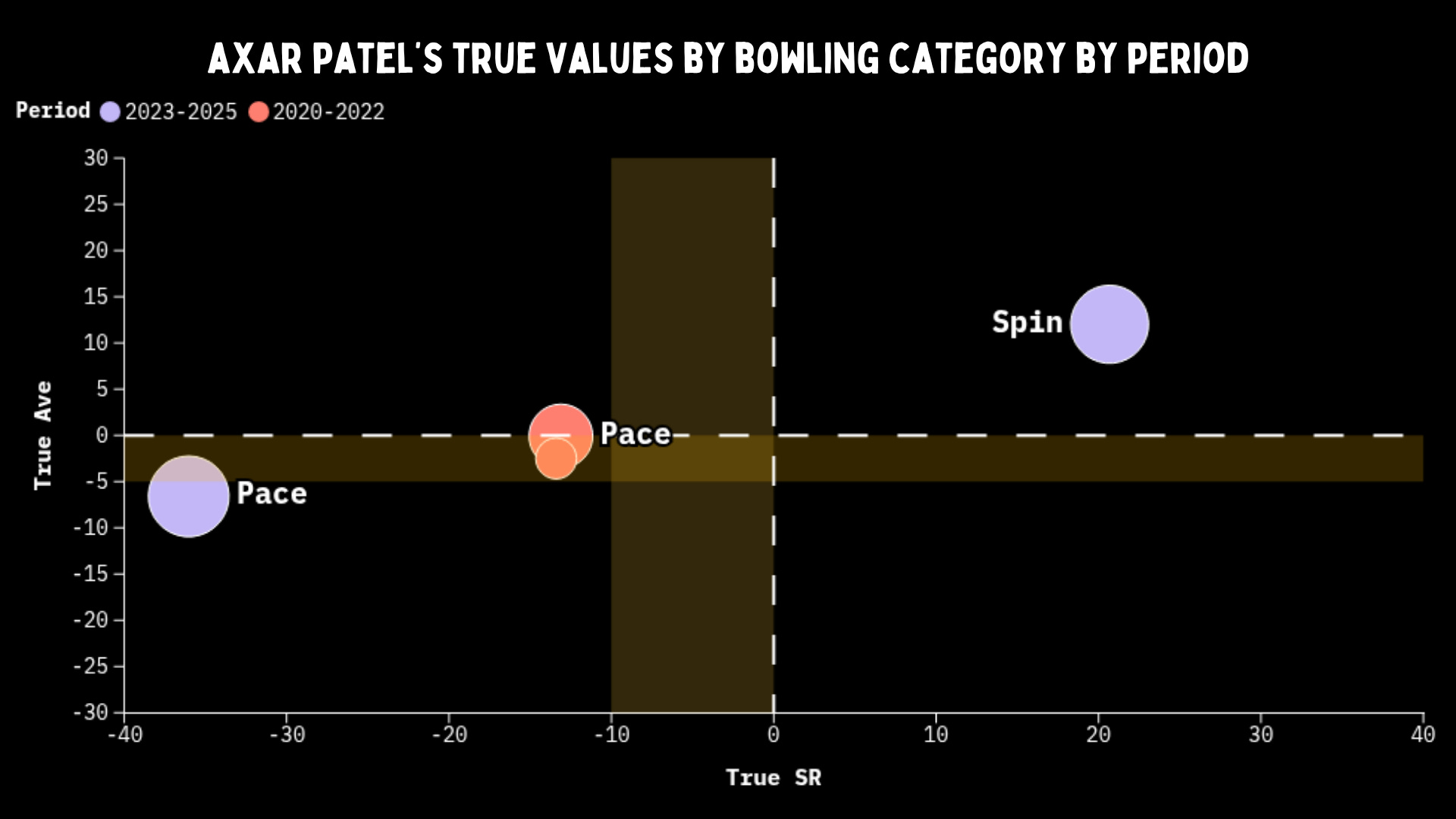
Till 2022, there were only two seasons where he faced more than 50 balls of it. But now, that’s gone up significantly. In the last two years, his true strike rate was 42 and 23, and in 2023 he had a true average of 45.
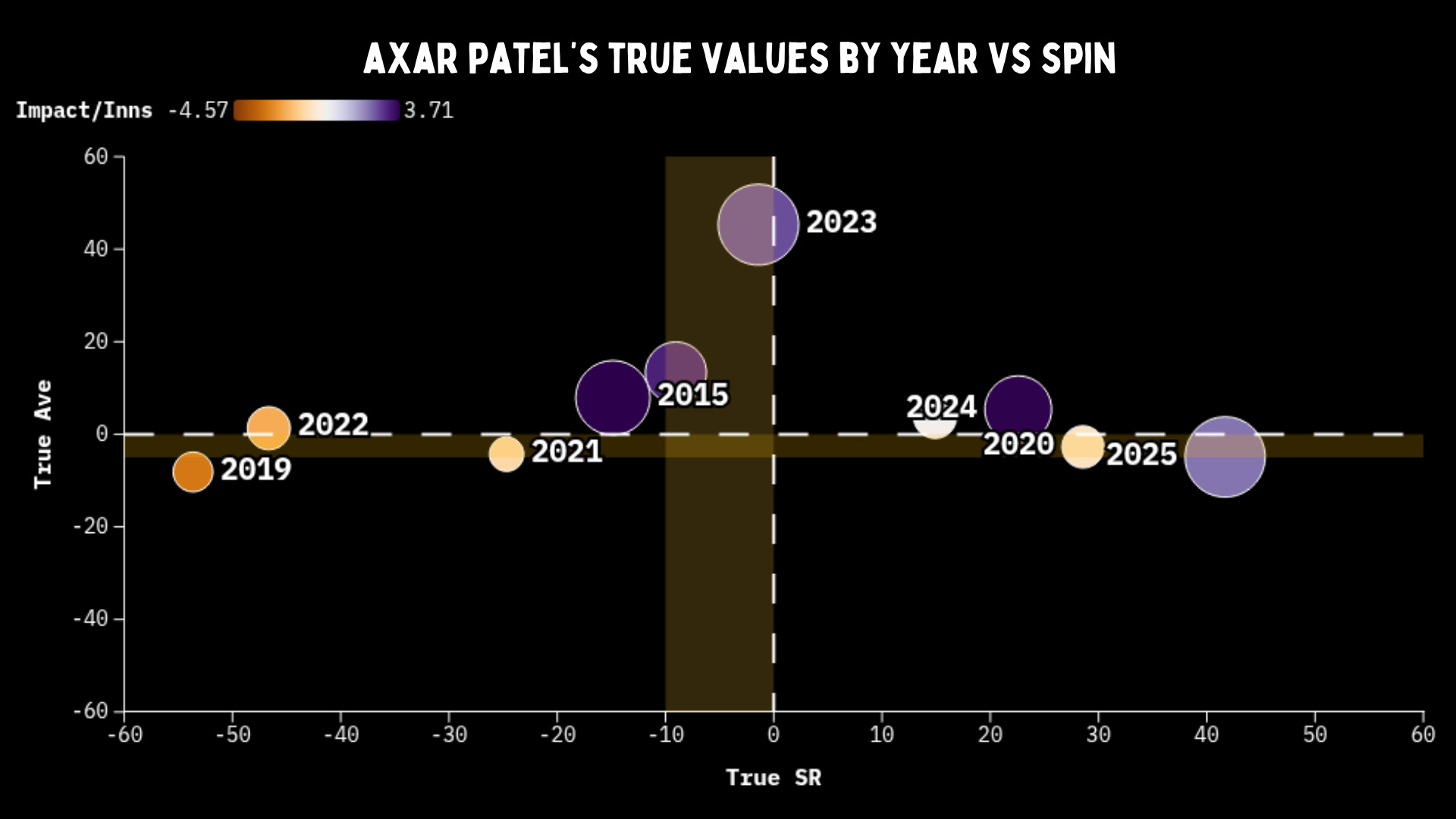
He is particularly ruthless if you bowl in the slot.
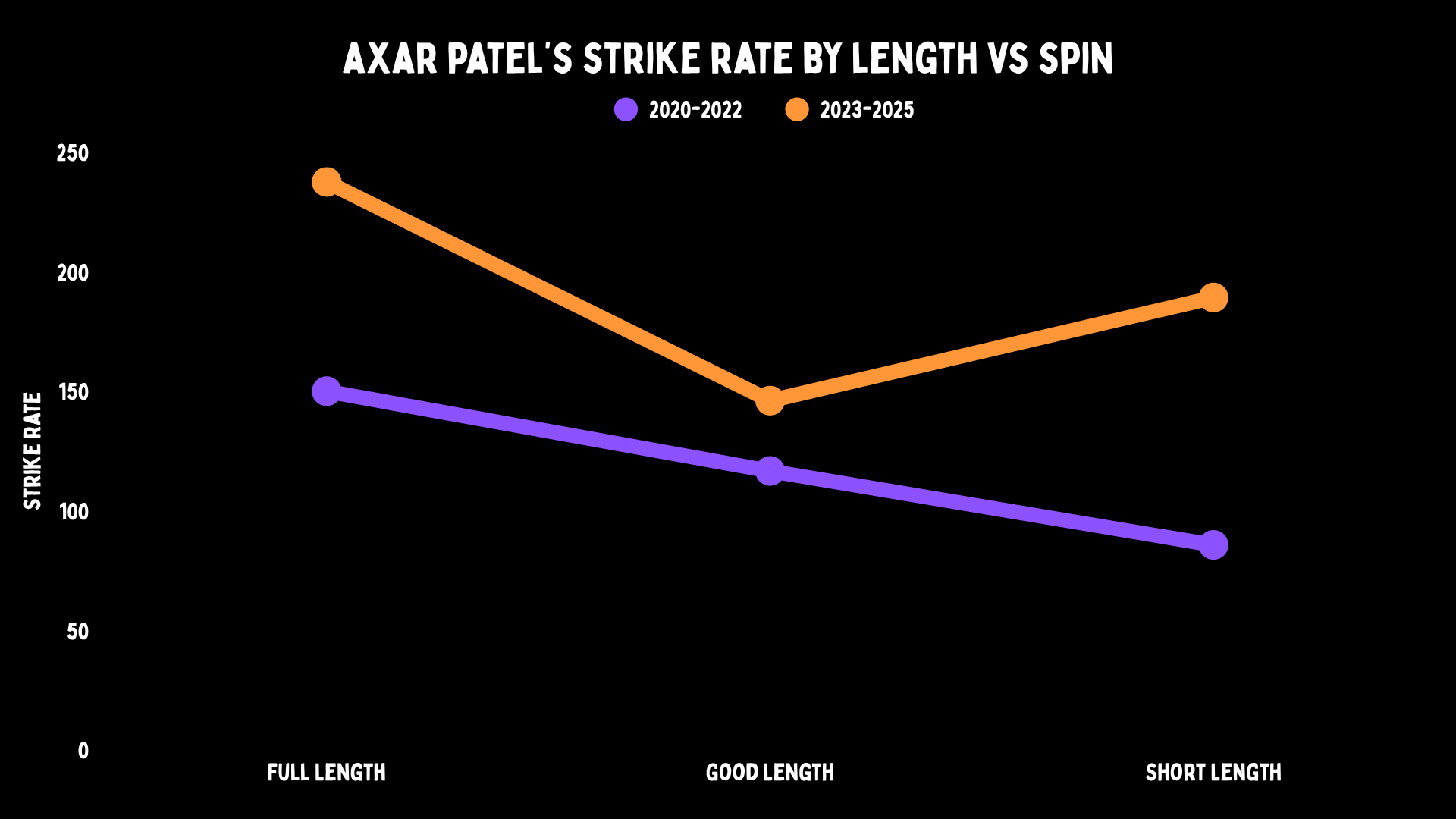
You can tell how much Axar Patel’s stock has risen by looking at his importance for the Indian team, often on both sides of the ball. Plus, the man can really field. He also gives you leadership - he was India’s vice-captain at the recent T20 World Cup and is the Delhi Capitals skipper.
Kuldeep Yadav
Kuldeep Yadav was benched for seven straight games in IPL 2021. This was the same bowler that three years before was bossing international cricket with partner Yuzvendra Chahal. In the IPL, he actually started regressing in 2019, and he was eventually dropped for the latter end of the 2019 World Cup too. He only plays five games in 2020. A knee injury in the second leg of 2021 meant he eventually played no games that entire year and was subsequently released by KKR.
Delhi Capitals get him for only INR 2 crore in the 2022 mega auction. And he instantly had a solid season for them, picking up 21 wickets. He took 0.67 wickets per spell more than expected, though was slightly expensive.
The main reason for his success was that he bowled faster. But crucially, he did that while maintaining his spin, which most wrist-spinners never do. His median speed till 2021 was around 81 kph, since 2022 it’s gone up to 85 kph. Spinners across the globe were getting quicker, so he had to adapt with the times. Daniel Vettori noted that he had a faster arm action and was imparting more revolutions to the ball.
In the last four years, this is the best he has ever bowled in his IPL career. Even before 2020, he didn’t have this level of impact. He has been more economical against both right-handers and left-handers than ever before.
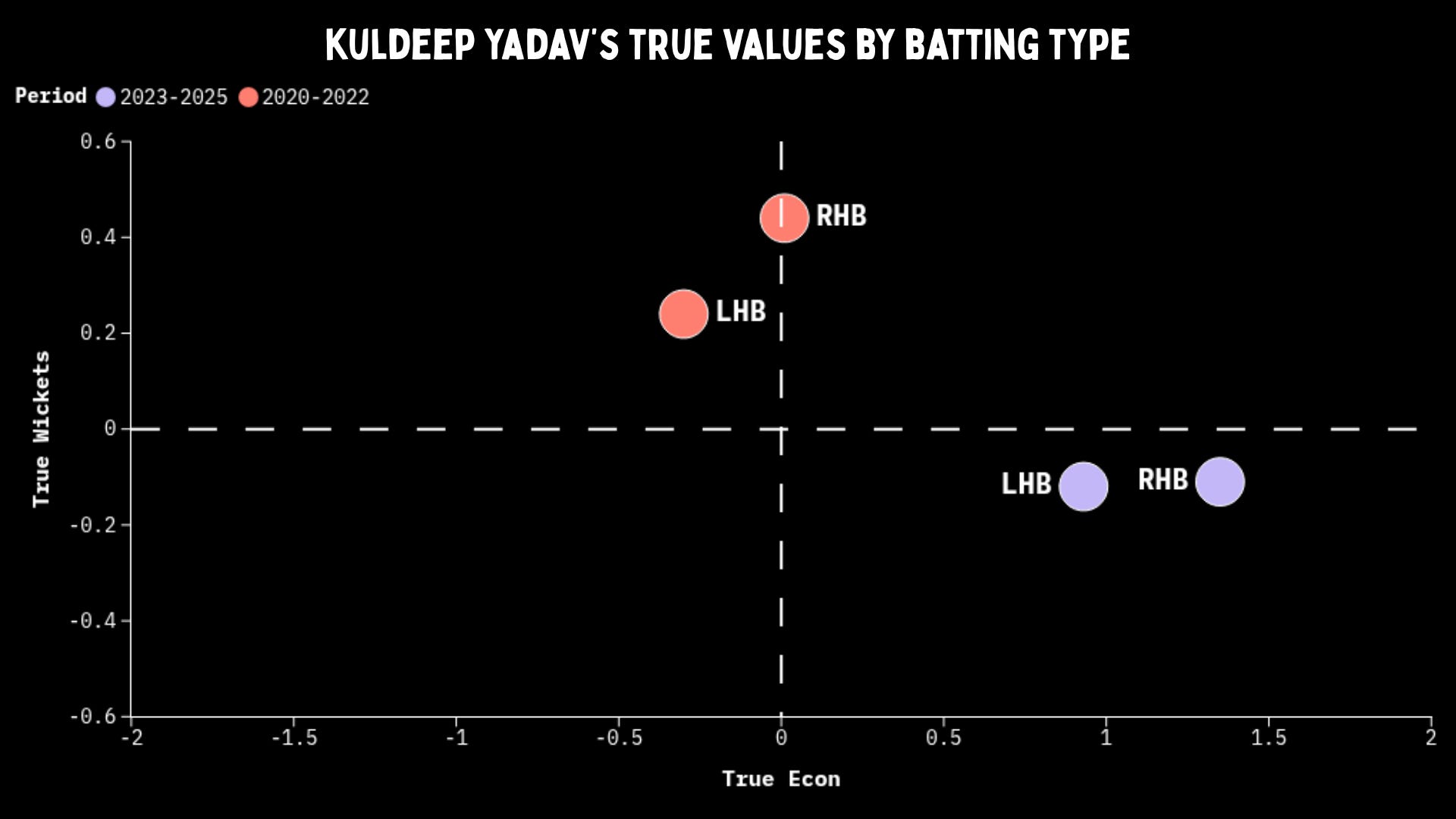
On our timelines, he has a true economy of 1.3 and -0.12 true wickets now, compared to -0.1 and 0.39 respectively. So in the impact sub era, he hasn’t been as much of a wicket-taker.
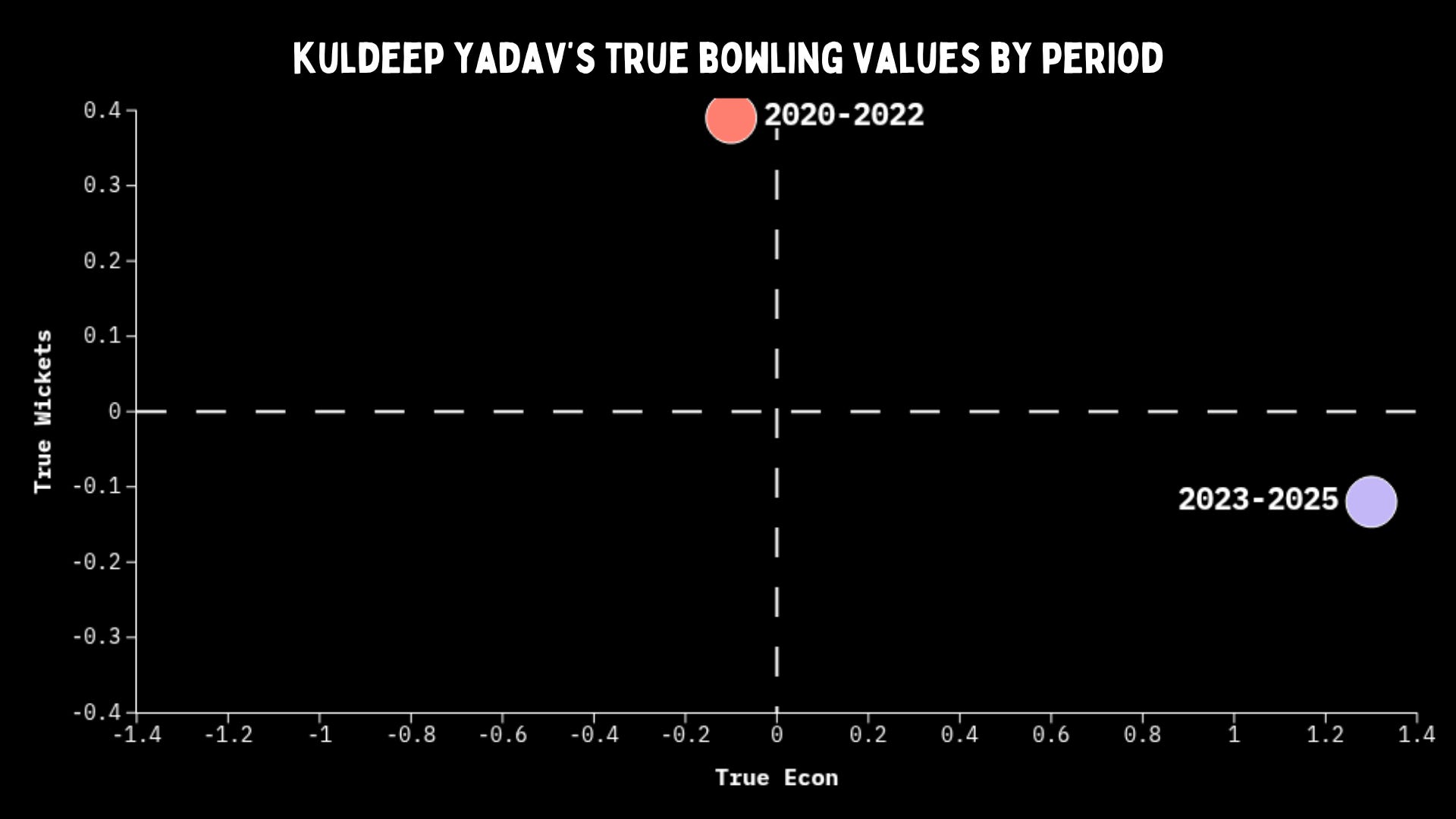
In terms of saving runs, he’s gone up from 2.12 to 3.95 runs per innings. And it’s obvious that when he’s out of touch for two years, he barely plays so his numbers don’t look as bad.
Kuldeep Yadav basically goes from KKR’s bench to DC’s lead spinner. In a high-scoring universe, he is one of the few bowlers to have actually improved their raw numbers.
Varun Chakaravarthy
Varun Chakaravarthy’s cricketer arc is perhaps unlike anyone else on this list. The man pursued architecture till his mid-20s before giving it up for pursuing the sport professionally. In fact, he started as a pacer but ended up bowling spin.
Punjab paid him INR 8.4 crore at the 2019 auction but he only played one game. KKR got him at 48% the price the following year.
Chakaravarthy delivered two really good seasons. He even got to play for the national team in the 2021 T20 World Cup (though that stint didn’t end well for him). But KKR put their faith in the mystery spinner by retaining him for INR 8 crore. However, 2022 turned out to be a horrible year for him.
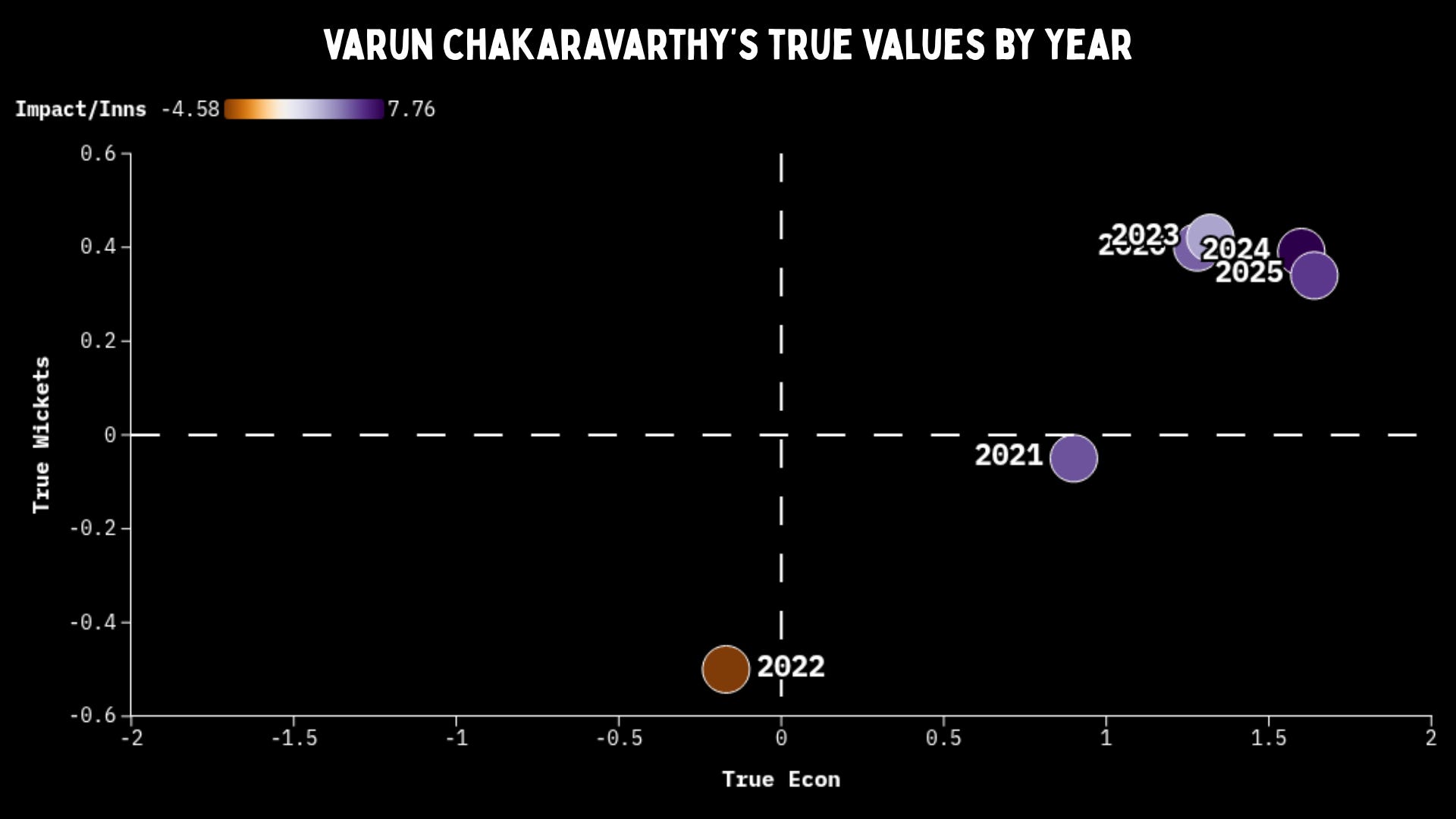
So in the last cycle, he took 41 wickets and conceded 0.76 runs per over less than expected and was about par on wickets - really good numbers. But since 2023, he has become even harder to score any runs off, plus he strikes a lot more often. Yes, it is a case of going from very good to great, but he has improved on both metrics. He is more defensive and attacking at the same time, so he’s putting more pressure on teams.
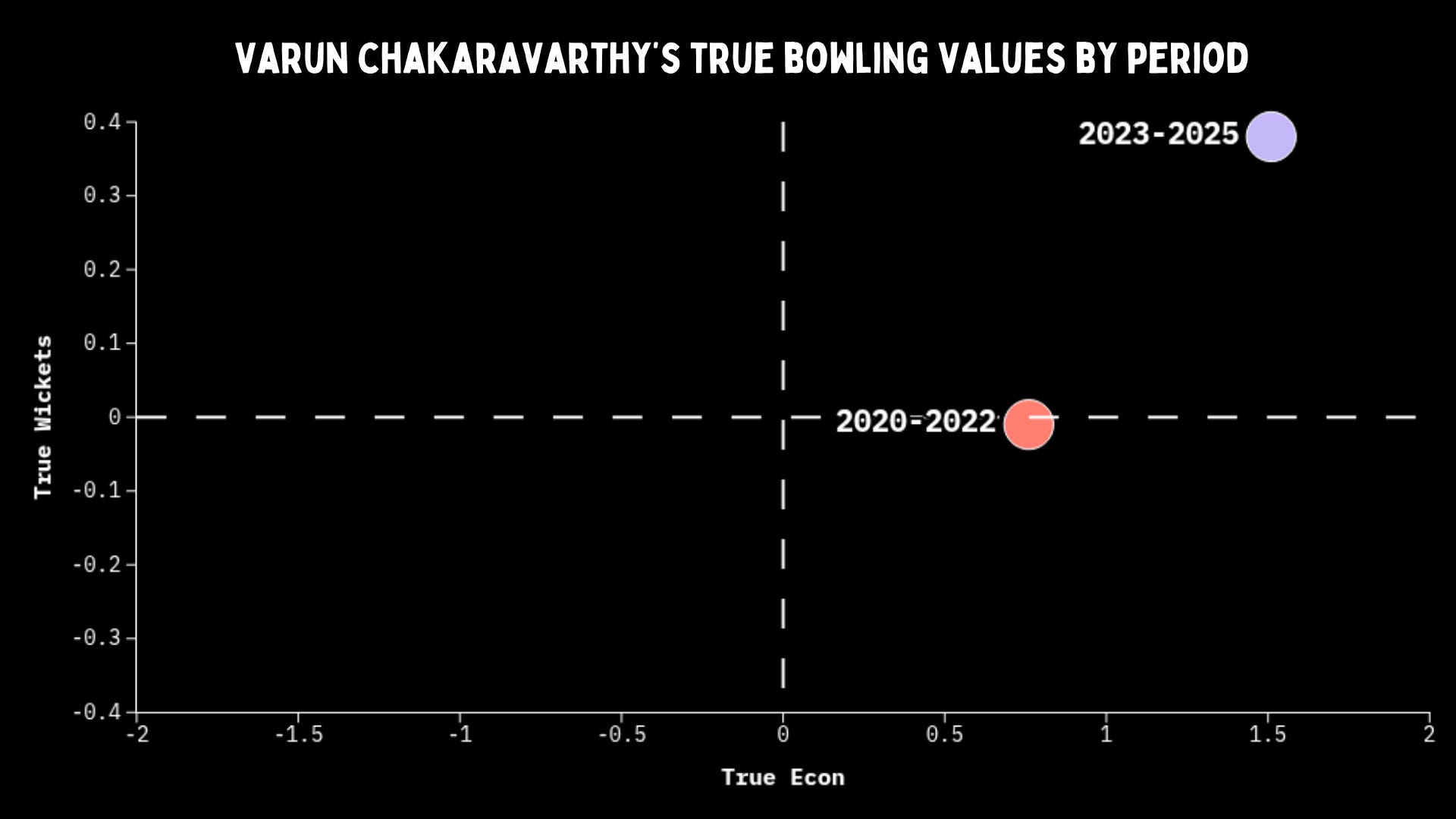
A big change in his bowling in the last three seasons is that he started getting right-handers out a lot more often.
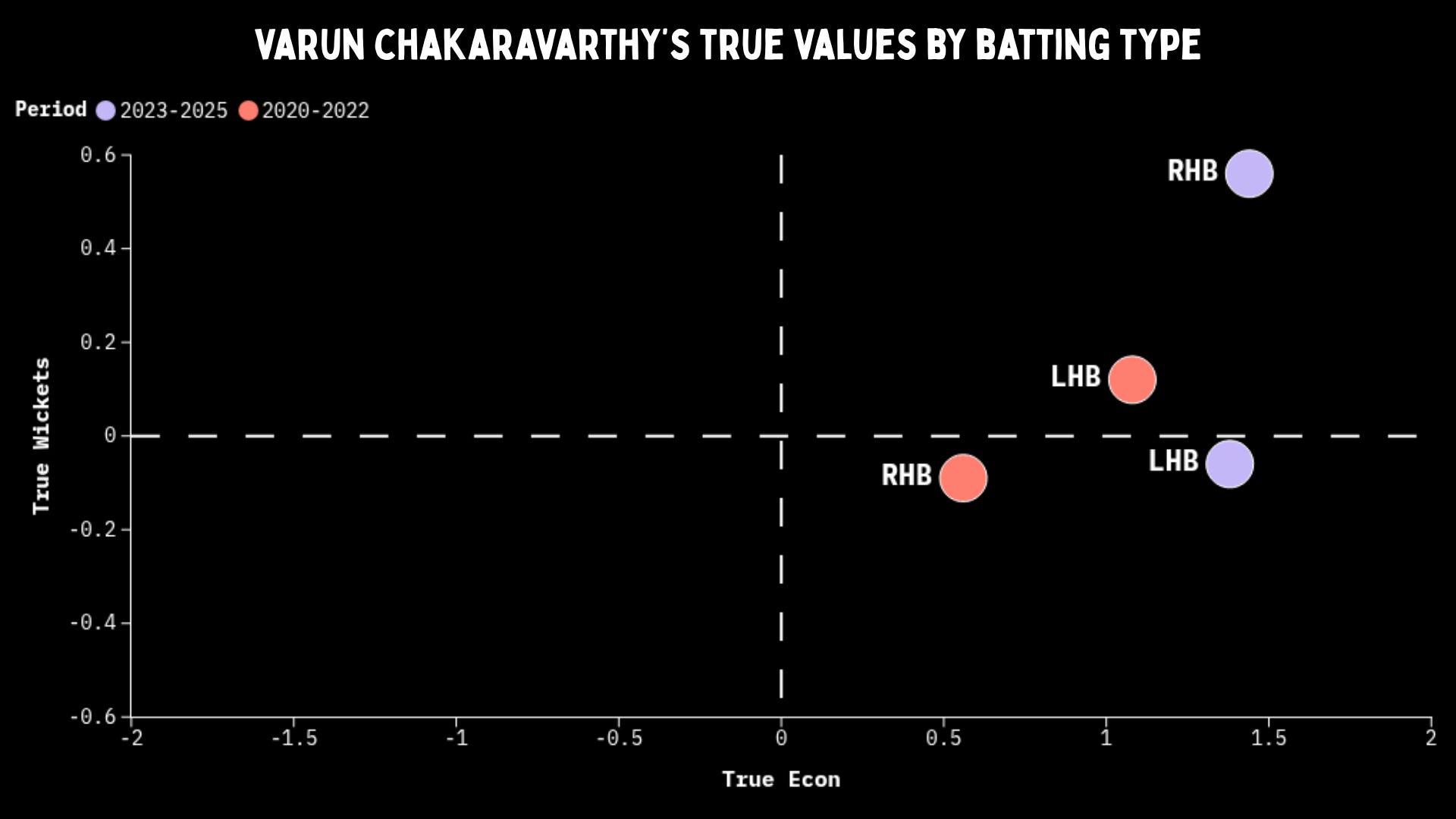
One reason is that he works on perfecting his leg-break, the away spinning delivery for the righties. It became more of a strike weapon for him. Plus, he became more of a threat if he bowled in the powerplay or death overs.
So it isn’t that he is possibly most improved, he is probably most changed. He himself says that he transitions from a side-spin to an overspin bowler.
In the impact sub era, he is certainly the second best bowler in the league after Jasprit Bumrah. What more needs to be said?
Pat Cummins
In the 2020 IPL auction, Pat Cummins went for INR 15.5 crore. That made him the most expensive foreign player in the league at the time. It seemed like an incredibly high amount for someone who didn’t play the format all that much. Cut to 2024, and now he was the second highest-paid player ever - second to only his Aussie teammate, Mitchell Starc.
But between those two big paycheques, Cummins hadn’t exactly set the stage on fire in the league.
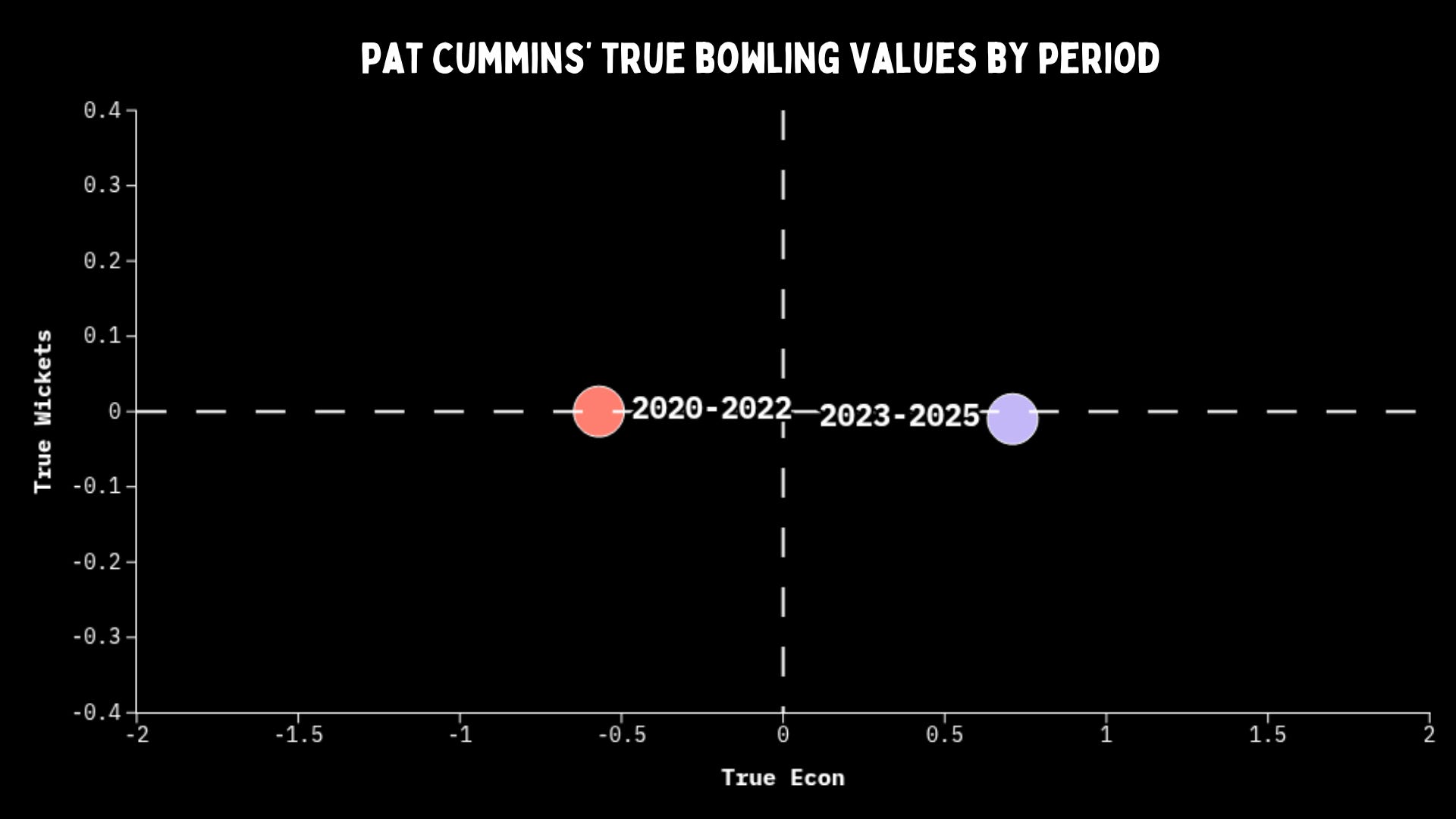
He opted out of 2023, but from 2020 to 2022, he had a true economy of -0.57 and he was exactly par for wickets taken. So he was neither a strike bowling option, nor did he save a lot of runs. His impact per innings was negative too.
He could slog a bit, which certainly helped, but it’s hard to argue he wasn’t overvalued.
We all remember 2024 for the Sunrisers’ groundbreaking approach with the bat. And that was under his watch. But what gets forgotten is that T Natarajan, Bhuvneshwar Kumar and Cummins all have solid defensive seasons. Cummins conceded 0.6 runs an over less than expected, even if he didn’t take loads of wickets. 2025 he actually has even better stats, but we did a deeper dive and felt the year before he actually changed more games. Of course, SRH’s batting lineup was not in form when the tournament was live, plus a worse bowling attack made it even harder.
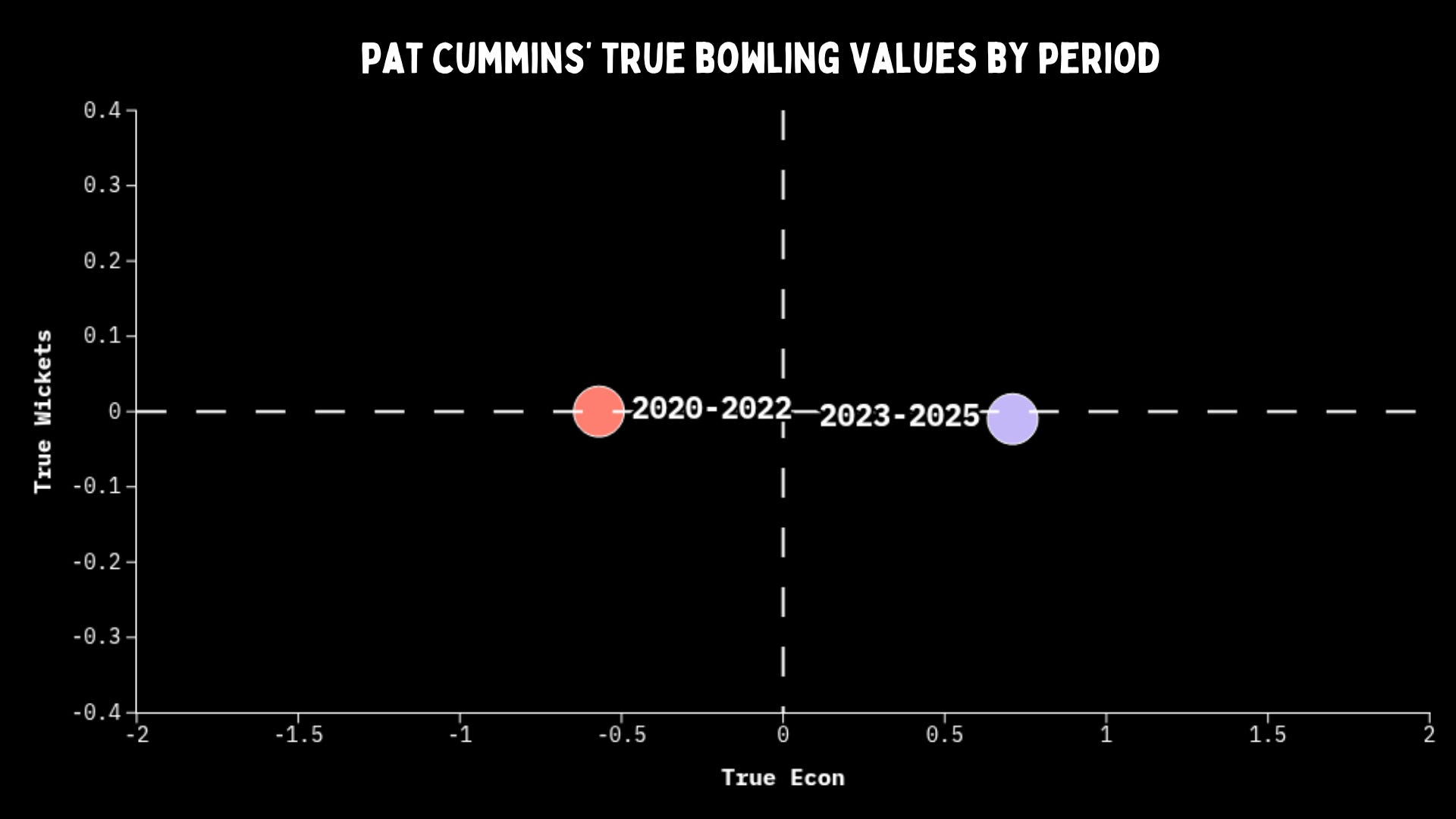
Cummins still gets smashed at the death (though not as much), but he’s a more reliable new ball bowler now. He took wickets more often in the middle overs for KKR, but he is far more economical for SRH.
He also improves his economy versus both RHBs and LHBs, but he also strikes more often against the former.
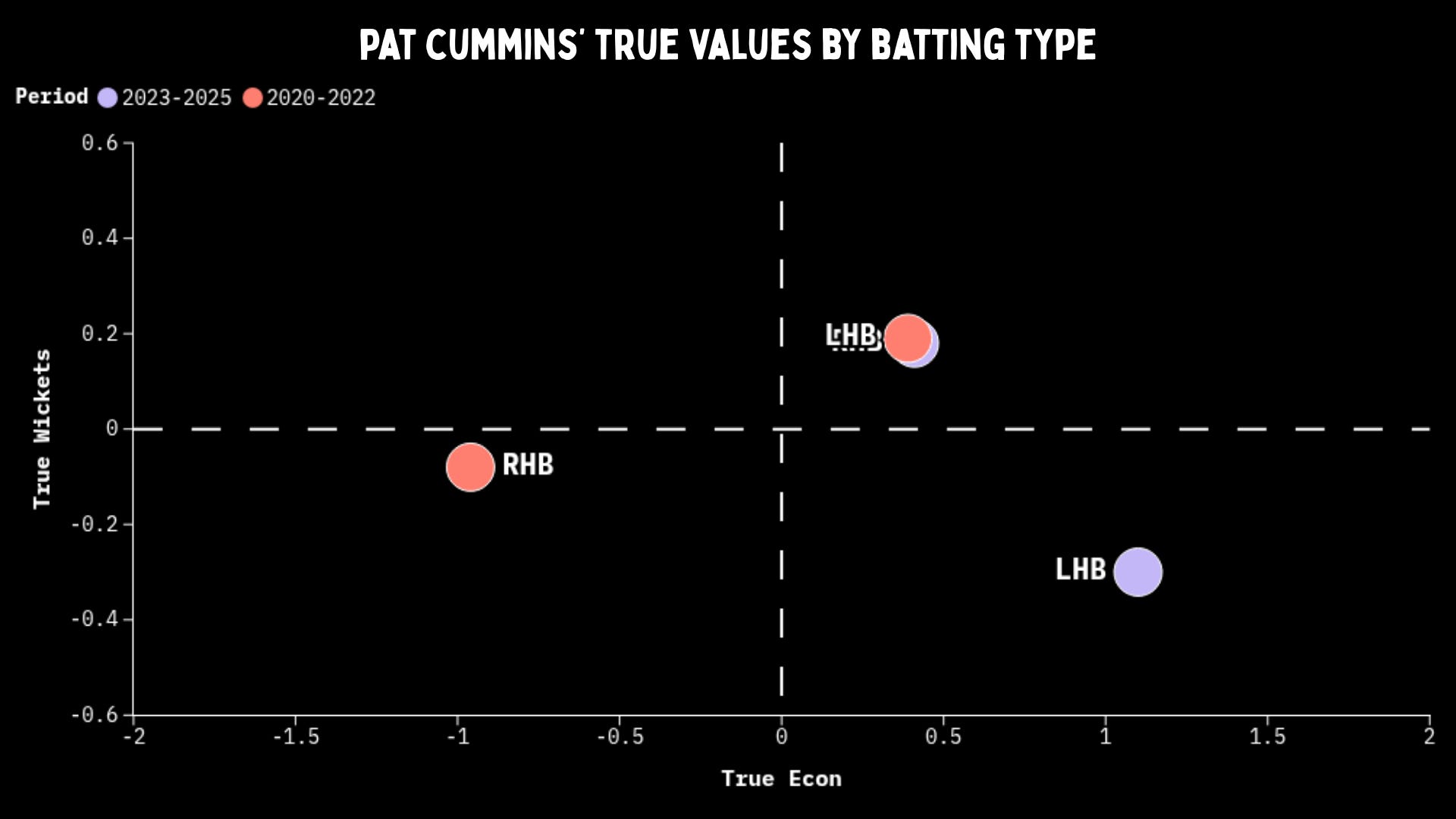
Compared to his reputation (and pay day), he hasn’t really impressed much.
But from where he was to now, he really has improved as an IPL player.
If you concede only half a run more per over in the impact sub era than in the three years before, it just has to put you in this conversation. The argument against him might be that he had been good before outside of the IPL, because his international numbers have always stood up.
Mohammed Siraj
Mohammed Siraj’s quality in first-class cricket was there to see for everyone, but it hadn’t always translated to T20 cricket early on. The game I always go back to was the one against KKR in Abu Dhabi in 2020, where he took three early wickets and went for just eight runs in four overs. From that point onwards, he played all but two matches (missing one each in 2022 and 2024) during his entire RCB stint. It’s at RCB where the term ‘Miyan Magic’ was coined for him.
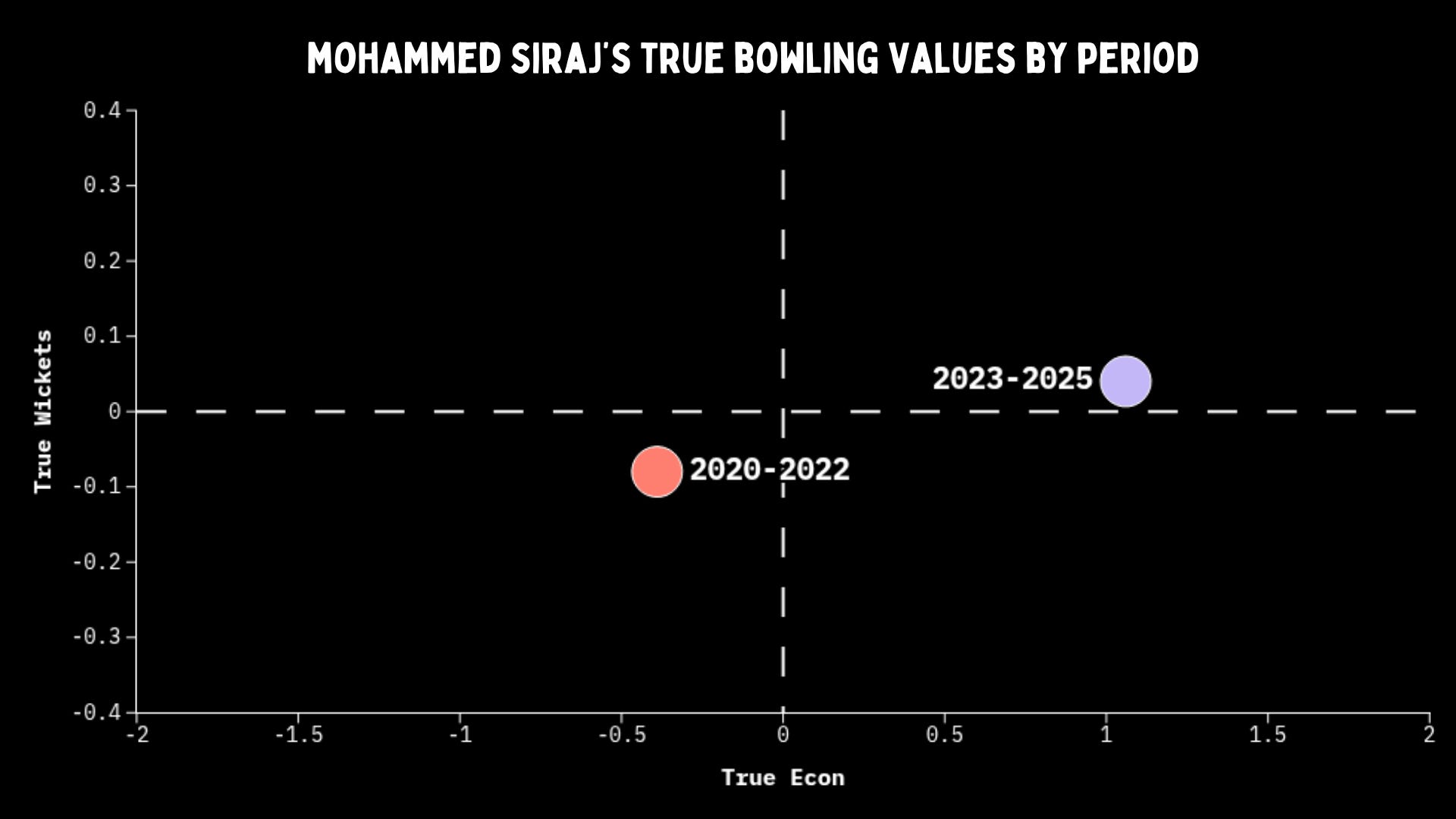
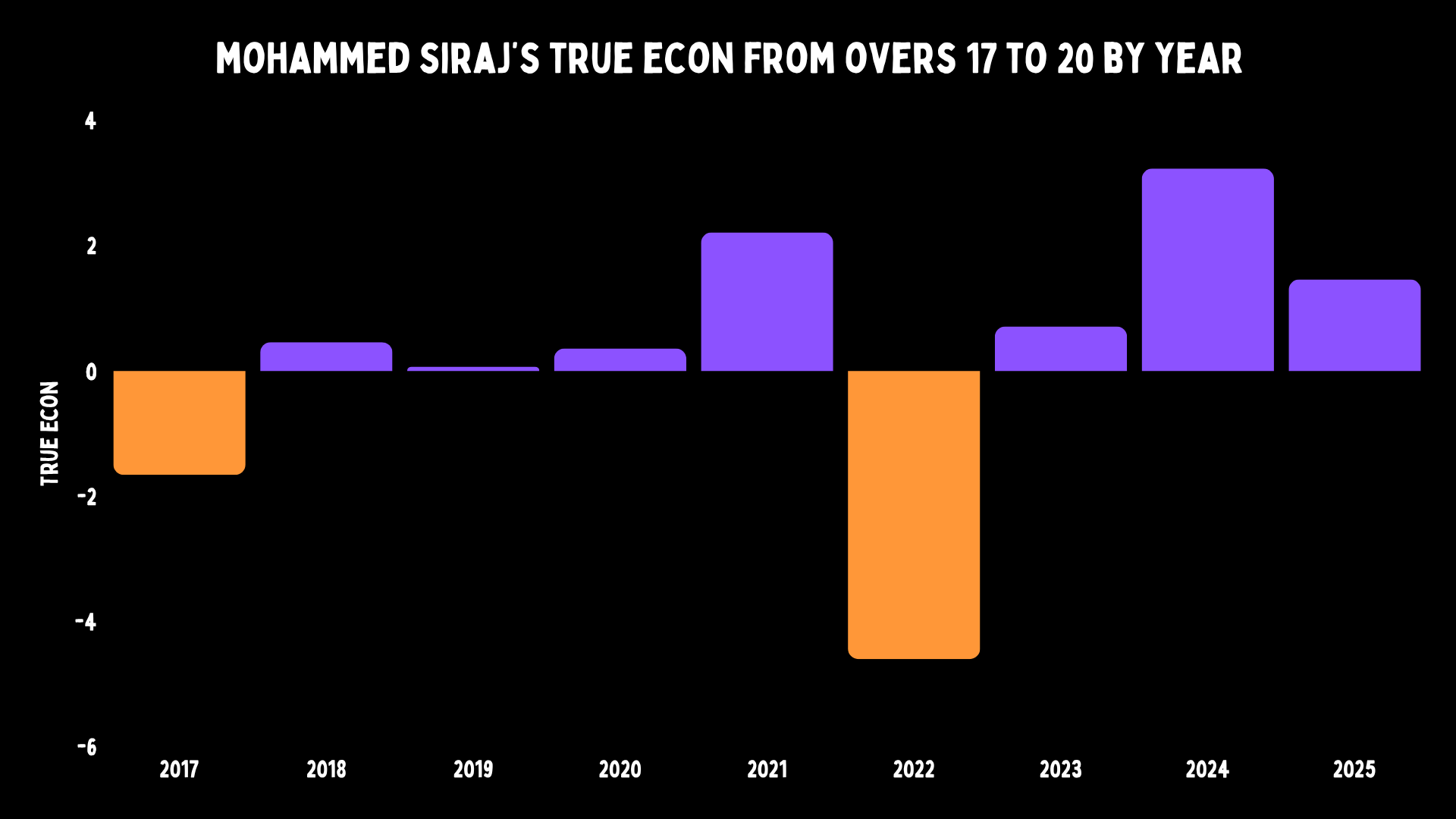
That season, he was a plus bowler on wickets but still below par on economy. He then had a terrific season in 2021, conceding 1.07 runs per over less than expected. Nobody could hit the ball off the square, which meant RCB would retain him over Yuzvendra Chahal and Harshal Patel. 2022 was easily the most forgettable year of his IPL career, even as an Indian regular.
That was the story really, that he would have a great or terrible season.
Since then, people don’t score off him. And in 2023, he started adding wickets. If we break it down by each phase of the innings, he improves on almost every metric.
But the most fascinating thing is that he becomes a far better death bowler.
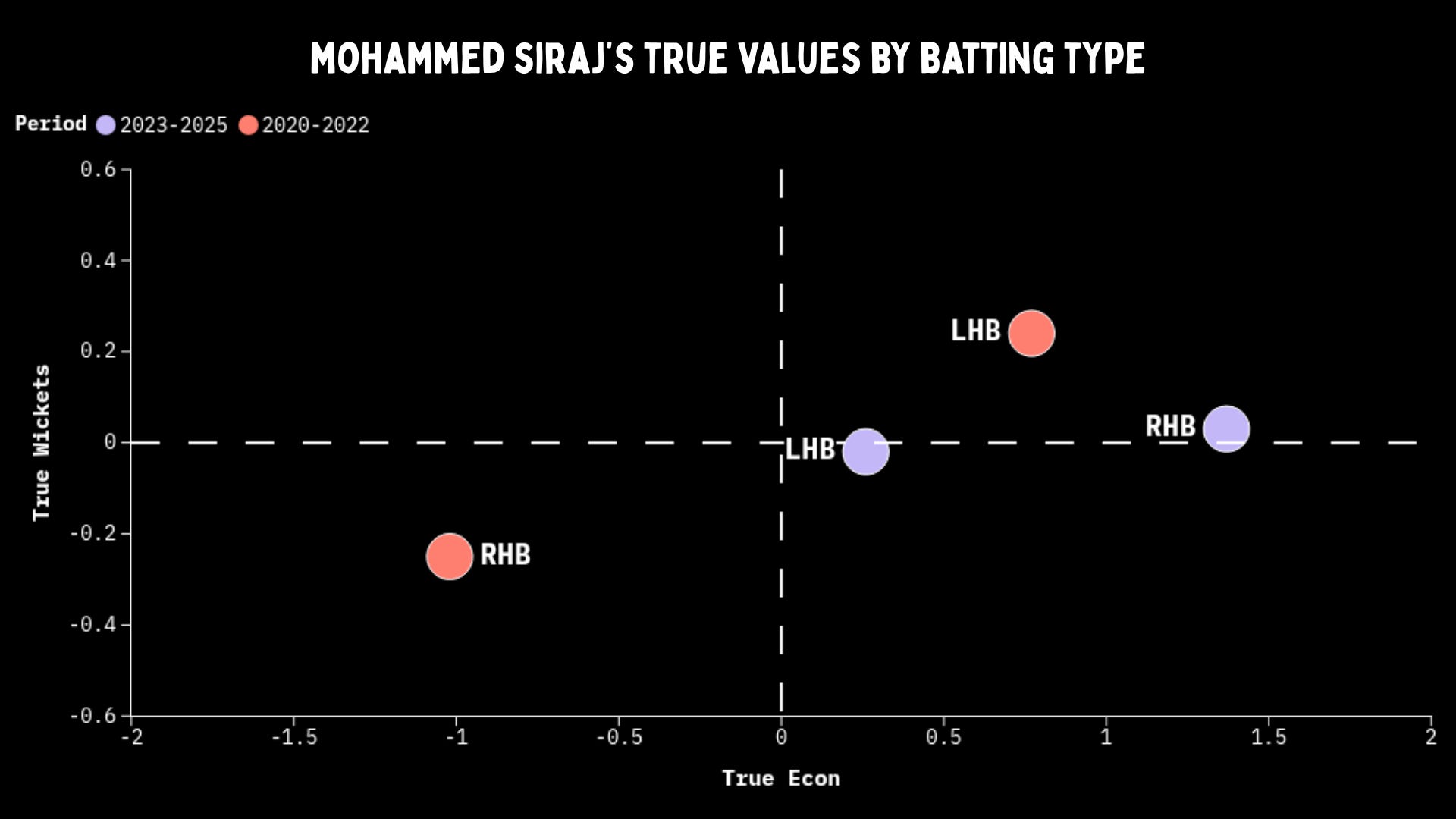
He used to be a menace against left-handers till 2022, but that has flipped against right-handers - which is the better thing to dominate.
RCB didn’t end up retaining him in the most recent mega auction, so there obviously was going to be demand for him in the market. Gujarat Titans won a bidding war against Rajasthan Royals and got him for INR 12.25 crore; a 75% rise from his value at RCB.
Siraj is not a perfect T20 bowler, but he has willed his way into being very effective. And as it often does with him, the effort has paid off.
***
So our long list of nominees is:
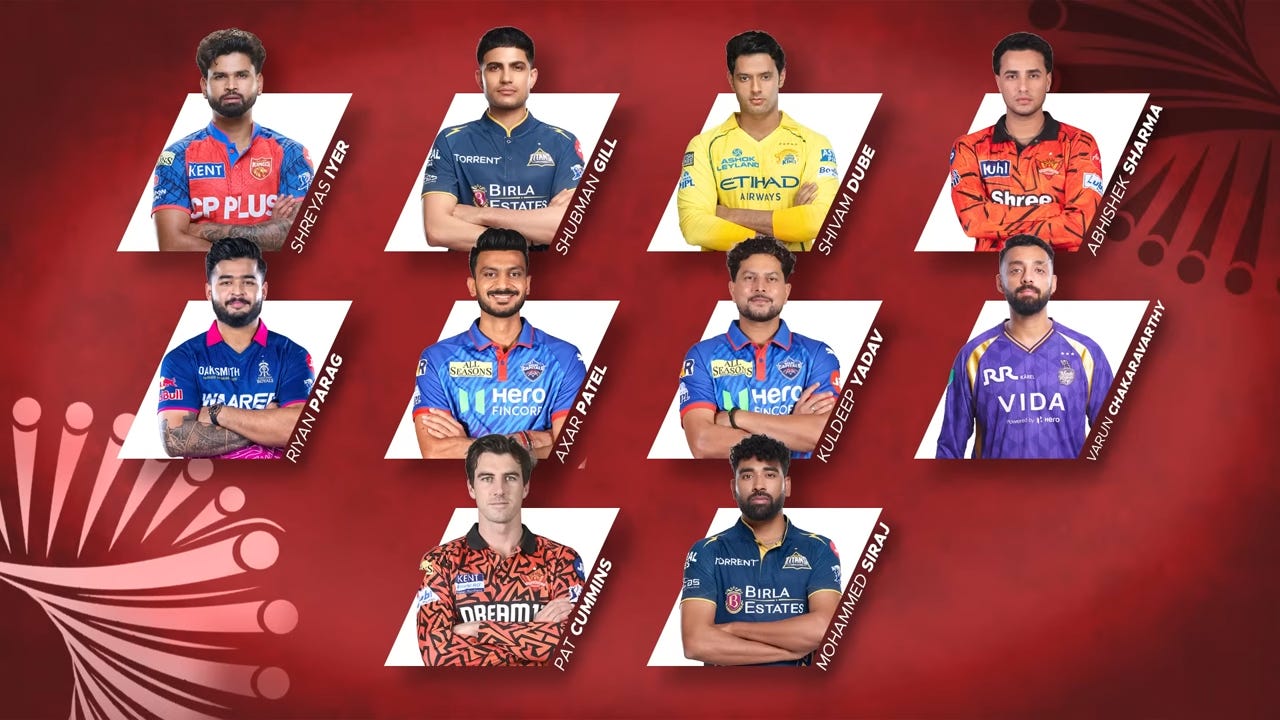
They’re all winners, except they really aren’t. There are three clear standouts here.
A Delhi allrounder who ups his game with the bat, Rajasthan’s newest captain and a Hyderabad opener that completely changes his play style.
The short list is:
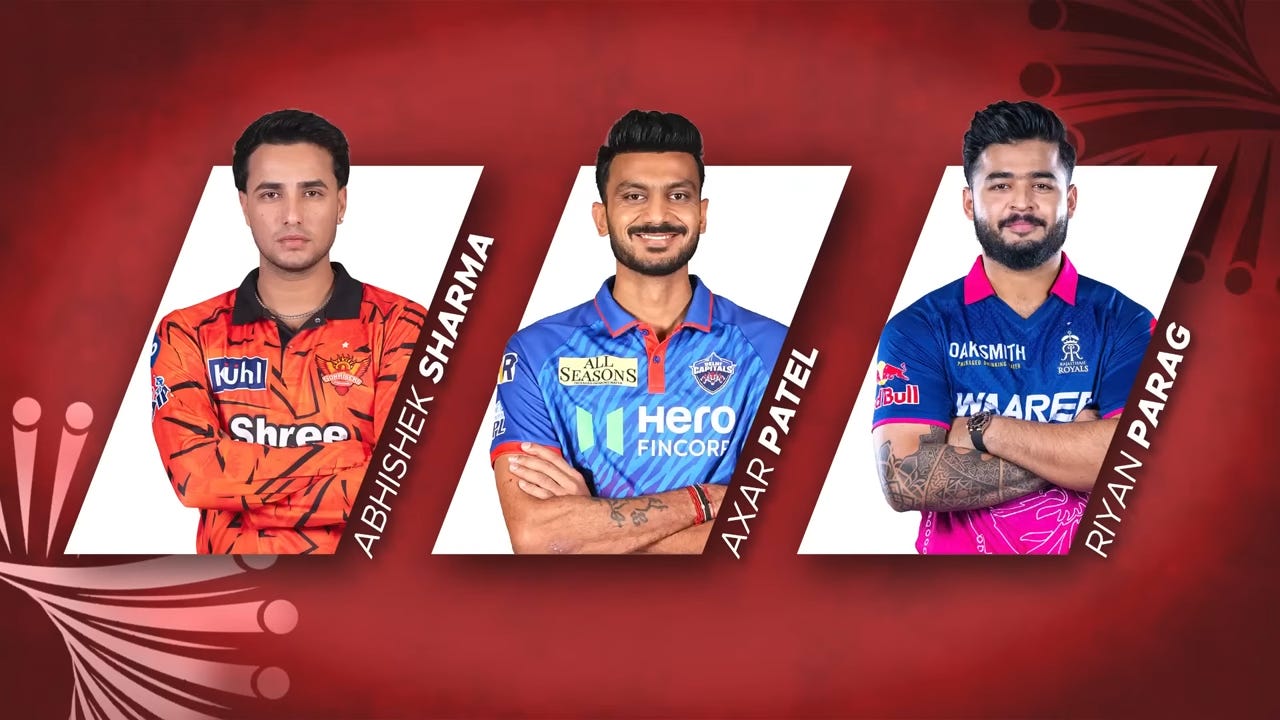
Axar Patel could chip in with the bat. But he’s gone from that to a solid role player against spin who can often float in the top five. He is often worth more than his runs, and his bowling is better in the impact sub era. The fielding and leadership is a huge bonus; he’s just an all-rounder in a game trying to legislate against his kind.
Abhishek Sharma was always a talented player. But the 2023/24 SMAT was when he first showed that he could be a thrasher. Since then, it almost doesn’t matter if it’s a normal IPL game or a T20 World Cup final - Abhishek will go for the kill. It’s easy to dismiss T20 hitters as ‘blind sloggers’, but in truth, what he’s doing requires immense skill and mastery. He can win games in half a powerplay.
Similarly, Riyan Parag’s rise also begins in the same SMAT season, where he proves himself as a skipper and with the bat. We’ve seen him bat in two different ways and find success. Obviously, Rajasthan Royals deserve a lot of credit for sticking with him during his lean phase. You don’t always get Vaibhav Sooryavanshis; sometimes you just have to back the potential for longer.
So who gets this much-awaited non-prestigious award?
The first winner of the Good Areas’ Most Improved IPL player is…
The face of Assam cricket, Riyan Parag Das.
Role clarity helped big time. But he truly went from being one of the worst top six batters in the league to having statistical neighbours like Kohli and Salt. Despite all the talent, it was the transformation to witness.
Riyan Parag has, in our minds, simply improved the most.
Great exercise, could have avoided the ragebaitmaxxing winner pick :D