


Too hot, too cool.
In many ways, this is how the IPL started. With Indian actor Shahrukh Khan alternating from a Matrix parody to full Bollywood epic. Cricket had never been like this before. It was dressed in white, sipping chai, and now we had golden helmets, prisoners taking on wardens with giant spoons, a rock band around some stumps and a posey white woman being bowled by a middle aged Indian mum.
Cricket had tried hot air balloons in the 1850s, pyjamas in the 1970s, and cut out most of the game by the 2000s. But none of this was like sweaty construction workers in a dance off against oiled up muscle boys. Cricket had changed.
If that was surreal, imagine it’s a couple of decades later, and Americans are re-explaining this music video to you.
“It is perfect Pump Up music.”
“How have I not seen this before?”
“Oh man, we’ve got like a construction crew. Yes. Too hot, too cool.”
Until I heard this episode, I’d have said that the best cricket podcasts ever were very different.
“Why science fu****g man, what da science, science is the man.”
That is a near perfect moment, and it happened on a cricket podcast when Usman Khawaja was interviewing Saeed Ajmal. The conversation was about the doosra, and the fact the ICC had banned everyone from bowling it. The Pakistani offspinner was pretty sure it was legal, and that somehow science had ripped him off.
Science is the man is t-shirt design worthy. Usman Khawaja still gets asked about it on podcasts.
Recently we had a new great podcast moment when Australian spinner Stuart MacGill briefly joined the Cricket Unfiltered podcast as a co-host. Then there was a disagreement that stemmed from an agreement that South African fans had gone too far in attacking David Warner’s wife, Candice. MacGill barked, “Well, I think it’s pretty low talking about it, for starters, Menners. You didn’t need to go into details there. I think that’s s***, you’re a f***ing idiot.”
MacGill then screamed ‘move on’, in various ways, and threatened violence. ‘Move on’ isn’t quite ‘science is the man’, but the entire episode is unintentionally hilarious and uncomfortable. It’s like a mash up scene between the US and UK The Office.
There have been many great cricket podcasts episodes over the years. This is a sport built for long conversations. But last year, an episode dropped that was not made by cricket fans; it was made by American finance nerds who tell stories and use SRK’s pop bop to pump themselves up.
Whether it is the best is subjective. The two spinners’ angry moments might be the funniest, but when the Acquired podcast explained the sweaty construction workers, it might actually end up as one of the most important.
Because, while you may not have heard this podcast, you know who did? Almost all the new investors in the IPL.
***
When people talk about the history of America and cricket, they usually start with the first international game being played between Canada and the USA in New York, decades before the Ashes.
But modern USA cricket is even more interesting. Pat Cummins’ manager, and former Fijian seamer, Neil Maxwell tried to make a league in the US in 2012 after his stint in the IPL. It was a partnership between the New Zealand and the US boards.
It didn’t happen. Like most things with US cricket, dealing with the board makes it almost impossible. In a cricket community stacked with terrible governance, the various USA boards have been standouts in mismanagement and worse.
The old board, and the one that replaced it, have both been suspended by the ICC. To be that bad at your job once is remarkable, but they have done it twice. Peter Della Penna, a tireless chronicler of all that is shit and horrific about their governance, reported on things like security guards outside of meetings to stop people voting. And for his trouble, he was called a knife salesman and blogger.
The biggest success for cricket was the All Stars tournament where you could pay to see Curtly Ambrose bowl very slow to great batters. It was an impressive moment, but it also only had the single edition before disappearing again.
League ideas came and went. Even the CPL tried to expand into the US. It was always part of their plan. The West Indies market is so small, and on top of it is the biggest sporting platform on earth. The Canadian league was also interested in the US.
Everyone was. There wasn’t a shortage of people trying to make cricket work there, or even offering up resources, but nothing seemed to stick.
Until Major League Cricket finally broke through. Their first season was 2023. A long time after the T20 franchise bubble started. But they had owners like Satya Nadella, Ross Perot Jr and Anurag Jain (founders of the venture capital firm Perot Jain) as well. These were big money people, and yet, for all that, the first season was almost cancelled a couple of weeks from the start. The days before it began, crews worked overnight just to get the games on.
American cricket seemed almost cursed.
But things were changing culturally in the US as well. Kumail Nanjiani (who is currently fitter than any of the Pakistan players) went from Silicon Valley to making his own movie, the Big Sick. He has been in Marvel movies as well. Yet, he’s also a cricket guy, who mentions it on major chat shows and puts it in his movie.
Hasan Minhaj had a huge Netflix show, and on that he did an entire special on cricket, including a truly wondrous performance from comedic legend Lalit Modi.
The Big Bang theory was the largest show in the US at one stage, and you see an episode where Raj Koothrappali, played by Kunal Nayyar, talks about R Ashwin surrounded by Indian cricket shirts in a bar.
These are huge stars, and they’re talking cricket to people who really know nothing of it.
Before these three, America’s most famous subcontinental man was actually voiced by a white guy. For a TV show with a regular returning Indian character, taking 21 seasons to get a decent cricket gag in feels like an error.
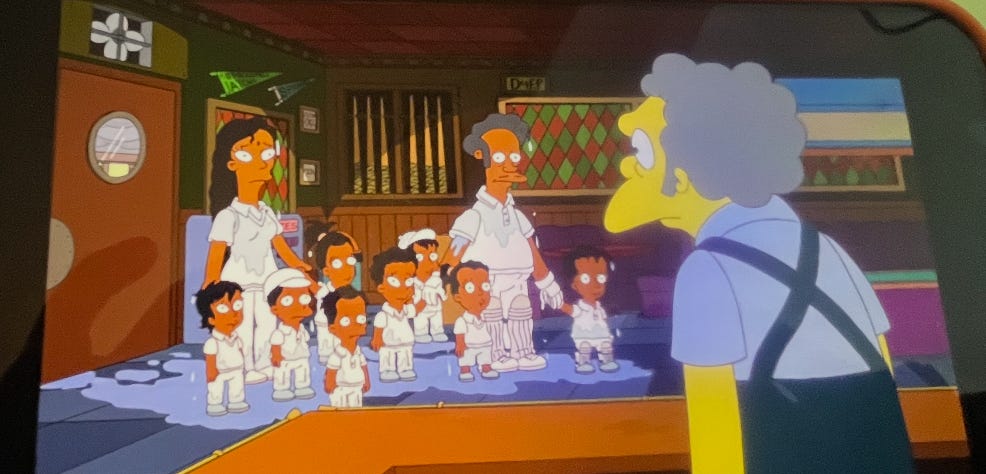
But perhaps the most important piece of content on cricket was made not by Americans, but by an Australian kids show called Bluey. This episode made Americans google the sport. This was not just knowing that cricket existed, but that it was magical. Cricket has never looked this beautiful, and it sold it better than any board ever has.
Americans won’t be across all of these, but cricket exists more now. It seeps into their culture almost subconsciously.
On top of all this, cricket was making a play for the US again. The game coming to the LA 2028 Olympics was a big deal. And in the middle of that, the USA was co-hosting a World Cup in which their team beat Pakistan. With Major League Cricket existing, the sport was just more prevalent. US betting sites had a tab for it. This was not the great hidden sport it had been through most of the 1900s.
It was everything that cricket had dreamed of, potentially approaching a tipping point in America.
All of these things have been adding up. So whether or not the Acquired podcasters are watching Bluey, saw USA’s super over victory against Pakistan, or follow updates on new sports at the Olympics, the environment of cricket is larger. And so their episode does not come from nowhere, it is the continuation of Americans noticing cricket.
***
Donald Trump trying to say Sachin Tendulkar’s name became a meme. While it is fun to laugh at him, it is part of cricket’s problem that someone as famous as Sachin isn’t known globally. Cricket’s issue has always been that it’s the world’s smallest big sport. It was important enough for Trump to mention, but not enough for his team to make sure they got the name right.
A few years back, I tried to get money for a cricket media startup called 99.94 DM. Most of the original interest came from US VC firms who realised that cricket was a big deal. The issue was, they didn’t really understand what that meant. They would agree to the pitch, but then every minute or so would be a question about cricket. It was like trying to sell blues music to an alien.
There was an added issue. In the West, there is a scepticism of India. Those who knew about it were aware everything worked differently. No one ever doubted you can make money from that size of a market. But can you keep it, people are not as sure. Investors get worried at having relationships with politicians, black money is still used, and the way to make things work in India is a whole culture to itself.
Then you have the IPL, which was set up by a man who is currently in exile from his own country. Lalit Modi was a visionary, but those who have looked into the original biddings suggest that it was a complete mess. We already know the process was a sham. They essentially wanted certain owners, and then guaranteed them amounts.
The thing that made overseas bidders more interested was IMG, who were co-founders of the league in a way, and the ones that kept the lights on. But in 2021, BCCI brought everything in-house.
That has worried people too. The BCCI doesn’t have great social media, or even a strong YouTube presence. They are secretive, and yet quite often leak. And during the IPL’s short run, the Supreme Court of India took over the BCCI in 2017. In 2021, IMG left. These kinds of things spook investors, especially in markets they don’t understand.
There is only a four year gap from the BCCI being taken over and them kicking IMG out. Things like this conspired to mean that the rush to get on board with the IPL from overseas investment was muted.
But the thing is, Americans are obsessed with money and sport. All they needed was a match. Or, a podcast.
***
Acquired started as two finance nerds in Seattle. Unlike most podcasts, they are not a weekly look at what is happening in their industry. They make episodes that are really more like books on their subjects. They find a company, and dissect every part of it.
It is considered by many to be the most important podcast in the finance world.
Their skill is storytelling. You don’t need to care much about customer acquisition costs to enjoy their 7 hour opus on the history of Nintendo. But at the end, you’ll know everything about how the Japanese giant went from Nudie playing cards to Mario Kart.
It’s the kinds of stories people tell their friends about, and so this became an explosive word of mouth show.
So when they did an episode on cricket, it again got a big reaction from their fans. An entire class of Americans suddenly understood cricket, or at least, its worth. Acquired did not build new cricket fans, it built investors.
***
Nestled between an episode on Rolex Watches and Epic Systems, is Acquired’s take on the IPL on their YouTube channel. The episode only has around 50k views, despite their 281K subscribers. But their videos are not where they get hits, because this is not a visual podcast, and neither is it for the normal YouTube audience. It is for people with money.
And it talks about them too, focusing on Lalit Modi, oddly skipping his colourful legal past in America, and instead delving into how he came to power and his war with Rupert Murdoch. So much of the early story is about this tussle between the billionaire and the man who kept getting in his way.
But where the episode is at its best is the breathless way they describe the decisions that were made to set this startup flying. Lalit’s obsession with celebrities opened the door for a whole new audience that sport had never seen before, women. And also the fact they were not really fighting other sports, they went after Bollywood and soap operas.
Their obsession is how differently this works than other major US sports, and they are right. Modi was inspired by America, but liberated by a bigger and different market.
But where this gets interesting is how they talk about where the league could go. They compare it to the NFL, and ask if it could surpass that as the biggest league on earth.
Can you hear that? That’s all the billionaires investing in sport around the world salivating at once.
The story of the IPL is linked to India. People will say, how can they make this much money so fast, but the truth is how has it taken this long, for the league, and nation. And what we are really seeing is that the opportunities, for cricket, and other things, are now opening up at massive rates. The IPL didn’t need overseas investment; the Bajaj family doesn’t own a team yet. And neither do many of their other billionaires.
But what American - and eventually Chinese/Saudi and Europe money - does is supersize a league that is already flying. It was going to move quickly, this adds extra rocket fuel.
The Acquired podcast is something I heard about when it was released, but quickly forgot. Until a couple of weeks back I was chatting to someone who was bidding for an IPL franchise. Instead of trying to sell US investors on cricket, they suddenly realised they were already primed, because almost all of them had listened to the podcast.
A few days later I was talking to another potential owner of a franchise, and he brought the podcast up unprompted as his secret weapon. I messaged others who had been investing or trying to in cricket, and they all said this podcast episode had been a part of their journey.
The sport they didn’t understand in the country that confused them had suddenly been opened up. All by two guys who told the crazy story of how the IPL got this big.
-
There is no way to explain Shahrukh Khan to someone who doesn’t understand India. You often hear Tom Cruise offered up as an example, but it isn’t the same. If anything, SRK is really a combination of Cruise and Michael Jackson, but even that doesn’t quite capture his status.
But people get fame, and they get fun.
Americans get showbiz, sport and money.
They may not understand cricket or India. But SRK’s Kolkata Knight Riders anthem is not entirely in English. It is actually a bunch of different languages, just showing how complex India is as a nation. But at a certain point, you don’t need to understand that much to get it.
The IPL is too hot, and too cool.
And if you get that, you will want to invest.
Fucking depressing that we live in a world where it's mandatory to get excited about losing control of the things we love to a bunch of "Americans" and "billionaires".
ngl i came in here reading the headline and expecting to find stu macgill