



T20 batting in 2026 is like Michael Phelps swimming in a pool, with meth in his veins instead of blood.
The Impact Sub in the IPL might have juiced the scoring, but once it showed the way, everyone has jumped on board.
A couple of years back there was one Abhishek Sharma. Today you could count at least five. One of them is a bowler-murdering mid-teen machine.
India might be at the forefront of this batting blitzkrieg, but other nations have made strides as well. Travis Head is one half of Travishek, and Heinrich Klaasen has changed spin bashing forever.
Australia and South Africa are undoubtedly two teams who have made significant efforts to evolve, and have enjoyed a decent amount of success with this intent-pilled modus operandi.
And then you have England, the poster boys of upping the volatility. They might not have the results since winning the T20 World Cup in 2022, but they have known no other way for quite some time now. The White Hot Revolution may well be dead, but that hasn’t stopped the English lads from swinging for the hills.
When we think of international teams who simply haven’t received the space age batting memo, Pakistan is perhaps the first name that comes to mind.
They might not be the worst T20I unit in the world, given how they were runners up in the Asia Cup, but currently it would feel much safer to back New Zealand or the West Indies ahead of them in a World Cup.
Pakistan were one of the most dynamic T20 sides when the shortest format kicked off, and two decades later, their batters are throwing the kitchen towel at everything. The sink is fixed firmly to the floor with the strongest adhesives money can buy. Even when they have tried to up the ante, they have failed miserably, unable to shift gears.
Perhaps the biggest contributing factor here is a skill deficit, but for a team that made the semi-final and final of back-to-back T20 World Cups at the start of the 2020s, this is a catastrophic fall from relevancy. The unpredictables have become painfully predictable, and while their pace bowling stocks have also dipped, batting remains their Achilles heel.
If you are convinced to play Babar Azam as a fail-safe batter at number four in a T20 World Cup in Sri Lanka, then something along the way has gone seriously wrong. But if not Babar, then who?
It is a question that desperately deserves some answering.
***
In this day and age, if you take ten deliveries as a batter just to get your eye in, your value-add in T20s diminishes drastically. The best in the business are attacking the ball from the word go and refuse to slow down in a later phase. If you have scored a sixty-ball ton in twenty overs, more often than not, you have let your team down.
Slow starters are fast running out of fashion, struggling to hold down their spot in top teams. They still exist, but it seems almost inevitable that they will be rendered obsolete at some point by those who start smashing the ball early in their innings.
The top echelon of fast scorers are a new breed altogether. You are a hot T20 batting commodity if you possess the freak gear, and that term is synonymous with Abhishek Sharma.
The 2024 edition of the IPL, in which Sunrisers Hyderabad lost the final, is where all of this madness begins. Since the start of that tournament, Abhishek has averaged 35 with the bat in the IPL and T20Is, striking at 196, and this includes a major slump in form during the 2026 T20 World Cup. His nearest neighbours in this period are Travis Head and Phil Salt. Head averages 31 at strike rate of 173, while Salt is at 35 and 171 respectively.
In these two plus years, Abhishek’s average in his first ten deliveries is 49, and he’s striking at 185. His odds of surviving those first ten balls are quite high, and rather than slowing down after, he takes his ball striking up a notch.
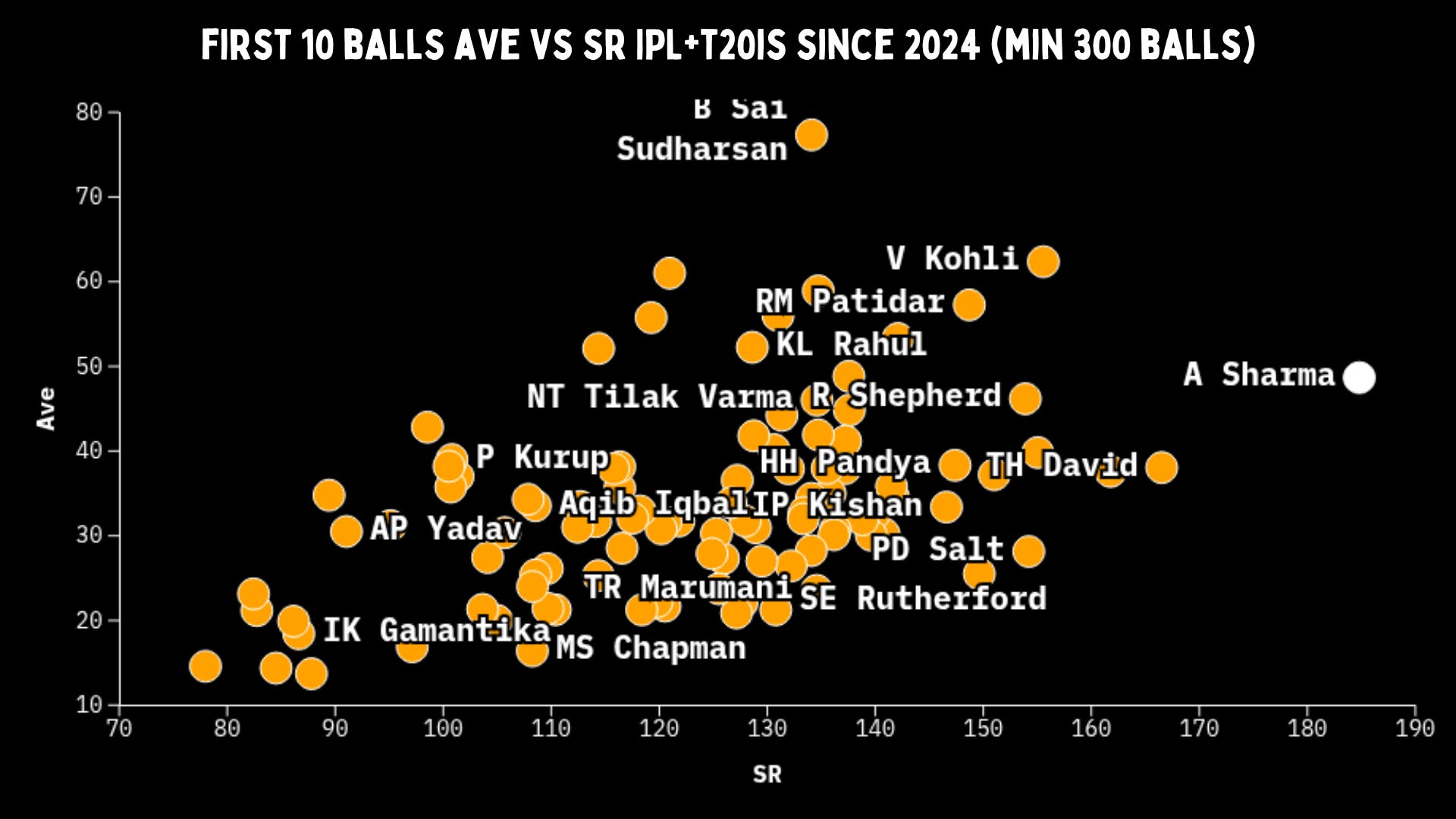
It is worth noting that in the ongoing IPL season, Abhishek doesn’t stand out as an anomaly anymore. He is joined by the likes of Priyansh Arya, Vaibhav Sooryavanshi and Rajat Patidar, who are all striking at north of 180 at an average of 35 plus in their first ten deliveries, for a minimum of 40 balls faced. In fact, Abhishek is not even topping this list of mad maxes.
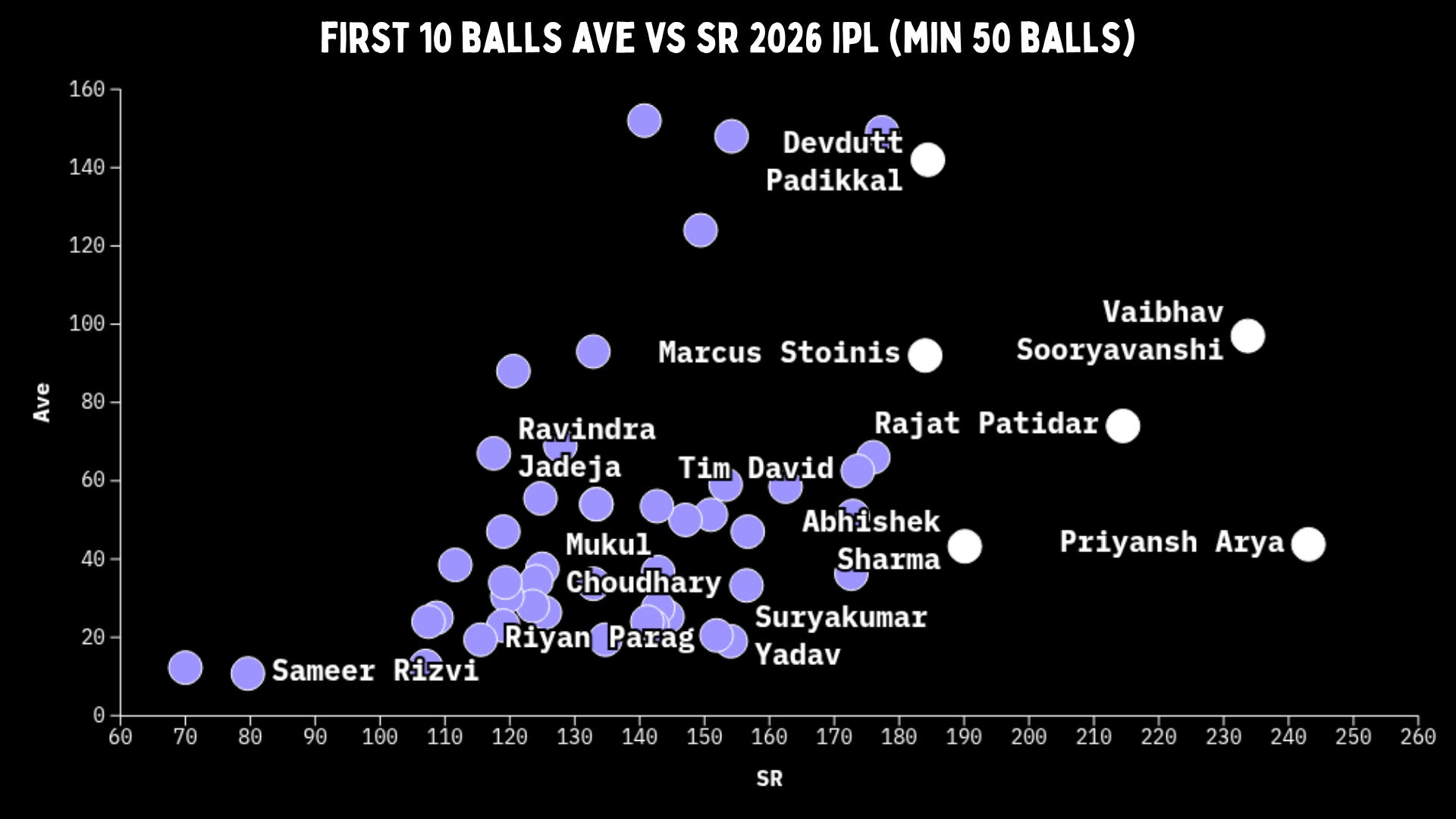
Unsurprisingly, the 2026 edition of the IPL is already the fastest scoring franchise T20 competition in history, and India’s batting output in the shortest format is hitting unprecedented highs. So perhaps it’s unfair to set their belligerence as a benchmark. Also, the Impact Sub rule definitely does play a role in allowing these batters to go gung ho.
***
But comparisons aside, where do Pakistan’s batters stand in terms of quick run-scoring in T20s?
If we look at the first ten ball data from the recently concluded PSL season, there are 31 batters who faced at least 40 deliveries, who averaged over 20 with the bat with a strike rate of 130 and above.
Out of this cohort of batters, there are 17 who hail from Pakistan. Hassan Khan would have made it 18, had he not pledged his allegiance to the USA.
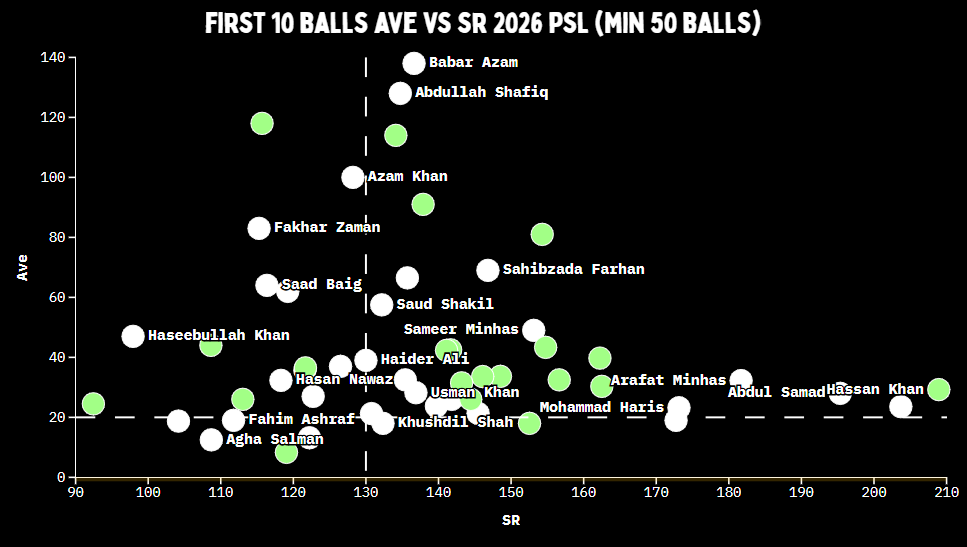
Both Fakhar Zaman and Salman Ali Agha did not make this list of 17, which means that Pakistan’s most mainstream attacking batter has underwhelmed, and their skipper in T20Is is nowhere near the conversation. It should come as no surprise that Mohammad Rizwan also finds himself on the outside, along with Saim Ayub, who has been a better carrom ball bowler than batter in the T20 format in recent times. He’s currently in his reverse Sunil Narine arc.
Other noteworthy names who failed to make the cut are those of Hasan Nawaz, Khawaja Nafay, Azam Khan, Mohammad Naeem, Khushdil Shah and Irfan Khan Niazi.
Only one Pakistani batter had a first ten ball strike rate in excess of 200 in this PSL season, and his name is Maaz Sadaqat. His average of less than 24 suggests that he has not fulfilled his role consistently enough, but he still stands tall as an outlier, with the freakiest of gears.
In all T20s, Maaz has averaged over 32 striking the ball at 148 plus, which reassures the notion that he is someone Pakistan could place their bets on, especially when it comes to maximising the powerplay. Someone in the mould of Imran Nazir or Shahid Afridi is the need of the hour, and Maaz could be that guy. It helps that he can bowl left arm off spin and is a livewire in the field.
Going back to the 17 Pakistan batters shortlisted, we need to determine how many of them had a successful PSL season in terms of ball striking. If we look at batters who had a minimum strike rate of 140 in this PSL season, that number drops down to 14, with Haider Ali, Saud Shakeel and Abdullah Fazal exiting the race.
And so, we have established the Fast Fourteen, spread across various roles.
Arafat Minhas and Shadab Khan are spin bowling allrounders, Farhan Yousaf and Shan Masood batted in the middle order in this season of the PSL, Abdul Samad was a finisher, Mohammad Haris and Usman Khan are the only full-time wicketkeeper batters, and everyone else bats in the top three. Even the two keepers prefer a top order spot.
It really should not shock anyone why Pakistan have fielded about a million openers in their T20I team in recent years. They have far too many batters in their ranks who love batting up top.
Six of these fourteen batters have both a positive true average and true strike rate in their first 10 balls - Babar Azam, Sahibzada Farhan, Sameer Minhas, Arafat Minhas, Abdul Samad and Farhan Yousaf.
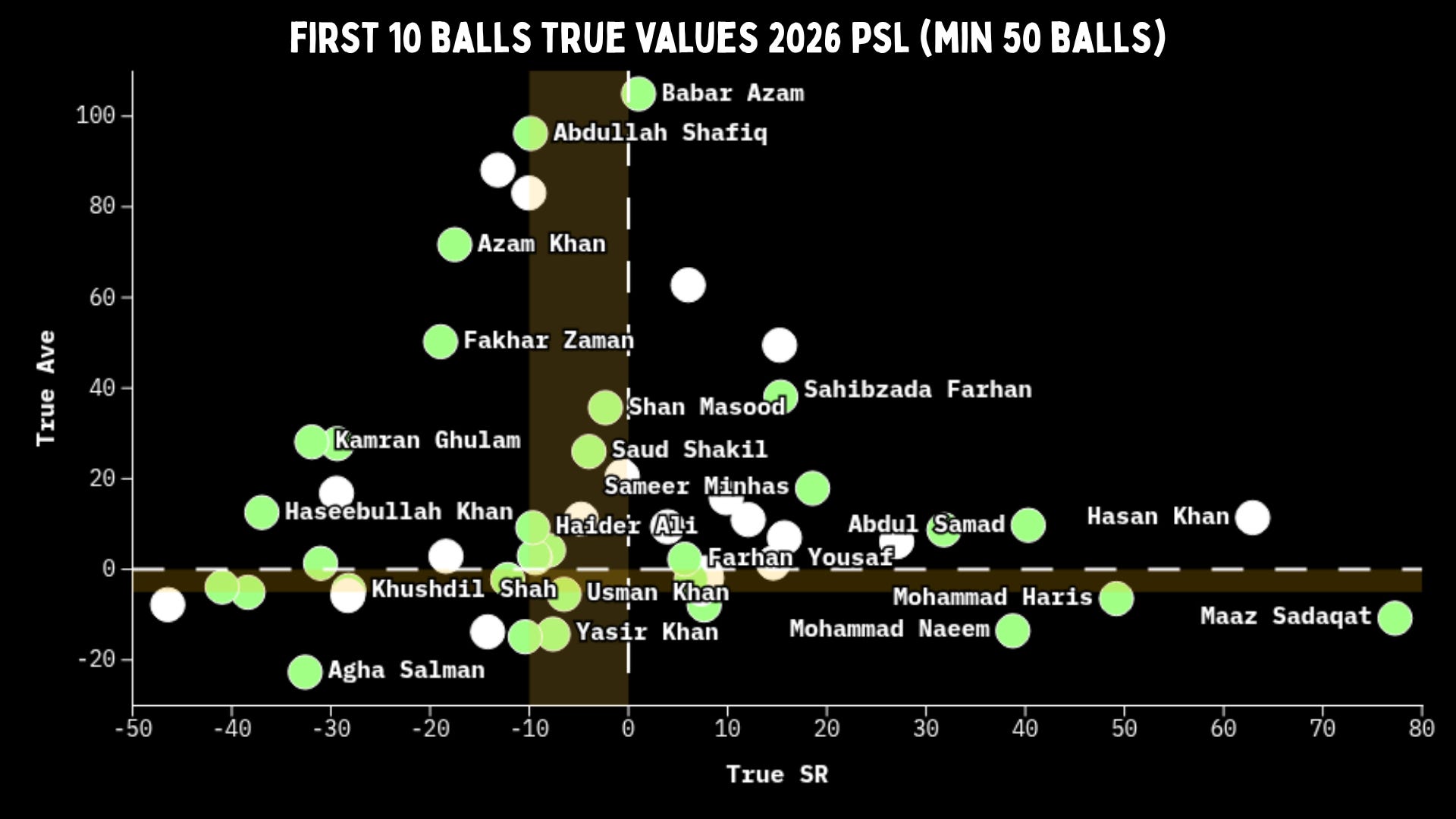
Babar Azam just makes the group with a true strike rate of 1 and a true average of 105. He was only dismissed once in his first 10 balls.
Sameer Minhas and Sahibzada Farhan both have a true average and true strike rate over 15. Farhan was comfortably Pakistan’s best batter in the T20 World Cup and he has continued that run of form in the PSL. Sameer Minhas seems to have a similar starting profile to Farhan, making him an interesting backup to him. The teenager is a technician, and doesn’t force slogs like Farhan does on occasion, which makes him different as a strokemaker.
Abdul Samad averaged 28 with a strike rate of over 195 in his first ten deliveries. Those numbers are second only to Maaz, although in a different role as a finisher. His true average of 10 and true strike rate of 40 in his first 10 balls is impressive for a batter who’s playing in a highly volatile role, making him a very reliable lower-order hitter. He also doesn’t have any proper competition in this role, which helps his case further.
Arafat Minhas, Sameer’s elder brother, also has a true strike rate above 30, with a true average of 8, making him another formidable death overs hitter. Him being a spin bowling all-rounder means he also adds balance to the side. Depending on the squad composition, you can have one or both of him and Samad.
Yasir Khan and Usman Khan have both a negative true average and true strike rate in their first 10 balls. Though Usman Khan managed to have a great season batting in multiple roles, Yasir Khan had a middling one. Pakistan need someone to keep wicket, which benefits Usman.
Two batters have a positive true average but a negative true strike rate - Abdullah Shafique and Shan Masood. The latter has been starting decently, with a true average of 35 and a true strike rate of -2, whereas the former has not been dismissed in his first 10 balls this season. It seems very intentional, as he has a true strike rate of -10. He’s definitely not someone you want in the first XI, but if you want a Babar Azam backup, he’s about as good as it gets. His issue though, seems to be making big runs. He was almost impossible to dismiss in his first 10 balls but he only went past fifty once.
While Maaz has a true average of -11, which is outside our allowed range, his true strike rate of 77 sets him apart. He’s batting in a different league altogether. The high volatility starts are more than worth the trade off. A good Maaz day ends the game in the powerplay itself. Since he’s only 20, he should get better and better. In an ideal world, Pakistan should pair him with Farhan to open the batting.
Shadab Khan, Shamyl Hussain and Mohammad Haris have positive true strike rates but have a true average below -5. Like Maaz, Haris’ true strike rate of over 50 is worth the trade off. However, if you play both of them in the same team, you could easily be two down for not many runs. The best option is to have Haris as a second attacking opener option, behind Maaz in the depth chart.
***
Not all batters who succeed against pace do well against spin, and vice versa. Some excel versus both bowling types. The Fast Fourteen are no different.
Four of the fourteen have a strike rate over 200 versus pace whilst starting - Arafat Minhas, Maaz Sadaqat, Abdul Samad and Mohammad Haris.
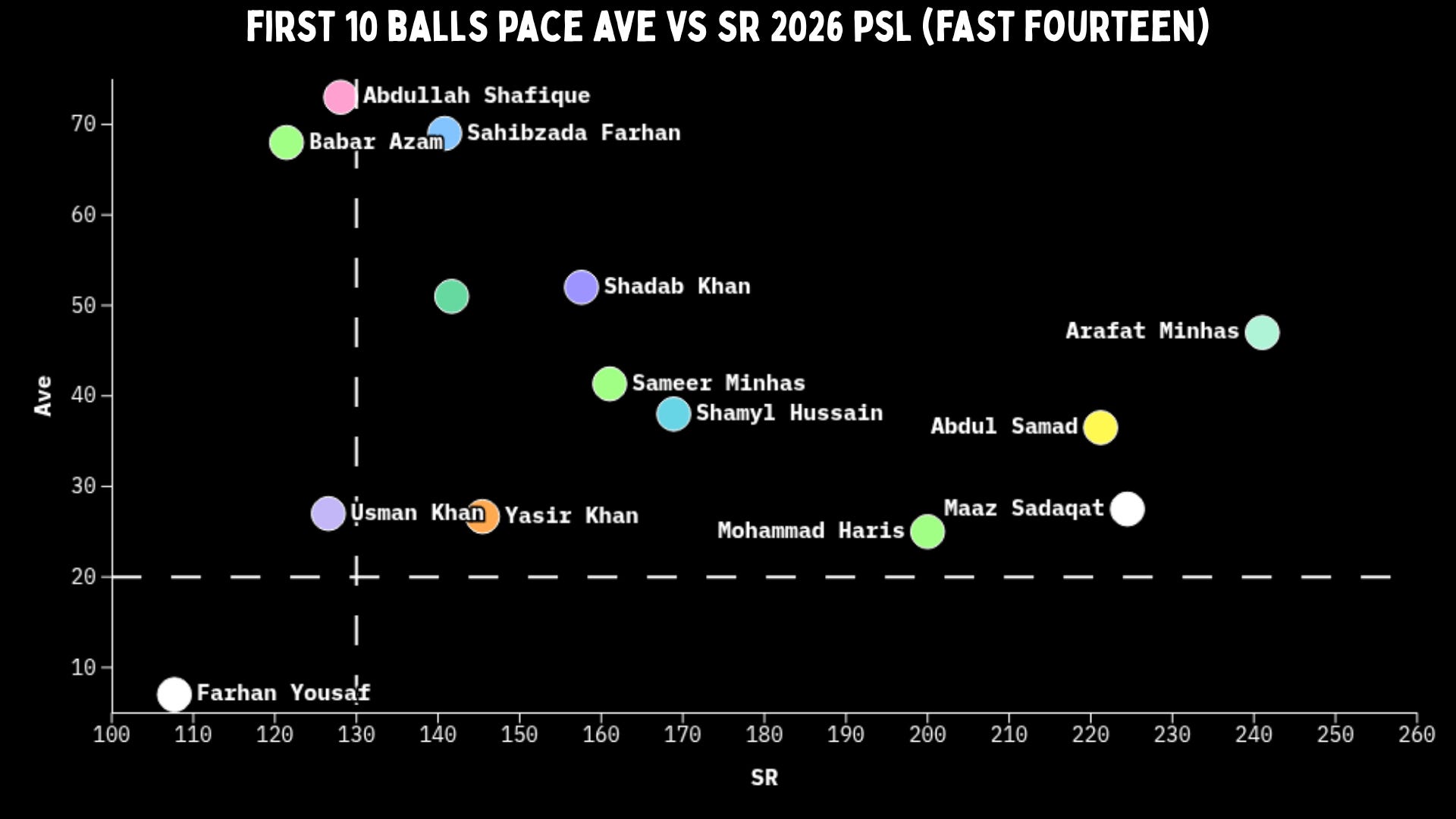
Maaz, Arafat and Haris have a true strike rate over 80. The elder Minhas brother seriously impresses here. A true average of 24 combined with that insane true strike rate means it’s fair to say he’s the best starter versus pace in the PSL. In a similar mould is Abdul Samad, with a true average of 21 and a true strike rate of 60, which works like a charm considering both power hitters mostly bat in the death overs.
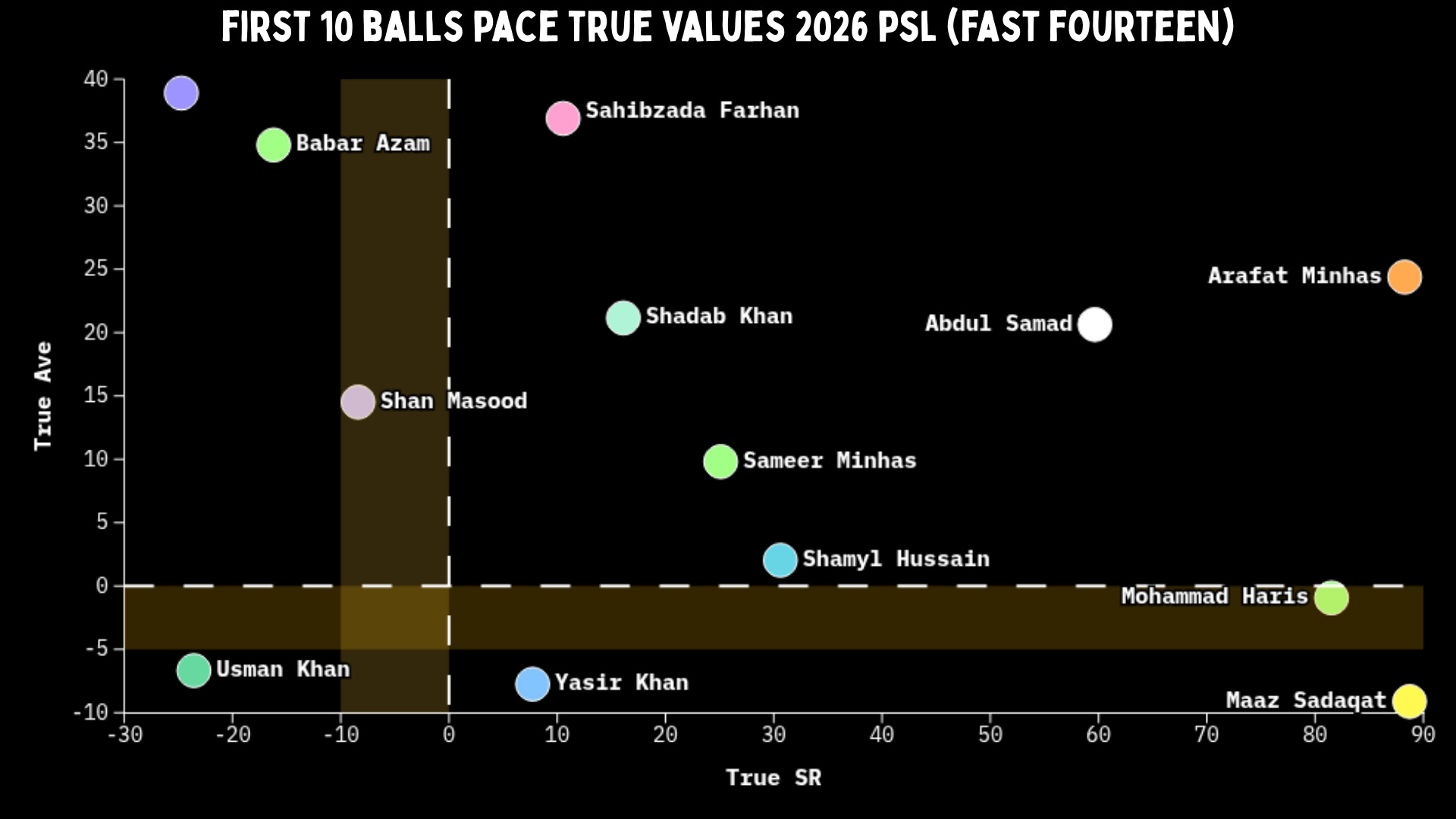
In the next tier, we have Shamyl Hussain and Sameer Minhas with true strike rates over 25 at positive true averages against the quick stuff.
On the opposite extreme, we have Babar and Abdullah who are very slow starters versus pace. With true averages in excess of 30 and true strike rates below -15, they like to take their time against seamers.
Sahibzada Farhan impresses again with the second-highest true average of 36 starting off against pace bowling, whilst maintaining a true strike rate of 10, and Shadab Khan has a true average over 20 and a true strike of 16, which is also solid.
Usman Khan is the only batter to have both a negative true average and true strike rate facing pace early on. A lot of that might have to do with how he came into form towards the business end of the recently concluded PSL season.
In a stat that might break space-time continuum as we know it, the two fastest starters versus spin are Babar Azam and Maaz Sadaqat, both going at 10 runs per over.
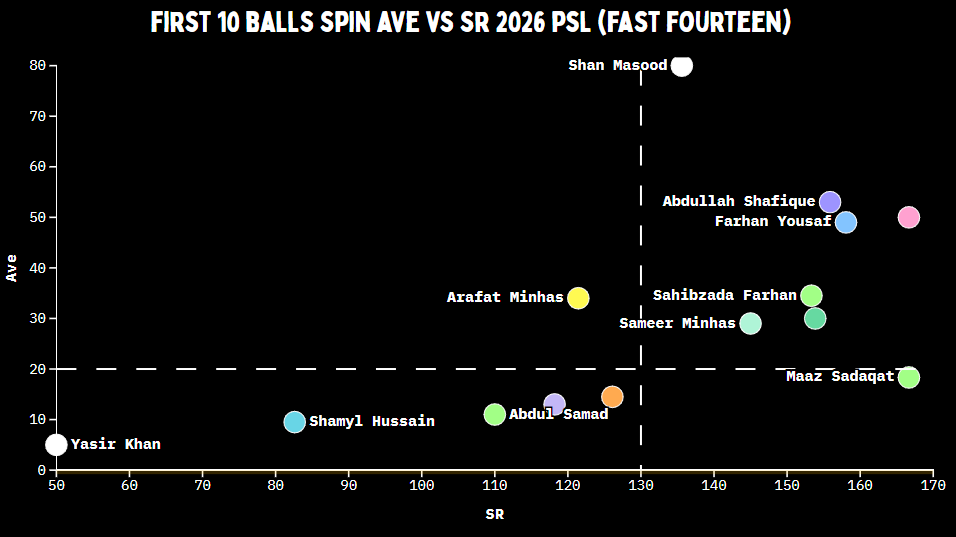
That said, Maaz’s true strike rate of 51 is nearly double that of Babar’s, which checks out given their style of play. The latter, however, was someone who used to get stuck facing spin bowling, and has clearly unlocked a new gear in the PSL.
The bulk of Babar’s record run tally of 588 in this PSL season was scored against spin bowlers. A grand total of 325 runs, to be exact. He scored them at an average of 81 and strike rate of 156, which quite frankly is unbelievable for Babar.
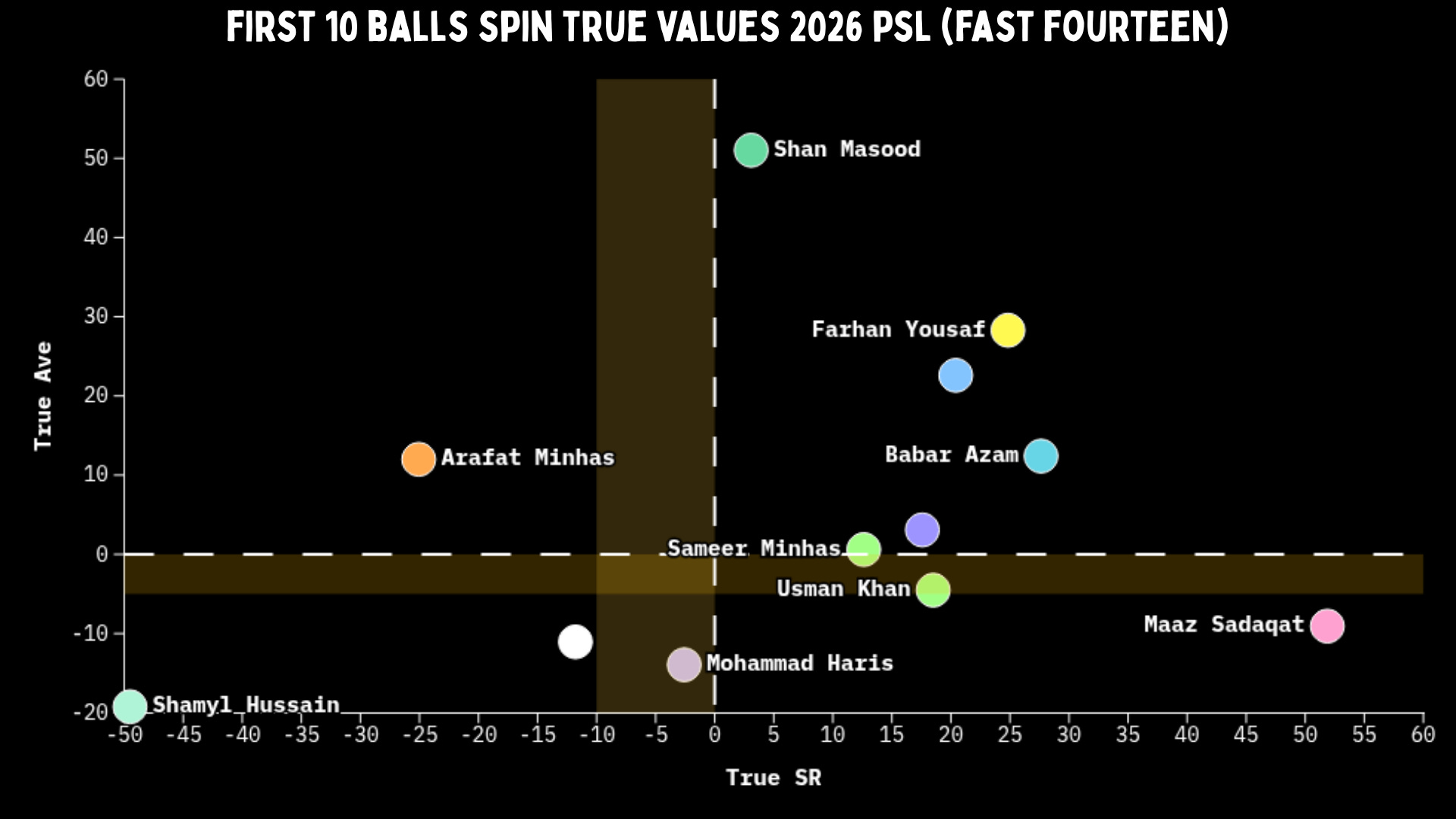
Farhan Yousaf, Abdullah Shafique, Usman Khan, Sahibzada Farhan and Sameer Minhas all have true strike rates of over 10 versus spin. Only Usman Khan amongst these five batters had a negative true average against spin. Usman’s poor starting versus pace and decent starts versus spin might make him more suitable at four or five rather than at three, which would work like a dream for Pakistan in terms of team composition.
Shan Masood is in a league of his own here, being the only one of the fourteen who has the same method versus both pace and spin. He’s got a true average of 51 at a true strike rate of 3 starting versus spin. His approach is quite simple, where he knocks the ball around for a bit, gets set and then starts hitting spin.
His raw average versus spin was 55 in this PSL season, coupled with a raw strike rate of 158, mostly batting in the middle overs. This combination makes him really fascinating given how Pakistan is in dire need of a batter who can take down spin slotting in the middle order.
The weakest of the fourteen starting off against spin bowling is Shamyl Hussain, who has true numbers in the deep negatives.
One last detail that we need to look up for the Fast Fourteen is phase-wise play. It is easier to set up a batting order after separating batting numbers across the powerplay, middle overs, and slog overs.
Shan Masood is the most unique batter here, who was not dismissed in the powerplay, and struck at 135 in the first six overs. His fastest phase was the middle overs, where his strike rate shot up to 160 plus, with a batting average just under 50, after which he slowed down again at the death. This further reaffirms the notion that his latest version is tailor-made to bat in the middle phase.
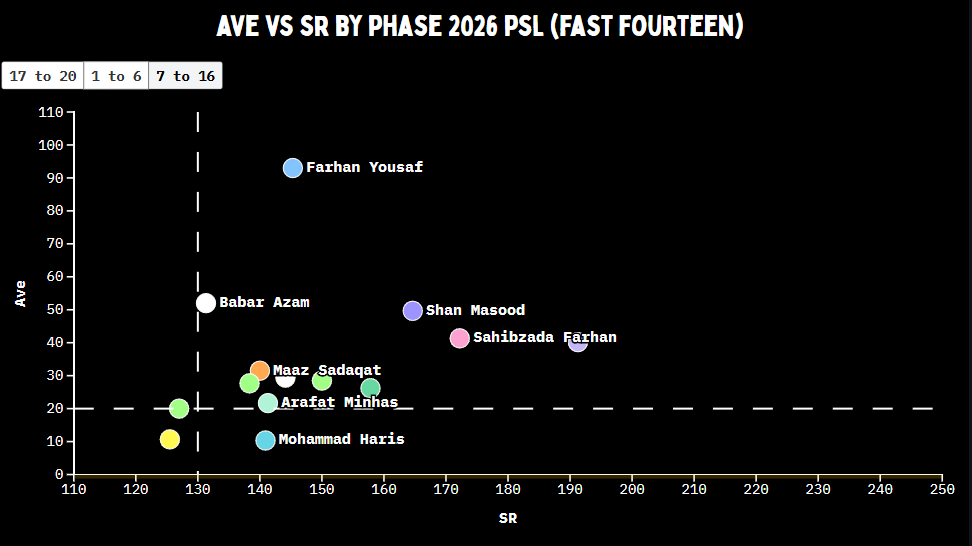
This is of course based on the data from the latest PSL season, so there is no guarantee that Shan, who has reinvented himself plenty of times in the past, can make this middle order spin hitting role work long term.
Abdul Samad’s death overs strike rate was almost 242, averaging roughly 25 runs per dismissal in that phase, which makes him a sure shot bet as a finisher. Arafat could bat before or after him, considering how he averaged nearly 20 at a strike rate touching 203 in the last 4 overs for the Multan Sultans in this PSL season.
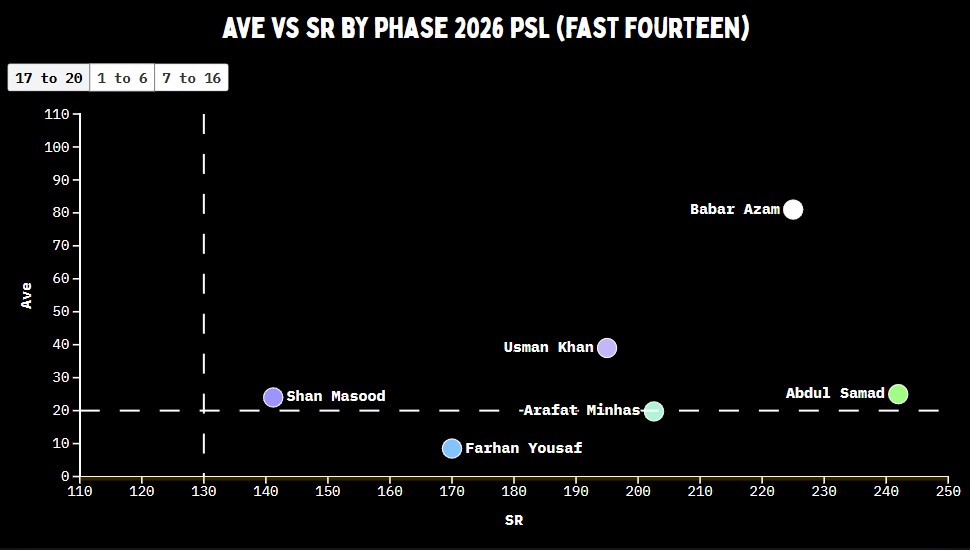
Usman Khan averaged 40 odd post powerplay with a strike rate north of 190, so he could bat after Shan and before Samad and Arafat. Given how Pakistan have a wicketkeeper problem in T20Is, this seems like a no-brainer.
Shadab Khan averaged just under 30 in the middle overs, striking at just under 145, which shot up to nearly 168 in the death overs. Realistically, he can only cover for Arafat here.
Farhan Yousaf is another solid bench option, given how he struck at just over 145 in the middle overs averaging 93, and at 170 with an average of just under 9 at the death.
That leaves us with eight of the fourteen battling it out for the top three spots.
Lets have Babar Azam as a starting point, who unsurprisingly averaged 109 with the bat in the powerplay at a strike rate of over 146, which went down to 52 at just over 131 in the middle overs. He picked up the pace big time at the death, striking at 200 plus, but by then he had spent a lot of time on the crease. What these numbers suggest is that Babar has to bat in the top order, at all costs, if he plays.
This complicates matters, because Maaz Sadaqat dominated the powerplay with an average of nearly 22 and strike rate of 193, amongst the many other metrics discussed earlier that work in his favour. Plus, you have Sahibzada Farhan averaging north of 40 up until the slog overs, striking at just under 165 in the powerplay, and over 172 in the middle phase.
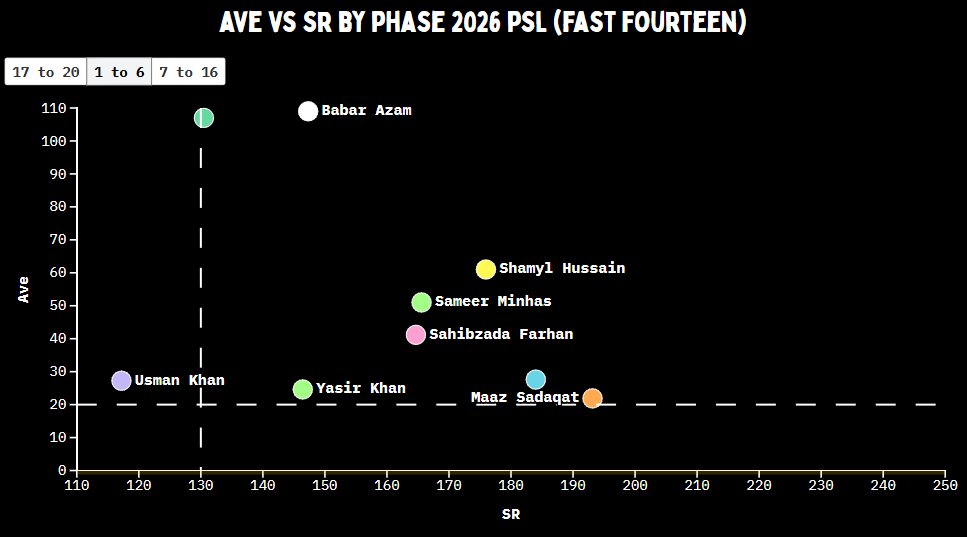
Mohammad Haris is another top order option who averaged just under 28 in the powerplay at a strike rate of 184, and that drops to 10 and 141 in the middle overs, so he can’t really bat anywhere else.
Sameer Minhas is yet to turn 20, so his game might develop further, but in this PSL his powerplay average of 51 with a strike rate of 165 plus dropped to 20 at just under 127 respectively in the middle overs. He only made it to the slog overs once, where he smashed 20 runs off 8 deliveries, so there is evidence of him having gears. It is up to Pakistan whether or not they would like to take a punt on the teenage batting sensation. They definitely would be tempted.
Yasir Khan averaged in the 20s in both the powerplay and middle overs, and his strike rate dropped from 146 plus to 138 after the powerplay, so he does not have a claim amongst his top order peers.
Abdullah Shafique averaged 107 in the powerplay but at a paltry strike rate of just over 130, and in the middle overs that went up to just under 158, but his average dropped to just over 26. He may or may not be suitable for the number three spot, and could be a decent option to have in the reserves.
Shamyl Hussain is another weird one, who’s average of 61 coupled with a 176 strike rate in the powerplay plummets to just under 11 and just under 126 in the middle phase. Opener or bust, who can’t play spin.
***
So there you have it. Pakistan have depth in the top order, but it would be criminal not to open with Maaz and Sahibzada in the build up to the T20 World Cup in Australia, which is two years away.
Haris and maybe Shamyl could be backups for Maaz, and Babar could slot in if Sahibzada injures himself or loses form. Sameer is another strong shout here, who could transform into something far greater than the rest in years to come.
There really is no correct answer for the first drop position, and realistically Pakistan could experiment with Sameer, Babar or Abdullah here.
Shan and Usman could be tasked with middle overs spin bashing with teenager Farhan Yousaf as a backup. At just 19 years of age, he could very well usurp either of those two senior pros in the future, depending on how he develops. That said, if Usman is benched, Haris has to play, because someone needs to keep wicket.
Samad has to be the finisher, with one of Arafat and Shadab in and around him. Compared to the experienced wrist spinner, the youthful slow left-armer has a stronger claim to that role as far as batting is concerned, if we are to judge them by their PSL performances.
Pakistan are not spoiled for choice when it comes to T20 batsmanship, but their talent pool does not qualify as grim. They have just about enough to work with, but no comfortable amount of depth outside the top order.
Plus, they have tried playing it safe since quite some time now, and that hasn’t particularly worked out for them. There is nothing to lose, really, especially in all the meaningless bilateral T20Is leading up to the big dance. Pakistan would gain absolutely nothing if they steer in a low-risk direction.
Who captains the side is another million dollar question, but leadership is secondary, or perhaps even tertiary, in comparison to skill and approach.
Knowing what we know about Pakistan, however, brace yourselves for an opening pair of Babar Azam and Sahibzada Farhan with Maaz Sadaqat warming the bench. High intent batting can go cry in a corner.