


Buy The Art of Batting here:
Anchor is a dirty word in cricket. But the actual term really comes back from Australian ODI cricket in the 1980s, with a guy called Geoff Marsh.
He wasn’t actually the first anchor; Desmond Haynes was probably that. But the Australians really said to Geoff Marsh, bat as long as you can and we will attack around you. They won the 1987 World Cup and kind of started what is modern ODI batting.
Outside of the finisher/closer role, we don’t really have that many terms for white-ball batting. And actually there are many different styles that you can start to see when you analyse the data a bit more closely.
So what we really wanted to do was come up with something that would show us different kinds of batters. The anchors are around here, but if you have a look at this entire graphic, you’ll see there are lots of different styles, methods, and outliers and people that we need to talk about.
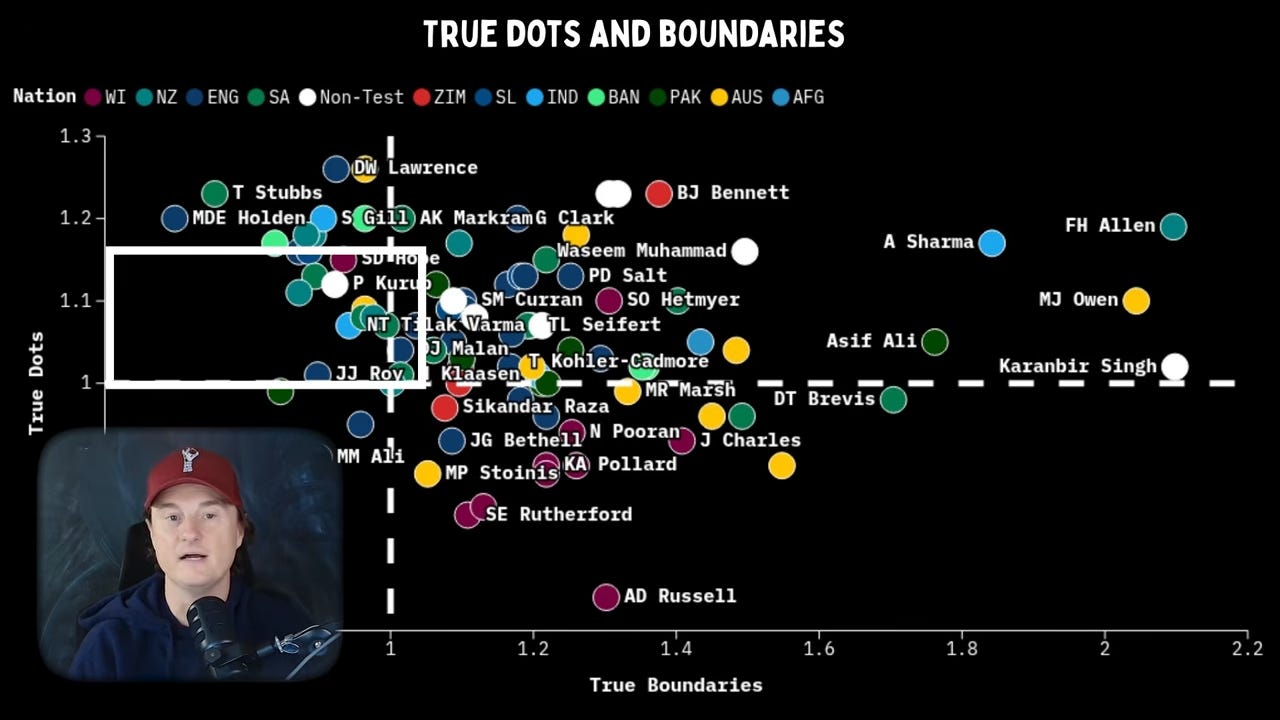
At the moment, it’s not that anchors are dying. It’s just that they’re a much rarer breed than they used to be a few years ago. And now we’ve got a whole new crop of players coming through, and they’re going to need new names as well.
***
This graphic is rating players on true dots versus true boundaries, which are metrics that we have come up with so that we can better explain exactly how a player is scoring.
Because in the past, when I was doing work like this, I would look at dot ball percentage. But the problem with that is that in the Powerplay, everyone’s dot ball percentage is a lot higher because you’ve got a bunch of fielders around you. And at the end, you have to try and hit fours and sixes, but you might not actually be an outlier on that. It’s just that you are batting at the end, while someone else is batting in the middle.
So that is why we’ve been using these metrics. And I thought that if we put these all together, we’d also be able to understand different kinds of players and the roles that they have.
As we talked about at the top, Kane Williamson is sort of in the middle of this anchor cluster. Traditionally, this would be one of the biggest clusters, because most T20 players probably played in this style.
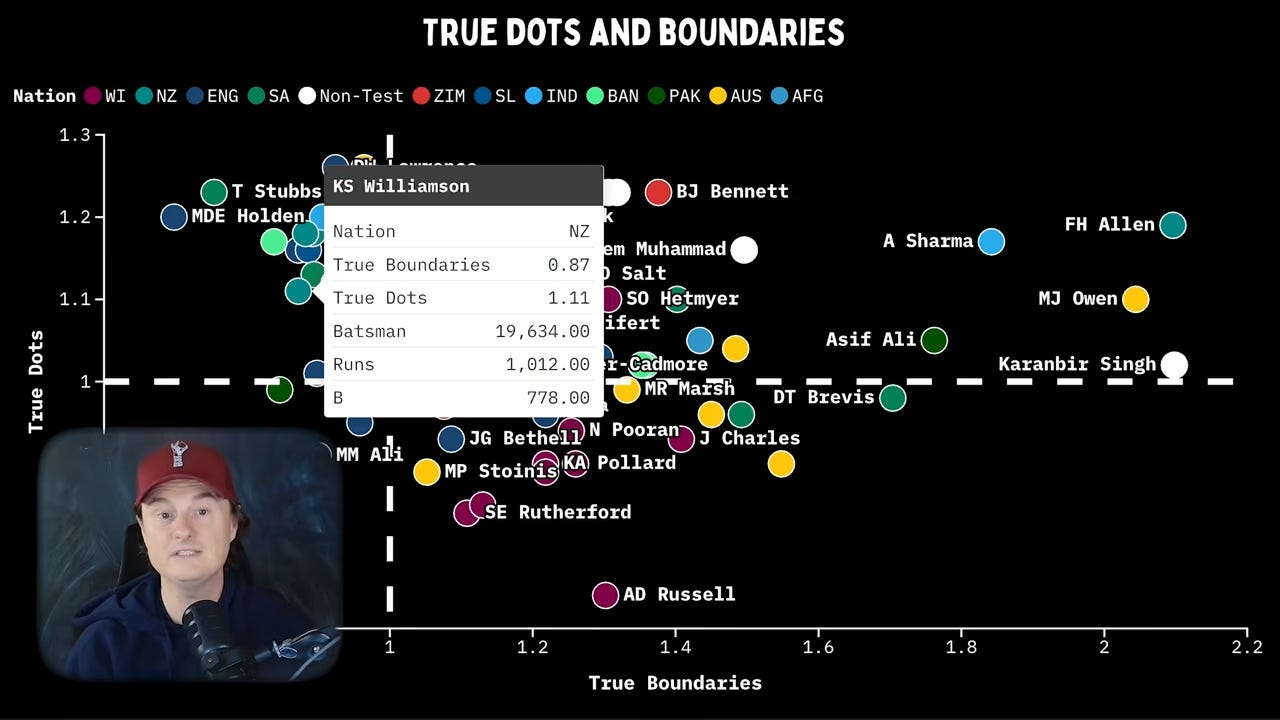
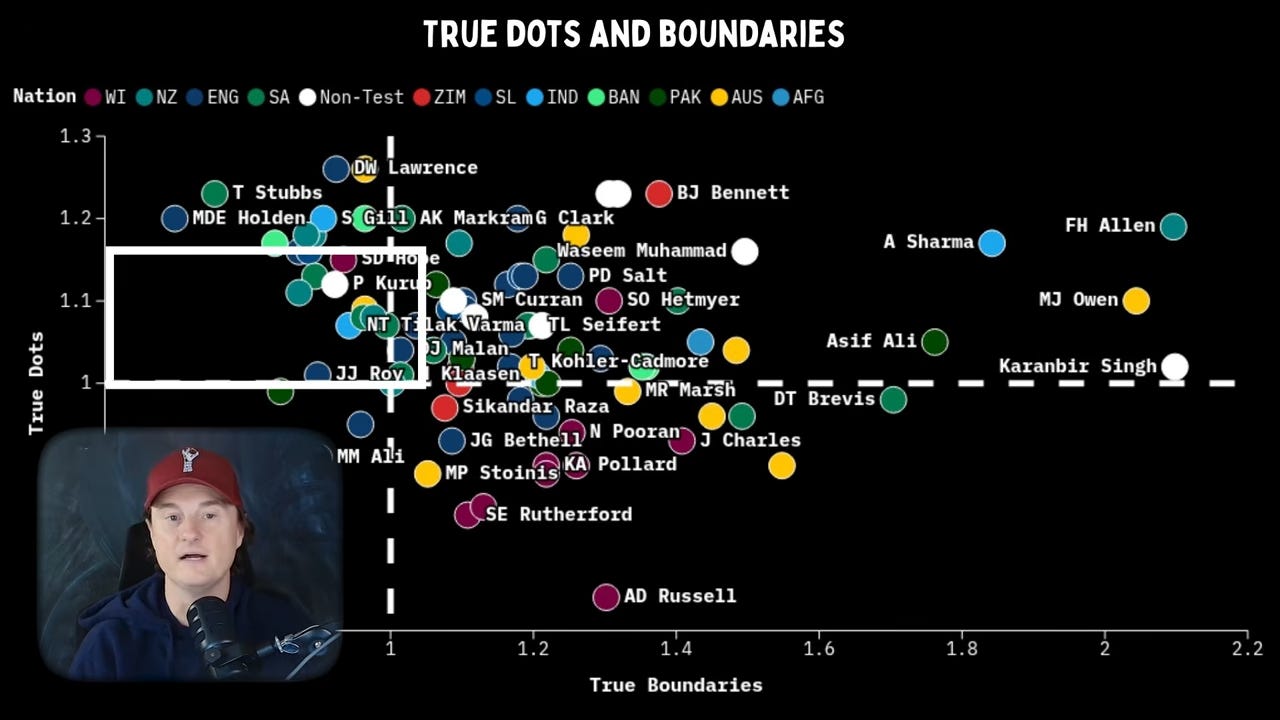
So this section in here is definitely the anchors. And this is only over the last couple of years, of course. So there are some players who might be here that you’d be a little bit shocked at. But generally these are the sorts of guys who don’t hit a lot of boundaries, and also are not particularly great at eradicating all their dot balls.
The next group up here, which I think needs to be talked about a little bit more, are the guys who are absolutely brilliant at strike rotating. And these are all different kinds of players.
If you have a look at this, you’ve got Tristan Stubbs here, who’s probably thought of as more of a power player, but actually his best skill is almost never facing a dot ball. You’ve also got guys like Dan Lawrence and Ashton Turner. These three players all play very different roles, but all three of them are brilliant when it comes to not facing a lot of dot balls in a row. So they’re making up for the fact that they’re not hitting boundaries.
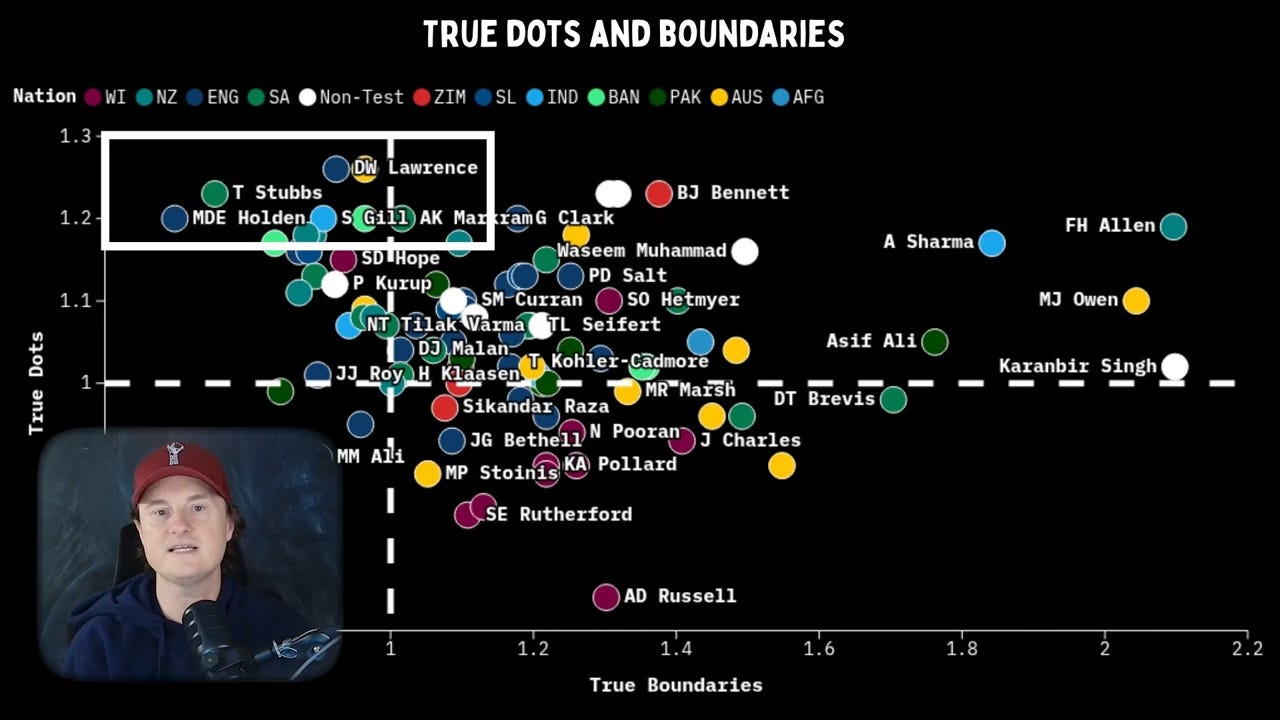
I wouldn’t say that they’re quite anchors, but you can see in Tristan Stubbs’ case that he’s actually 25% less likely to hit a boundary. But his strike rate is often absolutely fine, because he is also 25% more likely not to face dot balls, and he’s brilliant at stealing twos.
So while there is probably a little bit of overlap between anchors and strike rotators, because they’re very similar kinds of roles, I believe they’re two different player types. And perhaps in the future we’ll see even more of these kinds of players who just don’t face any dot balls at all and make up for their strike rate because of that.
This big section down here is where you see the vast majority of players. I don’t have a great name for this, but let’s just call this the normie section.
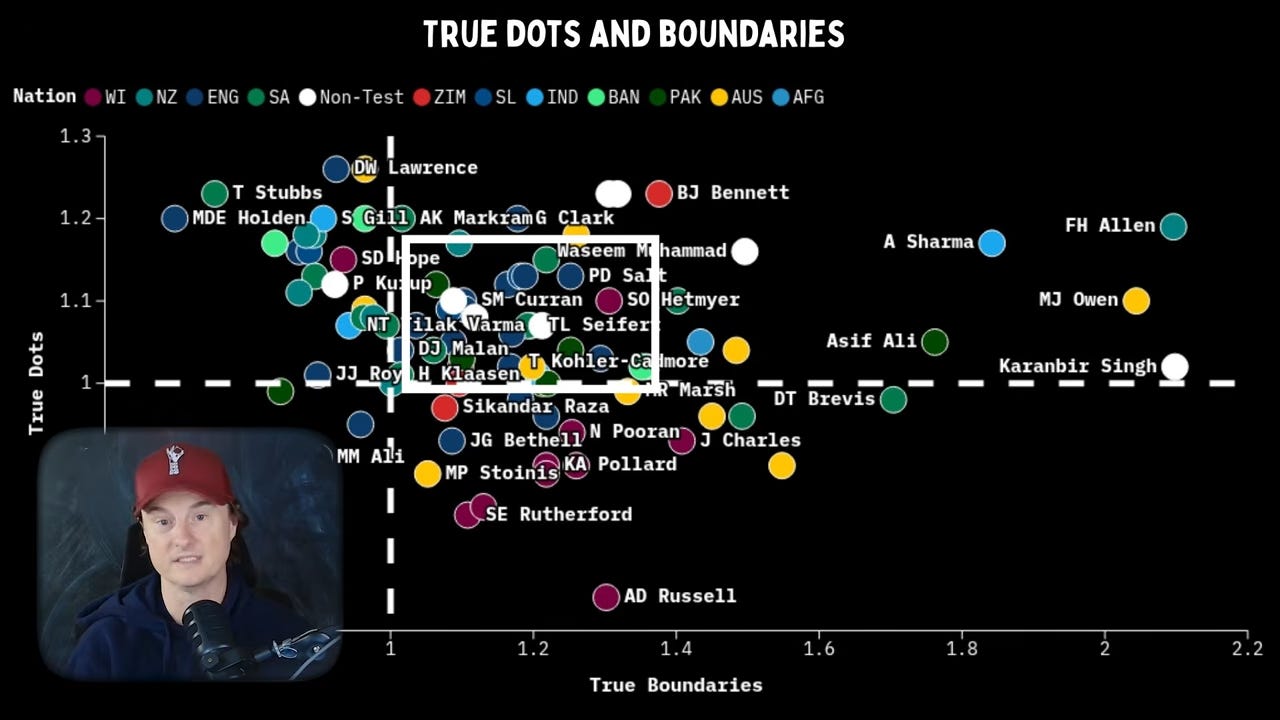
You can see Andries Gous from the USA and Sam Curran. Those are very different kinds of players, but most players around this section have a pretty normal attacking pattern. They don’t take up a lot of dot balls, and they also score a lot of runs from boundaries.
So there’s really not a lot of time we need to stick around in this area.
But the most interesting new style is this sort of Abhishek Sharma, Finn Allen, Mitch Owen, and Karanbir Singh in associate cricket. These are your thrashers.
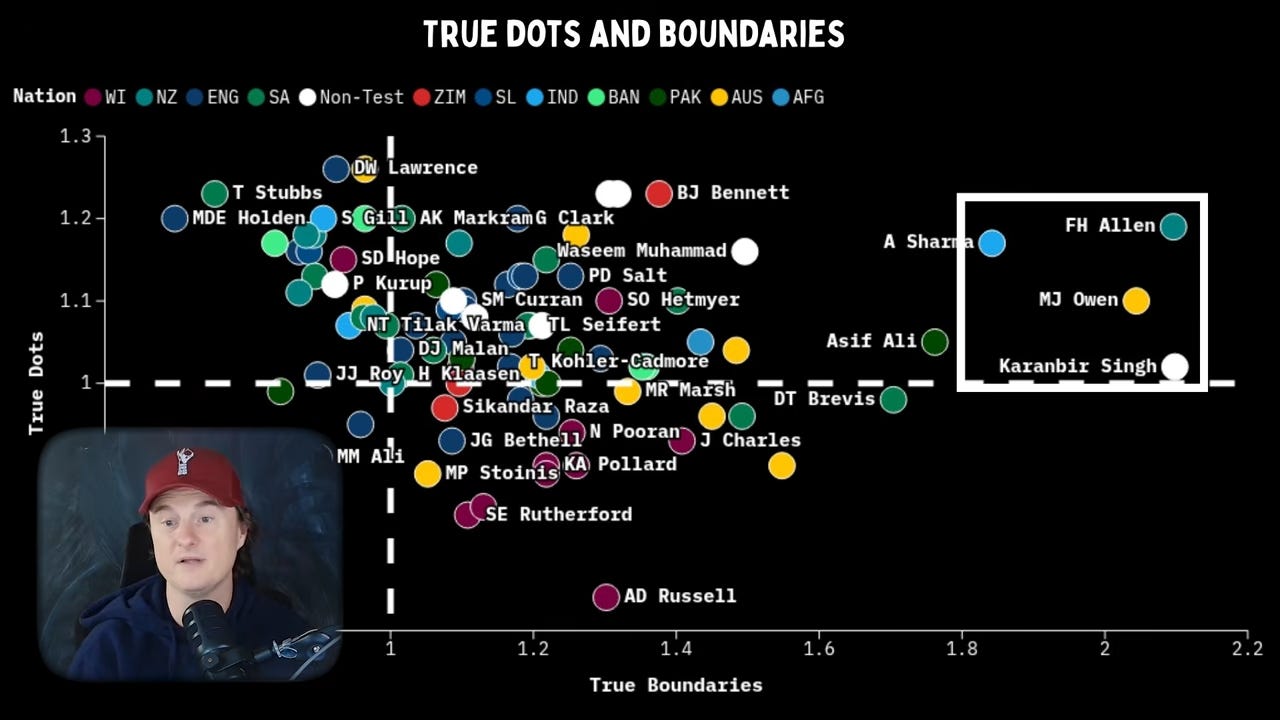
The big difference is that before we saw a lot of players who would chase boundaries a lot, but these guys also have incredible dot ball percentages.
You can see here that Abhishek Sharma is facing 17% fewer dot balls than you would expect. Finn Allen is even higher again, and even Mitch Owen is better than that.
So it’s not just that these guys are hitting boundaries. They’re also not letting you bowl dot balls to them. There’s no pause against these guys. They are absolutely thrashing the ball all the time.
This section down here is much more of your power hitters. Right at the bottom of this, Andre Russell is the most power of all the power hitters. Even in the last couple of years, as T20 cricket has completely changed, he’s still on his own.
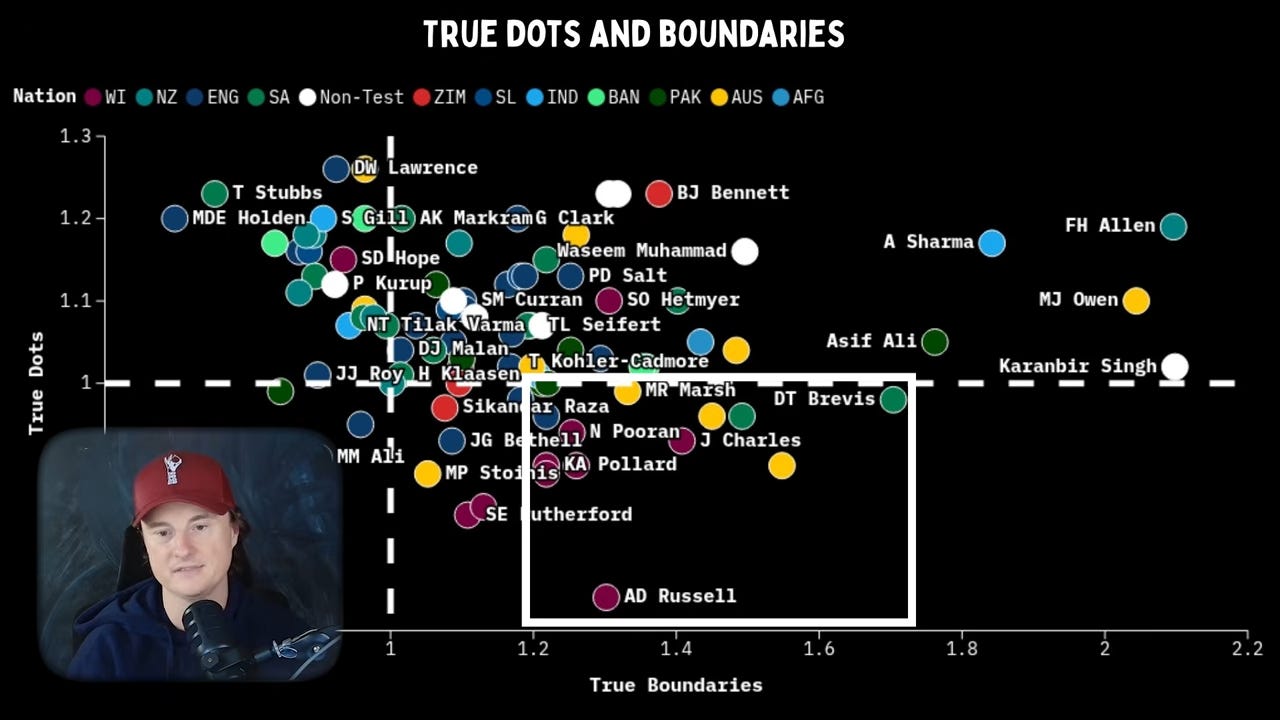
A true freak of nature in the way that he thinks about cricket and how he’s just willing to play his way, no matter what.
This is definitely your power hitter zone. These are the guys who are unafraid to have more dot balls than anyone else, because they know they can catch up with all the sixes.
This section down here I’ve called the strugglers, but it probably should be people who have a second skill. You’ve got someone like Moeen Ali and Sam Billings. You’ve got some wicketkeeping there, you might have some bowling as well. But generally the players who end up here are either in terrible form or are not always specialist batters.
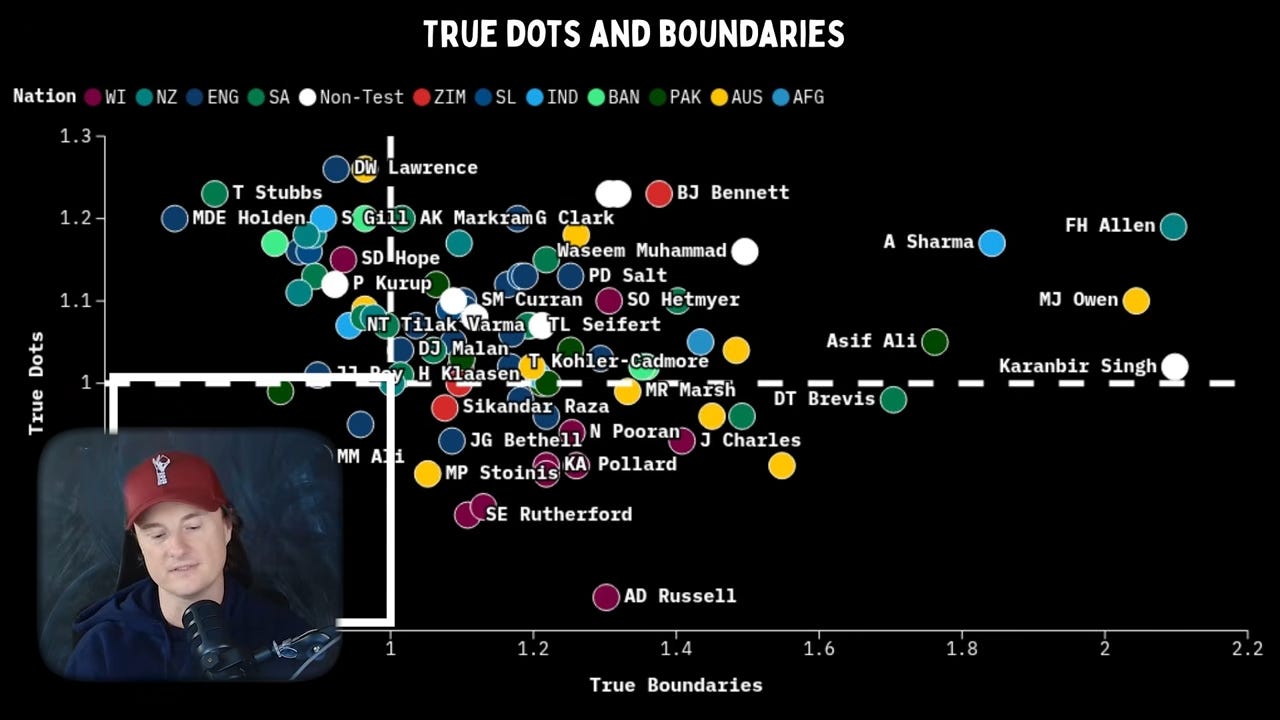
What’s fascinating is about eight years ago, I was looking at the data in a slightly different way, and there were a lot more players who really struggled at that point. Now, there aren’t that many. They’re basically being weeded out of the game.
And then there’s one section here that doesn’t really have a player at all. In fact, Brian Bennett, who’s played a completely different role for Zimbabwe at this World Cup, is the closest to it. But traditionally, this is where AB de Villiers was. His ability not to face dot balls or hit them for boundaries was absolutely remarkable. We don’t really have players like that now. But we might see some of them into the future.
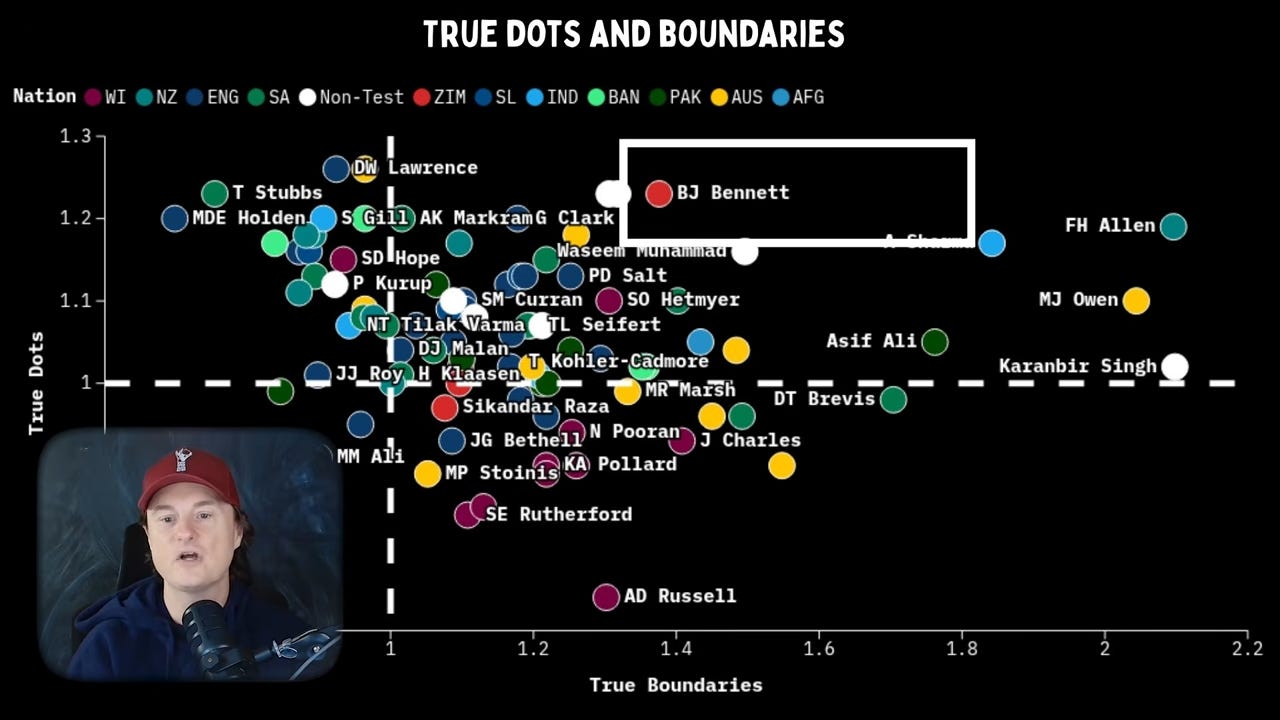
What we’ve really done here is set up different zones so you understand these things. Once we had all this information and we’d come up with these names, the next thing is: we’re at a World Cup, so is there a way of looking at this to see if certain nations produce more of one type of player?
So let me take away some of these countries so we can have a better look at individual nations and see if there are trends occurring.
