



Years ago, when I was backpacking across Western Europe, I was just outside Barcelona, hiking in the foothills of mount Tibidabo. I was at the end of this path, and I came to a clearing, and there was a lake, very secluded, and there were tall trees all around. It was dead silent. Gorgeous. And across the lake I saw a beautiful woman, bathing herself. but she was crying…
Wait, that’s not it. I was backpacking across the US and England on the way to South Africa for the 2003 Cricket World Cup. There was crying, but it was my own, and separate to this story.
When in grey-skied London, I found myself in Shepherd’s Bush, a place that had no sheep or greenery, but lots of pubs. In one of them, weirdly named after a US comedian, I watched a game between Australia and England.
With the Aussies as World Cup favourites, it was supposed to be an easy win. It started that way when Australia’s backup seamer Andy Bichel took 7/20, and England folded to 204. But incredibly, Australia also fell apart, soon they were 135/8, needing 70 from 74.
That is when Andy Bichel was needed again. He joined Michael Bevan.
And while the calculation didn’t make sense, Australia had their own calculator.
In those days we called him a finisher, but it turns out he was more than that.
***
Earlier this year in the IPL, Chennai Super Kings batted first. Sanju Samson got a century and set Delhi Capitals a target of 213 runs. Delhi started off brilliantly with 61/0 in 4.5 overs, but they quickly fell to 76/4 with the required rate at 11.4. David Miller and Tristan Stubbs were batting together.
Of those batting between five and seven in the IPL, these two gentlemen have the second and third-highest true averages of 27 and 21 respectively. They do not get out in the IPL. Virat Kohli and KL Rahul as openers have a true average of 16 and 20.
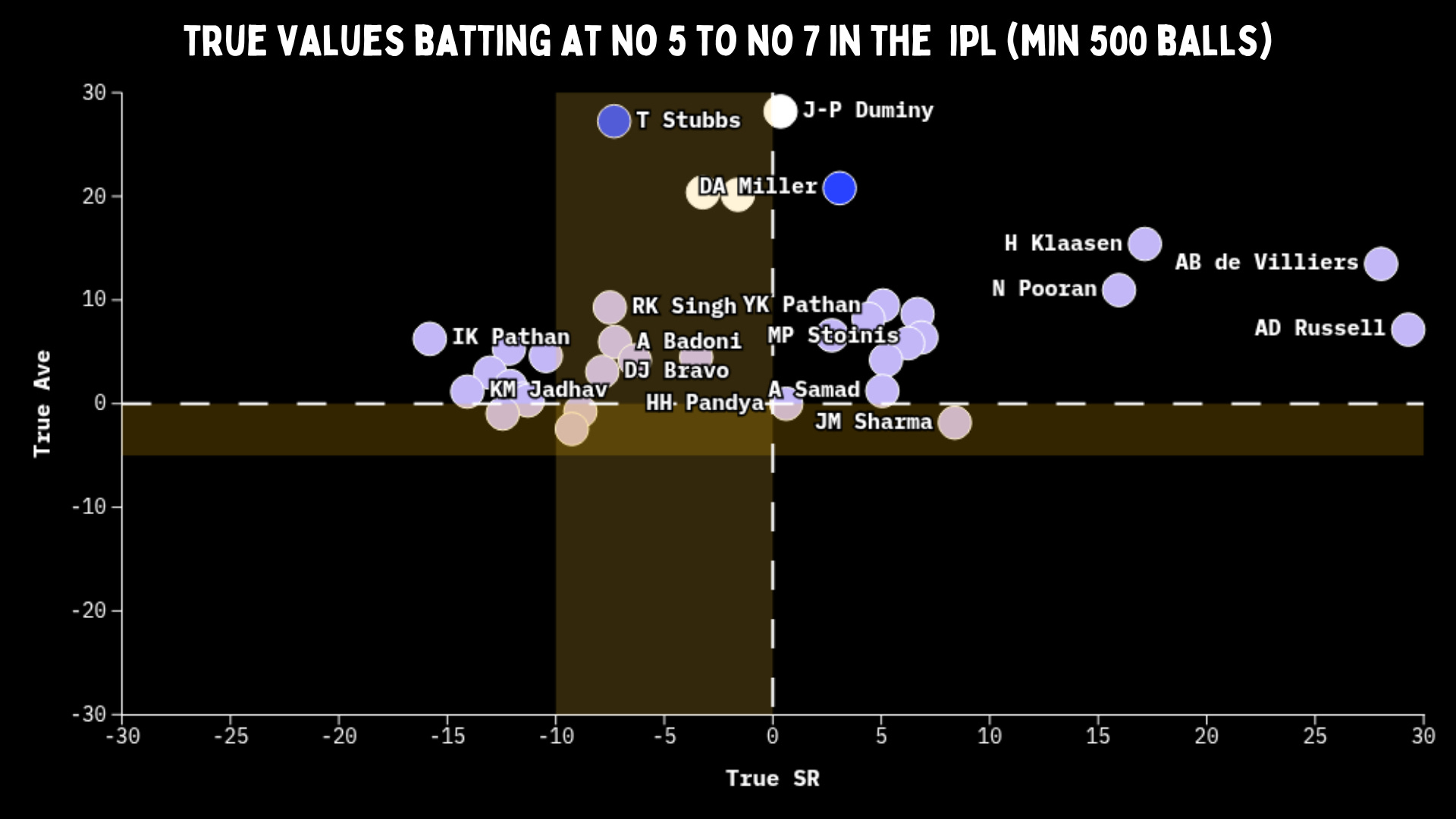
Two guys batting in the middle order who are known as big hitters, have higher true averages than two of the best run accumulators in IPL history.
The other batters that pop here are JP Duminy, MS Dhoni and Tilak Varma. Those three, along with Miller and Stubb, have a true average of 20 plus. However, out of the five only Duminy and Miller have a positive true strike rate. Duminy’s true strike rate is 7 points better than Stubbs, which no one who saw them both live would have guessed.
But what it really shows is that South African cricket does have a type. And that never really had a name before. Of recent times, we have started finding a lot of these high-scoring, neutral strike rate guys who bat in the middle order.
We call them finishing anchors.
***
When Delhi were in their chase, Miller was 12, and Stubbs was 11, both had faced 10 deliveries.
Throughout the season, it feels like these two always end up at the same point, hugging a run a ball strike rate after scoring double figures. They do it so consistently that we could simulate that part of their innings.
But this is making their chase harder. In baseball, they call this getting behind the count. By implementing this strategy, they are setting themselves up. Everything they do in the latter half of the game has to be perfect in order to dig themselves out of the hole.
The worst-case scenario is doing this, and then being dismissed shortly after.
That is what happens when Miller is out for 17 off 14.
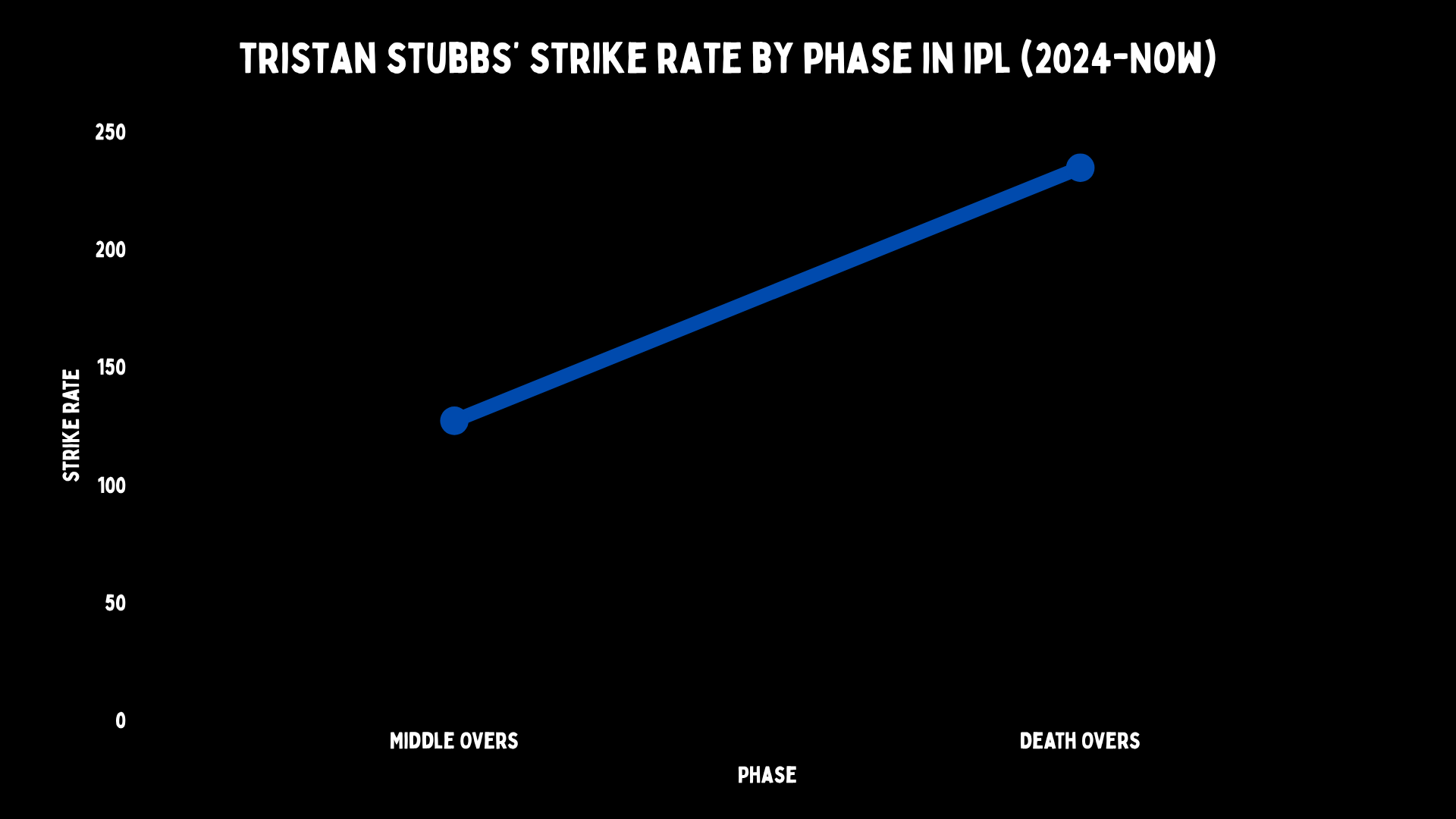
When Stubbs walked in, he needed to go at a strike rate of 190 for Delhi to chase this, but after the start, Stubbs needed a strike rate of 238 to win the game. The good news is that since 2024, Stubbs strikes at 234 in the death.
This was, as the cricketers say, in his wheelhouse.
However, his middle overs strike rate from 2024 in the IPL was 127. So in the match against Chennai, he had to better his record by a good 65 points to match the rate. At the end of the 16th over Stubbs was 37 off 26. A strike rate of 142. Nearly 20 better than usual.
But even an algorithmic player like Stubbs can’t do it every time, and on that day, he couldn’t take it to his normal fifth gear. Delhi were bowled out for 189.
Stubbs’ 60 off 38 meant his impact for the game was +14. The next best Delhi batter was Ashutosh, with an impact of +3.
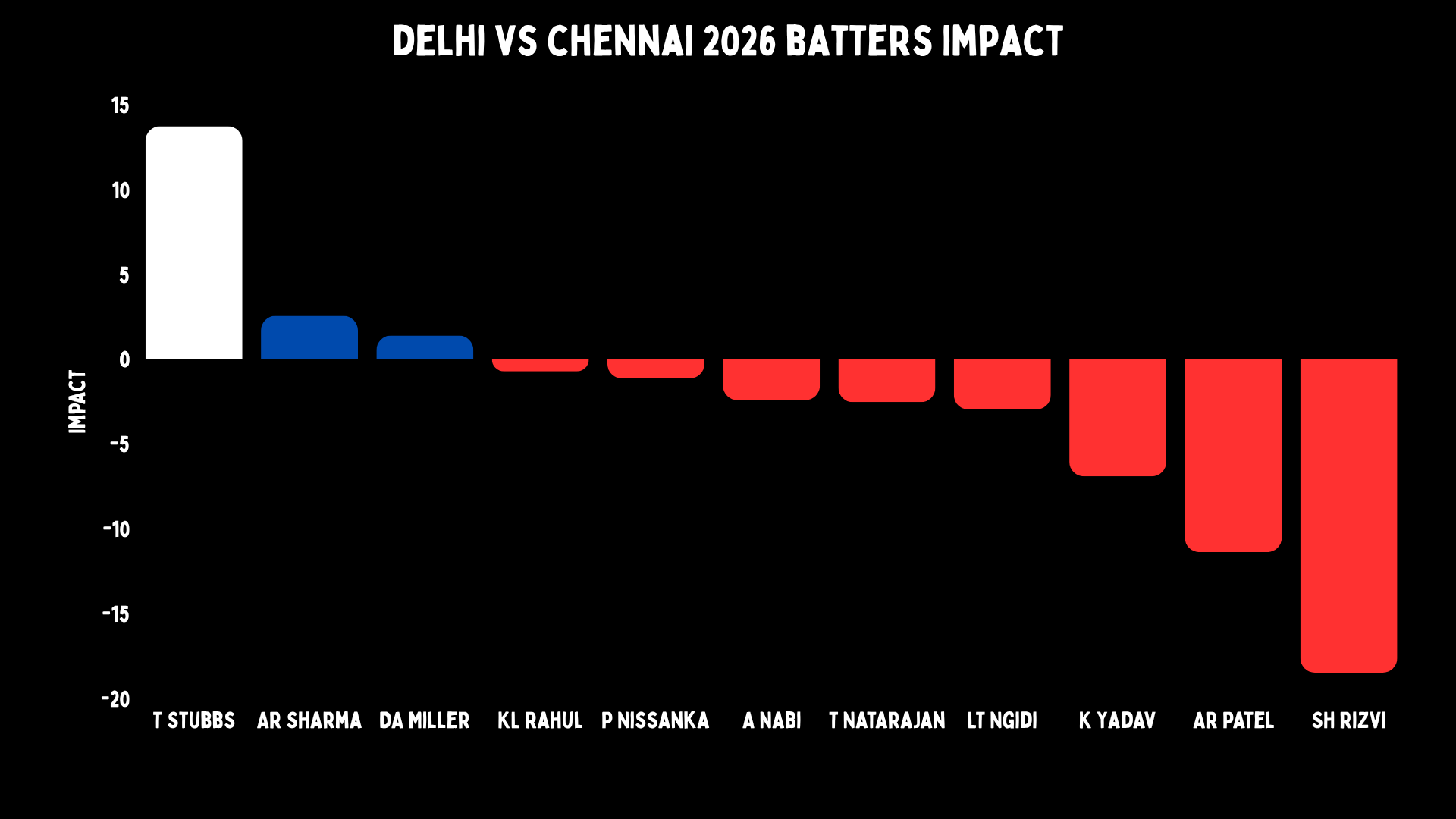
This was on the face of it, a great solo effort. It was also a losing one.
***
You can find any explanations regarding our advanced metrics here.
