


Buy your copy of 'The Art of Batting' here:
Sunil Gavaskar doesn’t want non-Indians talking about the Indian cricket team. It doesn’t matter how good they might have been or how many times they might have travelled to India, they should have no opinions about the Indian team at all.
Essentially, two of the people he was probably talking about are Brad Haddin, who's got his own podcast and so he is always asked questions about many different cricket teams, and AB de Villiers, who has his own YouTube page and often focuses on Indian topics.
A lot of people have discussed Gavaskar’s comments. An international cricket team doesn't just belong to that group of people from that country. It's international cricket. These things usually go beyond borders.
But how many people have actually looked into Gavaskar himself? He has written, talked, and commentated on teams from around the world. A quick search shows him criticising England’s rest-and-rotate policy and another time saying Pakistan picked the wrong XI.
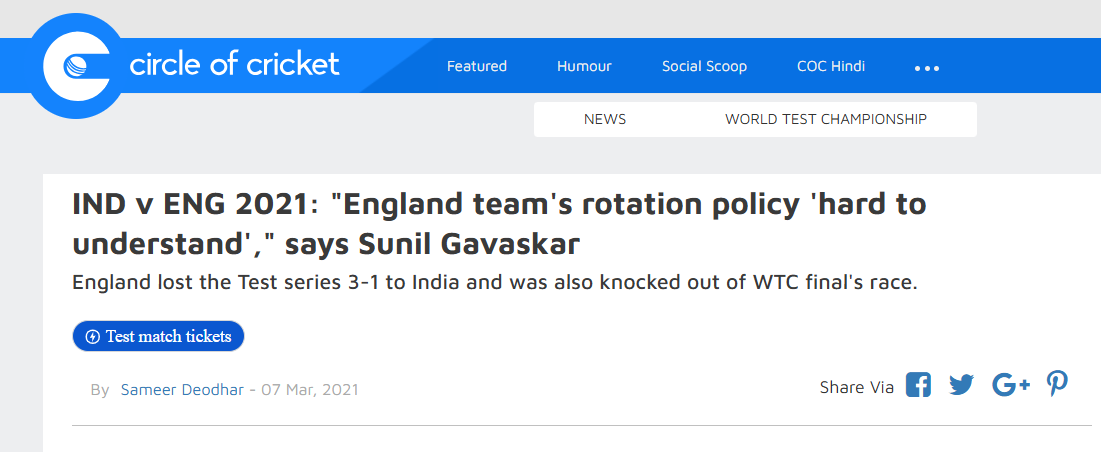
So yes, Gavaskar has often spoken about other teams. But there’s a bigger issue here: the new place India finds itself in the world of cricket.
Maybe the real question is, why is everyone always talking about India now?
***
If you followed cricket in the 1990s and weren’t from India, you’ll know it wasn’t easy to get news out of the country. That was true of most nations. Cricket was a newspaper-led sport. Unless the team was playing against your side, or you happened to catch a broadcast, you didn’t know much about India.
That meant very few people in the cricket world had opinions about the Indian team. Or New Zealand. Or South Africa. What you did know was about star players, maybe the best three or four. What you didn’t have was any information on the 16th best player in the land.
Back then, most fans couldn’t name 16 players from another nation. Gavaskar himself played in the ‘70s and ‘80s when no one outside India even thought about the 16th man. You wouldn’t form an opinion on him because he didn’t exist in front of you.
The one team people did know about was England. Because of how newspapers and wire copy worked, England dominated the headlines. India were a minor country when it came to global cricket news. Unless they won the 1983 World Cup or a big Test series, they weren’t in the conversation.
How much of that has changed with the IPL?
***
The IPL is the best T20 competition in the world. It’s also the biggest. It takes up more energy than anything else. Even if you don’t watch it much, it’s probably your second competition, because your local league has players or coaches who also play in India.
It also has a kind of window. Not official, but during that time of year little else is happening. If you’re a fan or working in cricket media, you’re drawn back to it. Even if it’s not your favourite competition, you still follow it because it’s on, and the best players are there.
That de facto window means the world’s fans and media are following, even passively. If you’re a content provider, you have to cover the IPL, or at least be aware of it.
I know this because I run Good Areas. If we stopped IPL coverage, it wouldn’t change our revenue much. But we’d still have to work out what to do for two months. I’ve covered it since the first year. Even when I’m not working, I keep track.
And like any cricket, not everyone in the media ecosystem always cares deeply about what they’re covering. I’ve commentated on matches I wasn’t especially interested in, but it was worth doing financially, so I did my job. That’s what professionals do. If you’re running cricket content, the IPL forces itself onto your agenda.
